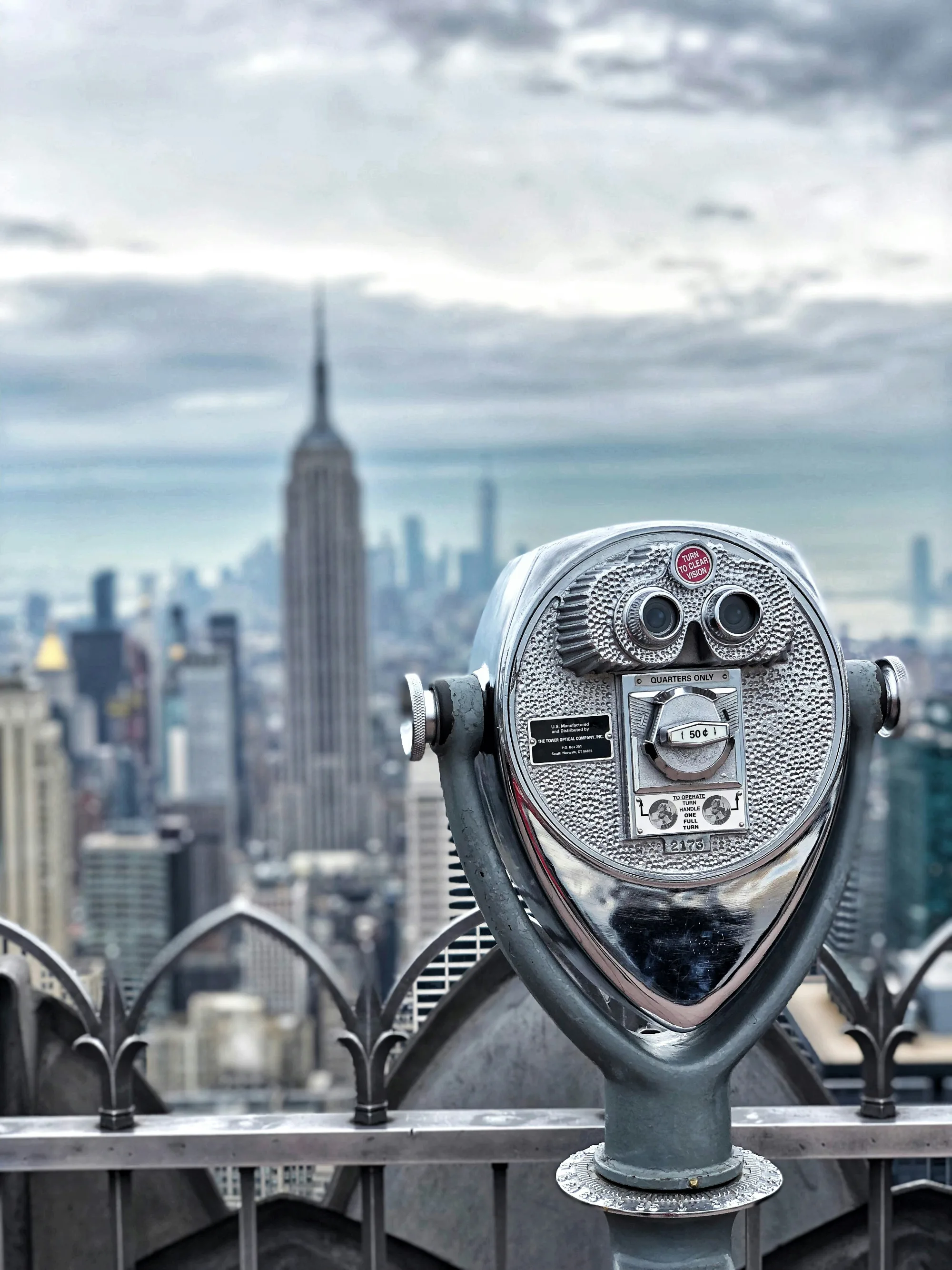
One of my first memories of NYC was going up to the top of the World Trade Center. I don't really remember it. I was about 5 years old. I knew it was one of the tallest buildings in the world, and all of Manhattan, a city that seemed to be made up only of skyscrapers. I still have the tacky photo they take of you as you wait in line on the ground floor, in front of a cardboard cutout of the Twin Towers. An overpriced souvenir, no doubt, but obviously one that holds a deeper significance today.
Today, New York City has more observation decks worth visiting than any other city in the world. And that isn't exaggeration. Between the Empire State Building, Top of the Rock, Summit One Vanderbilt, Edge at Hudson Yards, and One World Observatory, you are looking at five distinct experiences, each sitting somewhere between 850 and 1,268 feet above the streets of Manhattan. No two of them feel quite the same, and depending on who you are and what you're looking for, the right answer for you could be any one of them.
The problem, of course, is that tickets are not cheap, and realistically nobody is visiting all five in a single trip. So you might be doing some research on which is the absolute best one to go to (and getting lots of paid ads trying to convince you that one is somehow superior).
The answer, as with most things in New York, is that it depends. This guide breaks down all five, compares them honestly, and tries to help you figure out which ones are actually worth your time given who you are traveling with, what kind of experience you're after, and how much of your vacation budget you're willing to point straight up into the sky.
The Summary Version (so you don't have to scroll)
Before getting into the detail on each deck, here's the TL;DR
Empire State Building is the one you go to for history, prestige, and an open-air classic New York experience. It's the most iconic and the most photographed. It's also not so tall relatively anymore, and a little overpriced.
Top of the Rock is the one you go to for the best views of the Manhattan skyline, full stop. The fact that you can see the Empire State Building from here is something no other deck can offer.
Summit One Vanderbilt is the one you go to if you want an experience rather than just a view. It's the most unusual of the five, blending immersive art installations with the height.
Edge NYC is the one you go to if you want to feel the most exposed and the most terrified, in the best possible way. A glass floor, angled glass walls, and a platform that juts 80 feet out from the building like a diving board.
One World Observatory is the one you go to if you want the most emotionally resonant experience. It sits atop One World Trade Center, the tallest building in the Western Hemisphere, and the weight of what that building represents is present in every part of the visit.
The Long Version
Empire State Building
Location: Midtown Manhattan, 34th Street and 5th Avenue
Height: 86th floor at 1,050 feet (open-air) | 102nd floor at 1,250 feet (enclosed)
Best for: First-time visitors, classic NYC experience, open-air views
There is almost nothing left to say about the Empire State Building that hasn't already been said, and yet somehow it never gets old. Opened in 1931 and standing as the world's tallest building for nearly four decades, it remains one of the most visited structures on earth, and it deserves to be. The Art Deco lobby alone is worth the trip up.
The building offers two observation decks. The 86th floor is the one most people know: an open-air platform wrapping the entire building at 1,050 feet, with binoculars, 360-degree views, and that feeling you can only get from standing outside at altitude with wind in your face and the whole city laid out below you. The 102nd floor is an enclosed, floor-to-ceiling glass room 200 feet higher that feels more intimate and tends to draw fewer visitors, since it requires an upgrade ticket on top of standard admission.
The honest downside to the Empire State Building is that because you are in the Empire State Building, you cannot see the Empire State Building from it. That sounds obvious, but it matters when you look out over the skyline and realize that the city's most recognizable building is the one you're standing inside of. For pure skyline photography, this is a limitation that the competition has figured out how to exploit.
That said, no observation deck in the world carries the cultural weight of the Empire State Building. If you are visiting New York for the first time, this is probably the one you should go to. Not because the views are necessarily the best of the five, but because some experiences matter as much for what they represent as for what they show you.
Practical note: Sunset slots sell out fast, especially during summer. It's worth booking a few days to a week ahead for peak times. The 102nd floor requires a separate ticket on top of standard admission.
Top of the Rock
Location: Midtown Manhattan, Rockefeller Center, 50th Street between 5th and 6th Avenues
Height: 70th floor at 850 feet (fully open-air)
Best for: Manhattan skyline photography, the best overall views of the city
There is a strong case that Top of the Rock offers the single best view of Manhattan of any observation deck in the city. The reason comes down to location and geometry. Sitting in the middle of Midtown at 30 Rockefeller Plaza, it places you at exactly the right distance and elevation to see the Manhattan skyline for what it actually is: a dense, glittering collection of skyscrapers framed by Central Park to the north, the Hudson River to the west, and the East River to the east. The Empire State Building sits directly in your sightline to the south, exactly as it should, at the center of the frame.
The deck itself spans three floors, from the 67th through to the 70th. The 70th floor, the pinnacle, is fully open-air with no glass panels, which matters more than you might think when you're trying to take photos without reflections or just want to feel the city rather than observe it through a pane of glass. At 850 feet it sits lower than some of the newer competitors, but height alone has never been the only thing that makes a view great.
Top of the Rock also has a few newer additions worth knowing about. The Beam recreates the famous 1932 "Lunch Atop a Skyscraper" photograph, lifting you 12 feet above the 70th floor deck on a rotating steel beam that is significantly more terrifying than it has any right to be given how short the actual drop would be. Skylift, an add-on experience, takes things a step further and sends you three stories above the 70th floor on an open-air revolving glass platform. Neither is included in standard admission, but both are worth considering if you have a taste for that sort of thing.
This is the deck I tend to recommend to people who are visiting New York for a second or third time and already have the Empire State Building checked off. The views are outstanding, the setting inside Rockefeller Center gives you plenty to do before and after, and the open-air 70th floor delivers a viewing experience that the fully enclosed alternatives simply cannot replicate.
Practical note: Top of the Rock uses timed-entry tickets. Booking a day or two ahead is usually sufficient outside of peak season, but sunset slots fill up faster than other times of day.
Summit One Vanderbilt
Location: Midtown East, adjacent to Grand Central Terminal
Height: 91st to 93rd floors, approximately 1,000 to 1,100 feet
Best for: Travelers who want an experience as much as a view, or who have already done the classics
Summit One Vanderbilt, which opened in 2021, does not particularly want to be called an observation deck. It calls itself a "multisensory experience," and while that phrase carries the faint whiff of marketing copy, it's also not wrong. Summit is a little different from everything else on this list, and depending on your temperament, it will either be your favorite of the five or the one you wish you'd swapped for something else.
The experience spans floors 91 through 93 of One Vanderbilt, Midtown's tallest office tower, which sits directly next to Grand Central Terminal. You begin below ground, entering through the Grand Central transit hall, and ride an elevator up to the 91st floor in under a minute. From there, the experience unfolds through several distinct rooms and installations. "Air," created by artist Kenzo Digital, is a series of fully mirrored rooms that reflect the skyline and your own face back at you from every surface, creating a sense of being suspended inside the city rather than above it. "Levitation" takes you out onto glass-floored boxes that protrude from the facade 1,063 feet above Madison Avenue. The views are extraordinary, but the sense of exposure on the glass floor tends to produce reactions ranging from quiet awe to barely suppressed panic, which is part of the point.
For those who want to go higher, "Ascent" is an add-on glass elevator that travels up the outside of the building to over 1,200 feet, making it one of the highest vantage points accessible to visitors in the city. The elevator floor is also glass. It costs extra, and it is worth every penny if heights are something you find thrilling rather than distressing.
The views from Summit are excellent, with the Empire State Building and Chrysler Building particularly prominent given the location. There is also a bar and restaurant at the top, and the surrounding neighborhood of Grand Central and the Chrysler Building gives the whole area a walkable, well-designed quality that Hudson Yards, for all its ambition, hasn't quite achieved yet.
Practical note: Summit is not included in most New York City attraction passes, which means you're paying full price regardless. Tickets book up faster than the other decks, particularly for evening slots. Booking several days ahead is advisable during peak season.
Edge NYC
Location: Hudson Yards, West Midtown, 10th Avenue and 30th Street
Height: 100th floor, 1,131 feet (outdoor)
Best for: Thrill seekers, anyone who wants the most physically exposed outdoor experience in the city
Edge is not subtle about what it's trying to do. The observation platform at 30 Hudson Yards is a triangular deck that extends 80 feet out from the 100th floor of the building, cantilevered over nothing, surrounded by angled glass walls and a section of glass floor through which you can look straight down to the street 1,131 feet below. It is, by design, the most viscerally thrilling observation deck in New York, and probably in the entire Western Hemisphere by its own reckoning as the highest outdoor sky deck in the hemisphere.
The experience of standing at Edge's furthest point, where the triangular platform comes to its apex and there is only glass between you and open air on three sides, is unlike anything else the city offers. You are not behind a railing looking at the city. You are, in a very real physical sense, hanging off the side of a skyscraper. The angled glass walls lean outward, which means that when you lean against them, you are leaning over the city. A photographer could spend an entire visit here and not run out of angles.
Edge is located in Hudson Yards, which is the city's newest major neighborhood and sits on the far west side of Midtown. This is both a plus and a minus. The views toward the east are spectacular, looking back toward the Empire State Building, Midtown's classic skyline, and eventually the East River. The view directly west is the Hudson River and New Jersey. The location does feel slightly removed from the center of Manhattan, and getting there requires either the 7 train to Hudson Yards or a fairly long walk from anywhere in Midtown, which is worth factoring in when planning your day.
For those who want to push things even further, Edge offers City Climb, an add-on experience where you are harnessed and guided up a staircase on the exterior of the building to its apex at 1,271 feet. It takes about 60 to 90 minutes and is, by any reasonable standard, not for everyone. But it is for some people, and they tend to have strong feelings about it afterward.
Practical note: Edge offers a 35% early-bird discount when you book at least 14 days in advance, which is one of the better deals among the five decks. The peak bar on the 101st floor is one of the better places in the city to have a drink with a view.
One World Observatory
Location: Lower Manhattan, Financial District, West and Vesey Streets
Height: 100th to 102nd floors, 1,268 feet (indoor)
Best for: First-time visitors seeking emotional resonance, unmatched height, unique downtown perspective
One World Observatory carries a weight that none of the other four can claim. It sits atop One World Trade Center, which was built on the site of the original World Trade Center towers destroyed on September 11, 2001, and which stands at 1,776 feet to the tip of its spire: a height chosen specifically to reference the year of American independence. Before you even begin the experience, you walk past the 9/11 Memorial plaza, and the reflection pools are visible from the approach. The context is unavoidable, and it makes the experience of rising to the top of the tallest building in the Western Hemisphere feel different from every other entry on this list.
The elevator ride itself is one of the best in any observation deck in the world. The Sky Pod elevators climb from the ground floor to the 102nd floor in 47 seconds, and the walls display a time-lapse of Manhattan's evolution from its earliest days through to the present. When the doors open, there is a brief theatrical moment in which a video plays before the screens retract and the view is revealed. It sounds gimmicky in description and lands much better in person.
The observatory spans three floors from the 100th to the 102nd, offering 360-degree views that extend up to 45 miles on a clear day. One important distinction: unlike most of the others on this list, One World Observatory is fully enclosed. There is no outdoor deck. The views are through floor-to-ceiling windows, which are excellent but do require care with photography to manage reflections. For some visitors this is a dealbreaker; for others, particularly those visiting in winter or inclement weather, it's a feature rather than a limitation. The views of Lower Manhattan, the Brooklyn Bridge, New York Harbor, and the Statue of Liberty are the best of any deck on this list by virtue of geography.
The location in the Financial District means this works naturally as part of a downtown day: the 9/11 Memorial and Museum, the Oculus transit hub, and the Brooklyn Bridge are all within easy walking distance.
Practical note: One World Observatory is included in several popular New York City attraction passes, which can reduce the cost meaningfully. Timed-entry tickets are required and should be booked in advance during peak season.
So, Which Should You Visit?
If you can only visit one, the answer depends almost entirely on what you're looking for.
Visit the Empire State Building if you're a history buff and this is your first time in New York and you want the experience that defined the city's skyline for nearly a century. There is a reason it has survived every competitor.
Visit Top of the Rock if you want the best overall view of the Manhattan skyline, particularly if photographing the city from above is a priority. The open-air 70th floor and the unobstructed sightline to the Empire State Building are hard to beat.
Visit Summit One Vanderbilt if you've already done the classics and want something that feels different, or if the idea of a mirrored, immersive art experience combined with extraordinary views sounds more appealing than a straightforward deck.
Visit Edge NYC if you want to feel the most viscerally exposed, or if you're traveling with someone who needs to be convinced that New York can be thrilling. The glass floor and outward-angled walls deliver something the other four simply don't.
Visit One World Observatory if the emotional and historical significance of the location matters to you, or if you want the highest indoor view and are planning a day in Lower Manhattan anyway.
And if you're torn between the Empire State Building and Top of the Rock, which is the most common dilemma, the honest answer is that they complement each other rather than compete. The Empire State Building gives you the building; Top of the Rock gives you the best view of the building. Doing both in a single trip, ideally on different days and at different times of day, is one of the better ways to understand what New York actually looks like from above.
Planning a New York trip and figuring out what to book in advance? Visit What2Book's New York City page for a full breakdown of every major attraction and how far ahead to secure your tickets.


" width="24px"><path d="M 0 0 L 24 0 L 24 21.231 L 0 21.231 Z" fill="transparent" height="21.230768474975793px" id="nL2EwDcS9" width="24px"/><path d="M 0 0.541 C 0 0.242 0.245 0 0.547 0 L 2.735 0 C 3.037 0 3.282 0.242 3.282 0.541 L 3.282 4.598 C 3.282 4.897 3.037 5.139 2.735 5.139 L 0.547 5.139 C 0.245 5.139 0 4.897 0 4.598 Z" fill="rgb(196, 217, 201)" height="5.138657337892187px" id="hZ_rlBe_S" transform="translate(0 16.092)" width="3.2820512820512358px"/><path d="M 0 0.541 C 0 0.242 0.245 0 0.547 0 L 2.735 0 C 3.037 0 3.282 0.242 3.282 0.541 L 3.282 7.843 C 3.282 8.142 3.037 8.384 2.735 8.384 L 0.547 8.384 C 0.245 8.384 0 8.142 0 7.843 Z" fill="rgb(230, 211, 160)" height="8.38412513024521px" id="HgVBxIz3e" transform="translate(5.128 12.847)" width="3.282051282051235px"/><path d="M 0 0.541 C 0 0.242 0.245 0 0.547 0 L 2.735 0 C 3.037 0 3.282 0.242 3.282 0.541 L 3.282 12.982 C 3.282 13.281 3.037 13.523 2.735 13.523 L 0.547 13.523 C 0.245 13.523 0 13.281 0 12.982 Z" fill="rgb(232, 207, 164)" height="13.522782468137464px" id="utgrDnoM9" transform="translate(10.325 7.708)" width="3.282051282051377px"/><path d="M 0 0.541 C 0 0.242 0.245 0 0.547 0 L 2.735 0 C 3.037 0 3.282 0.242 3.282 0.541 L 3.282 16.498 C 3.282 16.797 3.037 17.039 2.735 17.039 L 0.547 17.039 C 0.245 17.039 0 16.797 0 16.498 Z" fill="rgb(233, 196, 166)" height="17.038705909853153px" id="OLOhW6STz" transform="translate(15.521 4.192)" width="3.2820512820512384px"/><path d="M 0 0.541 C 0 0.242 0.245 0 0.547 0 L 2.735 0 C 3.037 0 3.282 0.242 3.282 0.541 L 3.282 20.69 C 3.282 20.989 3.037 21.231 2.735 21.231 L 0.547 21.231 C 0.245 21.231 0 20.989 0 20.69 Z" fill="rgb(217, 170, 153)" height="21.230768474975793px" id="H5Z8wcwkd" transform="translate(20.718 0)" width="3.2820512820512278px"/></g></svg>)