Back to Rome Attractions
How Early to Book Tickets to the Galleria Borghese in Rome
Updated August 2026
The Galleria Borghese is, by almost any measure, the finest art museum in Rome. Housed in a 17th-century Baroque villa set within the 80 hectares of Villa Borghese park on the Pincian Hill, it holds one of the most concentrated collections of masterworks anywhere in Europe: four early sculptures by Gian Lorenzo Bernini that rank among the greatest achievements of Western art, six paintings by Caravaggio including some of his most celebrated work, and major pieces by Raphael, Titian, Canova, Rubens, Correggio, and Botticelli. Unlike the Vatican Museums or the Uffizi, which can feel overwhelming in scale, the Borghese presents all of this across just 20 rooms, with a strict visitor limit that makes the experience feel closer to a private viewing than a public museum. This intimacy is both the gallery's greatest asset and the reason its tickets are the hardest to secure in Rome. If the Borghese is on your itinerary, booking ahead is not optional.
At a Glance
How Early to Book:
As soon as tickets are available (see below), especially for peak time-slots.
Tickets Released:
Tickets are usually released in multiple waves: An initial batch will be available about 2-3 months ahead, but more tickets may be added about 10 days ahead of visits.
Best Times to Visit:
The 9am time-slot will the best one, but it will also sell out first.
Ticket price:
€18 for adults, including the booking fee.
Where to Book:
Museum Address:
Do You Need to Book Galleria Borghese Tickets in Advance?
Advance booking is mandatory. There are no walk-in tickets sold at the door. This applies to everyone, including those with free or reduced-price admission. If you arrive without a reservation, you will not get in.
How the system works:
The gallery admits a maximum of 360 visitors per two-hour slot, across five fixed time slots per day: 9:00am, 11:00am, 1:00pm, 3:00pm, and 5:00pm. Each visit is strictly limited to two hours, after which you are asked to leave. This is enforced.
Where to book:
The official booking portal is the Musei Italiani website, run by Italy's Ministry of Culture. This is the only source for standard-price tickets. A mandatory €2 booking fee applies per transaction, regardless of the number of tickets.
Tickets are typically released in an initial batch about 2-3 months before the visit date, with additional tickets sometimes added around 10 days ahead. In peak season (roughly April through October), popular time slots — particularly the 9:00am and 11:00am slots — can sell out within hours of becoming available. You need to check regularly and act quickly the moment your preferred date opens.
Third-party booking platforms such as GetYourGuide and Tiqets often carry tickets further in advance than the official portal, at a premium above the face value. If your visit is more than ten days away and you want certainty, or if the official site shows your preferred date as sold out, these platforms are a reliable alternative. The premium is modest compared to missing the gallery entirely.
Free entry days:
Entry is free on the first Sunday of every month, including for all visitors. However, reservations are still mandatory even on free Sundays, and free Sunday slots can be reserved up to 10 days in advance. They fill quickly. This option is worth pursuing if you can plan around it, but do not assume a free Sunday slot will be easy to get.
Galleria Borghese Opening Hours and Entry Information
Open Tuesday to Sunday, 9:00am to 7:00pm
Last entry: 5:00pm (the 5:00pm to 7:00pm slot is the final one)
Closed on Mondays
Closed on 25 December and 1 January
Time slots: 9:00–11:00am / 11:00am–1:00pm / 1:00–3:00pm / 3:00–5:00pm / 5:00–7:00pm
Address: Piazzale Scipione Borghese 5, 00197 Roma
Arrive 15 to 20 minutes before your time slot to allow time for the security check and the mandatory cloakroom deposit. Late arrivals are denied entry without exception. This is one of the very few museums in Rome where being five minutes late literally costs you your visit.
What is the Best Way to Get to Galleria Borghese?
The gallery sits within Villa Borghese park on the Pincian Hill, roughly 1.5 kilometres from the Spanish Steps. Getting there requires a little thought since the park is large and the gallery is not visible from any of the main approaches.
Important: When giving directions to a taxi driver or using a navigation app, always say "Galleria Borghese" or "Museo Borghese" specifically. "Villa Borghese" refers to the entire park and will likely drop you at the wrong entrance, leaving you with a long walk uphill.
On foot from the Spanish Steps: The most scenic approach. Walk up the steps or take the lift at the side, pass through the Pincio gardens, and follow the signs through the park to the gallery. Allow 20 to 25 minutes and note that the route involves uphill sections.
By bus: Routes 52, 53, and 61 stop near the Via Veneto entrance to the park, from which the gallery is around a 15-minute walk. Route 116 (a small electric bus) runs through the historic centre and stops closer to the Pinciana gate.
By Metro: The nearest station is Spagna (Line A), at the foot of the Spanish Steps, from which the walk through the park takes around 20 to 25 minutes. Barberini (Line A) is a similar distance but approached via a less scenic route.
By taxi: The most straightforward option, particularly in summer heat or if you are arriving tight to your time slot. Ask specifically for "Galleria Borghese, Piazzale Scipione Borghese."
By bike: The Villa Borghese park has several bike hire points and is very pleasant to cycle through. Bici & Baci and other operators offer rentals near the Spanish Steps.
How Much Time Should I Spend at Galleria Borghese?
The two-hour limit is fixed for all visitors and cannot be extended. This is more than enough time to see the entire ground floor and upper floor thoughtfully, particularly if you have done some preparation beforehand.
How to use your two hours well:
Spend the majority of your time on the ground floor, which houses the Bernini sculptures and the Caravaggio paintings. These are the works that define the collection and reward the most careful attention. The upper floor holds the major paintings, including Raphael, Titian, Correggio, and Rubens, along with elaborately frescoed ceilings and decorative rooms that are extraordinary in their own right.
If you are using an audio guide, prioritise the ground floor rooms. If time begins to feel tight, the upper floor can be covered at a faster pace without missing the essential works.
Before or after your two-hour slot, add time for the Villa Borghese gardens themselves: walking down through the park to the Pincio Terrace, which offers one of the best panoramic views of Rome looking over Piazza del Popolo toward the Vatican, takes around 20 minutes and is entirely free.
Image Credit: Sailko, CC BY 3.0
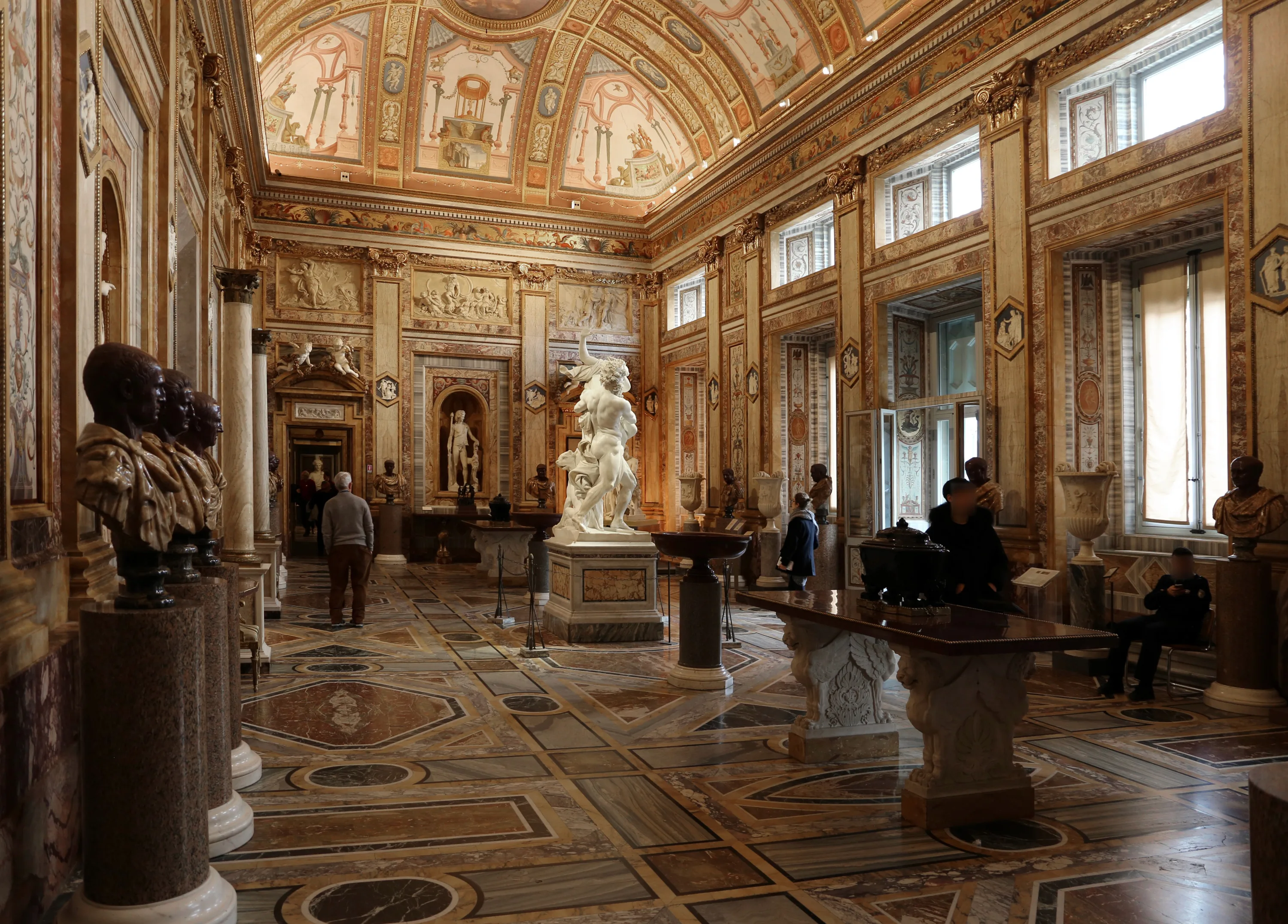
The Galleria Borghese, housed in a 17th-century Roman villa, is a treasure trove of Bernini sculptures and Caravaggio paintings, curated by the art-obsessed Cardinal Scipione Borghese. It is one of the most difficult museums in Europe to visit due to limited tickets being available each day.
What is the Best Time to Visit Galleria Borghese?
The 9:00am slot is the best choice for most visitors. The gallery is quietest at this hour, you have maximum energy for the art, and finishing by 11:00am leaves the rest of the day free for other sightseeing. The 9:00am slot also sells out first, so prioritise booking it.
The 11:00am slot is the most popular and often the first to sell out entirely in peak season. If you cannot get 9:00am, try 1:00pm as a second option.
The 5:00pm slot can be rewarding in summer, when the light through the villa's windows is warm and the surrounding park is beautiful for a post-gallery walk. The Pincio Terrace at sunset is one of Rome's finest views.
By season: Spring (March to May) and autumn (September to October) are the most popular periods. July and August see the highest tourist volume, and available slots frequently sell out the moment they are released. If visiting in peak summer, book the moment tickets for your visit date open, roughly 2-3 months ahead. November through February is quieter and slots are easier to secure, though the official site still releases them on a rolling basis.
Days to avoid: Weekends fill faster than weekdays at every time of year. If your schedule allows a Tuesday to Thursday visit, you will find it marginally easier to secure preferred slots.
What is Inside Galleria Borghese?
The gallery occupies two floors of the Villa Pinciana, a Baroque villa built between 1613 and 1616. The building itself is an artwork: elaborately decorated marble floors, painted ceilings, stucco reliefs, ancient Roman mosaic pavements embedded into the walls, and ancient sculptures integrated into the architecture throughout.
Ground floor: Bernini and Caravaggio
The ground floor is where most visitors spend the bulk of their two hours, and rightly so.
Apollo and Daphne (Room III): Widely considered Bernini's masterpiece and one of the supreme sculptures of any era. Carved when Bernini was in his mid-twenties, it captures the precise moment the nymph Daphne begins transforming into a laurel tree to escape Apollo's pursuit. Daphne's fingertips become leaves, her feet take root, bark creeps up her skin. That this is marble is almost impossible to accept standing in front of it. Walk slowly around the entire piece; Bernini designed it to be experienced from every angle.
The Rape of Proserpina (Room IV): Another Bernini marvel, completed when he was just 23. Pluto seizes Proserpina and carries her to the underworld; his fingers press into her thigh with such apparent softness that visitors instinctively reach out to check it is stone. It is always stone. The detail of Proserpina's tears, Pluto's muscles, and the three-headed Cerberus at their feet is extraordinary.
David (Room II): Bernini's David mid-action, winding up to sling his stone. Unlike Michelangelo's contemplative David or Donatello's serene one, this is all coiled tension and immediate movement. Bernini reportedly used his own face for David's expression of fierce concentration. The ceiling fresco of Phaeton falling from the sky echoes the drama below.
Aeneas, Anchises, and Ascanius (Room I): An early group, already showing Bernini's command of narrative and texture. Three generations of the founding family of Rome, carrying each other and their household gods to safety from burning Troy.
The Caravaggio Room (Room VIII): Six Caravaggio paintings occupy this single room, more than any other museum in Rome. Among them: Boy with a Basket of Fruit (one of his earliest known works, painted around 1593), Sick Bacchus (possibly a self-portrait during his hospitalisation), David with the Head of Goliath (in which Goliath's severed head is generally interpreted as Caravaggio's self-portrait, painted in the year he died while seeking a papal pardon for murder), Saint Jerome Writing, and Madonna and Child with Saint Anne. The density of masterwork here is extraordinary.
Canova's Pauline Borghese as Venus Victrix (Room I): Antonio Canova's neoclassical portrait of Pauline Bonaparte, Napoleon's sister and wife of Camillo Borghese, reclining as Venus with the apple of judgement. The sensuality of the marble — the soft impression of her weight on the cushion, the lifelike fold of drapery — scandalized Rome when it was unveiled. Pauline reportedly said that the studio was heated, which made posing undraped quite comfortable.
Upper floor: Paintings
The upper floor holds the gallery's major paintings across rooms with frescoed ceilings that are themselves worth careful attention.
Raphael's Deposition of Christ (Room IX): Painted in 1507, when Raphael was in his early twenties, this is considered one of the finest Italian Renaissance paintings outside of Florence. The arrangement of the figures, the balance of grief and tenderness, and the quality of the colour are exceptional.
Titian's Sacred and Profane Love (Room XX): The room devoted to Venetian painting is centred on this enigmatic masterpiece commissioned in 1514. Two women — one clothed and one nude — sit on either side of a sarcophagus, their relationship and meaning debated by art historians for five centuries. The landscape behind them is among the finest Titian ever painted.
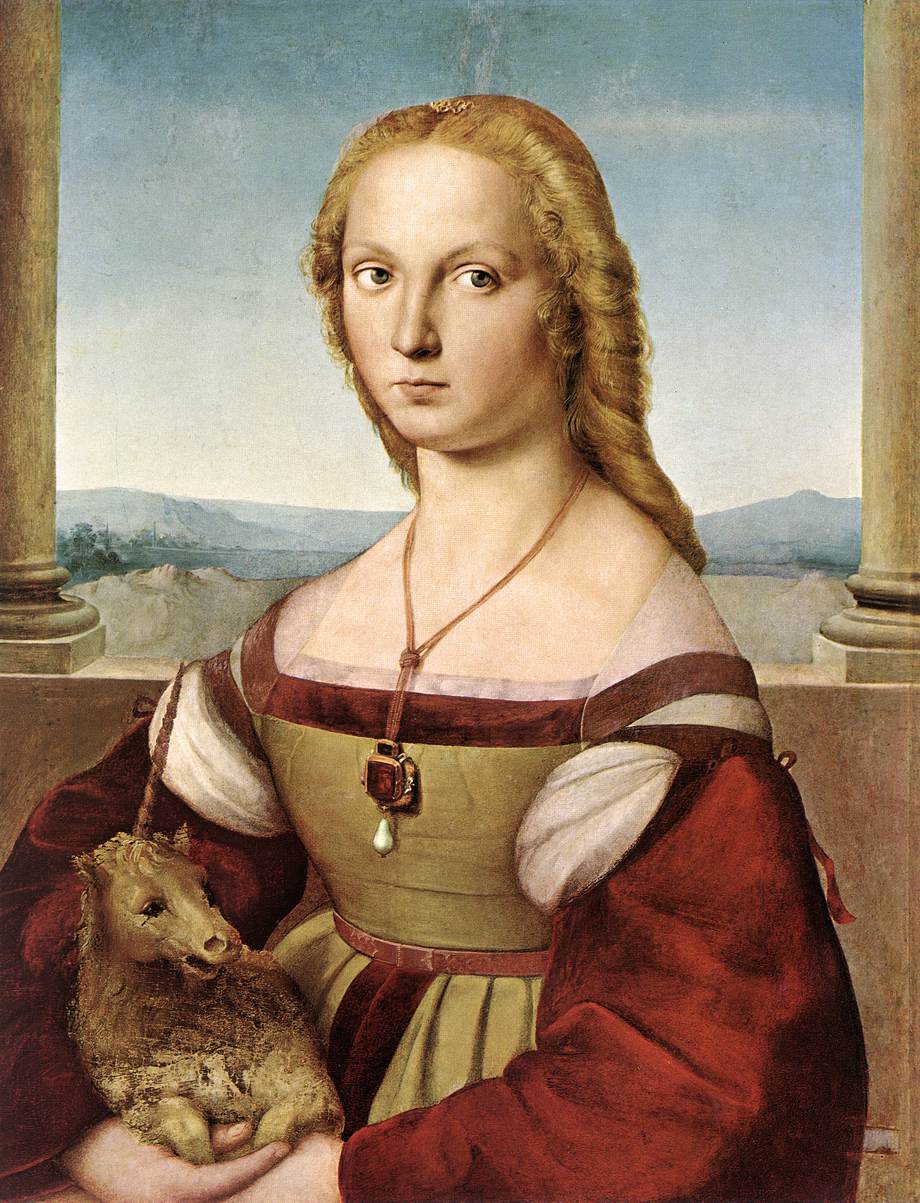
Raphael's Young Woman with a Unicorn (Room IX): A smaller panel but unmistakably Raphael in its serene beauty.
Correggio's Danaë (Room IX): A sensual mythological painting of extraordinary quality, in which Zeus appears to Danaë as a shower of gold.
Other notable works across the upper rooms include pieces by Rubens (including his Deposition), Botticelli, Pinturicchio, Bronzino, Lorenzo Lotto, Antonello da Messina, and Domenichino.
Guided Tours and Audio Guides of the Galleria Borghese
Audio guides are available for hire on the day at the welcome desk inside the gallery for €5. They are not bookable in advance. Bring your own earphones or purchase disposable ones at the desk. Audio guides are available in English, Italian, and French, and cover a 90-minute route through the main highlights. Given the almost total absence of explanatory text within the rooms themselves, an audio guide or guided tour is strongly recommended for all but specialist visitors.
Guided tours are available in small groups (typically up to 15 people) with a licensed art historian guide. These usually run for around two hours and cover the entire gallery, combining expert context with the kind of detail on individual works that transforms the experience entirely. Tours must be booked well in advance, particularly during peak season, as they are popular and limited in number. Some operators offer semi-private tours for groups of six or fewer, which offer more time at each work and more freedom to ask questions. Book these several weeks ahead during the main tourist season.
Private tours of the gallery are available for bespoke bookings and provide the most personalised experience possible within the two-hour time constraint.

Is Galleria Borghese Worth Visiting?
For many art lovers the Galleria Borghese is the single greatest museum visit of their lives. The combination of works on display, the intimacy of the setting, the quality of the building, and the controlled visitor numbers creates something rare: an encounter with world-class art that does not feel exhausting or impersonal.
The Bernini sculptures alone justify the visit. Apollo and Daphne is routinely described by art historians as the greatest marble sculpture of the Baroque period. Seeing it in person, at close range and from every side, is one of those experiences that recalibrates your understanding of what the medium can do. Then the six Caravaggios in a single room. Then the Canova. Then the Raphael and the Titian. The gallery is not large, but it is dense with work of this quality in a way that no other building in Rome matches.
At €18 all in, it is also one of the most extraordinary values in European art tourism.
Where Should I Eat Near Galleria Borghese?
The gallery sits within Villa Borghese park, which is not an area dense with restaurants. The most practical approach is to eat before or after your visit in the surrounding neighbourhoods rather than trying to find a meal in the immediate vicinity.
Within the park:
There is a small café within the Villa Borghese grounds near the gallery that is suitable for a coffee or a light snack before your slot. It is not a serious restaurant option.
Casina Valadier, set within a neo-classical villa inside the park near the Pincio, offers a more formal dining experience with sweeping views over Rome. It is expensive and best suited for a special occasion lunch or dinner rather than a quick meal around a gallery visit. Reservations are essential.
Near the Spanish Steps and Via Veneto (10 to 15 minutes on foot):
The Via Veneto area, south of the park, has a concentration of established restaurants ranging from mid-range trattorias to upscale dining. This is the most natural area for a pre- or post-gallery meal if you are arriving from or continuing to the Spanish Steps.
Ambasciata d'Abruzzo on Via Pietro Tacchini, in the Parioli neighbourhood just east of the gallery, is a long-running regional restaurant serving the hearty cuisine of Abruzzo. Solid, unpretentious, and popular with locals.
Ristorante Al Ceppo on Via Panama, in Parioli, is a bistro-style restaurant with a focus on the cuisine of Le Marche, known for its excellent grilled fish and Marchigiano specialities. A neighbourhood institution worth seeking out.
In the Parioli neighbourhood (east of the park, 10 to 15 minutes' walk from the gallery): Parioli is one of Rome's most prosperous residential areas and has a good selection of neighbourhood restaurants and cafes that cater primarily to locals rather than tourists, which generally means better value and quality than the tourist strip.
Practical advice: Given the two-hour time limit and the importance of arriving before your slot, it is easiest to plan your main meal for after the gallery rather than before. A post-gallery stroll down through the park to the Pincio Terrace, followed by a walk down to the Piazza del Popolo area or back toward the Spanish Steps for lunch or dinner, is a satisfying way to structure the visit.
What Else is There to Do Near Galleria Borghese?
Villa Borghese park is the obvious extension of any Galleria Borghese visit, and it costs nothing to enter. Rome's most central large green space covers 80 hectares with manicured gardens, a boating lake, fountains, open lawns, and several museums and institutions. It is one of the most pleasant places in the city for a walk at any time of year.
The Pincio Terrace is at the western edge of the park, above Piazza del Popolo, and offers one of Rome's best panoramic views, looking south over the piazza's twin churches and across the rooftops toward the Vatican. The terrace is free and can be reached on foot through the park in around 20 minutes from the gallery.
Villa Giulia and the National Etruscan Museum are at the northwest end of the park, around 15 minutes on foot from the Galleria Borghese. The Etruscan collection here is one of the finest in the world, covering over a thousand years of pre-Roman civilisation. Advance booking is not required and entry is moderately priced.
The National Gallery of Modern and Contemporary Art (Galleria Nazionale d'Arte Moderna) is a five-minute walk from the Galleria Borghese and holds the most important collection of 19th and 20th-century Italian and international art in the country, including major works by Modigliani, De Chirico, Klimt, and Cézanne. Entry is paid; advance booking recommended but not always essential.
The Bioparco (Rome Zoo) sits in the northeastern section of the park and is a strong option if visiting with children.
The Spanish Steps and Piazza di Spagna are around a 20-minute walk through the park. The steps are free to visit; the surrounding streets are some of the most elegant shopping territory in Rome.
Piazza del Popolo, at the foot of the Pincian Hill, is a grand baroque square with two almost identical churches flanking the Flaminian Gate and an Egyptian obelisk at its centre. Free to visit and well worth including on the walk back from the gallery.
Rules, Bags, and Security
Bag restrictions: This is one of the strictest bag policies at any museum in Rome. Only bags smaller than 21 × 15 cm are permitted inside the gallery. Everything else — backpacks, tote bags, shoulder bags, large handbags — must be deposited in the mandatory cloakroom at the entrance. Cloakroom use is free. Plan accordingly and travel as light as possible to your visit.
Security: All visitors pass through a security check before entering. Arrive early enough to allow for this and for the cloakroom.
No re-entry: Once you exit the gallery, your ticket is no longer valid. If you leave before the two hours are up, you cannot return on the same ticket.
Photography: Personal photography without flash is permitted throughout the gallery. Tripods, monopods, and selfie sticks are not allowed.
Accessibility: The gallery is accessible to visitors with reduced mobility. Wheelchair users enter through the rear entrance at Piazzale Scipione Borghese 5. Access to the upper floor is via a lift; note that a smaller wheelchair is required for the lift, which means leaving your own chair behind. Contact the gallery in advance for specific accessibility arrangements.
Final Tips for Visiting Galleria Borghese
Book as far in advance as possible. In peak season, set a reminder for roughly 2-3 months before your intended visit date and check the official booking portal as soon as it opens. Slots disappear fast.
If the official site shows nothing available, try GetYourGuide or Tiqets. Third-party platforms often carry availability the official site does not, at a small premium.
Book the 9:00am slot if you can. It is the quietest, and finishing by 11:00am maximises the rest of your day.
Arrive 15 to 20 minutes before your time slot. Late arrivals are turned away without exception or refund.
Leave your bag at the hotel or bring only a tiny one. The 21 × 15cm bag rule is enforced. Anything larger goes in the cloakroom, but it is much easier not to carry one in the first place.
Get the audio guide. At €5, it is essential context for a collection that has almost no explanatory text inside the rooms. Alternatively, book a guided tour, which is the single best way to spend the two hours if you want depth over breadth.
The Roma Pass covers entry but cannot be booked online. If using a Roma Pass, call the booking line or email as soon as your visit dates are confirmed.
Do not book two back-to-back slots hoping for four hours inside. Each slot is a separate ticket and timed separately. You will be asked to leave after two hours regardless.
Spend most of your time on the ground floor. The Bernini rooms and the Caravaggio room are the core of the collection. Budget at least 75 minutes for the ground floor before moving upstairs.
Walk down through the park to the Pincio Terrace after your visit. It is one of the best views in Rome and takes 20 minutes on foot. Entirely free.
Say "Galleria Borghese" not "Villa Borghese" to your taxi driver. The park is enormous and they are not the same destination.
Back to Rome Attractions
Explore other Rome attractions

" width="24px"><path d="M 0 0 L 24 0 L 24 21.231 L 0 21.231 Z" fill="transparent" height="21.230768474975793px" id="nL2EwDcS9" width="24px"/><path d="M 0 0.541 C 0 0.242 0.245 0 0.547 0 L 2.735 0 C 3.037 0 3.282 0.242 3.282 0.541 L 3.282 4.598 C 3.282 4.897 3.037 5.139 2.735 5.139 L 0.547 5.139 C 0.245 5.139 0 4.897 0 4.598 Z" fill="rgb(196, 217, 201)" height="5.138657337892187px" id="hZ_rlBe_S" transform="translate(0 16.092)" width="3.2820512820512358px"/><path d="M 0 0.541 C 0 0.242 0.245 0 0.547 0 L 2.735 0 C 3.037 0 3.282 0.242 3.282 0.541 L 3.282 7.843 C 3.282 8.142 3.037 8.384 2.735 8.384 L 0.547 8.384 C 0.245 8.384 0 8.142 0 7.843 Z" fill="rgb(230, 211, 160)" height="8.38412513024521px" id="HgVBxIz3e" transform="translate(5.128 12.847)" width="3.282051282051235px"/><path d="M 0 0.541 C 0 0.242 0.245 0 0.547 0 L 2.735 0 C 3.037 0 3.282 0.242 3.282 0.541 L 3.282 12.982 C 3.282 13.281 3.037 13.523 2.735 13.523 L 0.547 13.523 C 0.245 13.523 0 13.281 0 12.982 Z" fill="rgb(232, 207, 164)" height="13.522782468137464px" id="utgrDnoM9" transform="translate(10.325 7.708)" width="3.282051282051377px"/><path d="M 0 0.541 C 0 0.242 0.245 0 0.547 0 L 2.735 0 C 3.037 0 3.282 0.242 3.282 0.541 L 3.282 16.498 C 3.282 16.797 3.037 17.039 2.735 17.039 L 0.547 17.039 C 0.245 17.039 0 16.797 0 16.498 Z" fill="rgb(233, 196, 166)" height="17.038705909853153px" id="OLOhW6STz" transform="translate(15.521 4.192)" width="3.2820512820512384px"/><path d="M 0 0.541 C 0 0.242 0.245 0 0.547 0 L 2.735 0 C 3.037 0 3.282 0.242 3.282 0.541 L 3.282 20.69 C 3.282 20.989 3.037 21.231 2.735 21.231 L 0.547 21.231 C 0.245 21.231 0 20.989 0 20.69 Z" fill="rgb(217, 170, 153)" height="21.230768474975793px" id="H5Z8wcwkd" transform="translate(20.718 0)" width="3.2820512820512278px"/></g></svg>)