England isn't particularly known for its culinary scene, at least not compared to its Western European rivals in Spain, Italy, or France. But London is a different story. You can find virtually any cuisine imaginable, including some of the best Indian food you can find anywhere outside of Southeast Asia. But despite what your tummy might tell you each time you pass by Dishoom, eating out every day in London can take quickly add up, especially if you don't have an unlimited budget. This is where food markets come in.
One of the best pieces of advice I give to first-time visitors in London is to make sure they eat at a market. Not because restaurants are bad, quite the opposite, but because London's food markets and food halls are among the best in the world, and they offer something that almost no restaurant can: the chance to graze your way through a dozen different cuisines at your own pace, without a reservation, without a fixed menu, and without any real plan beyond hunger. They're also great for those visiting with a group, where each person has different tastes, preferences, food allergies, or budgets.
Although some food halls have been around for decades (or even centuries), their popularity with tourists has really taken off fairly recently. New generations of covered food courts have opened across the city in the past few years, bringing together independent traders, cult restaurant spin-offs, and occasionally the city's most talked-about new concepts under one roof. The quality, across the better ones, is undeniable.
This guide is organized by neighborhood, because in London, where you eat is as much a part of the experience as what you eat. The areas around these markets are worth exploring in their own right, and the best way to spend a day built around a food hall or market is to treat the surrounding streets as part of the itinerary.
Southwark and London Bridge

The Paella I got at Borough Market
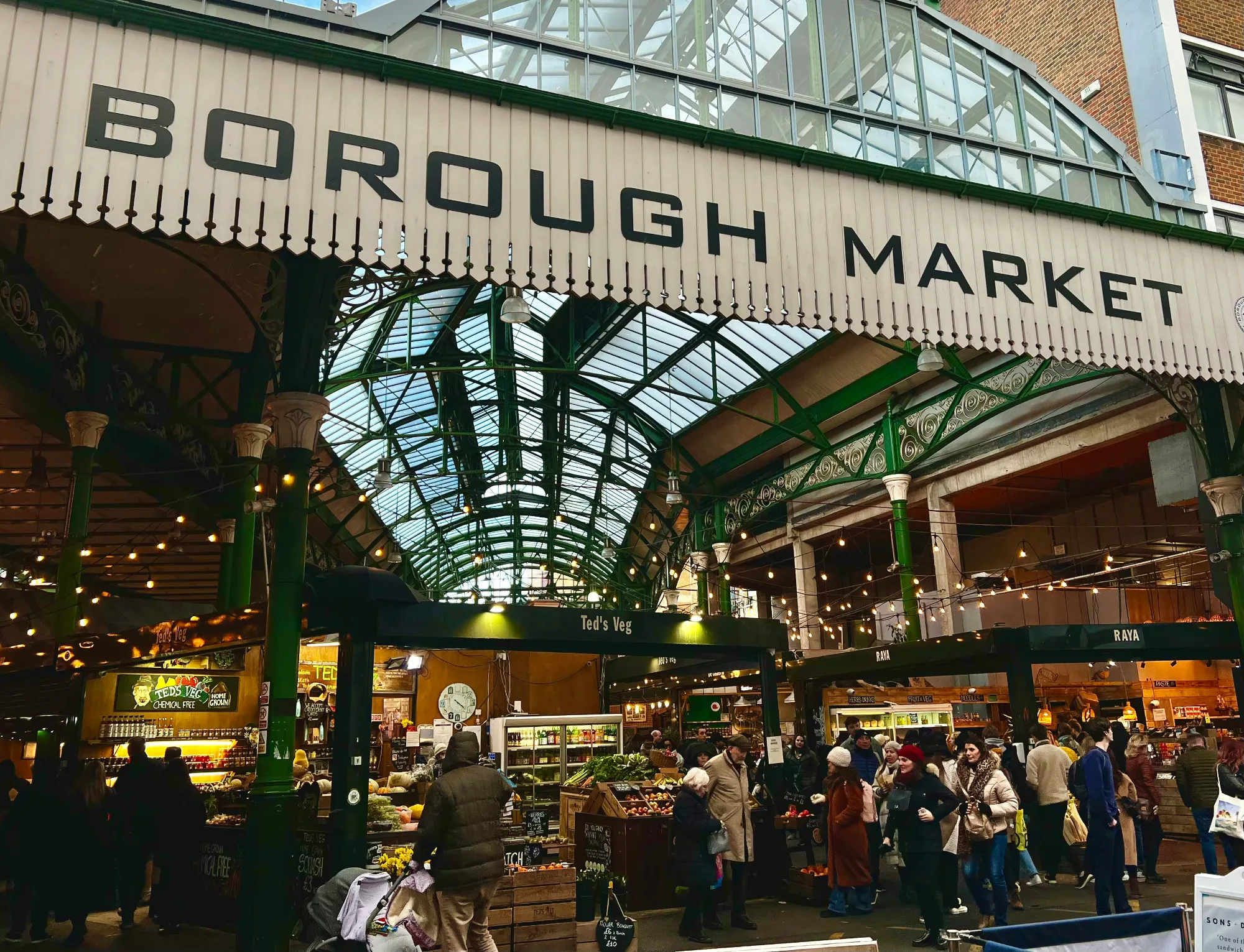
Borough Market
Borough Market is the place that most people mean when they talk about London food markets, and the reputation is earned. It is one of the oldest food markets in London, with records of a market on or near the site dating back to the 13th century, and it sits in one of the most atmospheric corners of the city: a Victorian iron-and-glass covered space tucked beneath the railway arches beside Southwark Cathedral, with the Thames a short walk to the north.
The market operates primarily as a destination for high-quality produce, which means you will find extraordinary bread from Bread Ahead, aged cheeses from Neal's Yard Dairy, fresh pasta, heritage meats, seasonal vegetables from small British farms, and enough artisan condiments to fill a very ambitious suitcase. But Borough Market is also very much a place to eat on the spot. Stalls selling salt beef sandwiches, Ethiopian injera, grilled raclette poured over potatoes, and freshly shucked oysters are woven throughout the market and the lanes immediately surrounding it. Padella, the cult pasta restaurant that helped put the area on the map for food lovers, has its entrance on Borough Market itself and operates a walk-in queue policy.
Borough Market is at its best on a Saturday morning, when it runs at full capacity and the energy is considerable. It is open Tuesday through Friday from 10am to 5pm, and Saturday from 9am to 5pm. It is closed on Sundays and Mondays. The nearest tube stations are London Bridge and Borough, both a short walk away.
Maltby Street Market
A fifteen-minute walk southeast of Borough Market, tucked between Victorian railway arches along a narrow open-air corridor called Rope Walk in the Bermondsey neighborhood, Maltby Street Market has a strong claim to being the most satisfying food market in London for people who already know Borough and want something with a little less tourist traffic.
Around thirty artisan vendors set up along the arches on weekends, selling everything from wood-fired sourdough and carefully sourced charcuterie to tacos, natural wine, craft spirits, and freshly made dumplings. Jensen's, a gin distillery, bar, and shop all in one, is worth a stop for a drink to accompany whatever you've been eating. The atmosphere along Rope Walk is unlike anywhere else in London: smoky, informal, and with the feeling that you've found something the guidebooks haven't quite caught up with yet, even though they have.
Maltby Street Market runs on Saturdays from 9am to 4pm and Sundays from 11am to 4pm. It is a fifteen-minute walk from Bermondsey tube station or London Bridge station.
Mayfair and Oxford Street
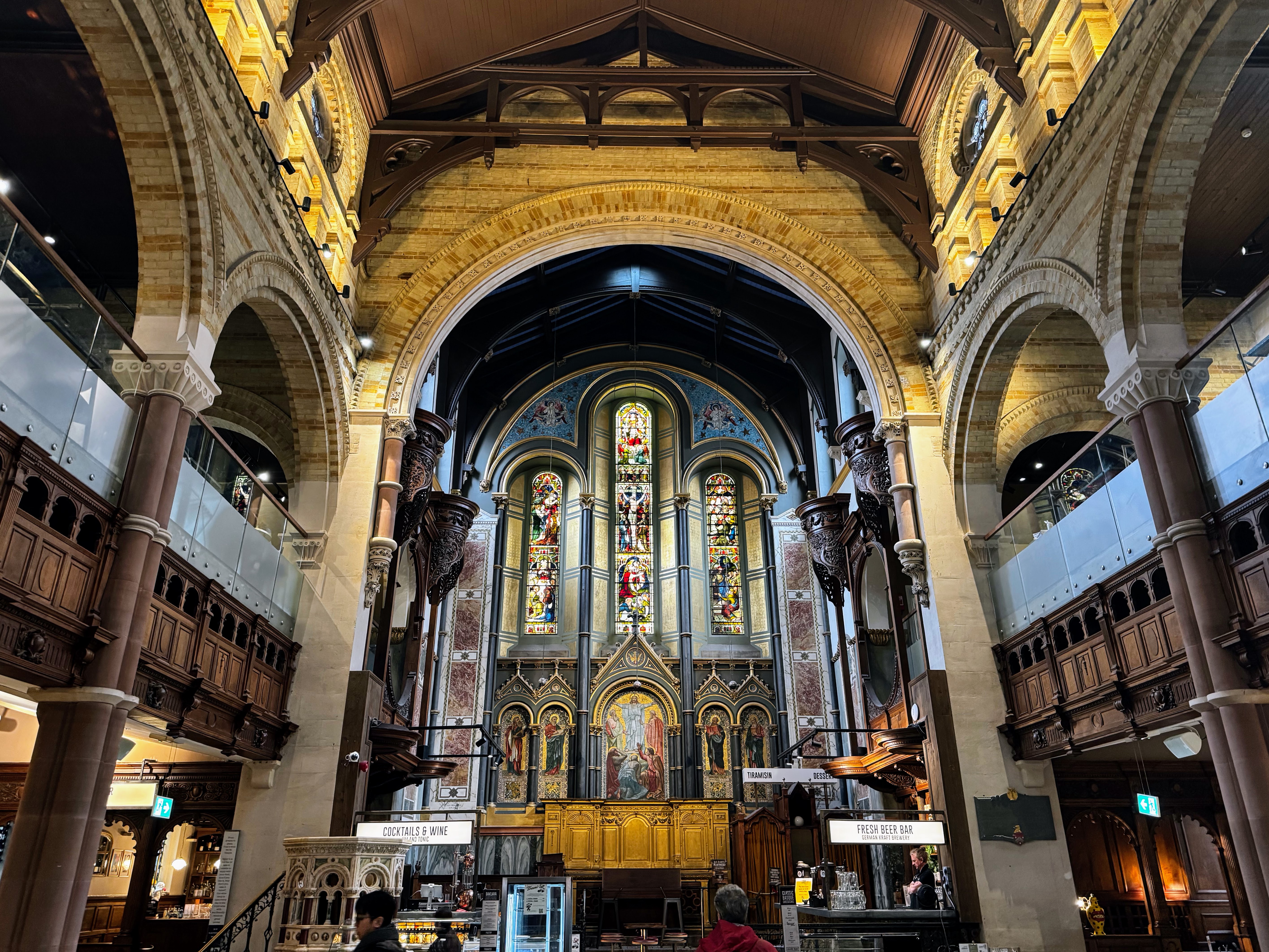
Mercato Mayfair sits within the old St Mark's Church.
Mercato Mayfair
There is a reasonable argument that Mercato Mayfair is the most visually striking food hall in London. It occupies St Mark's Church, a Grade I-listed building originally constructed in 1828, which was deconsecrated in 1974 and later underwent a £5 million restoration before reopening as a food hall in 2019. The stained glass windows are intact. The organ is still in place. The altar is still there. You are eating in a Georgian church, and the effect is hard to prepare yourself for the first time you walk in.
The venue spans three floors: a ground floor nave that serves as the main food hall with communal seating, a first-floor gallery with additional seating and food options looking down into the nave, and a basement crypt housing bars, a wine cellar, and the German Kraft microbrewery. A rooftop terrace adds an outdoor element in warmer months. The range of food on offer is broad and international, rotating regularly across the various trader slots, with an emphasis on fresh ingredients and sustainable sourcing that runs across all Mercato Metropolitano sites.
The crypt is worth making your way down to even if you are not particularly thirsty. The vaulted ceilings and atmosphere make it one of the more unusual places to have a drink in a city that has no shortage of unusual drinking venues. The German Kraft lager brewed on-site is exclusively available at Mercato locations and is a good reason to linger downstairs beyond the novelty of the setting alone.
Walk-ins for smaller parties are accommodated, with table bookings generally reserved for groups of six or more. Opening hours run Monday through Thursday from noon to 11pm, Friday and Saturday from noon to midnight, and Sunday from noon to 10pm. The nearest tube stations are Bond Street and Marble Arch, both a short walk away. The location, tucked just behind the western end of Oxford Street, makes it a natural stop on any day spent in the West End, and a far more interesting lunch option than anything the main shopping street itself has to offer.
Covent Garden and Seven Dials
Seven Dials Market
Seven Dials Market is the flagship venue from KERB, the street food operator that has spent years running rotating outdoor markets across London and has an unusually good track record of identifying the city's best independent food traders. Their biggest venture is Seven Dials Market, a two-story food hall in the Thomas Neal's Warehouse, tucked into a back alley in Seven Dials. Despite being in one of the most central and heavily touristed parts of London, it retains a surprisingly local feel.
The market spills across two floors, with stalls lining the perimeter. It has the viral Bleecker burger spot, Los Gordos serving tacos, Oshpaz with authentic Uzbeki food, and Lucky Hot Chicken with fried chicken that will leave your lips tingling. Pick & Cheese, which operates the world's first cheese conveyor belt, is a recurring highlight. There are also several bars and a bookshop that converts into a private dining room in the evenings.
Seven Dials Market sits in the heart of the West End, making it an excellent option for a lunch stop between sightseeing or a pre-theatre meal before something at one of the nearby venues in the West End. It is open daily, generally from around 11am, and the closest tube stations are Covent Garden and Leicester Square.
Soho and Fitzrovia
Arcade Food Hall
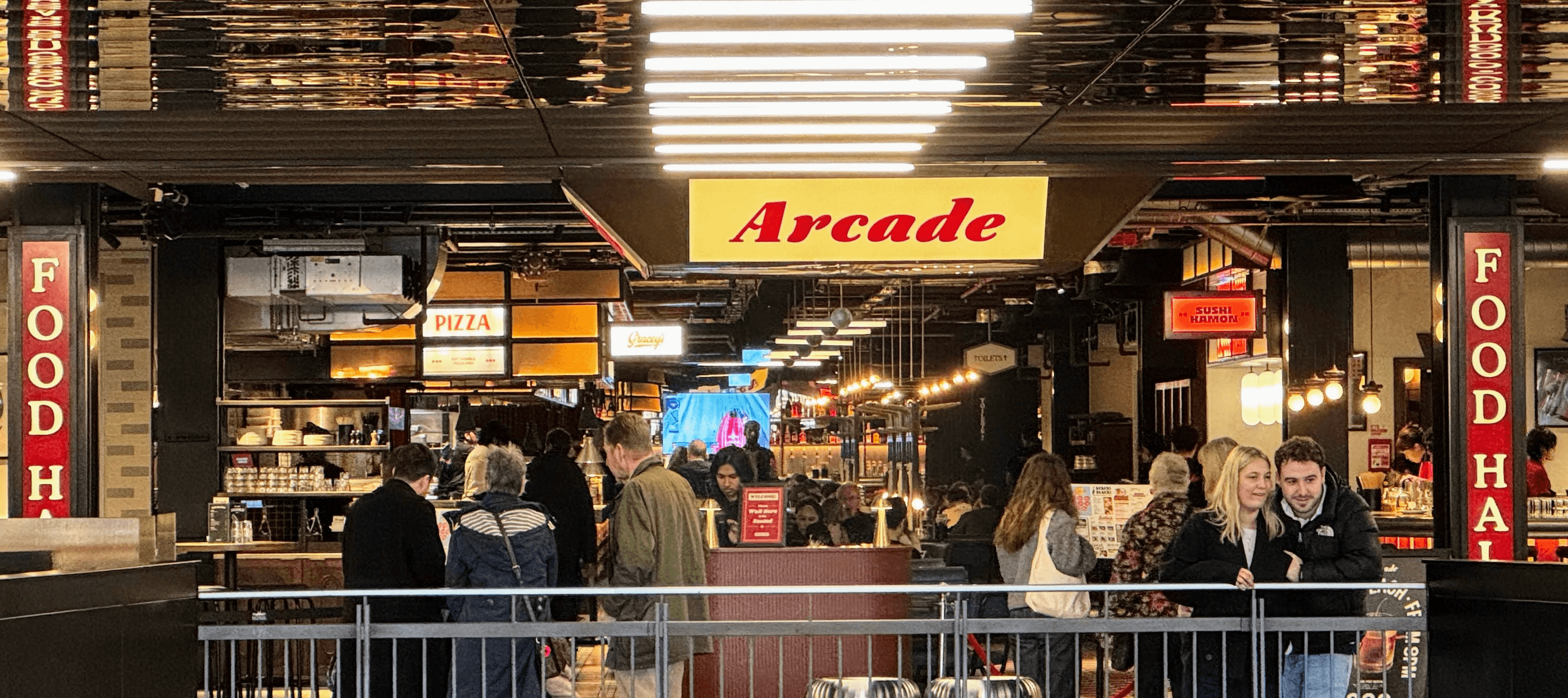
Arcade Food Hall near Soho is home to Gracey's pizza, Supa Ya ramen, Manna burgers, and excellent Thai restaurant Plaza Khao Gaeng. Located in the Centre Point building right at Tottenham Court Road station, it occupies a corner of the West End that until recently had little to recommend it from a food perspective. That has changed substantially.
Unlike many of its counterparts, Arcade Food Hall does not host established street food names. The various kitchens are all new ventures by London chefs hailing from institutions such as Berenjak and Sonora Taqueria. This gives it a slightly different energy from the other food halls on this list: less familiar brand names, more the sense of watching something new being built. The Thai restaurant on the first floor, Plaza Khao Gaeng, has developed a following well beyond the food hall itself and is worth planning a visit around specifically.
Arcade Food Hall is open from late morning through the evening, Monday to Saturday. Tottenham Court Road tube station is directly outside.
Brixton
Brixton Village and Market Row
Brixton Village and its neighboring Market Row are housed inside two covered Victorian arcades in the heart of Brixton, South London, and they represent one of the most interesting food destinations in the city. Brixton Village is still packing more gems per square metre than most, with its beauty in the sheer breadth of options.
The arcades are home to an eclectic mix of independent restaurants, cafés, and food traders reflecting the cultural diversity of Brixton and South London more broadly. Colombian bakeries sit next to West African restaurants, Japanese curry spots, natural wine bars, and Caribbean jerk specialists. The atmosphere is relaxed and neighborhood-focused in a way that the more centrally located food halls sometimes aren't. You will share tables with people who work nearby and families who have been eating here for years alongside visitors who discovered the place last week.
Brixton Village and Market Row are open most days from late morning, with many traders staying open into the evening. Brixton tube station on the Victoria line is a short walk away, making this a very accessible day trip from the centre of the city.
Battersea
The main hallway of the Mercato Metropolitano at Battersea Power Station.
Mercato Metropolitano, Battersea Power Station
Mercato Metropolitano is one of the original food halls and it's not hard to see why it kickstarted the trend. The vibrant spot is filled with over 40 stalls selling everything from arancini to ramen, ice cream and seafood.
The Battersea Power Station location is the most dramatic of their London outposts. The building itself, one of the most recognizable industrial structures in the world, underwent a long and ambitious redevelopment and now houses retail, restaurants, and cultural spaces alongside residential apartments. Mercato's position within it gives you the experience of eating inside a genuinely spectacular piece of architecture, with the option to walk the riverside promenade afterward along the Thames. In summer months, the riverside alfresco offering, Arcade X, adds an outdoor element to the experience.
The focus across Mercato's venues leans Italian, but the range extends well beyond it. The Battersea location is open daily, and the nearest tube station is Battersea Power Station on the Northern line extension.
The City and East London
Eataly, Liverpool Street
Eataly is a concept that originated in Turin and has expanded to cities including New York, Chicago, and Tokyo, but its Liverpool Street outpost is worth singling out as one of the more satisfying food hall experiences in central London for anyone drawn to Italian food specifically. Eataly combines both a market and a food hall, with over 11 restaurants and stalls covering pizza, pasta, pastries, gelato, wine, and an Aperol Spritz. On the market side, you can pick up fresh Italian bread, cheese, and oil.
The location directly beside Liverpool Street station makes it one of the most accessible food destinations in the city, convenient whether you are arriving into London or heading to a different part of the East End. It is open from morning through the evening, with different counters operating across different hours.
Brick Lane Market
Brick Lane on a Sunday morning is one of the great London rituals. The street itself, running through the heart of Spitalfields in East London, becomes a sprawling mixture of vintage clothing, independent market traders, and food vendors stretching across multiple sites from the covered Truman Brewery yard to the open-air stalls along the pavements. Inside and outside the massive space on Brick Lane, you will find a mix of vintage stalls and food and drink traders, with an eclectic range of street food covering everything from Dutch pancakes and freshly made macarons to Korean tteokbokki with gochujang.
Brick Lane has a long history as the center of London's Bangladeshi community, which means that alongside the Sunday market culture, the street is lined with Bangladeshi and Bangladeshi-British restaurants that are worth exploring before or after the market itself. The whole area connects naturally to Shoreditch to the west and Spitalfields Market to the north, where a covered market of independent traders operates across the week. Shoreditch High Street overground station is the most convenient way to arrive.
A Note on Timing
London's outdoor markets are almost universally at their best on Saturday mornings, when they operate at full capacity and the atmosphere is at its peak. Most are significantly quieter on Sundays, and some, including Borough Market, are closed entirely. The indoor food halls tend to operate across the full week, with evenings often busier than lunchtimes, particularly those close to the West End. If you are hoping to avoid the biggest crowds at somewhere like Borough Market or Brixton Village, arriving early, before 11am, makes a significant difference.
None of the markets or food halls listed here require advance booking for general entry. Several of the sit-down restaurants within them do take reservations, and the most popular spots, like Padella at Borough or Plaza Khao Gaeng at Arcade, can have queues at peak times. Turning up with an appetite and a flexible attitude toward where exactly you'll end up eating is, in most cases, the right approach.
Planning your London trip and figuring out what to book in advance? Visit What2Book's London city page for a full breakdown of the attractions, landmarks, and museums where pre-booking makes the biggest difference.
" width="24px"><path d="M 0 0 L 24 0 L 24 21.231 L 0 21.231 Z" fill="transparent" height="21.230768474975793px" id="nL2EwDcS9" width="24px"/><path d="M 0 0.541 C 0 0.242 0.245 0 0.547 0 L 2.735 0 C 3.037 0 3.282 0.242 3.282 0.541 L 3.282 4.598 C 3.282 4.897 3.037 5.139 2.735 5.139 L 0.547 5.139 C 0.245 5.139 0 4.897 0 4.598 Z" fill="rgb(196, 217, 201)" height="5.138657337892187px" id="hZ_rlBe_S" transform="translate(0 16.092)" width="3.2820512820512358px"/><path d="M 0 0.541 C 0 0.242 0.245 0 0.547 0 L 2.735 0 C 3.037 0 3.282 0.242 3.282 0.541 L 3.282 7.843 C 3.282 8.142 3.037 8.384 2.735 8.384 L 0.547 8.384 C 0.245 8.384 0 8.142 0 7.843 Z" fill="rgb(230, 211, 160)" height="8.38412513024521px" id="HgVBxIz3e" transform="translate(5.128 12.847)" width="3.282051282051235px"/><path d="M 0 0.541 C 0 0.242 0.245 0 0.547 0 L 2.735 0 C 3.037 0 3.282 0.242 3.282 0.541 L 3.282 12.982 C 3.282 13.281 3.037 13.523 2.735 13.523 L 0.547 13.523 C 0.245 13.523 0 13.281 0 12.982 Z" fill="rgb(232, 207, 164)" height="13.522782468137464px" id="utgrDnoM9" transform="translate(10.325 7.708)" width="3.282051282051377px"/><path d="M 0 0.541 C 0 0.242 0.245 0 0.547 0 L 2.735 0 C 3.037 0 3.282 0.242 3.282 0.541 L 3.282 16.498 C 3.282 16.797 3.037 17.039 2.735 17.039 L 0.547 17.039 C 0.245 17.039 0 16.797 0 16.498 Z" fill="rgb(233, 196, 166)" height="17.038705909853153px" id="OLOhW6STz" transform="translate(15.521 4.192)" width="3.2820512820512384px"/><path d="M 0 0.541 C 0 0.242 0.245 0 0.547 0 L 2.735 0 C 3.037 0 3.282 0.242 3.282 0.541 L 3.282 20.69 C 3.282 20.989 3.037 21.231 2.735 21.231 L 0.547 21.231 C 0.245 21.231 0 20.989 0 20.69 Z" fill="rgb(217, 170, 153)" height="21.230768474975793px" id="H5Z8wcwkd" transform="translate(20.718 0)" width="3.2820512820512278px"/></g></svg>)