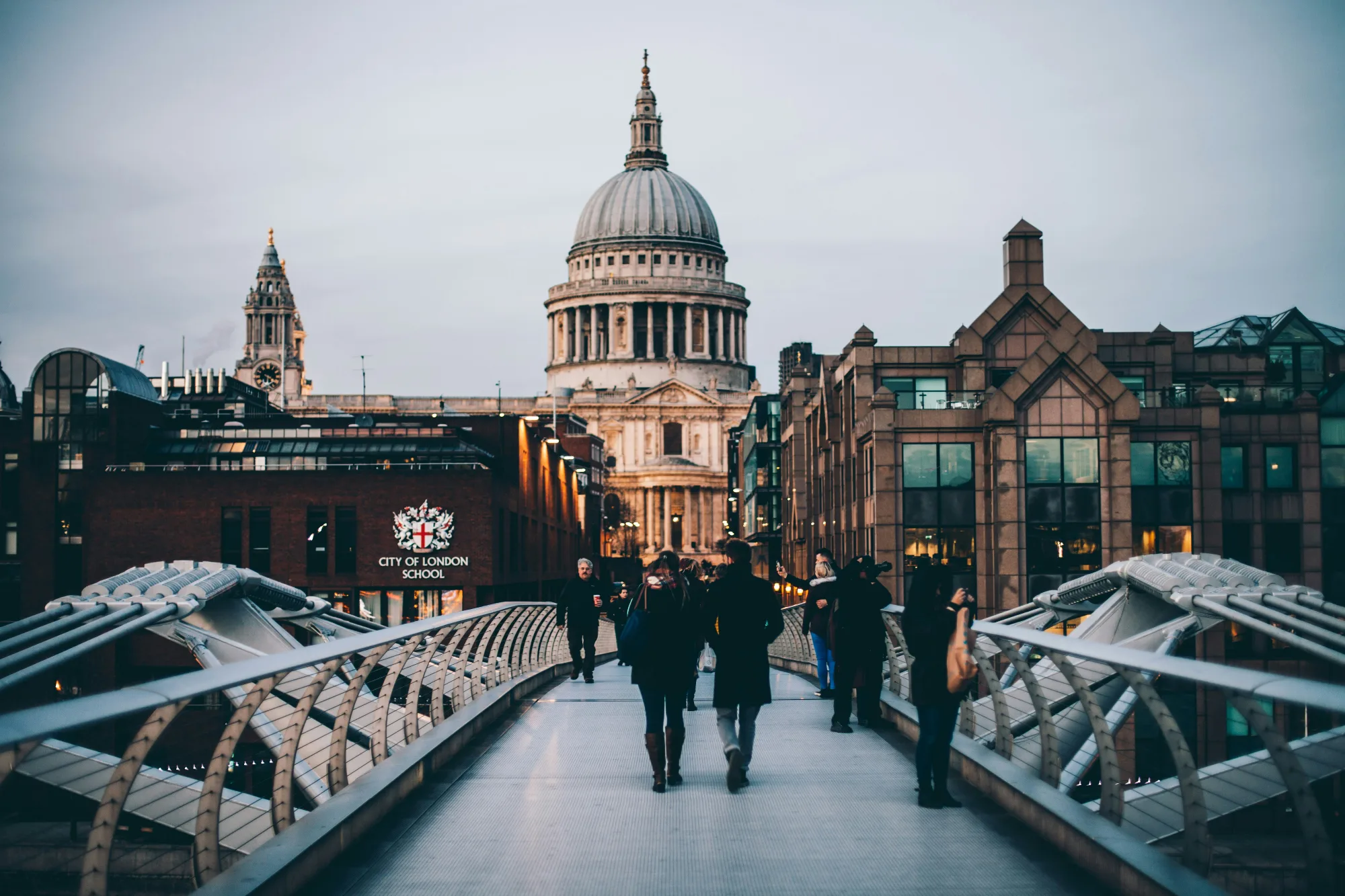
London does not make things easy for the underprepared traveler. The city is enormous, the most popular attractions fill up weeks or months in advance, and the sheer volume of things to do can make it difficult to know where to focus your planning energy in the first place. Add in the fact that several of London's best-known museums are free to enter, which means the queues at peak times can be staggering, and you have a city that rewards research and punishes assumptions.
If you're reading this because you're already in London and realized too late that you didn't book something in time, or because you're planning a trip and want to know what to do if your first choices fall through, this guide is for you. What follows are five alternatives for when the most popular London attractions are sold out or oversubscribed. None of them require advance booking to walk in. Several of them are, with a little honest reflection, every bit as rewarding as the attraction you originally had in mind.
If the Harry Potter Studio Tour Is Sold Out: Visit the British Library Treasures Gallery
The Warner Bros. Studio Tour is one of the hardest tickets in England, full stop. It books out months in advance, and unlike most other attractions on this list, there is no timed walk-in option available on the day. If you missed the window, no amount of refreshing the booking page at odd hours is likely to change that.
The alternative worth considering is not, strictly speaking, a thematic substitute. But it is one of the most astonishing free attractions in the country, and it rarely gets the attention it deserves from tourists focused on the obvious landmarks. The British Library's permanent Treasures Gallery, housed in the Sir John Ritblat Gallery, is free to enter and requires no advance booking. You simply walk in.
What's inside is difficult to fully prepare yourself for. The gallery displays some of the most culturally significant documents in human history, presented in a single, beautifully lit room. The Magna Carta. The Lindisfarne Gospels. A Gutenberg Bible. Shakespeare's First Folio. Lewis Carroll's handwritten manuscript of Alice's Adventures Underground, the original that became Alice in Wonderland. Handwritten lyrics by the Beatles. Leonardo da Vinci's notebook. Jane Austen's writing desk and personal letters. These objects are not reproductions, and the effect of standing in front of them is something that's hard to describe until you've done it.
The British Library is located in King's Cross, which is in itself a relevant detail for anyone who came to London partly for Harry Potter, since the station concourse nearby features the famous Platform 9¾ installation and photo opportunity. The two can be combined into a single morning without any planning required. The Treasures Gallery is open Monday to Saturday from 9:30am to 8pm, and on Sundays from 11am to 5pm. Entry is completely free.
If the British Museum Is Sold Out or Too Crowded: Spend the Day at the Victoria and Albert Museum
The British Museum is the most visited attraction in the United Kingdom. Even with a pre-booked timed-entry ticket, the most popular galleries can feel more like a rush-hour tube platform than a cultural institution. If you couldn't get a ticket in time, or you have one but the thought of fighting through the Egyptian Mummies exhibition during the middle of a summer Saturday is making you reconsider, there is a much calmer option a short tube ride to the south.
The Victoria and Albert Museum, universally referred to as the V&A, is free to enter and requires no advance booking for the permanent collection. General admission is free and you don't need to book. It is also, by area, the largest design and decorative arts museum in the world, with a permanent collection spanning 5,000 years and covering fashion, ceramics, furniture, jewellery, architecture, photography, and textiles across more than 145 galleries. If you are the kind of person who is drawn to human craft at its most refined, the V&A will hold you for an entire day without effort.
The building itself is worth the visit. The main entrance on Cromwell Road opens into a sequence of Victorian-era interiors that are genuinely overwhelming in the best possible way. The Cast Courts house full-scale plaster replicas of Trajan's Column and Michelangelo's David. The Raphael Cartoons, seven full-scale preparatory designs painted by Raphael himself for the Sistine Chapel tapestries, hang in a dedicated gallery and are on permanent loan from the Royal Collection. The medieval and Renaissance galleries are quietly among the finest in Europe.
The V&A is located in South Kensington, a five-minute walk from South Kensington tube station. It is open daily from 10am to 5:45pm, with extended Friday evening hours until 10pm.
If Churchill War Rooms Are Sold Out: Visit the Imperial War Museum
The Churchill War Rooms are one of London's most popular history attractions and, as detailed on What2Book's London city page, guided tours in particular book up fast, sometimes months in advance. If you're visiting in summer without a pre-booked ticket, availability even for standard entry can be tight.
The good news is that there is a free, no-booking-required alternative nearby that covers overlapping and in many ways complementary ground. Entry to the Imperial War Museum is free, and you don't need to book. It is open every day except Christmas Eve through Boxing Day, and the permanent collection covers conflict from the First World War through to present-day operations, told primarily through the experiences of ordinary people rather than the strategic decisions of generals and politicians.
The IWM is not a light or easy museum, and it shouldn't be. The First World War Galleries are among the most thoughtfully constructed in the country, immersing visitors in the experience of the trenches through personal accounts, artefacts, and spatial design that makes the scale of the conflict feel human rather than abstract. The Holocaust Galleries on the lower floors are among the most important Holocaust memorial spaces in the UK, requiring time and quiet attention. The large military hardware on display in the central atrium, including tanks, aircraft, and a V2 rocket, provides a striking visual anchor for the rest of the collection.
If the Churchill War Rooms were specifically on your list for their WWII focus, the IWM covers that period in remarkable depth. If anything, the broader scope of the IWM offers more historical context around the same events. It is located in Lambeth, about a 15-minute walk from Waterloo station, and is open daily from 10am to 6pm.
If the National Gallery Is Too Crowded: Head to the Courtauld Gallery
The National Gallery on Trafalgar Square is free to enter, which is wonderful, but it also means there is no ticketing system to manage visitor numbers on a busy day. During peak summer months, the most famous rooms, those containing the Monets, the Van Goghs, and the Turners, can become extremely difficult to move through. If you arrived and found the experience more exhausting than enlightening, or if you simply want an alternative that trades scale for intimacy, the Courtauld Gallery is the most logical step.
The Courtauld Gallery is located within Somerset House, right in the heart of the city, and tickets for the permanent collection are available at the Gallery on the day. It is a short walk from Trafalgar Square, and the contrast in atmosphere between the two is immediate and significant. Where the National Gallery is vast and occasionally overwhelming, the Courtauld is compact, beautifully organized, and the kind of place where you can stop in front of something and actually think about what you're looking at.
The permanent collection is weighted heavily toward Impressionism and Post-Impressionism, and it is extraordinary by any standard. Manet's A Bar at the Folies-Bergère is here. So is Van Gogh's Self-Portrait with Bandaged Ear. So is the most significant collection of Cézannes in the United Kingdom. These are not secondary works; they are among the most important paintings in the world, presented in rooms that hold perhaps thirty people comfortably rather than three hundred. Because of its manageable size and exceptional quality, the Courtauld Gallery is an excellent choice for first-time visitors who want to experience top-tier art without committing half a day to a large museum.
The Courtauld is housed in the neoclassical Somerset House on the Strand, which is worth exploring in its own right. The gallery is open Monday through Sunday from 10am to 6pm, with last entry at 5:15pm.
If the Tower of London Is Sold Out: Walk Across Tower Bridge and Visit Tate Modern
The Tower of London requires timed-entry tickets and during peak season these book up a week or more in advance. If you've missed the window, the area immediately surrounding it still contains two of London's most worthwhile experiences, neither of which requires any booking at all.
The first is Tower Bridge itself. Most visitors walk across Tower Bridge without realizing that the interior is open to visit, but for this alternative the exterior crossing is the point. Walking the full length of the bridge, pausing at the center to look east toward Canary Wharf and west toward the City and St Paul's Cathedral, gives you one of the most iconic views in London for free. From the south bank, the Tower of London itself reads beautifully against the skyline, which is in many ways a better way to appreciate its scale and relationship to the river than viewing it from inside.
From Tower Bridge, the Thames Path runs west along the South Bank to Tate Modern, a walk of about twenty-five minutes that passes Southwark Cathedral, Borough Market, and the Golden Hinde replica. Tate Modern is free to enter, requires no booking for the permanent collection, and is housed in the former Bankside Power Station: one of the most dramatic conversions of an industrial building into a cultural space anywhere in the world. The Turbine Hall alone, a vast open space that once housed the generating equipment, is worth entering for its sheer physical impact. The permanent collection covers modern and contemporary art from 1900 to the present, with works by Picasso, Matisse, Warhol, Bourgeois, and Rothko alongside contemporary pieces that regularly change.
Combining the riverside walk with Tate Modern turns what might have been a disappointing morning into one of the better half-days London has to offer. Tate Modern is open Sunday through Thursday from 10am to 6pm, and Friday and Saturday from 10am to 10pm.
A Note on Planning Ahead
Every alternative on this list is worth visiting on its own terms, not just as a fallback. But the brutally honest takeaway remains the same one that applies to Paris, Rome, and every other major European city: London's best-loved attractions have become significantly harder to access without advance planning, and the gap between a well-organized trip and an improvised one is almost entirely a matter of booking a few key things before you leave home.
If you're still in the planning stage and want to know exactly what to book and how far ahead, visit What2Book's London city page for a full breakdown of every major attraction in the city.
And if you're already there with a free afternoon and no plan, the South Bank between Tower Bridge and Tate Modern, with Borough Market somewhere in the middle of it, is one of the better ways to spend it.
" width="24px"><path d="M 0 0 L 24 0 L 24 21.231 L 0 21.231 Z" fill="transparent" height="21.230768474975793px" id="nL2EwDcS9" width="24px"/><path d="M 0 0.541 C 0 0.242 0.245 0 0.547 0 L 2.735 0 C 3.037 0 3.282 0.242 3.282 0.541 L 3.282 4.598 C 3.282 4.897 3.037 5.139 2.735 5.139 L 0.547 5.139 C 0.245 5.139 0 4.897 0 4.598 Z" fill="rgb(196, 217, 201)" height="5.138657337892187px" id="hZ_rlBe_S" transform="translate(0 16.092)" width="3.2820512820512358px"/><path d="M 0 0.541 C 0 0.242 0.245 0 0.547 0 L 2.735 0 C 3.037 0 3.282 0.242 3.282 0.541 L 3.282 7.843 C 3.282 8.142 3.037 8.384 2.735 8.384 L 0.547 8.384 C 0.245 8.384 0 8.142 0 7.843 Z" fill="rgb(230, 211, 160)" height="8.38412513024521px" id="HgVBxIz3e" transform="translate(5.128 12.847)" width="3.282051282051235px"/><path d="M 0 0.541 C 0 0.242 0.245 0 0.547 0 L 2.735 0 C 3.037 0 3.282 0.242 3.282 0.541 L 3.282 12.982 C 3.282 13.281 3.037 13.523 2.735 13.523 L 0.547 13.523 C 0.245 13.523 0 13.281 0 12.982 Z" fill="rgb(232, 207, 164)" height="13.522782468137464px" id="utgrDnoM9" transform="translate(10.325 7.708)" width="3.282051282051377px"/><path d="M 0 0.541 C 0 0.242 0.245 0 0.547 0 L 2.735 0 C 3.037 0 3.282 0.242 3.282 0.541 L 3.282 16.498 C 3.282 16.797 3.037 17.039 2.735 17.039 L 0.547 17.039 C 0.245 17.039 0 16.797 0 16.498 Z" fill="rgb(233, 196, 166)" height="17.038705909853153px" id="OLOhW6STz" transform="translate(15.521 4.192)" width="3.2820512820512384px"/><path d="M 0 0.541 C 0 0.242 0.245 0 0.547 0 L 2.735 0 C 3.037 0 3.282 0.242 3.282 0.541 L 3.282 20.69 C 3.282 20.989 3.037 21.231 2.735 21.231 L 0.547 21.231 C 0.245 21.231 0 20.989 0 20.69 Z" fill="rgb(217, 170, 153)" height="21.230768474975793px" id="H5Z8wcwkd" transform="translate(20.718 0)" width="3.2820512820512278px"/></g></svg>)