One of the things that separates Rome from almost every other city in the world is the density of history that exists at street level. In most cities, the landmarks are inside buildings: museums, palaces, churches behind closed doors. In Rome, a significant portion of the most extraordinary things you will ever see are simply out in the open, surrounded by cobblestones, accessible at any hour, and free.
The piazza is the organizing unit of Roman life. Rome has more than two thousand of them, ranging from vast ceremonial squares that could hold tens of thousands of people to tiny intersections with a fountain and a few tables outside a trattoria. They have served, across different centuries, as markets, execution grounds, political rally points, horse-racing circuits, theatrical stages, and neighborhood living rooms. Most of them are still doing several of those things at once.
This guide covers the best piazzas and public spaces in Rome, organized by the neighborhood each sits in. All of them are free to enter. Some are surrounded by paid attractions worth booking in advance, and those are noted where relevant. But the piazzas themselves cost nothing, and several of them are rewarding enough to justify a dedicated visit on their own terms.
The Historic Center
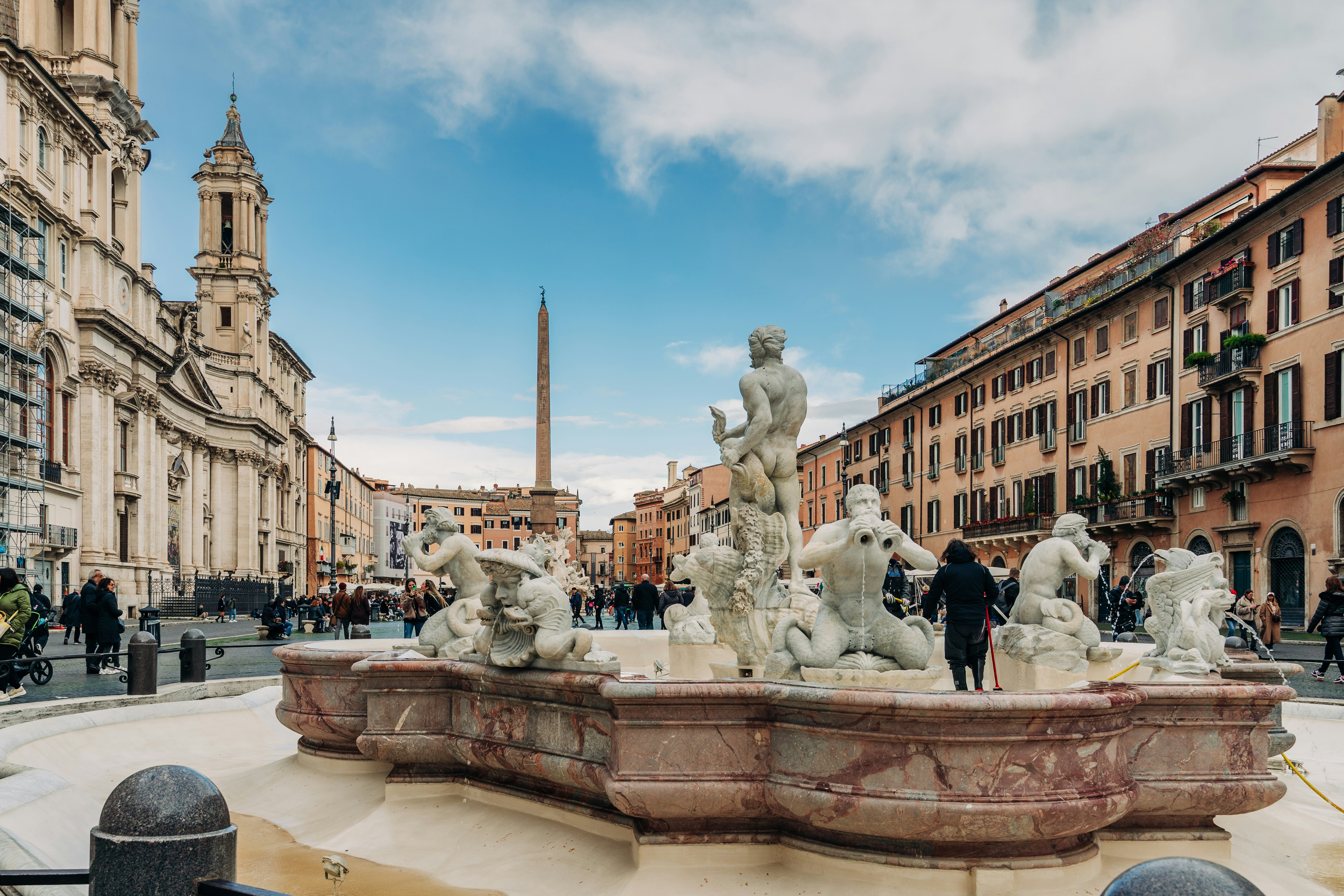
Piazza Navona in Rome
Piazza Navona
If there is a single piazza that encapsulates everything Rome does best, it is Piazza Navona. The shape of it tells the whole story: the square is long, narrow, and gently curved because it was built directly on top of the Stadium of Domitian, a first-century athletic arena whose outline has been preserved perfectly in the surrounding buildings for nearly two thousand years. Romans have been gathering here since the days of chariot races and gladiatorial games, and the square has never really stopped being a gathering place since.
The Baroque architecture that frames the piazza today dates primarily to the 17th century, when Pope Innocent X commissioned a wholesale renovation of the square as a statement of papal power and aesthetic ambition. The result is one of the finest urban spaces in Europe, anchored by three fountains. The most famous is the Fontana dei Quattro Fiumi, the Fountain of the Four Rivers, designed by Gian Lorenzo Bernini in 1651. Four colossal marble figures represent the Nile, the Ganges, the Danube, and the Río de la Plata, arranged around a dramatic Egyptian obelisk at the center. The story that Bernini positioned the figure representing the Río de la Plata with its hand raised to shield its eyes from the facade of the rival church of Sant'Agnese in Agone, designed by his great rival Borromini, is widely repeated and almost certainly invented after the fact. But it is a good story, and both the fountain and the church are worth examining carefully regardless.
Piazza Navona is at its best in the early morning, before the tourist trade gets fully underway, when it belongs mostly to people walking dogs and having coffee at the outdoor tables. It is also worth visiting in December, when a Christmas market sets up across the square, and in the evening, when the floodlit fountains and the surrounding restaurant terraces give it an atmosphere that feels completely cinematic.
Campo de' Fiori
Campo de' Fiori sits about ten minutes' walk south of Piazza Navona, and the contrast between the two says a lot about how many different versions of a Roman piazza can coexist within a few blocks of each other. Where Navona is formal, Baroque, and theatrical, Campo de' Fiori is rough-edged, market-focused, and distinctly earthier.
The name translates as "field of flowers," and the square has been used as a market since the late Middle Ages, a function it still performs every morning from Monday through Saturday. The stalls sell produce, flowers, spices, and increasingly tourist-oriented goods, but the atmosphere in the early morning hours, when local restaurants are buying vegetables and the smell of coffee drifts out from the surrounding bars, still has something of the workaday Rome that can be hard to find in the more heavily touristed parts of the center.
The most arresting element of Campo de' Fiori is not the market but the statue at its center: a dark bronze figure in a monk's hood, arms folded, staring down at the square with an expression that communicates something between defiance and contempt. This is Giordano Bruno, the philosopher and cosmologist who was burned at this spot in 1600 for heresy, and whose statue was erected here in 1889 by anticlerical movements as a deliberate provocation to the Vatican. The Catholic Church found the statue objectionable, which was very much the point. Bruno's execution remains one of the most discussed acts of the Inquisition, and standing at the base of his statue and reading the inscription is a useful counterpoint to the golden-age grandeur that dominates most of Rome's public spaces.
In the evening, Campo de' Fiori transforms again, becoming one of the more lively nightlife spots in the center, with the surrounding bars and restaurants filling with a mix of students, tourists, and Romans looking for aperitivo. It is not the most serene piazza in Rome after dark, but it is one of the most alive.
Piazza della Rotonda
The square in front of the Pantheon goes by several names, most commonly Piazza della Rotonda or Piazza del Pantheon, and it is the kind of place that becomes almost impossible to process the first time you see it. The Pantheon was built around 125 AD under the Emperor Hadrian on the site of an earlier temple, and it is the best-preserved ancient building in Rome, possibly in the world. The dome, spanning 43 meters, was the largest in the world for over thirteen centuries and is still one of the greatest engineering achievements in human history. The concrete from which it was poured has been standing for nearly nineteen centuries.
The piazza itself is modest in scale, centered on an Egyptian obelisk atop a Baroque fountain, and the surrounding streets narrow it considerably. This means that the facade of the Pantheon seems to arrive suddenly, which may be why the impact of it is so consistently described as overwhelming by people who have just encountered it for the first time. The visit to the Pantheon interior now requires a paid, timed-entry ticket. But the piazza in front of it, and the view of the building from the outside, remain free and always will be.
The cafés around the piazza charge a premium for the view, but a cup of coffee at a table facing the Pantheon is one of the canonical Roman experiences and worth the inflated price at least once.
The Tridente and Trevi
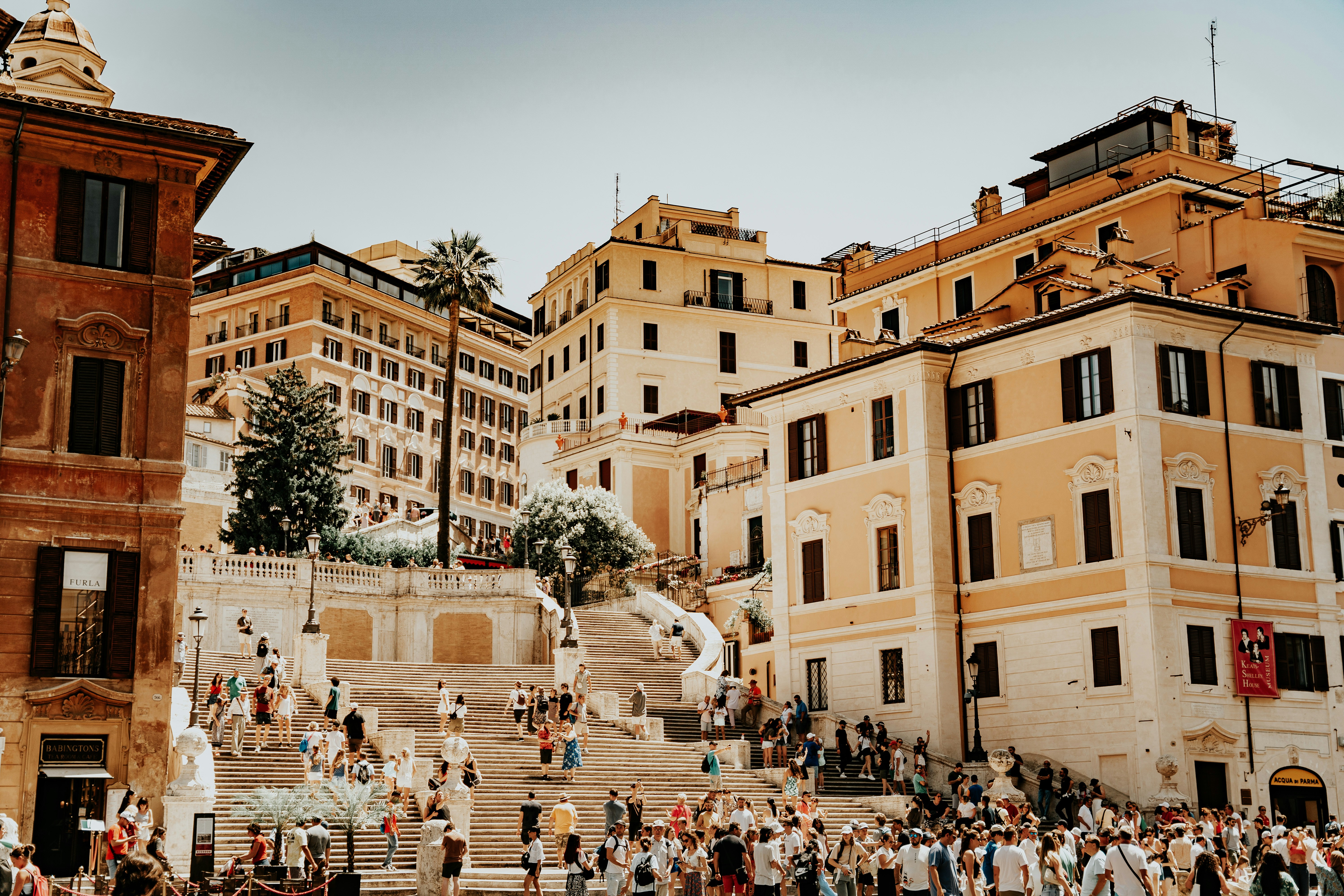
The Spanish Steps in Rome
Piazza di Spagna and the Spanish Steps
Piazza di Spagna sits at the base of the Spanish Steps, and the two together form one of the most photographed public spaces in the world. The steps themselves, 135 of them, climb from the piazza up to the French church of Trinità dei Monti at the top, a project completed in 1725 and funded through a bequest from a French diplomat, which makes the name "Spanish Steps" somewhat ironic: the Spanish Embassy had established itself on the square in the 17th century, giving the piazza its name, but the steps themselves are thoroughly French in origin.
The view from the top is one of the finest free vantage points in central Rome, looking back down the steps toward the piazza and the Barcaccia fountain below, a low-lying stone boat fountain attributed to Pietro Bernini, father of the more famous Gian Lorenzo. The fountain's unusual sinking shape is a practical solution to low water pressure: by keeping the basin close to street level, the designer maximized the available flow. The surrounding neighborhood, known as the Tridente for the three streets that fan out from nearby Piazza del Popolo, has been fashionable since the 17th and 18th centuries, when it was the preferred part of Rome for visiting artists, writers, and Grand Tour travelers. John Keats died in a house directly overlooking the piazza in 1821; the house is now a museum in his memory and that of Percy Bysshe Shelley.
The Spanish Steps are at their busiest in the middle of the day during summer, when the crowd can make the actual experience of climbing them fairly unpleasant. Early morning visits, before 9am, offer a version of the steps that feels almost meditative.
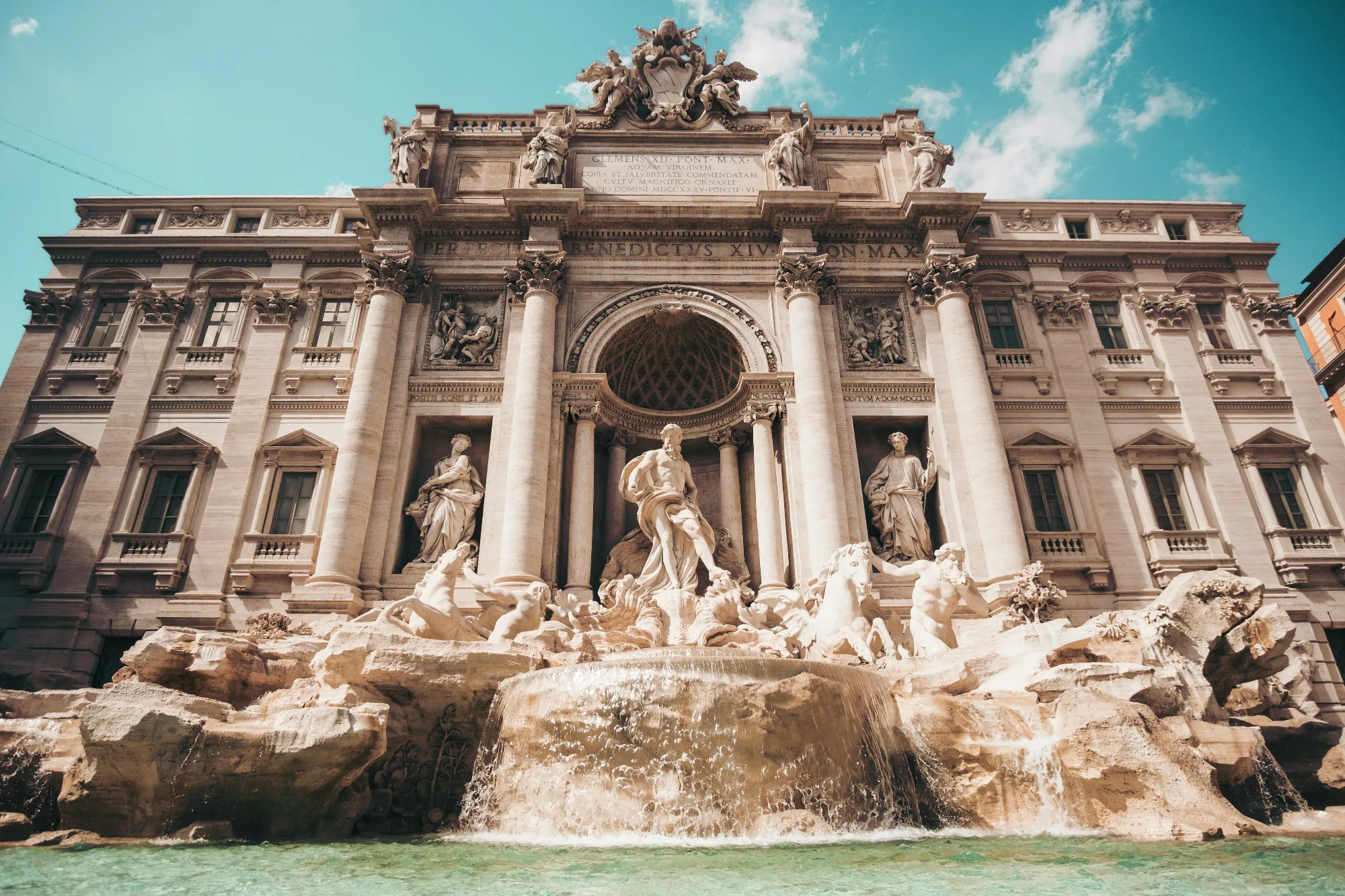
Piazza di Trevi and the Trevi Fountain
The Trevi Fountain is the largest Baroque fountain in Rome, standing 26 meters tall and 49 meters wide, and it occupies most of the small piazza that surrounds it. It is not, in the technical sense, a particularly large public square: it is more that an enormous fountain was built into the junction of several narrow streets in such a way that the surrounding space became a piazza by necessity.
The fountain was completed in 1762, designed by Nicola Salvi, and depicts the god Neptune riding a shell chariot pulled by sea horses and guided by Tritons. The whole composition crashes out of the facade of Palazzo Poli as if the building itself were dissolving into water, which is architecturally audacious and visually extraordinary. The Trevi Fountain is the terminal monument of the ancient Aqua Virgo aqueduct, one of the eleven great aqueducts of ancient Rome, which has been supplying water to this part of the city since 19 BC.
The tradition of throwing coins into the fountain, with the promise of a return to Rome, was popularized by Federico Fellini's film La Dolce Vita in 1960 and has since become one of the most practiced rituals in European tourism. The coins thrown each year are collected regularly and donated to a Roman charity. The fountain is illuminated at night and considerably less crowded after 9pm, which is the recommended time to visit if you want any chance of experiencing it without a hundred people between you and the water.
Flaminio and the Northern Entrance
Piazza del Popolo
Piazza del Popolo sits at the northern edge of Rome's historic center, at the point where the Via Flaminia, the ancient road connecting Rome to the Adriatic coast, enters the city through the old Aurelian Walls. For centuries, this was the first piazza visitors encountered when arriving in Rome from the north, and the architecture was designed with that first impression explicitly in mind.
The square was given its current neoclassical form in the early 19th century by the architect Giuseppe Valadier, who created the large oval space, the terraced slopes connecting to the Pincian Hill above, and the fountains that line the eastern and western edges. At the center stands the Flaminio Obelisk, an Egyptian obelisk originally carved in the 13th century BC for the Temple of Re in Heliopolis, brought to Rome by the Emperor Augustus to celebrate his conquest of Egypt, placed initially in the Circus Maximus, and relocated to the piazza in 1589 under Pope Sixtus V. At its base, four marble lions designed by Valadier in the Egyptian style spout water from their mouths.
At the southern end of the piazza, marking the start of three streets that fan out into the city like the prongs of a trident, stand the twin churches of Santa Maria dei Miracoli and Santa Maria in Montesanto. They look identical from the piazza but are subtly different: the architect Carlo Rainaldi was working with two different plot sizes, so he gave one church a circular dome and the other an oval dome to compensate for the difference in width. This kind of architectural problem-solving, absorbed seamlessly into a composition that reads as perfectly symmetrical, is one of the defining qualities of Rome's Baroque urban design.
On the northern side of the square, within the walls, stands the Basilica of Santa Maria del Popolo, which houses two extraordinary Caravaggio paintings: the Conversion on the Way to Damascus and the Crucifixion of Saint Peter. The church is free to enter and is one of the most rewarding art visits in Rome that most tourists overlook entirely.
The Pincian Hill terrace above the piazza, reached by a long ramp from the eastern edge of the square, offers one of the best panoramic views of Rome, with the domes of the city laid out to the south. Late afternoon, when the light is warm and the view is at its most photogenic, is the best time to make the walk up.
Trastevere
Piazza Santa Maria in Trastevere
Trastevere, which translates as "across the Tiber," is the neighborhood on the west bank of the river south of the Vatican that has been popular with visitors and expats for decades, largely because it still feels like a working Roman neighborhood despite the attention. Its central piazza, Piazza Santa Maria in Trastevere, is the social heart of the neighborhood and one of the most pleasant places to spend an evening anywhere in the city.
The piazza is dominated on one side by the Basilica di Santa Maria in Trastevere, which is among the oldest churches in Rome and was likely the first in the city officially dedicated to the Virgin Mary. The current structure dates to the 12th century, and the golden mosaics on the facade and in the apse interior are among the finest examples of medieval mosaic work in Rome. The church is free to enter and worth ten minutes of quiet attention even for visitors with no particular interest in religious art.
At the center of the piazza is a fountain that was restored in the 17th century by Carlo Fontana, incorporating fragments of an earlier ancient Roman fountain. The steps around the fountain are where the neighborhood gathers in the evening, with students, young Romans, and visitors sharing space in the easy, unhurried way that Trastevere manages better than most parts of the center. This is also where you will see children playing while their parents have dinner at the surrounding restaurants, which is a particular quality of Italian public space that is worth experiencing deliberately.
Piazza Trilussa
A short walk along the river from Piazza Santa Maria in Trastevere brings you to Piazza Trilussa, a smaller square at the Trastevere end of the Ponte Sisto bridge. It is named after the Roman poet who wrote in the local dialect and whose statue stands at one end of the square. The piazza has wide steps leading down from the street level, which function as informal seating for the crowds that gather here in the evenings, and it has become one of the more reliably lively outdoor social spaces in the city after dark.
The fountain behind the steps is a 17th-century nymphaeum relocated here from elsewhere in the city, and while it is not among Rome's most celebrated, it adds to the overall architectural quality of a square that is really more about the people in it than the buildings surrounding it. Street musicians are a regular presence, and the aperitivo culture of the surrounding bars spills out onto the steps from early evening onward.
Capitoline Hill
Piazza del Campidoglio
Piazza del Campidoglio sits atop the Capitoline Hill, the smallest but most historically significant of Rome's seven hills, and it was designed by Michelangelo. Pope Paul III commissioned the project in 1536, partly to impress Charles V, Holy Roman Emperor, who was about to visit Rome, and partly to restore dignity to a hill that had fallen into considerable disrepair. Michelangelo designed the trapezoidal piazza, the paired palaces that flank it, the cordonata ramp approach, and the elliptical pavement pattern at its center, though he did not live to see it completed. The work was finished, following his designs, roughly a century after his death.
The equestrian statue of Marcus Aurelius at the center of the piazza is a cast: the original, one of the very few equestrian bronzes from antiquity to survive the Middle Ages largely intact, is inside the Capitoline Museums on the northern flank of the square. The museums themselves contain one of the finest collections of ancient sculpture in the world and require tickets, but the piazza is free to enter at any time.
The rear of the piazza, behind the central Senatorial Palace, offers a terrace with one of the best views in Rome: the Roman Forum, the Colosseum, and the Palatine Hill laid out below, with the layers of the ancient city compressed into a single panorama. This view is free, requires no booking, and is particularly beautiful in the hour before sunset.
The Vatican
Piazza San Pietro
St. Peter's Square, known in Italian as Piazza San Pietro, is one of the most ambitious pieces of urban design in history, and standing inside it for the first time is one of those experiences that surprises even visitors who have seen many photographs. Bernini designed the great colonnade between 1656 and 1667, intending the two curved arms of 284 columns and 88 pilasters to embrace visitors as they arrived, like the welcoming arms of the Church itself. The effect, particularly when approached from the Via della Conciliazione and the square suddenly opens up before you, is theatrical in the best sense.
At the center of the piazza stands an Egyptian obelisk that is among the oldest objects in Rome: brought from Heliopolis to Alexandria, then transported to Rome under the Emperor Caligula in 37 AD to decorate the Circus of Nero, where, according to tradition, Saint Peter was martyred. It was moved to its current position in 1586, a feat of engineering that required 900 workers, 140 horses, and 47 cranes, and was apparently watched in tense silence by a crowd of thousands. Two large fountains flank the obelisk symmetrically, one by Carlo Maderno and one by Bernini.
The square is free to enter at almost all times, though large papal events, Wednesday general audiences, and certain religious ceremonies will affect access. Entry to St. Peter's Basilica itself is also free, though it can require queuing, and the dome climb requires a separate paid ticket that benefits from advance booking. The square alone, however, needs nothing. Walking around the colonnade on either side and looking up at the statues of saints and martyrs lining the top, 140 of them designed by Bernini and his workshop, is worth twenty minutes of unhurried attention.
A Note on Timing
Rome's piazzas are free to enter around the clock, and many of them are worth visiting at different times of day for different reasons. Early mornings, before 9am, offer the closest thing Rome has to quiet. The famous spots, particularly the Trevi Fountain and the Spanish Steps, are dramatically more pleasant in the first hour after sunrise than at any other point in the day. Evening, from about 7pm onward, is when the piazzas come back to life in a different way: the light softens, the tourist crowds thin, the restaurants fill, and the squares return, at least partially, to their function as neighborhood gathering places.
A walking route that takes in Piazza del Popolo in the morning, Piazza Navona before lunch, Campo de' Fiori for the market, the Pantheon square and Piazza di Trevi in the afternoon, and Trastevere's piazzas in the evening covers a large portion of this guide in a single long day and represents about as rewarding a walk as any city in the world can offer.
None of what you have just read requires a booking, a ticket, or any advance planning. The planning, in Rome, is for what is inside the buildings.
\Visiting Rome and figuring out which attractions to book ahead of time? Visit What2Book's Rome page for a full breakdown of every major site and exactly how far in advance to secure your tickets.

" width="24px"><path d="M 0 0 L 24 0 L 24 21.231 L 0 21.231 Z" fill="transparent" height="21.230768474975793px" id="nL2EwDcS9" width="24px"/><path d="M 0 0.541 C 0 0.242 0.245 0 0.547 0 L 2.735 0 C 3.037 0 3.282 0.242 3.282 0.541 L 3.282 4.598 C 3.282 4.897 3.037 5.139 2.735 5.139 L 0.547 5.139 C 0.245 5.139 0 4.897 0 4.598 Z" fill="rgb(196, 217, 201)" height="5.138657337892187px" id="hZ_rlBe_S" transform="translate(0 16.092)" width="3.2820512820512358px"/><path d="M 0 0.541 C 0 0.242 0.245 0 0.547 0 L 2.735 0 C 3.037 0 3.282 0.242 3.282 0.541 L 3.282 7.843 C 3.282 8.142 3.037 8.384 2.735 8.384 L 0.547 8.384 C 0.245 8.384 0 8.142 0 7.843 Z" fill="rgb(230, 211, 160)" height="8.38412513024521px" id="HgVBxIz3e" transform="translate(5.128 12.847)" width="3.282051282051235px"/><path d="M 0 0.541 C 0 0.242 0.245 0 0.547 0 L 2.735 0 C 3.037 0 3.282 0.242 3.282 0.541 L 3.282 12.982 C 3.282 13.281 3.037 13.523 2.735 13.523 L 0.547 13.523 C 0.245 13.523 0 13.281 0 12.982 Z" fill="rgb(232, 207, 164)" height="13.522782468137464px" id="utgrDnoM9" transform="translate(10.325 7.708)" width="3.282051282051377px"/><path d="M 0 0.541 C 0 0.242 0.245 0 0.547 0 L 2.735 0 C 3.037 0 3.282 0.242 3.282 0.541 L 3.282 16.498 C 3.282 16.797 3.037 17.039 2.735 17.039 L 0.547 17.039 C 0.245 17.039 0 16.797 0 16.498 Z" fill="rgb(233, 196, 166)" height="17.038705909853153px" id="OLOhW6STz" transform="translate(15.521 4.192)" width="3.2820512820512384px"/><path d="M 0 0.541 C 0 0.242 0.245 0 0.547 0 L 2.735 0 C 3.037 0 3.282 0.242 3.282 0.541 L 3.282 20.69 C 3.282 20.989 3.037 21.231 2.735 21.231 L 0.547 21.231 C 0.245 21.231 0 20.989 0 20.69 Z" fill="rgb(217, 170, 153)" height="21.230768474975793px" id="H5Z8wcwkd" transform="translate(20.718 0)" width="3.2820512820512278px"/></g></svg>)