
London • Westminster
Book 5 Months Ahead
All Seasons
Back to London Attractions
NOTE: Queen Elizabeth II: Her Life in Style has been extended to April 18, 2027. The King's Gallery is open seven days a week for the full run of the exhibition.
The King's Gallery London: Everything You Need to Know Before You Visit
Updated September 2026
The King's Gallery at Buckingham Palace is one of the few places in Britain where the public can see works from the Royal Collection: the largest private art collection in the world, encompassing over 260,000 objects held in trust by the monarch for the nation, including works by Leonardo da Vinci, Holbein, Vermeer, Rembrandt, Canaletto, and Rubens, alongside drawings, jewellery, furniture, ceramics, armour, and photographs accumulated over 500 years of royal patronage. Opened in 1962 as the Queen's Gallery, rebuilt and greatly expanded in 2002, and renamed the King's Gallery following the accession of King Charles III, the gallery has its own separate public entrance on Buckingham Palace Road and is open for most of the year, closing only for short periods between exhibitions. The current exhibition, Queen Elizabeth II: Her Life in Style, runs from April 10, 2026 to April 18, 2027 after a six-month extension. It is the largest display of Queen Elizabeth II's fashion ever mounted, bringing together more than 300 items from her wardrobe across ten decades in a year that marks the centenary of her birth.
At a Glance
How Early to Book:
Book 4+ months ahead to guarantee entry, especially for the most popular exhibitions.
Tickets Released:
Tickets are on sale for the full exhibition run to April 18, 2027, with the best availability from December 2026 onward.
Best Times to Visit:
Weekday mornings at opening time, especially Tuesday through Thursday, have the smallest crowds.
Ticket price:
£22 for adults in 2026, rising to £24 in 2027.
Where to Book:
Museum Address:
Do You Need to Book The King's Gallery Tickets in Advance?
Yes, the gallery operates on a timed-entry system, and advance booking is strongly recommended, particularly during the current Queen Elizabeth II: Her Life in Style exhibition, which has drawn high demand since opening in April 2026. Tickets for popular time slots, especially at weekends and bank holidays, have been selling out weeks to even months in advance.
Where to book: The official and cheapest booking channel is the Royal Collection Trust website. Tickets purchased here are valid for the date and time slot selected, and include the complimentary multimedia guide.
Ticket prices for Queen Elizabeth II: Her Life in Style are £22 per adult for visits in 2026 and £24 per adult for visits from January 2027, with discounted rates for young people aged 18 to 24, children aged 5 to 17, and disabled visitors. Children under 5 go free.
What is always included in the ticket price:
Entry to the current main exhibition
A complimentary multimedia guide in English, with expert commentary on the works on display
Large-print exhibition texts, plus translations of the main wall panels into Brazilian Portuguese, French, German, Italian, Japanese, Mandarin Chinese, Russian, and Spanish, available from the multimedia guide desk
Concessions and discounts:
Disabled visitors receive a concessionary rate. A free access companion ticket is available and can be booked online alongside the primary ticket.
£1 tickets are available for visitors who receive Universal Credit, Pension Credit, Income Support, or other named benefits. These must be booked online in advance via the dedicated link on the RCT website, not through the standard booking flow.
Groups of 15 or more receive a group discount and must pre-book online or by telephone.
1-Year Pass: Any standard ticket can be converted to a 1-Year Pass, giving unlimited re-admission to the King's Gallery for 12 months (a £2 transaction fee applies for each subsequent booking). This is worth calculating if you plan to return, or if you live in or near London and want access across multiple exhibitions.
Walk-up tickets: No tickets are held back for same-day visitors, and there is no waiting list for sold-out dates. Tickets occasionally reappear on the official booking site, so keep checking if your date is sold out, but do not turn up without a booking.
On a handful of dates the gallery does not open until 2:00pm. These dates are listed in the opening hours below and on the official website.
King's Gallery Opening Hours and Entry Information
During the Queen Elizabeth II: Her Life in Style exhibition (April 10, 2026 to April 18, 2027):
Daily: 10:00am to 5:30pm
Last entry: 4:15pm
On Tuesday, October 6 and Tuesday, October 13, 2026, the gallery does not open until 2:00pm. Check rct.uk for any updates before your visit.
The gallery is open seven days a week for the full run, apart from occasional closure days published on rct.uk
The gallery may close at short notice when State Visits or other royal commitments require it
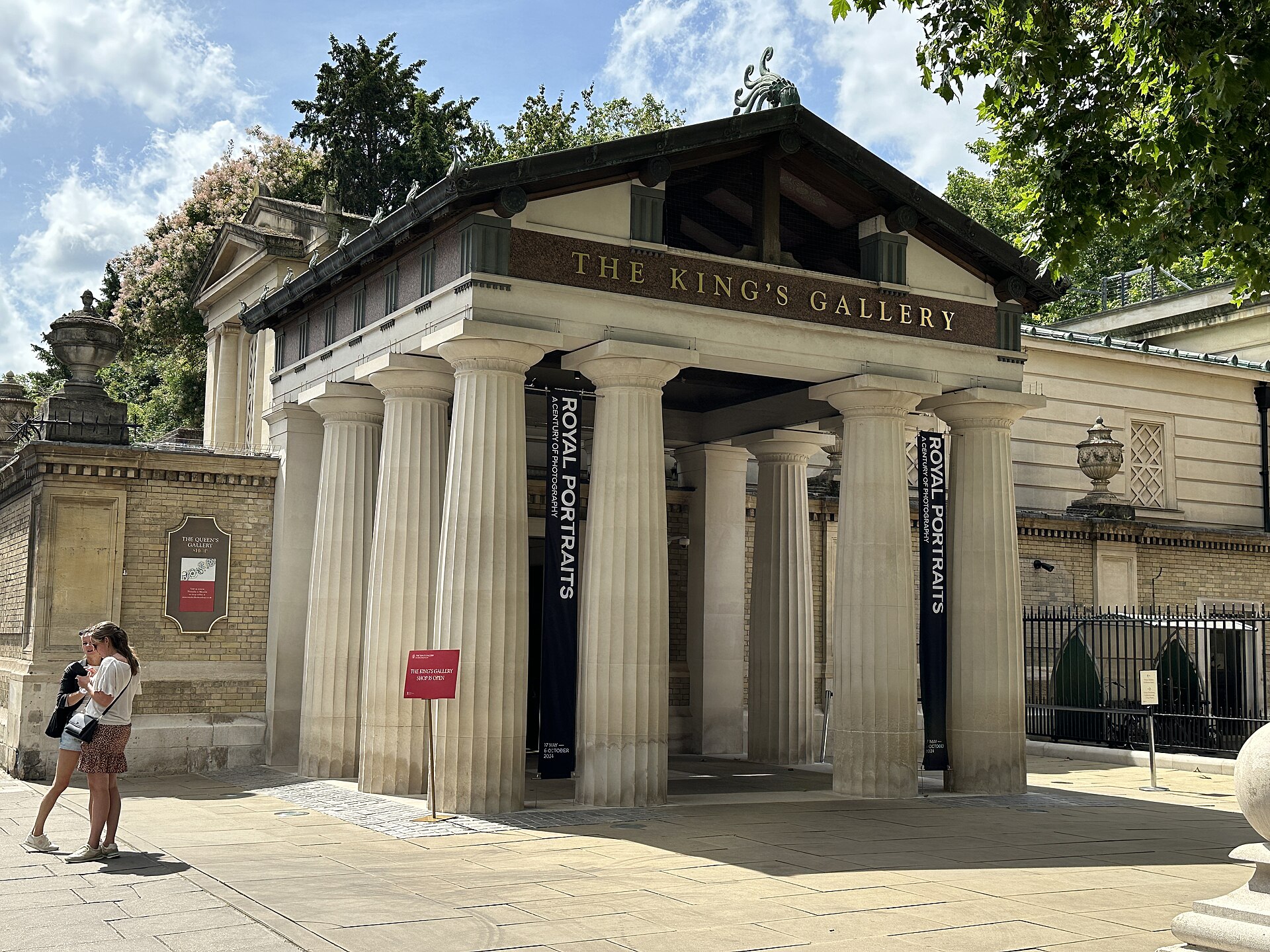
Address and entrance: The King's Gallery has its own dedicated public entrance on Buckingham Palace Road, separate from the main palace forecourt on The Mall. Walking from Victoria, head north-east along Buckingham Palace Road with the Royal Mews on your left; the gallery entrance is just beyond it, also on your left. It is a classical stone entrance with a Doric portico, distinct from the main palace gates. Do not approach the palace from The Mall expecting to find the gallery there.
What is the Best Way to Get to The King's Gallery?
The gallery is in Westminster, close to Victoria station, and is easily reached from central London.
By Tube: The most convenient stations are:
Victoria (Circle, District, and Victoria lines): around a five-minute walk north-east along Buckingham Palace Road
Green Park (Jubilee, Piccadilly, and Victoria lines): around a 10-minute walk south-west through Green Park
St James's Park (Circle and District lines): around a 10-minute walk north-west
By bus: Routes 11, 211, C1, and C10 all stop on Buckingham Palace Road, very close to the gallery entrance.
By train: Victoria National Rail station is a five-minute walk. Services connect from across southern England, making the King's Gallery practical to combine with a day trip from further afield.
On foot from key landmarks:
From Westminster Abbey: around 10 minutes west through St James's Park
From St James's Park (the park itself): around 8 minutes south
From the Houses of Parliament: around 12 minutes west
From the National Gallery / Trafalgar Square: around 25 minutes south-west
By Santander Cycles: Docking stations are available at Victoria Street and near the junction of Buckingham Gate and Petty France, a short walk from the gallery.
Driving is not recommended. The area around Buckingham Palace is heavily managed for traffic, and parking is very limited. Public transport is the right choice for almost all visitors.
Practical tip on the entrance: The gallery's entrance is on Buckingham Palace Road, not on the main palace forecourt facing The Mall. This is a common source of confusion. If you arrive at the famous front of Buckingham Palace with the Victoria Memorial in front of it, you are on the wrong side. Facing the palace, walk left around its southern corner onto Buckingham Palace Road, and the dedicated gallery entrance is on your right, just before the Royal Mews.
How Much Time Should I Spend at The King's Gallery?
I'd recommend spending about 60 to 90 minutes in the gallery.
The gallery is compact: three main exhibition rooms (the Nash Gallery, the Chambers Gallery, and the Pennethorne Gallery) with a smaller adjacent display space (the Nash Cabinet), connected in a logical sequence. The experience is focused and curated rather than sweeping.
For the current Queen Elizabeth II: Her Life in Style exhibition, which covers ten decades of fashion across around 200 objects, 90 minutes is the more comfortable estimate. If you use the full multimedia guide and pause at each piece with commentary, allow closer to two hours.
When the gallery is busy, the rooms can feel crowded, and moving through at your own pace becomes harder. Arriving at opening time on a weekday allows you to set the pace yourself rather than being steered by crowd movement.
I would plan for 90 minutes and see how the gallery feels on the day. There is no pressure to leave by a particular time once you are inside.
Image Credit: Firebrace, CC BY-SA 4.0
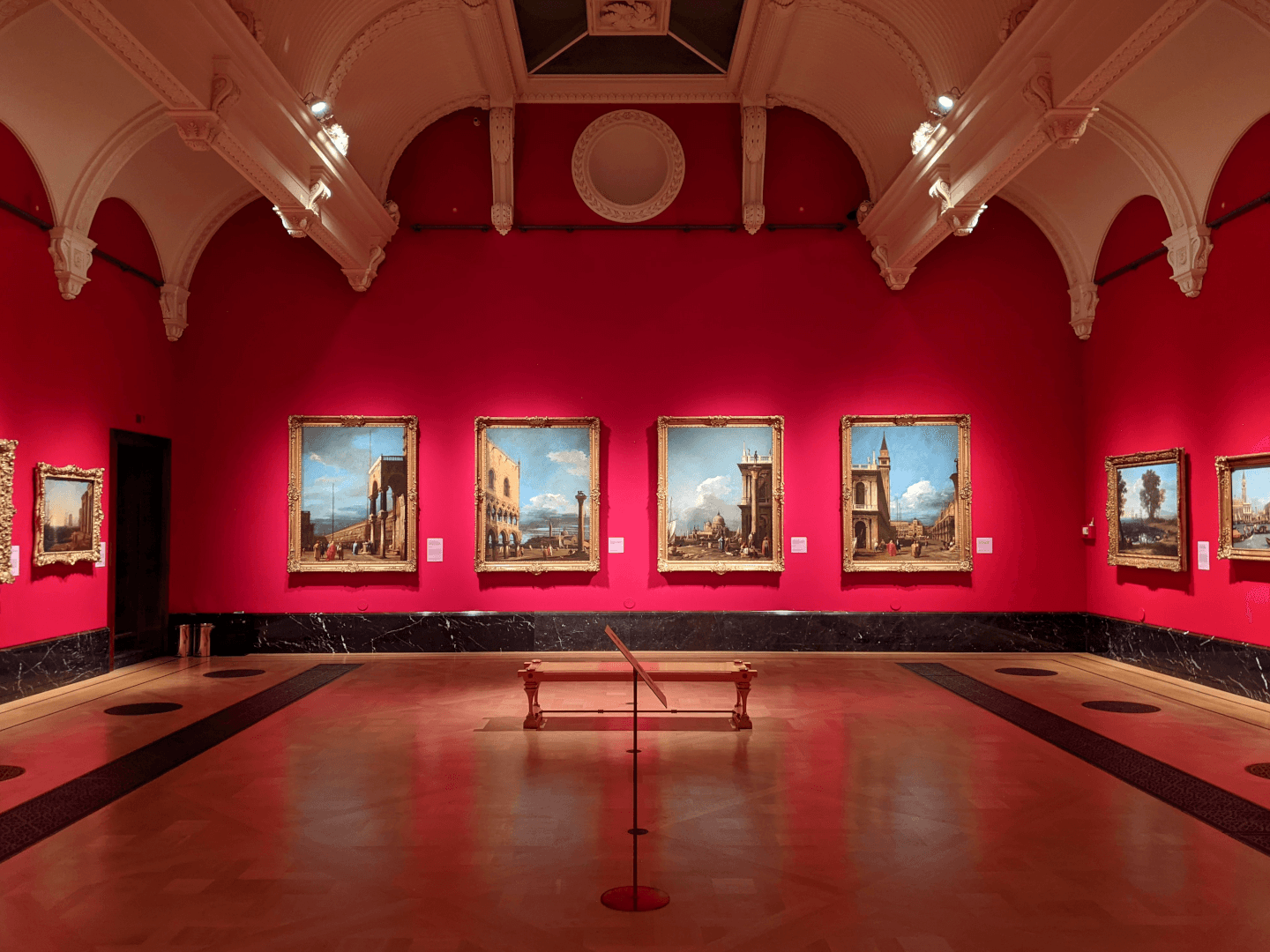
The King's Gallery at Buckingham Palace was created from the ruins of a private chapel destroyed in an air raid in 1940. Opened in 1962 at the suggestion of Queen Elizabeth II and Prince Philip, the bombed-out chapel became a premier art space, which has since welcomed millions of visitors.
What is the Best Time to Visit The King's Gallery?
Best days: Weekdays from Tuesday through Thursday are significantly quieter than weekends. The gallery can feel cramped when busy, with bottlenecks in the smaller connecting rooms. This concern largely disappears on a calm weekday morning.
Best time of day: Opening time, from 10:00am, gives you the gallery at its quietest. I would book the first slot of the day if you can, particularly for the current fashion-focused show, where the curatorial thinking behind the selection is as interesting as the objects themselves and rewards a slower pace.
Late afternoon on weekdays (from around 3:30pm) is another relatively quiet window as tour groups and school parties typically clear out by this point.
What to avoid: Saturday and Sunday mornings during peak season, and any day that coincides with a Changing of the Guard ceremony at the palace (the ceremony typically takes place at 11:00am on Monday, Wednesday, and Friday, though dates vary and the confirmed schedule is published by the Household Division). The ceremony draws large crowds to the surrounding area, which can make the Buckingham Palace Road entrance busier and the security check line slightly longer.
What is Inside The King's Gallery?
The physical gallery consists of three principal interconnected rooms and the smaller Nash Cabinet. The spaces are purpose-built for displaying art, with excellent environmental controls, considered lighting, and a level of curatorial presentation that compares well with any major public gallery.
The Nash Gallery: The largest of the three rooms, taking its name from architect John Nash who designed the original Buckingham Palace. This space typically holds the most large-scale works in any given exhibition: major paintings, tapestries, or in the case of the current exhibition, full-length formal gowns displayed on mannequins with generous space around them.
The Chambers Gallery: A more intimate space suited to drawings, photographs, smaller paintings, and objects displayed in vitrines. This room often holds the objects most dependent on close examination: the detail of a jewel, the inscription on a document, or the construction of a garment.
The Pennethorne Gallery: Named after architect James Pennethorne, who later worked on the palace, this room is often arranged to evoke the setting in which objects would have originally been encountered: hung and furnished in a manner reminiscent of a formal room in a royal palace. For visitors unfamiliar with the Royal Collection, this room typically does the most work in conveying the context in which these objects live.
The Nash Cabinet: A smaller display space opening off the main route, used for more intimate or focused displays of objects related to the main exhibition theme but benefiting from closer study than the main rooms allow.
The current exhibition: Queen Elizabeth II: Her Life in Style (April 10, 2026 to April 18, 2027):
This is the largest display of Queen Elizabeth II's personal wardrobe ever mounted, staged to mark the centenary of her birth on April 21, 1926, and extended by six months after huge demand. More than 300 items, many on display for the first time, span all ten decades of her life, from childhood dresses through the formal gowns of her years on the throne to the bright, carefully chosen ensembles of her later decades.
The exhibition draws its significance from the fact that Queen Elizabeth II used fashion with great intentionality as part of her public role: colours coordinated with the host country's flag, outfits designed to stand out clearly in a crowd, and fabric choices reflecting deep protocol considerations that spanned more than seven decades of state events. Norman Hartnell and Hardy Amies were her principal couturiers for decades; Angela Kelly later became her Personal Advisor, Dresser, and Senior Curator of the Queen's Wardrobe.
The headline pieces include:
The 1947 wedding dress by Norman Hartnell, worn for her marriage to Prince Philip on November 20, 1947, and widely considered one of the most significant dress commissions of the 20th century in Britain
The 1953 Coronation dress, also by Hartnell, embroidered with the national floral emblems of the United Kingdom and the Commonwealth and one of the most symbolically complex garments ever made in Britain
The royal christening robe, worn by 62 members of the royal family
Never-before-seen design sketches, fabric samples, and handwritten correspondence between the Queen and her couturiers that illuminate the collaborative process behind the public wardrobe
Outfits specifically designed for State Visits abroad, reflecting how carefully the wardrobe was coordinated with diplomatic purpose
For those who have a background in fashion, dress history, or the social and diplomatic history of the 20th century, this exhibition offers an unusual density of primary material. For more general visitors, it is more rewarding than a simple parade of famous garments: the curatorial approach consistently illuminates the thinking and intention behind each choice.
Typical exhibitions between major shows:
The King's Gallery runs a year-round programme of exhibitions, typically one major show per year alongside smaller Nash Cabinet displays. Past exhibitions have included old master paintings, royal portrait photography, drawings by Leonardo and Raphael, Vermeer and the Dutch masters, and the Edwardian court (the most recent exhibition before the current one). The quality of the exhibitions is consistently high, and the permanent infrastructure of the gallery means even smaller shows benefit from excellent lighting and environmental standards.
Is The King's Gallery Worth Visiting?
This depends on what you are hoping to see.
For anyone with an interest in the Royal Collection, royal history, or dress history, the answer is a clear yes. The objects in the Royal Collection are extraordinary by any standard, the curation is thoughtful and scholarly, and the gallery environment is calm and well-designed in a way that some of London's larger institutions cannot always achieve.
That being said, there are some issues with the size of the space and the crowd management. The gallery is relatively small: three rooms and a cabinet. When admission numbers are high, the rooms can feel congested, and the experience of seeing the objects clearly and at your own pace becomes harder. For the current exhibit on Queen Elizabeth II, mannequins and vitrines take up considerable floor space which results in a concentration of visitors into narrower circulation areas. The most reliable solution is to visit on a weekday morning or late afternoon, not on a weekend during peak season.
The gallery is less suited to visitors whose primary interest is the palace itself. The King's Gallery is not part of Buckingham Palace in the sense of showing the State Rooms or giving access to the interior of the working palace. It is a dedicated art gallery adjacent to the palace, with its own separate entrance and its own distinct experience. If seeing the State Rooms is your goal, that requires a separate ticket during the summer opening season.
For families with younger children: the gallery's appeal is primarily to adult and teenage visitors with some interest in art, history, or royal heritage. The current fashion exhibition is more engaging for older children with an interest in this area than many art gallery exhibitions, but the overall format is not designed around younger visitors in the way some London museums are.
Guided Tours and Audio Guides
Multimedia guide: Included free in the standard ticket price, the guide is available in English and covers the objects in the exhibition with expert commentary that provides the context behind individual pieces that the wall text alone cannot always supply. Large-print texts and translations of the main wall panels into eight other languages are available at the multimedia guide desk. The guide can feel information-dense. My own advice for the King's Gallery is to use the guide selectively for the objects you want to understand more deeply, rather than following it from start to finish.
External guided tours: The gallery does not permit external tour guides to lead tours inside the space. If you are visiting with a tour operator, your guide can brief you before entry on Buckingham Palace Road but must not guide inside the gallery itself. This makes the multimedia guide particularly valuable.
Access resources: A Plain English script of the exhibition text is available to borrow from the multimedia guide desk or to download before your visit, and the guide handsets are T-coil compatible with volume control. Large-print texts are available in each gallery space for blind or partially sighted visitors.
Where Should I Eat Near The King's Gallery?
The area immediately around Buckingham Palace Road and Victoria is not London's most vibrant dining neighbourhood, but there are several good options within a short walk.
The Goring on Beeston Place, around an eight-minute walk, is the closest thing to a truly royal dining experience available to the public in London. The hotel has deep connections with the royal family and was where Catherine, Princess of Wales, spent the night before her wedding. The restaurant serves classic British food with some dishes of real historical significance: the Eggs Drumkilbo, a prawn and lobster cocktail, was a favourite of the late Queen Mother. The setting is elegant and old-fashioned in the best sense. Booking well in advance is essential. This is a splurge, but an appropriate one for the neighbourhood.
Chez Antoinette on Palmer Street, around a 10-minute walk, is a French café and restaurant that's a great choice for visitors looking for something affordable and well-made rather than pretentious. The French onion soup and the oeufs cocotte are the things to order. Open for breakfast, lunch, and dinner. Booking ahead is worthwhile for dinner; lunch is more casual.
The Thomas Cubitt on Elizabeth Street in Belgravia, around a 12-minute walk, is a thoroughly good British gastropub with a proper kitchen, a warm atmosphere, and seasonal menus. It is used by locals rather than tourists, which keeps the food quality high and the prices reasonable. Arrive early for lunch on weekdays to guarantee a table without booking; book ahead for dinner and weekend visits.
The Rubens at the Palace, directly across Buckingham Palace Road from the Royal Mews and two minutes from the gallery entrance, is a hotel with afternoon tea that looks out over the Royal Mews. The Palace Lounge afternoon tea is a practical choice if you want the full British experience in the immediate vicinity of the palace. Book ahead.
Timmy Green in the Nova development behind Victoria station, around a seven-minute walk, is a popular all-day café and restaurant with a sustainable seasonal menu, a good brunch offering, and a brighter and more informal atmosphere than the hotel restaurants nearby. The pan-fried fish and the mushroom risotto are both pretty darn good here.
Regency Café on Regency Street, around a 10-minute walk toward Westminster, is a classic tiled British greasy spoon that has been serving fry-ups and lunch specials since 1946. Cash only, no nonsense, and around £10 for a full breakfast. For a contrast to the grandeur of the exhibition you have just left, it is hard to beat.
Peggy Porschen on Ebury Street in Belgravia, around a 10-minute walk, is the pink-fronted cake and afternoon tea café that has become one of the most photographed in London. The cakes and biscuits are carefully made and good. If the Instagram aesthetic bothers you, avoid it; if it makes you happy, book ahead for afternoon tea or walk in for a coffee and cake.
What Else is There to Do Near The King's Gallery?
The gallery sits between several of central London's major attractions, all within comfortable walking distance.
The Royal Mews is immediately adjacent on Buckingham Palace Road. The working stables that provide carriage horses and transport for the royal family house the Gold State Coach (used at coronations), the Diamond Jubilee State Coach, and an impressive collection of royal carriages and motor vehicles. Tickets are separate and available through the Royal Collection Trust website. The Mews opens seasonally, typically from March to early November, and can close in advance of major state events.
Buckingham Palace State Rooms open to the public each summer, typically from July through September. A separate ticket is required and should be booked well in advance for the summer season. The State Rooms give access to 19 magnificent public rooms used for official entertaining, alongside a temporary exhibition and a display of works from the Royal Collection in the Picture Gallery. Outside the summer opening, the palace opens only on selected dates for guided tours.
St James's Park is directly north of the palace and is one of the most beautiful royal parks in London, with a lake populated with pelicans (fed at around 2:30pm daily), a clear view of Buckingham Palace from the bridge over the lake, and the palace skyline of Whitehall visible in the opposite direction. It is entirely free and requires no planning.
Green Park adjoins St James's Park to the north-west and provides a quieter, more wooded alternative. The walk through Green Park from the King's Gallery to Piccadilly takes around 15 minutes and is one of the most pleasant routes in central London.
Westminster Abbey is around a 10-minute walk east through St James's Park and is the site of every English and British coronation since 1066, and the burial place of monarchs, poets, scientists, and prime ministers. It requires a paid ticket and advance booking is recommended, particularly during school holidays and the summer season.
The Houses of Parliament and Big Ben are around a 15-minute walk east. The exterior and the riverside walk are free; access to the interior for tours requires booking.
Churchill War Rooms is a 10-minute walk east through St James's Park. The underground complex from which Winston Churchill directed Britain's war effort is now a museum operated by the Imperial War Museum. Tickets can be purchased on the day, though booking ahead is advisable in peak season.
The National Gallery is around a 25-minute walk north-east via St James's Park and Trafalgar Square. Entry to the permanent collection is free. For visitors interested in the Royal Collection context of the King's Gallery, the National Gallery's collection is its natural complement: where the Royal Collection shows the taste of monarchs, the National Gallery shows the broader sweep of European art history from which those choices were made.
Rules, Bags, and Security
All visitors pass through airport-style security on arrival, including bag scanners and metal detectors. Allow a few extra minutes for this at busy times. Arriving promptly for your time slot is advisable.
Bags: Small bags are allowed in the exhibition space but must be carried by your side rather than worn on your back. Larger bags and long umbrellas must be left in the free cloakroom at the entrance. Suitcases and any bag larger than 45cm × 20cm × 30cm cannot be brought into the gallery or stored in the cloakroom, so use luggage storage nearby, such as at Victoria station.
Prams and strollers: Pushchairs and buggies cannot be taken into the exhibition space and must be left in a designated area while you visit. Toilets and baby-care facilities are available in the gallery.
Food and drink: Not permitted inside the gallery, with the exception of sealed water bottles. You will be asked to place any food or open drinks in closed bags before entry. No food or drink is sold inside the gallery.
Photography: Personal photography is generally permitted within the gallery. However, flash photography is not permitted, and photography restrictions may apply to specific objects on loan or to specific areas within any given exhibition. Signs and staff will indicate where restrictions apply.
External guides: Tour guides are not permitted to lead commentary inside the gallery, regardless of group size. External guides can brief visitors before entry.
Assistance dogs: Welcome throughout the gallery.
Accessibility at The King's Gallery
The King's Gallery is fully accessible, with step-free access to the exhibition by lift.
There are 17 steps up to the exhibition level, and a lift with a voice announcer provides step-free access. Mobility scooters can be used if they fit the lift, which measures 145cm deep by 82cm wide.
Manual wheelchairs can be borrowed free of charge at the entrance on a first-come, first-served basis and cannot be booked in advance. Folding seats and rollators are also available to borrow, and there are backless wooden benches in the gallery spaces.
An accessible toilet is provided.
There is no parking at the gallery. The nearest on-street bays are on Palace Street, and the nearest wheelchair-accessible Underground station is Green Park.
Concessionary rates are available for disabled visitors, with no proof of disability required. A free access companion ticket can be booked online alongside the primary ticket.
A Plain English script of the exhibition text and large-print texts are available from the multimedia guide desk, and the guide handsets are T-coil compatible. For anything else, the Specialist Sales team can advise before your visit.
Final Tips for Visiting The King's Gallery
Book your timed-entry ticket in advance. No tickets are held back for walk-ups, and there is no waiting list for sold-out dates. If your date is sold out, keep checking the official booking site for returns.
Check the current exhibition before booking. The gallery's programme changes, and the experience varies significantly depending on what is on. The official rct.uk site shows the full schedule; brief yourself on what you will be seeing before you buy.
The entrance is on Buckingham Palace Road, not the main palace frontage. Do not walk to the Victoria Memorial and the main forecourt: the gallery entrance is around the side on Buckingham Palace Road. This is the single most common visitor confusion point for first-timers.
Arrive on time for your slot. Visitors are not admitted before their booked entry time, and late arrivals may face a wait or not be admitted. Allow a few extra minutes for airport-style security.
Use the multimedia guide selectively. It is excellent but comprehensive to the point of density. Using it for the objects that most interest you, rather than from start to finish, makes it a tool rather than an obligation.
Consider the 1-Year Pass conversion. If you expect to return during the current exhibition's run, converting your standard ticket to a 1-Year Pass on the day of your first visit costs £2 per subsequent booking and gives unlimited re-admission.
Weekday mornings are the best time to visit. The gallery is a compact space, and when it fills up, the experience suffers. Tuesday through Thursday before noon is the most comfortable window.
Combine with the Royal Mews next door for a full morning in this part of London. The Royal Mews is immediately adjacent and gives a very different perspective on royal life: working horses, historic carriages, and the enormous Gold State Coach up close. The Mews opens seasonally, typically from March to early November, so check it is open before planning a combined visit.
Visit the gift shop. It is well stocked with exhibition catalogues, prints from the Collection, and gifts connected to the royal palaces, and you do not need a gallery ticket to shop there.
Back to London Attractions
Explore other London attractions

" width="24px"><path d="M 0 0 L 24 0 L 24 21.231 L 0 21.231 Z" fill="transparent" height="21.230768474975793px" id="nL2EwDcS9" width="24px"/><path d="M 0 0.541 C 0 0.242 0.245 0 0.547 0 L 2.735 0 C 3.037 0 3.282 0.242 3.282 0.541 L 3.282 4.598 C 3.282 4.897 3.037 5.139 2.735 5.139 L 0.547 5.139 C 0.245 5.139 0 4.897 0 4.598 Z" fill="rgb(196, 217, 201)" height="5.138657337892187px" id="hZ_rlBe_S" transform="translate(0 16.092)" width="3.2820512820512358px"/><path d="M 0 0.541 C 0 0.242 0.245 0 0.547 0 L 2.735 0 C 3.037 0 3.282 0.242 3.282 0.541 L 3.282 7.843 C 3.282 8.142 3.037 8.384 2.735 8.384 L 0.547 8.384 C 0.245 8.384 0 8.142 0 7.843 Z" fill="rgb(230, 211, 160)" height="8.38412513024521px" id="HgVBxIz3e" transform="translate(5.128 12.847)" width="3.282051282051235px"/><path d="M 0 0.541 C 0 0.242 0.245 0 0.547 0 L 2.735 0 C 3.037 0 3.282 0.242 3.282 0.541 L 3.282 12.982 C 3.282 13.281 3.037 13.523 2.735 13.523 L 0.547 13.523 C 0.245 13.523 0 13.281 0 12.982 Z" fill="rgb(232, 207, 164)" height="13.522782468137464px" id="utgrDnoM9" transform="translate(10.325 7.708)" width="3.282051282051377px"/><path d="M 0 0.541 C 0 0.242 0.245 0 0.547 0 L 2.735 0 C 3.037 0 3.282 0.242 3.282 0.541 L 3.282 16.498 C 3.282 16.797 3.037 17.039 2.735 17.039 L 0.547 17.039 C 0.245 17.039 0 16.797 0 16.498 Z" fill="rgb(233, 196, 166)" height="17.038705909853153px" id="OLOhW6STz" transform="translate(15.521 4.192)" width="3.2820512820512384px"/><path d="M 0 0.541 C 0 0.242 0.245 0 0.547 0 L 2.735 0 C 3.037 0 3.282 0.242 3.282 0.541 L 3.282 20.69 C 3.282 20.989 3.037 21.231 2.735 21.231 L 0.547 21.231 C 0.245 21.231 0 20.989 0 20.69 Z" fill="rgb(217, 170, 153)" height="21.230768474975793px" id="H5Z8wcwkd" transform="translate(20.718 0)" width="3.2820512820512278px"/></g></svg>)