Back to London Attractions
The V&A Museum London: Everything You Need to Know Before You Visit
Updated July 2026
The Victoria and Albert Museum, known to almost everyone as the V&A, is the world's largest museum of art, design, and performance: 145 galleries spread over five floors of a magnificent Victorian building on Cromwell Road in South Kensington, holding 5,000 years of human creativity. Fashion, jewellery, sculpture, ceramics, furniture, photography, theatre, Islamic art, stained glass, and the most eccentric collection of treasures in London all live under one roof, from a full-scale plaster of Michelangelo's David to a mechanical tiger devouring a British soldier.
Founded in 1852 in the wake of the Great Exhibition, the V&A was built to make great design available to everyone, and it still runs on that principle: general admission is completely free, seven days a week, with no booking required. What has changed in recent years is the scale of the V&A itself, which now spans four London sites, and the calibre of its ticketed exhibitions, which have become some of the hottest cultural tickets in the city; the recent Marie Antoinette show sold out its entire run. This guide covers the free entry, the 2026 exhibitions, what to see, and how the wider V&A family fits together.
At a Glance
How Early to Book:
Tickets are not required for the permanent collection, and visitors can directly enter the museum. Special exhibits may require booking ahead.
Best Times to Visit:
Early weekday mornings will have the least crowds, while Friday nights after 5pm will have the liveliest vibes while not being too crowded.
Ticket price:
Like many museums in London, the Victoria & Albert museum is free of charge. Special exhibitions may have an admission fee.
Where to Learn More:
Museum Address:
Do You Need to Book V&A Tickets in Advance?
No booking is needed for the museum itself. Entry is free and you can simply walk in. The V&A is one of London's great free attractions: the permanent collection, all 145 galleries of it, costs nothing, seven days a week, with no timed tickets and no advance reservation. You may queue briefly for a bag check at busy times, but that's it.
What does need booking: the major exhibitions. The V&A's ticketed exhibitions, particularly its fashion blockbusters, are a different story entirely. These sell out, sometimes for their entire run. Marie Antoinette Style, the most recent headline show, sold out completely before closing. For the big exhibitions, book as soon as your dates are fixed, and treat weekend slots as the first to disappear.
Exhibition prices (2026):
Schiaparelli: Fashion Becomes Art: £28 weekdays, £30 weekends
The Music Is Black: A British Story (at V&A East Museum): £22.50 weekdays, £24.50 weekends
Smaller exhibitions typically run £12 to £16
Where to book: The official site is vam.ac.uk. Exhibition tickets are sold there directly, with concessions for students, under-26s, and disabled visitors, plus a free companion ticket with every disabled ticket.
Membership: V&A Membership includes free entry to all exhibitions across every V&A site, plus access to the Members' Room and priority booking for events. With Schiaparelli at £28 to £30 a ticket, Membership pays for itself within two or three exhibition visits and is the standard move for anyone London-based or making repeat trips.
Donation points sit at the entrances; free entry survives on them, and a few pounds is well spent here.
V&A Opening Hours
Standard hours: Open daily, 10am to 5:45pm. On Fridays the museum stays open until 10pm, though some galleries and spaces close earlier in the evening. Gallery clearing starts 30 minutes before closing.
Closed: 24 to 26 December. Otherwise the V&A is open every day of the year, including all bank holidays.
Friday Lates: The late Friday opening regularly hosts the V&A's Friday Late programme of free evening events, performances, and installations, one of the best free nights out in London and the calmest time to see the collection.
Address: Cromwell Road, London SW7 2RL, with a second entrance on Exhibition Road.
What is the Best Way to Get to the V&A?
The V&A anchors South Kensington's museum quarter, sharing the neighbourhood with the Natural History Museum and the Science Museum.
By tube: South Kensington (Piccadilly, Circle, and District lines) is a five-minute walk, connected to the museum quarter by a Victorian pedestrian tunnel that runs directly from the station; follow the signs and surface at the museums. Gloucester Road (same three lines) is around ten minutes. Neither station is step-free; the nearest step-free stations are Knightsbridge (a 14-minute walk) and Earl's Court.
By bus: Multiple routes stop directly outside on Cromwell Road, including the 14, 74, 414, and C1.
By bike: Santander Cycle docking stations sit on Exhibition Road and Thurloe Place.
On foot: The V&A is 10 minutes' walk from Harrods and Knightsbridge, 15 from Hyde Park and the Royal Albert Hall, and immediately across the road from the Natural History Museum.
By car: Parking is very limited and the area sits in the Congestion Charge zone; public transport is the practical choice. Blue Badge parking is available nearby and detailed on the museum's website.
How Much Time Should I Spend at the V&A?
Two to three hours is the standard visit: enough for a highlights circuit, one or two collection areas explored properly, and a stop in the café. Add 75 minutes to 2 hours on top if you are seeing a ticketed exhibition.
The truth is that you're not going to see the whole thing in one visit. Seven miles of galleries means even a full day leaves most of the museum unseen, and trying to walk through the whole thing is the classic mistake here. Pick two or three areas, follow whatever catches your eye between them, and accept that the V&A is a museum you return to. Free entry makes short repeat visits the smartest way to see it, and plenty of locals treat it exactly that way.

The Victoria and Albert Museum houses a number of design-oriented galleries, such as the Design 1900 - Now Gallery, that displays everything from Adidas sneakers to Apple iPhones.
What is the Best Time to Visit the V&A?
Weekday mornings at 10am opening are the calmest all-round window, particularly Tuesday to Thursday outside school holidays.
Friday evening is the connoisseur's choice. With the museum open until 10pm, the hours after 6pm are the quietest of the week in the permanent galleries, and Friday Late events add live programming to the mix. Seeing the Cast Courts or the Medieval and Renaissance galleries near-empty in the evening is a completely different experience from a Saturday afternoon.
Weekend afternoons are the peak, amplified whenever a fashion blockbuster is running, since exhibition visitors spill into the surrounding galleries. Rainy days push the whole South Kensington museum quarter's crowds indoors, and the V&A absorbs its share.
For ticketed exhibitions, midweek morning slots are consistently the most comfortable; the final weeks of any show's run are the busiest of all.
What is Inside the V&A? Highlights of the Collection
The V&A's range defeats any summary, but these are the things visitors cross London for:
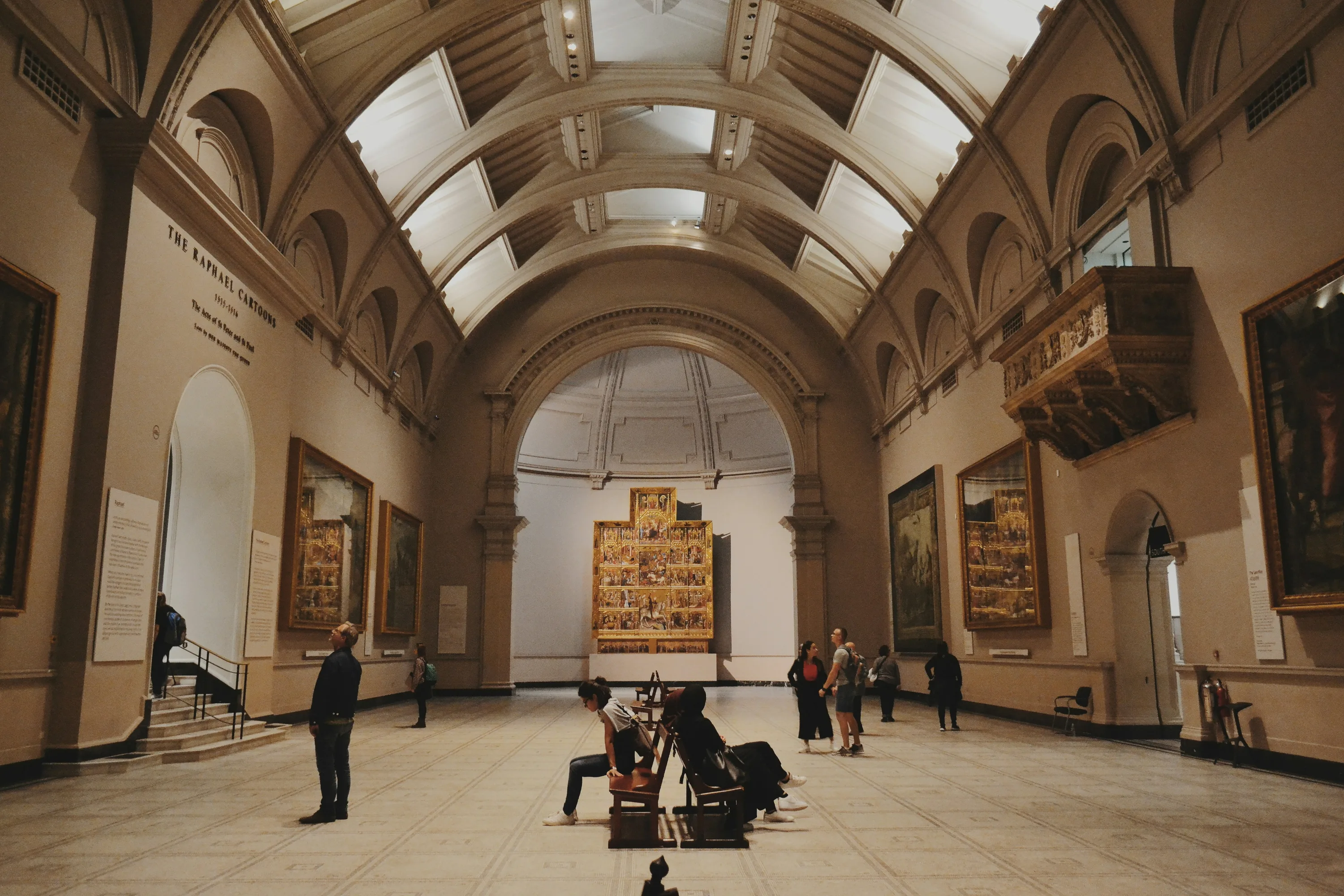
The Cast Courts: Two cathedral-height Victorian halls filled with full-scale plaster casts of Europe's greatest sculpture and architecture, dominated by Michelangelo's David and the two halves of Trajan's Column, each the height of a building. Created so Victorians who could never travel could study the masterpieces, the Cast Courts are the most photographed rooms in the museum and, for many visitors, the single most jaw-dropping free sight in London.
The Raphael Cartoons: Seven vast painting-sized designs by Raphael for tapestries in the Sistine Chapel, on loan from the Royal Collection since 1865, displayed in their own dedicated court. Among the greatest Renaissance works anywhere in Britain, and inexplicably easy to have almost to yourself.
Tipu's Tiger: An 18th-century mechanical organ from Mysore in the form of a life-size tiger mauling a British soldier, complete with growling sounds when its handle is turned. Commissioned by Tipu Sultan, seized by the East India Company, and the museum's most famous single object.
The Jewellery Gallery: Around 3,000 pieces spanning 3,000 years in a darkened, vault-like gallery, from ancient gold to Cartier and contemporary designers. Consistently named by visitors as the gallery that exceeded expectations.
The Ardabil Carpet: The world's oldest dated carpet, woven in Iran in 1539, displayed flat in the Islamic Middle East gallery under low light, with the lights raised briefly on the hour and half-hour: time your pass through the gallery to catch it.
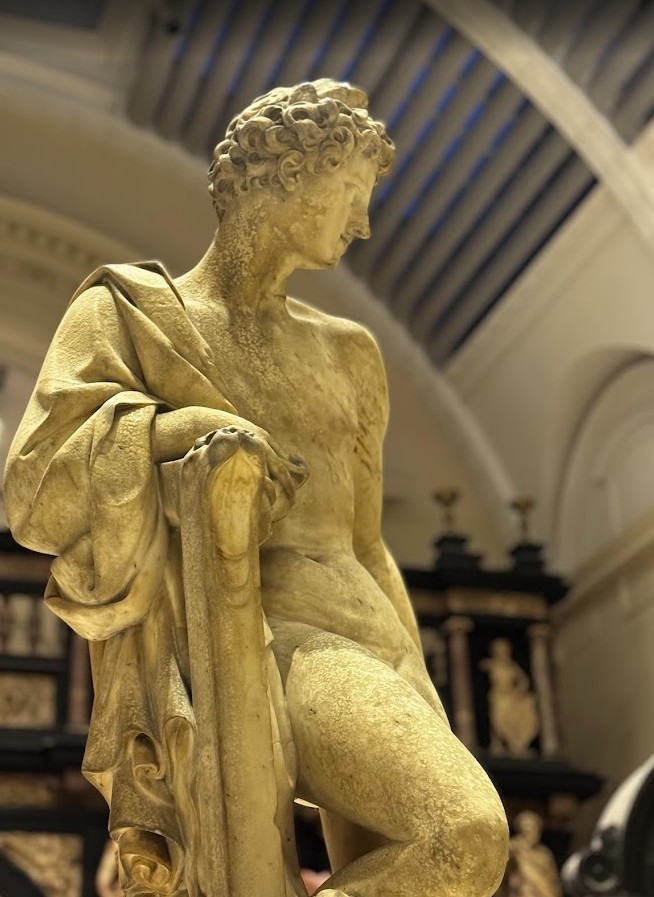
The Medieval and Renaissance Galleries: A world-class sweep from 300 to 1600, including works by Donatello and the finest collection of Italian Renaissance sculpture outside Italy.
The Chihuly Chandelier: Dale Chihuly's 27-foot blue-green glass chandelier spirals above the main Cromwell Road entrance rotunda, the museum's unofficial welcome.
The Great Bed of Ware: The gigantic Elizabethan oak bed famous enough to be name-checked by Shakespeare in Twelfth Night.
Fashion: The V&A holds Britain's national fashion collection, 400 years of couture and costume. One important note for 2026: the permanent Fashion Gallery is closed for a major refurbishment, with fashion currently represented through the ticketed exhibitions instead. If historic fashion displays are the main reason for your visit, check the reopening status before you go; if Schiaparelli is on your list, that exhibition is where the fashion is.
The building itself: The John Madejski Garden courtyard at the museum's heart, with its shallow oval pool that children paddle in on hot days, the mosaic-and-tile Victorian interiors, the Exhibition Road Courtyard with its porcelain-tiled floor, and the vast subterranean Sainsbury Gallery exhibition space are all part of the show. Level 2 hides some of the least-visited and most rewarding galleries in the building, worth seeking out when the ground floor fills up.
Free one-hour introductory highlights tours run daily from the Cromwell Road entrance foyer, led by volunteer guides; times are posted at the information desk, and no booking is needed.
V&A Exhibitions in 2026
The exhibition programme is the reason the V&A needs advance planning at all, and 2026's slate is led by fashion again:
Schiaparelli: Fashion Becomes Art (28 March to November 2026): The first UK exhibition devoted to Maison Schiaparelli, tracing Elsa Schiaparelli's surrealist collaborations and radical designs through to Daniel Roseberry's celebrated present-day couture, with over 200 objects. £28 weekdays, £30 weekends. After Chanel and Marie Antoinette both sold out, treat this the same way: book early, favour midweek mornings, and do not leave it to the final weeks.
Rising Voices: Contemporary Art from Asia, Australia and the Pacific (from 16 May 2026): A landmark contemporary art survey in the Sainsbury Gallery.
At the wider V&A family: The Music Is Black: A British Story runs at the new V&A East Museum (18 April 2026 to 3 January 2027), and Inside Aardman: Wallace & Gromit and Friends runs at Young V&A through 25 November 2026, marking Aardman's 50th anniversary.
Members enter all of these free without booking fees; everyone else should book through vam.ac.uk.
The V&A Café and Shop
I'd recommend stopping at the museum cafe, because it actually is pretty cool. The V&A opened the world's first museum restaurant in the 1860s, and the three original Refreshment Rooms still serve as the main café: the Gamble Room, a glittering hall of ceramic pillars and gilded tiles; the Poynter Room, blue-and-white Dutch tiles with a stained-glass fox; and the Morris Room, the sombre green dining room that was William Morris's first major commission, complete with Burne-Jones stained glass. The food is standard good-quality museum café fare (hot dishes, salads, and an excellent cake counter), but the rooms are Grade I listed Victorian showpieces and eating lunch inside one costs no more than the food. Expect a queue at the counter through the lunch rush; before noon or after 2pm is far calmer. In warm weather, the Garden Café in the John Madejski Garden courtyard is the alternative.
The V&A Shop might be the best museum shop in London: jewellery inspired by the collection, William Morris prints and textiles, design books, exhibition ranges, and homeware people actually want to own. The dedicated bookshop covers art and design publishing in a depth few actual bookshops manage, and the online shop at vam.ac.uk ships the ranges worldwide if your luggage disagrees with your intentions.
Young V&A, V&A East, and the David Bowie Centre
The V&A is now a family of four London-relevant sites, and knowing which is which will save you some confusion:
V&A South Kensington is the main museum this page covers: the Cromwell Road original.
Young V&A in Bethnal Green, east London, is the former V&A Museum of Childhood, comprehensively reimagined and reopened in 2023 as a museum designed for 0 to 14-year-olds and their families, built around play, imagination, and design. It is free, a 20-minute tube ride from South Kensington, and the right destination for a visit that is primarily about young children, something the main museum, for all its family programming, is not.
V&A East Storehouse in Stratford opened in 2025 inside the former Olympic media centre: a free, working museum store where over 250,000 objects sit on open racking, with an Order an Object service letting anyone book a personal viewing of almost anything in the collection. It is also home to the David Bowie Centre, holding Bowie's complete archive of over 90,000 items, from Ziggy Stardust costumes to handwritten lyrics, with free timed entry booked online. For Bowie fans, this, not South Kensington, is the destination.
V&A East Museum, also in Stratford, opened in April 2026 as the newest full museum in the family, launching with The Music Is Black: A British Story.
All are free to enter (exhibitions aside), and a South Kensington plus Stratford combination makes a legitimate full V&A day for the dedicated.
Is the V&A Worth Visiting?
This is one of the world's great museums, and it costs nothing to find out whether it is your kind of place. The harder question is who it suits best. The V&A rewards curiosity about how things are made and why they look the way they do: fashion, craft, design, ornament, theatre. Visitors wired that way routinely rate it above every other museum in London. The building itself, the Victorian interiors, the courtyard garden, and the café rooms give it an atmosphere the purpose-built museums cannot match, and the crowds are consistently thinner than at the British Museum or the Natural History Museum next door.
The sheer scale can throw you off course, and wandering without any anchor points produces the museum-fatigue shuffle within an hour. The painting collection is modest next to the National Gallery's, so pure fine-art visitors may be better served in Trafalgar Square. And with the Fashion Gallery closed for refurbishment, the permanent free fashion display that draws many first-timers is currently absent, worth knowing before building a visit around it.
Families do well here with the right expectations: the Cast Courts, Tipu's Tiger, and the paddling pool in the courtyard garden are reliable hits, back-pack trails and free family resources are available, and the Natural History and Science Museums are across the road when attention spans expire. For a visit centred on young children, Young V&A in Bethnal Green is the better-designed destination.
Where Should I Eat Near the V&A?
Inside the museum: The Refreshment Rooms café and the seasonal Garden Café, covered above, are good enough that many visitors never leave the building to eat.
A short walk away:
Daquise (Thurloe Street, two minutes, beside South Kensington station) has been serving Polish food since 1947, making it London's oldest Polish restaurant: pierogi, borscht, and schnitzel in a charmingly time-warped dining room. A South Kensington institution and the local answer to the question of where to have a proper sit-down lunch near the museums.
Comptoir Libanais (Exhibition Road, three minutes) does bright, fast, family-friendly Lebanese food: mezze platters, wraps, and fresh juices, well suited to refuelling between museums.
Ognisko (Prince's Gate, eight minutes towards Hyde Park) is the grander Polish option, a white-tablecloth dining room in the Polish Hearth Club with a beautiful terrace, right on the walking route to the Royal Albert Hall.
The Bunch of Grapes (Brompton Road, seven minutes towards Harrods) covers the classic London pub lunch: pints, pies, and fish and chips in a proper Victorian pub.
Thurloe Street and Pelham Street, immediately around South Kensington station, hold a dense cluster of cafés, bakeries, and delis for quicker and cheaper options, and the Bute Street "French quarter" a few minutes further has patisseries that represent the neighbourhood's large French community.
What Else is There to Do Near the V&A?
The Natural History Museum is directly across Exhibition Road, free, and home to the dinosaurs, the blue whale skeleton in Hintze Hall, and, in winter, the ice rink. It shares the pedestrian tunnel from South Kensington station with the V&A, and the two museums are the classic South Kensington double bill, though each deserves half a day.
The Science Museum, next door to the Natural History Museum, is also free and completes the museum quarter trio, with the strongest appeal for children of the three.
Hyde Park, the Albert Memorial, and the Royal Albert Hall are a 15-minute walk up Exhibition Road: the gilded memorial to the V&A's co-namesake faces the great concert hall, and the park opens out beyond.
Harrods is ten minutes along Brompton Road, for the food halls if nothing else.
Kensington Palace and Kensington Gardens are 20 to 25 minutes on foot through the park, rounding out a full royal-Kensington day.
Bags, Rules, and Security
Bags: All visitors pass through a bag check at the entrances. Cloakrooms at both the Cromwell Road and Exhibition Road entrances take coats, bags, and folded pushchairs for a small charge; oversized luggage and suitcases are not accepted, so use luggage storage near South Kensington station if you are travelling with cases.
Photography: Allowed for personal use throughout the permanent collection; be considerate around other visitors. Some exhibitions restrict photography, signposted at their entrances. Sketching in the galleries is not just permitted but actively encouraged, a V&A tradition.
Food and drink: Not allowed in the galleries; the café, Garden Café, and courtyard are the places for it.
Touching: Off-limits unless a sign explicitly invites it; the museum marks the handful of touchable objects clearly.
Accessibility at the V&A
Both the Cromwell Road and Exhibition Road entrances are step-free and wheelchair accessible, and lifts serve the gallery floors. Wheelchairs and walking sticks can be borrowed free of charge by completing the accessibility aid form on the museum's website at least 24 hours before visiting.
Note that South Kensington tube station itself is not step-free; the nearest step-free stations are Knightsbridge (a 14-minute walk) and Earl's Court. Blue Badge parking is available nearby, with details on the museum's website.
Disabled visitors receive discounted exhibition tickets, and a free companion or carer ticket can be added to every disabled ticket. Assistance dogs are welcome throughout. Accessible toilets are available across the museum, and the nearest Changing Places toilet is at the Science Museum next door. The museum publishes a visual story and detailed access guides online, and its programme includes regular access-focused events and tours.
Final Tips for Visiting the V&A
Walk straight in; entry is free with no booking. Save the planning for exhibition tickets, which is when the V&A does sell out, and book Schiaparelli early if it is on your list.
Go Friday evening if you can. Open until 10pm, near-empty galleries, and free Friday Late programming make it the best-kept scheduling secret in South Kensington.
Start with the Cast Courts and the Raphael Cartoons, then follow your curiosity; a highlights spine plus wandering beats any attempt to be systematic in a museum this size.
Time the Ardabil Carpet. The lights over the world's oldest dated carpet come up on the hour and half-hour; passing through the Islamic gallery at the right moment is one of the quiet thrills of the building.
Have lunch or at least cake in the Refreshment Rooms. The world's first museum café, in three Grade I listed Victorian rooms, at ordinary café prices; go before noon or after 2pm to dodge the queue.
Know that the Fashion Gallery is closed for refurbishment, and that fashion currently lives in the ticketed exhibitions; check reopening status if the permanent fashion display is your main draw.
Match the site to the visit: Young V&A in Bethnal Green for young children, the V&A East Storehouse and David Bowie Centre in Stratford for Bowie and behind-the-scenes collections, South Kensington for everything on this page.
Use the museum tunnel from South Kensington station and pair the V&A with the Natural History Museum across the road, but give each its own half day rather than cramming both into one.
Back to London Attractions
Explore other London attractions

" width="24px"><path d="M 0 0 L 24 0 L 24 21.231 L 0 21.231 Z" fill="transparent" height="21.230768474975793px" id="nL2EwDcS9" width="24px"/><path d="M 0 0.541 C 0 0.242 0.245 0 0.547 0 L 2.735 0 C 3.037 0 3.282 0.242 3.282 0.541 L 3.282 4.598 C 3.282 4.897 3.037 5.139 2.735 5.139 L 0.547 5.139 C 0.245 5.139 0 4.897 0 4.598 Z" fill="rgb(196, 217, 201)" height="5.138657337892187px" id="hZ_rlBe_S" transform="translate(0 16.092)" width="3.2820512820512358px"/><path d="M 0 0.541 C 0 0.242 0.245 0 0.547 0 L 2.735 0 C 3.037 0 3.282 0.242 3.282 0.541 L 3.282 7.843 C 3.282 8.142 3.037 8.384 2.735 8.384 L 0.547 8.384 C 0.245 8.384 0 8.142 0 7.843 Z" fill="rgb(230, 211, 160)" height="8.38412513024521px" id="HgVBxIz3e" transform="translate(5.128 12.847)" width="3.282051282051235px"/><path d="M 0 0.541 C 0 0.242 0.245 0 0.547 0 L 2.735 0 C 3.037 0 3.282 0.242 3.282 0.541 L 3.282 12.982 C 3.282 13.281 3.037 13.523 2.735 13.523 L 0.547 13.523 C 0.245 13.523 0 13.281 0 12.982 Z" fill="rgb(232, 207, 164)" height="13.522782468137464px" id="utgrDnoM9" transform="translate(10.325 7.708)" width="3.282051282051377px"/><path d="M 0 0.541 C 0 0.242 0.245 0 0.547 0 L 2.735 0 C 3.037 0 3.282 0.242 3.282 0.541 L 3.282 16.498 C 3.282 16.797 3.037 17.039 2.735 17.039 L 0.547 17.039 C 0.245 17.039 0 16.797 0 16.498 Z" fill="rgb(233, 196, 166)" height="17.038705909853153px" id="OLOhW6STz" transform="translate(15.521 4.192)" width="3.2820512820512384px"/><path d="M 0 0.541 C 0 0.242 0.245 0 0.547 0 L 2.735 0 C 3.037 0 3.282 0.242 3.282 0.541 L 3.282 20.69 C 3.282 20.989 3.037 21.231 2.735 21.231 L 0.547 21.231 C 0.245 21.231 0 20.989 0 20.69 Z" fill="rgb(217, 170, 153)" height="21.230768474975793px" id="H5Z8wcwkd" transform="translate(20.718 0)" width="3.2820512820512278px"/></g></svg>)