
New York City • Turtle Bay, Midtown Manhattan
The UN offers about 8 different guided tours. All tours should be pre-booked in advance online. The on-site ticket office sells tours based on availability.
Book 1 Week Ahead
Standard Tours
Book 2-4 Weeks Ahead
Non-Standard Tours
Back to New York City Attractions
United Nations Tour New York: Everything You Need to Know Before You Visit
Updated September 2026
The United Nations Headquarters sits on 18 acres of international territory along the East River in Turtle Bay, a modernist complex built between 1948 and 1952 by a team of eleven architects that included Le Corbusier and Oscar Niemeyer, and the only place in New York City where you can stand inside the General Assembly Hall and the Security Council Chamber. Guided tours have run here since November 1952, and more than 40 million people have taken one. Getting inside involves more waiting and more ID checks than any other attraction in the city, so knowing exactly what to book, what to bring, and when the building is actually open will decide whether this is a highlight of your trip or a wasted morning.
At a Glance
How Early to Book:
Book 1 week ahead for standard tours, especially during the peak Summer season. Book 2-4 weeks in advance for non-standard tour types.
Best Times to Visit:
The 10am to 11am hour is the sweet spot; it is after many of the morning tour groups arrive, but before the post-lunch crowd descends into the building.
Ticket price:
All tours are $29.00 per adult.
Where to Book:
Attraction Address:
Do You Need to Book United Nations Tour Tickets in Advance?
Booking ahead is strongly recommended, but not strictly required. Tours cap at 20 people, and tickets are sold on site at the Cashier's Desk only if a slot on that day still has space, so an advance ticket is the difference between a planned visit and a gamble.
Before anything else, check the dates. UN Headquarters is closed to visitors from 12 September to 4 October 2026 because of the General Debate of the General Assembly. In-person guided tours resume on 5 October 2026. This closure happens every autumn and it is longer than most people expect, covering roughly three weeks rather than just the week world leaders are in town.
Where to book: Tickets are sold through the official UN Visitors Services booking system, reached by the "Book Now" button on un.org/visit. That is the only place to buy them. Third-party resellers list "UN tours" that are often just walking tours of the surrounding streets that never go inside the building.
Ticket prices: Individual tickets for the standard guided tour are $29.00 for adults, $21.00 for students aged 13 and over with a valid student ID, $21.00 for seniors aged 60 and over, and $18.00 for children aged 5 to 12. A 6% booking fee is added at checkout. Only credit cards are accepted.
Group tickets: Groups book by the block, with one block covering up to 20 people. An adult block is $580.00, a student block $436.00, a senior block $420.00, and a child block $404.00, with a 3% booking fee. Where a group mixes age categories, the pricing follows the majority of participants. School and youth groups need one adult for every 20 minors.
Security registration is separate from your ticket: Visitors are asked to register on the United Nations Security website before arriving, which is a different online form from the ticket purchase. This is not a locked gate, though. Registration and screening together are exactly what the 60-minute arrival window exists for, and the Visitor Check-in Office at 801 First Avenue handles visitors on the day. Registering the night before simply moves you through that office faster. What is not negotiable is the original photo ID and the 60 minutes.
City passes do not cover this. The UN guided tour is not included in New York CityPASS, the New York Pass, or the Go City Explorer Pass. There is no combination ticket and no discount for pass-holders. You buy directly from the UN, full stop.
Refunds: All sales are final. There are no refunds and no exchanges, including if a meeting closes the chambers on the day of your visit or if you miss your slot. Arrive more than 15 minutes late at the check-in desk and your reservation may not be honoured, with no refund.
How far ahead to book: Tours cap at 20 people, which is a small number for a building that draws over a million visitors a year, so slots for popular mid-morning times in July, August, and around school holidays can go a week or more ahead. Outside peak season, a few days is usually enough. Tickets are also sold on site at the Cashier's Desk subject to availability, which works fine on a quiet Tuesday in February and is a real risk in August. If you are turning up on spec, go early in the day and be flexible about which tour time you take.
United Nations Opening Hours and Entry Information
Opening hours: Monday to Friday, 9:00am to 5:00pm.
Closed: Every Saturday and Sunday. There are no weekend tours and no weekend access to the building, despite what several older guidebooks still say. Guided tours run only on weekdays.
Public holiday closures in 2026:
1 January, New Year's Day
2 March, Eid al-Fitr (observed)
3 April, Good Friday
25 May, Memorial Day
27 May, Eid al-Adha
3 July, Independence Day (observed)
7 September, Labour Day
26 November, Thanksgiving Day
25 December, Christmas Day
Seasonal closure: 12 September to 4 October 2026, for the General Debate.
Check-in and arrival: Plan to arrive 60 minutes before your tour time. Start at the Visitor Check-in Office at 801 First Avenue at 45th Street, across the street from the UN itself. You collect a security pass or wristband there, then cross to the United Nations Visitors Entrance at 46th Street and First Avenue for airport-style screening, then walk into the General Assembly building and check in at the Cashier's Desk at the back of the lobby.
What to bring: Every visitor aged 18 and over needs a valid, original, government-issued photo ID from a UN Member State or Non-Member Observer State, printed in Latin or Roman characters. A passport, driving licence, national identity card, or IDNYC card all work. Military IDs are not accepted. Photocopies and photos on your phone are not accepted, only the physical document. Bring your ticket as a printout, a screenshot, or on your phone.

Where Is the United Nations Headquarters?
The visitors entrance is at 46th Street and First Avenue, New York, NY 10017, and the check-in office you go to first is at 801 First Avenue at 45th Street. The complex's formal address is 405 East 42nd Street, and the surrounding blocks are addressed as United Nations Plaza, which is why searches throw up several different addresses for the same place. If you are dropping a pin, use the Visitor Check-in Office rather than the headquarters address on 42nd Street, or you will end up at the wrong end of a very long, fenced complex with no way through.
The neighbourhood is Turtle Bay, in Midtown East, bounded by First Avenue and the FDR Drive. The territory itself belongs to the 193 Member States rather than to the United States, which is a fact your guide will enjoy telling you.
What is the Best Way to Get to the United Nations?
By subway: Grand Central to 42nd Street is the nearest hub, served by the 4, 5, 6, 7, and S shuttle. From the Lexington Avenue exit it is a 10 to 12 minute walk east along 42nd or 43rd Street. The E and M at Lexington Avenue and 53rd Street are a similar distance from the north.
By bus: The M15 runs along First and Second Avenues and stops within a block of the check-in office, which is the single easiest approach. The M42 crosstown runs along 42nd Street and terminates near the UN, and the M50 covers 49th and 50th Streets.
Walking: Around 12 minutes from Grand Central Terminal, 10 minutes from the Chrysler Building, and 25 minutes from Rockefeller Center. The walk east along 42nd Street past the Ford Foundation and up the Tudor City steps is one of the better routes to take in Midtown.
By car: There is no on-site parking and drop-off options are very limited. Charter and school buses should drop passengers on the right side of First Avenue at East 46th Street, in front of the Visitors Entrance.
A practical tip specific to this site: The 60-minute arrival window is not padding. The queue for the check-in office forms outside on the pavement, there is no covered waiting area, and on a wet or freezing morning you will be standing in it. Aim to be there closer to 60 minutes than 30, and dress for standing outdoors regardless of what you are doing later that day.
Image Credit: Lusi Lindwurm, CC BY-SA 4.0

The UN headquarters in New York City sits on international territory, meaning it has its own zip code and post office. Staff members have special legal protections, and the U.S. court system cannot prosecute them without permission from the Secretary-General.
How Much Time Should I Spend at the United Nations?
The standard guided tour lasts 45 to 60 minutes. But that amount of time is misleading as a planning figure, because the security process either side of it is substantial.
Budget two and a half hours door to door for a standard tour: 60 minutes for check-in and screening, an hour on the tour, and 20 to 30 minutes afterwards for the Visitors Lobby exhibits, the shops, and the post office counter downstairs.
The From Chambers to Garden Tour runs approximately 90 minutes, so allow three hours in total. If you want to linger over the exhibits, the technology museum under the ceremonial stairs, and lunch at the Visitors Café, half a day is comfortable.
What is the Best Time to Visit the United Nations?
Time of day: Mid-morning, around 10:00am to 11:00am, is the sweet spot. The 9:00am opening sees the biggest single crush at the check-in office as school groups and pre-booked tours all arrive together, and the last slots of the afternoon are more likely to run into chambers being occupied by late meetings.
Day of week: Tuesday to Thursday tend to have the most active diplomatic calendar, which cuts both ways. You are more likely to see the building working, and more likely to find the Security Council Chamber closed because it is actually in use. Monday and Friday give you the best odds of getting into every chamber on the route.
Season: Late spring and early summer are the best combination, since the Garden Tour of the North Lawn runs from May through August and the outdoor sculptures and cherry trees are at their best. Mid-January to early March is the quietest stretch of the year and the easiest time to book last-minute.
When not to come: Mid-September through early October, when the building closes entirely. Avoid the days immediately before the closure too, as security build-out around First Avenue begins the week before.
No free days: The UN does not offer free-entry days for the guided tour. The Visitors Lobby exhibits are free, but the chambers are not.
Visiting During the UN General Assembly
The General Assembly's high-level week is the one time of year the UN is truly at the centre of world events, and the one time of year you cannot get inside it.
In 2026, the 81st session opens on 8 September, which is a procedural affair that barely registers on the street. The General Debate, when roughly 100 heads of state descend on Midtown East, runs from 22 to 28 September 2026. Around that, UN Headquarters is closed to the public from 12 September to 4 October, with tours resuming on 5 October.
The area itself becomes difficult well before the debate begins. First Avenue typically closes to traffic between 42nd and 48th Streets, cross streets between First and Second Avenues are restricted, and the NYPD publishes exact closures only 48 to 72 hours ahead. Traffic through Midtown Manhattan slows to a crawl during the debate. If you are staying in a hotel near the UN during that window, plan on walking or using the subway for everything and add half an hour to any crosstown journey.
What is Inside the United Nations?
The tour route covers the General Assembly building and the Conference building, and the highlight is not any single room so much as the fact that these are working spaces rather than reconstructions.
The General Assembly Hall is the room everyone comes for, and it is usually saved for last. All 193 Member States have a desk, arranged in an order that changes each session when a name is drawn by lot to occupy the front-left seat. Two abstract murals by Bruce Gregory, painted from sketches by Fernand Léger, flank the hall in blue, orange, and grey. You get to sit in the seats, which is the moment most people remember.
The Security Council Chamber was designed and furnished by Norway. Per Krohg's 1952 mural Untitled (Mural for Peace) covers the east wall, a rising phoenix with scenes of war below and scenes of peace above. Guides tend to explain the veto and the five permanent members here, and this is where the questions get sharpest. Access depends entirely on whether the Council is meeting, and there is no way to know in advance.
The Economic and Social Council Chamber, designed by Sweden's Sven Markelius, is the one with the deliberately unfinished ceiling above the public gallery: exposed pipes and ductwork, left bare as a reminder that the work of the organisation is never complete. The Trusteeship Council Chamber, designed by Denmark, is quieter and warmer, panelled in blond Danish wood, with Henrik Starcke's teak statue of a woman releasing a bird.
In the General Assembly Lobby, look for the Foucault pendulum given by the Netherlands in 1955, a 200-pound gold-plated sphere hanging on a steel wire from the 75-foot ceiling, taking around 36 hours and 45 minutes to complete a full cycle. Marc Chagall's stained-glass Peace Window sits on the western side, a memorial to Dag Hammarskjöld and the fifteen others who died in the 1961 plane crash in what is now Zambia. Nearby are a full-size model of Sputnik 1, Rufino Tamayo's Brotherhood, and a bronze replica of the Poseidon of Artemision donated by Greece.
On the third floor, José Vela Zanetti's 60-foot mural Mankind's Struggle for Lasting Peace runs along the corridor, and Norman Rockwell's mosaic of The Golden Rule was given by the United States in 1985.
Do not miss the Meditation Room, on the west side of the public lobby. It opened in 1952 at Dag Hammarskjöld's initiative, a dim, wedge-shaped space built around a six-ton block of iron ore lit by a single shaft of light, with an abstract fresco by Bo Beskow. Every Thursday at 12:00pm, visitors, staff, and delegates gather there for 30 minutes of silent meditation, and anyone inside the building can join.
Under the ceremonial stairs, a permanent exhibition traces eight decades of communications technology at the UN, including the microphone used by John F. Kennedy and Fidel Castro during the Cold War, headphones from the Nuremberg Trials, and the pens used to sign the UN Charter.
Outside on the plaza and grounds, Non-Violence, Carl Fredrik Reuterswärd's knotted revolver, was given by Luxembourg in 1988. Rodney Leon's Ark of Return is the permanent memorial to the victims of the transatlantic slave trade. In the North Lawn, reachable on the Garden Tour or the Chambers to Garden Tour, are Zurab Tsereteli's Good Defeats Evil, a St George slaying a dragon built from actual sections of a Soviet SS-20 and an American Pershing II nuclear missile, a segment of the Berlin Wall, the Japanese Peace Bell, and Eleanor Roosevelt's memorial.
United Nations Guided Tours: Which Tour Should You Take?
There is no audio guide and no self-guided route through the chambers. A guide is the only way in, and the UN's guides come from 13 countries and speak more than 15 languages between them.
The Standard Guided Tour is the default and the one that runs throughout the day. One hour, covering the General Assembly Hall, the Security Council Chamber, and the exhibits and gifts along the route, meetings permitting. Offered in all six official UN languages: Arabic, Chinese, English, French, Russian, and Spanish, plus other languages in high demand. Non-English tours need to be arranged in advance, and if the language you booked is not available on the day, the tour runs in English.
From Chambers to Garden Tour is the newest option and, for most visitors with the time, the better one. Roughly 90 minutes, combining the Security Council Chamber and General Assembly Hall with a guided walk through the North Lawn and the sculpture collection overlooking the East River. It runs indoors and outdoors, so shoes and weather matter.
Garden Tour, May through August only, covers the rose collection, the cherry trees, the Berlin Wall segment, and the Eleanor Roosevelt memorial. It is not wheelchair accessible.
Art Tour, every other Thursday at 1:15pm, goes deeper on the gifts collection: Chagall, Portinari, Pomodoro, Hepworth, Henry Moore, and access to all four main chambers, meetings permitting.
Architecture Tour, every other Tuesday at 1:00pm, is built around the "Workshop for Peace" and the international-style collaboration that produced the complex. If the building itself is what drew you here, this is the tour to take.
Children's Tour, Fridays at 1:30pm, is aimed at ages 5 to 10 and uses the Kids Corridor with its wall-sized maps, Security Council flags, and a real refugee tent, plus role-play and quizzes. It visits the General Assembly Hall but does not access the Conference Building.
Black History Tour and Focus on Women Tour run on rotating schedules, the latter every other Wednesday at 1:30pm. Both cover the standard chambers with a different thematic thread, and both are worth choosing over the standard tour if the subject interests you.
Your guide makes or breaks this visit more than at any other attraction in New York. The best of them will take a direct question about a live conflict and answer it thoughtfully without turning it into a lecture. A rushed guide who starts talking before the group has caught up turns the same route into a corridor march. Unfortunately (or fortunately depending on your perspective) it's just luck of the draw in terms of what type of guide you get.
Can You Visit the UN Without Taking a Tour?
Walk-ins without a tour ticket are permitted during opening hours. You go through the same check-in office and the same screening, and you still need your physical photo ID. Registering online beforehand speeds that up, but the check-in office is set up to process people on the day. What you get is the Visitors Lobby, the free exhibits, the technology museum, the Meditation Room, the Visitors Café, the shops, and the post office counter downstairs.
What you do not get is the part most people came for. The General Assembly Hall, the Security Council Chamber, and the other chambers are closed to the public and can only be seen on a guided tour. If seeing those rooms is the point of your visit, the ticket is not optional.
The plaza outside, with the flags of all 193 Member States, the knotted revolver, and the Ark of Return, is publicly accessible without any registration at all, and photographs perfectly well from the pavement.
The Visitor Centre, Gift Shop, and UN Post Office
The lower level of the General Assembly building is a small, strange, and rather good shopping concourse that most visitors rush past on the way out.
UN Stamps is the reason to slow down. The United Nations is the only non-state entity in the world entitled to issue its own postage, valid on mail sent from the UN offices in New York, Geneva, and Vienna. You can buy the stamps, write a postcard, and post it from inside the building, and it will be franked with a UN postmark that cannot be obtained anywhere else. Bring your passport: the counter will stamp it with a commemorative UN stamp marking the date of your visit, free of charge, and there is a UN stamp passport sold as a souvenir for the same purpose. This is the single best thing you can buy here and it costs almost nothing.
The UN Gift Shop carries merchandise from across the 193 Member States, plus the Non-Violence Project's twisted-gun collection and UN-branded items you will not find elsewhere. The UN Bookshop stocks books by and about the organisation, with all proceeds supporting its work. The WFUNA kiosk and the UN Women's Guild Gift Shop are smaller counters on the same level, the latter raising funds for maternal and child welfare projects.
The Visitors Café, also on the lower level, is open Monday to Friday from 9:00am to 5:00pm and serves coffee, pastries, sandwiches, salads, and hot food. Since you cannot bring any food or drink into the building, this is your only option on site. An ATM sits near the Bookshop.
Is the United Nations Tour Worth Visiting?
For the right visitor, yes, and for the wrong one it is an expensive hour spent walking through long hallways.
I'd put it this way: what you are paying for is the room, not the presentation. Standing in the General Assembly Hall, in the seats, in the actual chamber where the Universal Declaration of Human Rights was adopted, does something that no museum reconstruction manages. If you follow international news at all, the Security Council Chamber lands even harder. Visit when a conflict or a contested resolution is in the headlines and the room carries real weight.
The frustrations are consistent and worth knowing in advance. The security process is long and the queue is outdoors with no shelter, which in January or in heavy rain is miserable. Signage around the check-in office is poor and staff can be brusque with people who look lost. You cannot bring in a water bottle. Guide quality is a lottery, and a rushed guide leaves you with no time to look at anything. And the chambers you were promised may be closed because a meeting is running, with no refund and no warning.
Who will love it: Anyone with an interest in politics, diplomacy, or postwar history. Teenagers studying government, and Model UN participants, get more out of this than almost any other attraction in the city. Architecture enthusiasts should book the Architecture Tour rather than the standard one, because the standard tour treats the building as a backdrop.
Who will not: Small children under about eight, unless you book the dedicated Children's Tour, which is well designed for them. Anyone wanting a visual spectacle or a view, as there is none. Visitors on a tight one-day schedule, since the two-and-a-half-hour real cost buys you far more at the Met or the Museum of Modern Art.
On the price: $29 plus a booking fee for a 45-minute tour is not cheap by the hour, and a slow guide makes it feel worse. I still think it earns its place, but I'd book the 90-minute Chambers to Garden Tour instead if the weather is good. You are already paying most of the cost in queueing time, so the longer tour is much better value for the same overheads.
Where Should I Eat Near the United Nations?
This is a diplomatic-corps neighbourhood rather than a tourist one, which means the food is better than you would expect for Midtown and the lunch trade is mostly people who work here.
Tudor City Cafe, 5 Tudor City Place, is my pick for an affordable, easy meal. It sits up the steps in the quiet enclave above First Avenue, the food is Moroccan-inflected and halal, the couscous and spinach pies are excellent, and the prices are startlingly reasonable for the postcode. Open from 7:00am, so it also works for breakfast before an early tour.
Burp Bowl Cafe, 246 East 45th Street, is a plain, fast, brilliant noodle counter about three minutes from the check-in office. Beef rice noodle soup runs around $13 and arrives in minutes. If you have an hour to kill before check-in and want to spend $15, go here.
John's Coffee Shop, 823 Second Avenue, is the classic New York diner version of the same idea. Breakfast until mid-afternoon, closes at 3:00pm, and the omelettes and pancakes are the real thing. It fills up, so go early.
Zara Terrace, 862 Second Avenue, is where I'd take someone for a proper sit-down lunch. Turkish, mid-priced, with a good upstairs room, and the adana kebab and lahmacun are consistently excellent.
Norma Turtle Bay, 930 Second Avenue, is the upscale option: Sicilian, wood-fired pizza and pasta, generous portions and a warm room. Book ahead for dinner.
A warning: The hotel restaurants directly attached to the UN complex, including the one inside One United Nations Plaza, trade almost entirely on location and are not worth the money. Walk two blocks west to Second Avenue and everything improves. Grand Central's lower-level dining concourse, 12 minutes away, is also a far better fallback than anything on First Avenue.
What Else is There to Do Near the United Nations?
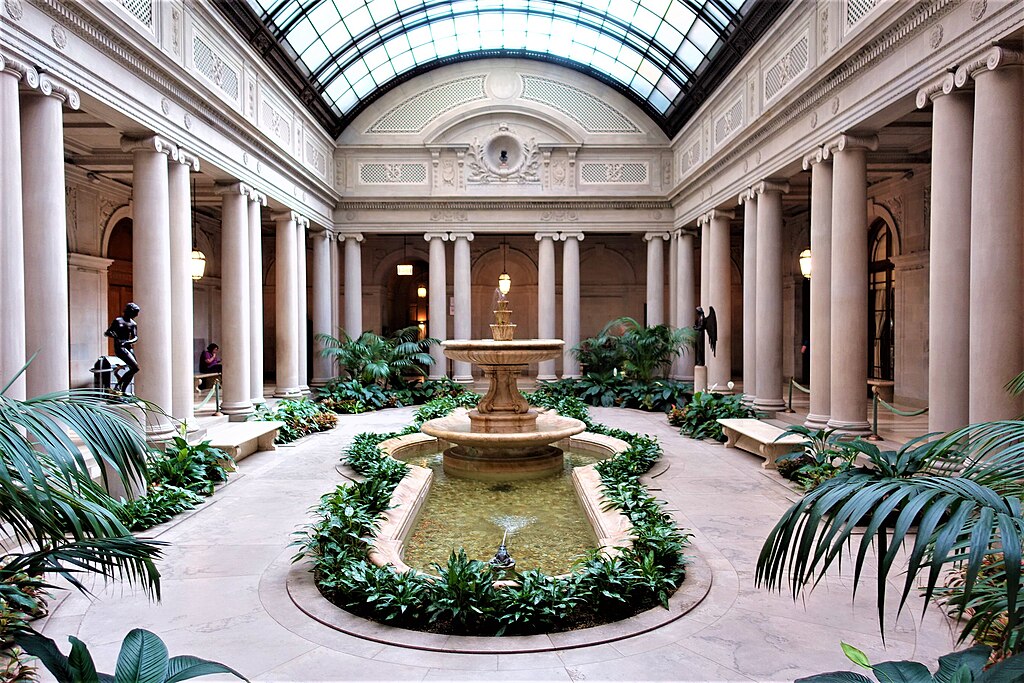
The Ford Foundation Center for Social Justice, 320 East 43rd Street, is a five-minute walk and the best free thing in the neighbourhood. Kevin Roche's 1967 building wraps a twelve-storey glass atrium around a terraced subtropical garden with 39 plant species and a reflecting pool, and it is silent. Entry is free, visiting hours are weekdays with limited Saturday opening when an exhibition is on, and pre-registration is required, so sort that out the day before.
Tudor City Greens, on 42nd Street between First and Second Avenues, is a pair of small private-but-public gardens up the granite steps from First Avenue, and the bridge over 42nd Street has one of the better sightlines in Midtown. Six minutes away.
Ralph Bunche Park, directly across First Avenue, holds Peace Form One, a 50-foot stainless steel obelisk honouring the first African American to win the Nobel Peace Prize. Two minutes.
Japan Society, 333 East 47th Street, is a five-minute walk and runs a serious gallery programme of Japanese art alongside film and performance. Worth checking what is on before you go, as the gallery is only open during exhibitions.
Grand Central Terminal is 12 minutes west, free to walk through, and pairs naturally with the UN as a half-day. The whispering gallery outside the Oyster Bar and the constellation ceiling are the two things not to miss.
The Chrysler Building lobby, 10 minutes west at Lexington and 42nd, is open during business hours and is one of the great Art Deco interiors in the city. There is no observation deck, so this is a lobby visit only.
Rules, Bags, and Security
Political expression: Public displays of any kind are prohibited on the premises, including messages on clothing, banners, placards, chanting, gatherings, or demonstrations, including passive ones. This is enforced.
Bags: There is no bag check, no coat room, and no luggage storage anywhere on site. Everything you bring, you carry for the whole tour. Backpacks and bags larger than 14 inches wide by 13 inches high by 4 inches deep (35 x 33 x 10 cm) are not permitted at all.
Prohibited items: No liquids of any kind, including water. No cans, bottles, food, or beverages. No scooters, skateboards, or bicycles. No aerosols or sprays other than medical prescriptions. No pointed objects beyond pens and pencils. The UN has been a single-use plastic free zone since June 2019, so leave plastic bottles behind entirely. Strollers are allowed in the building but not on the tour route.
Allowed: Cameras and recording devices, battery-operated and medical devices, creams and perfumes.
Photography: Personal photography with cameras and phones is permitted. Video recording is not. Depending on which meetings are running, your guide may rule out photography in particular chambers on the day. Phone use and photography are not permitted in the screening facility itself.
Children: Under-18s must be accompanied by an adult and cannot register or enter alone. Children under 5 are not permitted on the tour for security reasons.
Re-entry: Your pass covers a single visit. Leave the complex and you go through the whole registration and screening process again.
Accessibility at the United Nations
United Nations Headquarters is accessible to visitors with disabilities and limited mobility, with step-free access throughout the tour route in the General Assembly and Conference buildings.
Wheelchairs are available to borrow at no cost. Request one at the Cashier's Desk in the Visitors' Lobby when you check in for your tour.
The Garden Tour of the North Lawn is not wheelchair accessible. The From Chambers to Garden Tour includes outdoor terrain, so visitors with mobility needs should flag this when booking so the route can be adapted.
American Sign Language interpretation is not provided on standard scheduled tours. Guidance on whether it can be arranged in advance has changed recently, so deaf and hard-of-hearing visitors should confirm the current position before booking rather than relying on any single page.
Service dogs are permitted on the premises to assist individuals with disabilities. Emotional support animals are not permitted.
Designated lactation rooms for nursing parents are located in the public visitors area of the General Assembly building, signed and equipped with cold storage, a microwave, a changing table, seating, and handwashing facilities.
Final Tips for Visiting the United Nations
Book your tour slot online rather than chancing the Cashier's Desk, since only 20 people fit on each tour, and register on the UN Security site the night before while you are at it. Neither is a locked door, but between them they turn a gamble into a plan.
Bring your passport even if you have another accepted ID, because the stamps counter downstairs will add a commemorative UN postmark to it, and posting a card with UN stamps from inside the building is something you cannot do anywhere else in the world.
Drink your water before you join the queue. No liquids of any kind get through screening, there is nowhere to store a bottle, and you will be there a while.
Book the From Chambers to Garden Tour rather than the standard one if the weather is decent and you have three hours. The security overhead is identical and you get an extra 45 minutes and the sculpture garden for a modest difference.
Arrive on the earlier side of the 60-minute window and dress for standing outdoors, because the check-in queue forms on the pavement with no shelter.
Accept that the Security Council Chamber may be shut. It closes when the Council is meeting, which is the whole point of the place, and there are no refunds. Monday and Friday give you slightly better odds.
Pair it with the Ford Foundation atrium and Tudor City Greens, both a few minutes' walk away and both free. After an hour of security and corridors, the quiet indoor garden is the right way to end the morning before heading west to Grand Central.
Back to New York City Attractions
Explore other New York City attractions

" width="24px"><path d="M 0 0 L 24 0 L 24 21.231 L 0 21.231 Z" fill="transparent" height="21.230768474975793px" id="nL2EwDcS9" width="24px"/><path d="M 0 0.541 C 0 0.242 0.245 0 0.547 0 L 2.735 0 C 3.037 0 3.282 0.242 3.282 0.541 L 3.282 4.598 C 3.282 4.897 3.037 5.139 2.735 5.139 L 0.547 5.139 C 0.245 5.139 0 4.897 0 4.598 Z" fill="rgb(196, 217, 201)" height="5.138657337892187px" id="hZ_rlBe_S" transform="translate(0 16.092)" width="3.2820512820512358px"/><path d="M 0 0.541 C 0 0.242 0.245 0 0.547 0 L 2.735 0 C 3.037 0 3.282 0.242 3.282 0.541 L 3.282 7.843 C 3.282 8.142 3.037 8.384 2.735 8.384 L 0.547 8.384 C 0.245 8.384 0 8.142 0 7.843 Z" fill="rgb(230, 211, 160)" height="8.38412513024521px" id="HgVBxIz3e" transform="translate(5.128 12.847)" width="3.282051282051235px"/><path d="M 0 0.541 C 0 0.242 0.245 0 0.547 0 L 2.735 0 C 3.037 0 3.282 0.242 3.282 0.541 L 3.282 12.982 C 3.282 13.281 3.037 13.523 2.735 13.523 L 0.547 13.523 C 0.245 13.523 0 13.281 0 12.982 Z" fill="rgb(232, 207, 164)" height="13.522782468137464px" id="utgrDnoM9" transform="translate(10.325 7.708)" width="3.282051282051377px"/><path d="M 0 0.541 C 0 0.242 0.245 0 0.547 0 L 2.735 0 C 3.037 0 3.282 0.242 3.282 0.541 L 3.282 16.498 C 3.282 16.797 3.037 17.039 2.735 17.039 L 0.547 17.039 C 0.245 17.039 0 16.797 0 16.498 Z" fill="rgb(233, 196, 166)" height="17.038705909853153px" id="OLOhW6STz" transform="translate(15.521 4.192)" width="3.2820512820512384px"/><path d="M 0 0.541 C 0 0.242 0.245 0 0.547 0 L 2.735 0 C 3.037 0 3.282 0.242 3.282 0.541 L 3.282 20.69 C 3.282 20.989 3.037 21.231 2.735 21.231 L 0.547 21.231 C 0.245 21.231 0 20.989 0 20.69 Z" fill="rgb(217, 170, 153)" height="21.230768474975793px" id="H5Z8wcwkd" transform="translate(20.718 0)" width="3.2820512820512278px"/></g></svg>)