Back to Rome Attractions
NOTE: A dress code for The Pantheon is usually enforced by security. Knees, shoulders, and chest must be covered.
Do You Need to Book Pantheon Tickets in Advance?
Updated August 2026
The Pantheon is, by most measures, the best-preserved ancient building on earth. Built by Emperor Hadrian between 118 and 125 AD on the site of an earlier temple commissioned by Marcus Agrippa, it has stood for nearly 1,900 years without significant structural failure. Its dome, 43.3 metres in diameter with a central oculus open to the sky, held the record as the world's largest unreinforced concrete dome for over a millennium and remains one of the greatest engineering achievements in human history. Converted into a Christian church in 609 AD, a fact that saved it from the abandonment and ruin that befell most Roman monuments, it continues to function as an active basilica today. Visiting it is among the most memorable experiences Rome has to offer, and the good news is that it costs very little to get inside.
At a Glance
How Early to Book:
1 week ahead for full time-slot availability, 2-3 days ahead if you are okay with any time-slot.
Tickets Released:
Through the end of the month.
Best Times to Visit:
Right at opening at 9:00am, or in the late afternoon will have the fewest crowds. However, around mid-day there is the best view of the sunbeam through the oculus.
Ticket price:
€7 for adults.
Where to Book:
Landmark Address:
Do You Need to Book Pantheon Tickets in Advance?
Yes, and this is the most important thing to know before you arrive at Piazza della Rotonda.
Until July 2023, the Pantheon was one of the last major Roman monuments without an entry fee. That changed when a mandatory €5 ticket (now €7) was introduced for tourist visits. Tickets are now required, and while walk-up purchase is possible at the door, queues at the on-site ticket office can stretch across the square during busy periods, particularly in summer. Booking online in advance is strongly recommended.
There is a €1 booking fee per transaction when purchasing online, regardless of the number of tickets.
Where to book: Official tickets are sold officially through the Musei Italiani portal. This is the only authorised online platform for standard entry tickets. A number of third-party platforms also sell entry, often bundled with an audio guide or guided tour, which can offer better value and a smoother booking experience if you want more than basic entry. Tickets from unauthorised resellers risk being invalid on the day. You can also get tickets at the on-site ticket office.
How far in advance can you book? As of 2026, tickets on the Musei Italiani website are available for the current month only, released on a rolling basis. Availability opens for each month roughly mid-month. During peak season (April through October), popular time slots sell out quickly, and booking as soon as your preferred date becomes available is advisable.
Important caveats:
Ticket sales are suspended approximately one hour before any Mass. Saturday Mass begins at 5:00pm, meaning ticket sales pause around 4:00pm. Sunday Mass is at 10:30am, meaning sales pause around 9:30am on Sundays. Plan your visit around these windows.
The Pantheon is not included in the Roma Pass or the Omnia Card. These passes give no discount or priority here.
Tickets are valid for one entry only, on the booked date and time slot. There is no re-entry.
Pantheon Opening Hours and Entry Information
Open daily, 9:00am to 7:00pm
Last entry for individual visitors: 6:30pm
Last entry for groups and schools: 6:00pm
Ticket sales suspend approximately one hour before Mass times
Closed:
1 January (New Year's Day)
15 August (Ferragosto)
25 December (Christmas Day)
Mass times (entry is free for worshippers during Mass, sightseeing visits are paused):
Saturday and public holiday eves: 5:00pm
Sundays and public holidays: 10:30am
The Pantheon is an active Catholic church, officially known as the Basilica of Santa Maria ad Martyres. This means Mass takes precedence over tourist access at the times above. If you arrive during Mass and wish to attend as a worshipper rather than a sightseer, entry is free and no ticket is required.
Address: Piazza della Rotonda, 00186 Roma

What is the Best Way to Get to the Pantheon?
The Pantheon sits at the centre of Rome's historic district, within easy walking distance of most of the city's main sightseeing areas.
On foot: This is by far the most practical way to reach the Pantheon. It is around a 10-minute walk from Piazza Navona, 15 minutes from the Trevi Fountain, 20 minutes from Campo de' Fiori, and around 25 minutes from the Colosseum. The streets around it are entirely pedestrian-friendly, and the walk through Rome's centro storico is a pleasure in its own right.
By bus: The nearest major bus stop is at Largo di Torre Argentina, approximately a 5-minute walk from the Pantheon. Bus routes 40, 64, 492, and 81 stop there, connecting the historic centre to Termini station, Trastevere, and the Vatican.
By Metro: Rome's Metro does not have a station close to the Pantheon. The nearest are Barberini (Line A), around a 20-minute walk, and Spagna (Line A), slightly further. The bus is a more convenient option from most parts of the city.
By tram: Line 8 connects Trastevere to Largo di Torre Argentina, making it a useful option if you are staying on the other side of the Tiber.
Driving to the Pantheon is not recommended. The entire historic centre is a ZTL (Zona a Traffico Limitato), meaning access is restricted to resident vehicles during most of the day, and fines for non-resident drivers are automatic and substantial.
Practical tip: Piazza della Rotonda, directly in front of the Pantheon, is surrounded by bars and restaurants with outdoor seating. If you arrive early and your time slot has not yet begun, this is a perfectly pleasant place to wait with a coffee.
How Much Time Should I Spend at the Pantheon?
The Pantheon is a single large circular room, and most visitors spend 20 to 30 minutes inside on a standard self-guided visit. There is no time limit once you are in; you are free to stay as long as you like.
If you are using an audio guide, allow 35 to 45 minutes to complete it comfortably. A guided tour typically runs 45 minutes to an hour.
Because the Pantheon is compact by the standards of Rome's major attractions, it is almost always combined with nearby sights in the same morning or afternoon. A popular loop from the Pantheon takes in Piazza Navona (10 minutes on foot), the Trevi Fountain (15 minutes), and the Spanish Steps (a further 10 minutes). Budget around two to three hours for this circuit, not including queuing time.
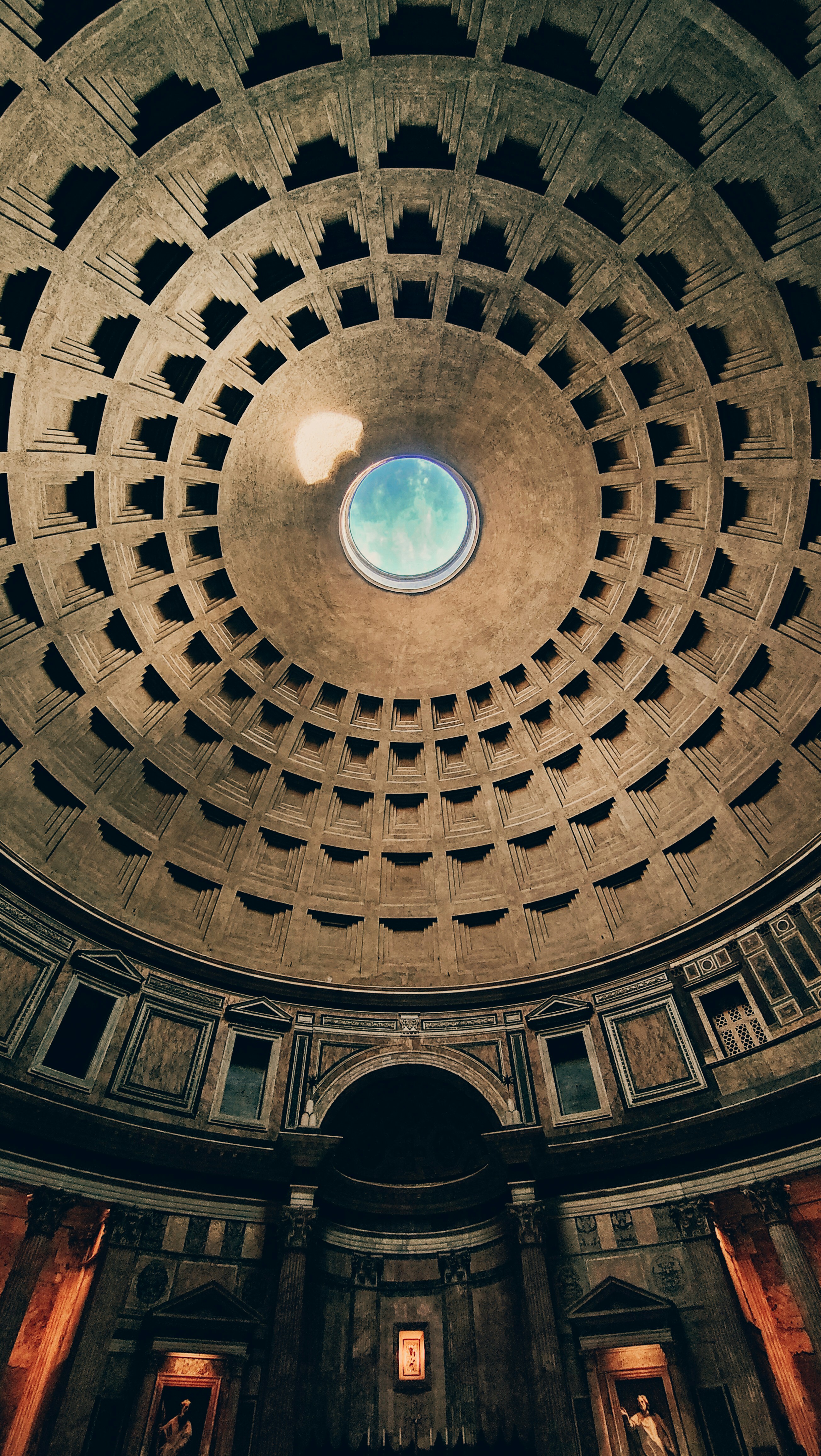
The Pantheon features a 27-foot-wide circular opening at the peak of the dome. This is the only light source, creating a "reverse sundial" effect, and it is open to the elements, with drains on the floor to handle rain.
What is the Best Time to Visit the Pantheon?
Best time of day: The first hour after opening, between 9:00am and 10:00am, is significantly quieter than the rest of the day. Tour groups typically begin arriving from 11:00am onwards, and midday to mid-afternoon on weekdays and all day on weekends is the busiest window. Late afternoon, after 5:00pm on weekdays, is another good option for smaller crowds, though note that ticket sales pause around 4:00pm on Saturdays ahead of evening Mass.
Best days: Weekdays are consistently less crowded than weekends. Saturday and Sunday between 11:00am and 3:00pm are the busiest periods of the week.
Best season: Spring (March to May) and autumn (September to November) offer the most pleasant conditions: manageable crowds compared to summer, and cooler temperatures that make queuing outside considerably more comfortable. July and August are the peak tourist months, and early booking is essential.
Free entry Sundays: The first Sunday of every month offers free entry to everyone. This sounds appealing but draws very large crowds. If you visit on a free Sunday, arrive as early as possible and expect to queue to collect your free ticket on-site (no online booking is possible on these days).
The oculus in the rain: One of the more unexpected and memorable experiences the Pantheon offers is watching rain fall through the open oculus into the interior. The floor slopes imperceptibly toward the centre and drains through 22 small holes. If it rains during your visit, stay for it.
What is Inside the Pantheon?
The Pantheon consists of one magnificent circular room, the rotunda, preceded by a rectangular portico supported by 16 granite Corinthian columns. The experience of stepping through the bronze doors into the interior is one of the most singular moments in all of Rome.
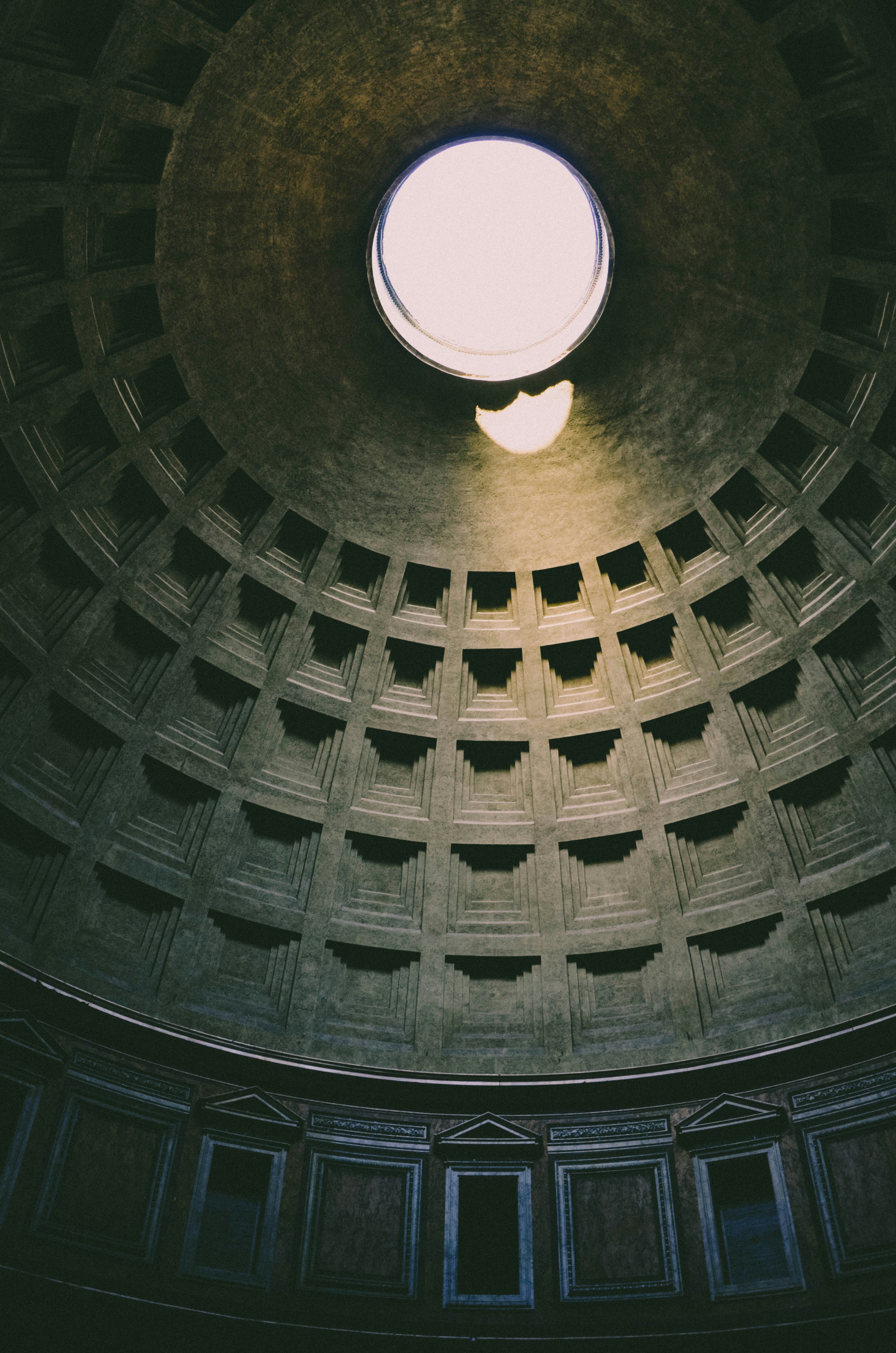
The dome and oculus: The coffered concrete dome rises 43.3 metres above the floor, the same measurement as the internal diameter of the rotunda. This perfect geometric proportion, a sphere precisely fitting the cylindrical drum, is deliberate and gives the space its extraordinary sense of balance. The oculus at the apex is 8.2 metres wide and open to the sky. It is the sole source of natural light in the building, and the column of light that moves across the interior over the course of the day creates one of architecture's great theatrical effects.
The tombs: The Pantheon has served as a prestigious burial site for several centuries. The most famous tomb is that of Raphael, the Renaissance painter and architect, who died in 1520 and requested burial here. His tomb is on the left side of the interior, marked by a simple Latin inscription. Also buried here are the Italian kings Vittorio Emanuele II and Umberto I, along with the painter Annibale Carracci and the composer Arcangelo Corelli.
The niches and chapels: Seven curved niches are set into the thickness of the rotunda walls, each originally housing a statue of a Roman deity. Several are now decorated as chapels with Renaissance and Baroque art, including a Madonna painted by Raphael's student Lorenzetto.
The portico inscription: The bronze inscription on the portico facade reads "M. AGRIPPA L.F. COS. TERTIUM FECIT" (Marcus Agrippa, son of Lucius, built this in his third consulship). Hadrian, who rebuilt the structure entirely, chose to retain Agrippa's original dedication rather than adding his own name, a decision that puzzled historians for centuries until archaeological investigation confirmed Hadrian's authorship.
What you will not find inside: There are no information panels within the building, which makes an audio guide or guided tour particularly worthwhile if you want context beyond the basics.
Guided Tours and Audio Guides
Audio guides are available on-site from the welcome desk inside the entrance, available in English, Italian, French, Spanish, German, Portuguese, Chinese, and Russian. Many third-party ticket providers also bundle an audio guide app with entry tickets, which can be downloaded to your phone and used at your own pace. This is a particularly good option given the absence of information panels inside the building.
Guided tours range from 45-minute focused visits of the Pantheon alone to longer tours combining the Pantheon with nearby sites such as Piazza Navona, the Trevi Fountain, or the Largo Argentina archaeological area. Small group tours with a licensed guide add significant value at a site where context transforms the experience: the engineering story of the dome, the religious transition from Roman temple to Christian basilica, and the decisions made in Hadrian's reign about what to preserve and why are all compelling threads that most visitors miss entirely on a self-guided visit.
If you book a guided tour, always check that the guide is licensed (autorizzato). In Rome, only holders of an official guide card are permitted to lead tours inside paid historic sites. Tours booked through reputable operators will use licensed guides.

Is the Pantheon Worth Visiting?
The Pantheon is one of those buildings that justifies an entire trip to Rome on its own terms. Unlike many ancient Roman sites, where significant imagination is required to reconstruct what the original looked like from ruins, the Pantheon is essentially intact. The bronze doors through which you enter are original. The marble floor, though repaired many times, follows the original Roman pattern. The dome has never collapsed. Standing under it, you are experiencing a space that Romans of the 2nd century AD also stood in, more or less as they left it.
At €7 for most adult visitors, it is also one of the most remarkable values in European sightseeing.
Where Should I Eat Near the Pantheon?
The streets immediately surrounding the Pantheon contain a higher than usual concentration of tourist-trap restaurants with mediocre food at inflated prices. The tables directly on Piazza della Rotonda with views of the Pantheon facade are the most obvious example: you are paying primarily for the view, and the food is unlikely to be memorable. That said, if eating in front of one of the world's great ancient buildings is something you want to do at least once, it is easy enough to find.
Walk one or two streets away and the picture changes considerably.
For a proper Roman meal:
Armando al Pantheon on Salita de' Crescenzi, literally a one-minute walk from the entrance, is one of the most consistently recommended traditional Roman restaurants in the area and has been run by the same family since 1961. The menu centres on Roman classics: cacio e pepe, carbonara, saltimbocca alla romana, and trippa alla romana. Prices are reasonable by central Rome standards. Booking ahead is essential; it fills up quickly at both lunch and dinner. Closed on Sundays.
Da Fortunato on Via del Pantheon is another longstanding trattoria just steps from the square, known for its reliable Roman cooking and unpretentious atmosphere. A favourite with local politicians and professionals from the nearby parliament buildings.
Enoteca Corsi on Via del Gesù is a wine bar and simple trattoria a short walk south, beloved for its excellent value set lunch and its selection of Italian wines by the glass. Particularly good for a relaxed midday meal.
For coffee:
Sant'Eustachio il Caffè on Piazza di Sant'Eustachio, three minutes from the Pantheon, is widely regarded as one of the finest espresso bars in Rome. The beans are roasted on-site and the coffee is served with a layer of cream produced by the machine. Worth seeking out at any point in the day.
For a snack or quick bite:
Antica Salumeria on Piazza della Rotonda, right next to the entrance, is one of Rome's oldest delicatessens, dating to 1375. A meat and cheese platter with a glass of wine eaten at one of the outdoor tables, directly facing the Pantheon, is one of the more pleasurable and reasonably priced ways to enjoy the square.
Frigidarium on Via del Governo Vecchio, a short walk toward Campo de' Fiori, is a popular gelateria worth the detour for excellent gelato made with quality ingredients.
For something more upscale:
Salotto 42 on Piazza di Pietra, midway between the Pantheon and the Trevi Fountain, is a stylish bar with cocktails and small plates, set against the 2nd-century ruins of the Temple of Hadrian. One of the more atmospheric spots for an aperitivo in the area.
What Else is There to Do Near the Pantheon?
The Pantheon sits at the geographical heart of Rome's historic centre, and the density of extraordinary things to see within walking distance is almost overwhelming.
Piazza Navona is a 10-minute walk west and is one of the most beautiful squares in Rome. Its centrepiece is Bernini's Fountain of the Four Rivers, and the piazza is lined with baroque palaces and churches including Sant'Agnese in Agone. Entry to all of these is free.
The Trevi Fountain is a 15-minute walk northeast and is one of the most visited sights in Rome. There is no entry fee; the fountain is a public monument. It is the best very early in the morning before the crowds arrive.
Campo de' Fiori is a 15-minute walk southwest and hosts a daily morning market of fresh produce, flowers, and street food. The surrounding neighbourhood has some of Rome's better restaurant streets.
Largo di Torre Argentina is a 5-minute walk south and contains the ruins of four Republican-era Roman temples, some of the oldest preserved in the city. Julius Caesar was assassinated nearby on the Ides of March, 44 BC. Entry to the archaeological area is free for the exterior walkways; a small museum on-site has recently opened. It is also home to a cat sanctuary.
The Capitoline Museums are around 20 minutes on foot south, near the Roman Forum. They are the oldest public museums in the world, housing an extraordinary collection of ancient Roman sculpture, including the original bronze equestrian statue of Marcus Aurelius. Advance booking is required for the best time slots.
Piazza della Minerva, immediately behind the Pantheon, contains one of Rome's most charming and unexpected landmarks: a small marble elephant designed by Bernini supporting an ancient Egyptian obelisk. The adjacent church of Santa Maria sopra Minerva is the only Gothic church in Rome and contains Michelangelo's Christ Bearing the Cross.
Rules, Bags, and Security
Dress code: The Pantheon is an active church and enforces a dress code. Both men and women must have shoulders and knees covered. Sleeveless tops, short shorts, short skirts, and backless dresses are not permitted. Staff at the entrance enforce this rule. If you are unsure, a scarf or light layer carried in a bag solves the problem quickly.
Bags: Large bags, backpacks, and umbrellas are not permitted inside the Pantheon. There is no bag storage facility at the site itself. Several bag storage businesses operate within a short walking distance of the square; search for "deposito bagagli Pantheon" for current options. Travelling light is strongly advised.
Photography: Personal photography is permitted inside the Pantheon. Flash photography and tripods may not be allowed during religious services.
No re-entry: Once you exit, your ticket is no longer valid. If you need to leave and return, you will need to purchase a new ticket.
Pickpockets: Piazza della Rotonda is one of the busiest tourist squares in Rome and pickpockets are active, particularly in summer. Keep valuables secured and be particularly careful in crowds near the entrance queue.
No public toilets inside: There are no toilets within the Pantheon. The cafes and bars on Piazza della Rotonda are the easiest option nearby; most will allow access if you purchase something.
Accessibility at the Pantheon
The Pantheon is accessible to wheelchair users via a ramp at the main entrance. The interior floor is level and navigable by wheelchair throughout most of the building, though some areas near the altar may have limited access given the historic nature of the structure. Staff at the entrance can assist visitors with mobility needs.
Audio guides are available in multiple languages, including for visually impaired visitors. Disabled visitors are entitled to free entry on presentation of documentation confirming their status.
Final Tips for Visiting the Pantheon
Book tickets online in advance, particularly between April and October and on any weekend. The Musei Italiani portal is the only official source for standard entry tickets.
Arrive at opening time (9:00am) for the quietest visit. The first hour is dramatically calmer than any other window of the day.
Avoid arriving just before Mass times. Ticket sales pause around 4:00pm on Saturdays and around 9:30am on Sundays. Plan accordingly.
The Pantheon is NOT included in the Roma Pass or Omnia Card. Do not assume your pass covers entry here.
First Sunday of the month is free, but busy. If you visit on a free Sunday, arrive as early as possible and queue for your free ticket on-site.
There are no information panels inside the building. An audio guide or guided tour adds enormous value to a visit that might otherwise feel mysteriously sparse for its scale and fame.
Cover your shoulders and knees. The dress code is enforced at the entrance. A light scarf or layer resolves any ambiguity.
Do not bring large bags or a backpack. They will not be allowed inside, and there is no storage at the site.
Combine with Piazza Navona and the Trevi Fountain for an efficient and spectacular half-day loop through the centro storico.
Eat at Armando al Pantheon if you can get a reservation. It is one of the most reliably excellent Roman trattorias in the area, and the proximity to one of the world's greatest buildings makes it a memorable lunch or dinner.
If it rains, stay for the oculus. Watching rain fall through the open eye of the dome into the interior is one of Rome's most memorable and completely free experiences.
Back to Rome Attractions
Explore other Rome attractions
" width="24px"><path d="M 0 0 L 24 0 L 24 21.231 L 0 21.231 Z" fill="transparent" height="21.230768474975793px" id="nL2EwDcS9" width="24px"/><path d="M 0 0.541 C 0 0.242 0.245 0 0.547 0 L 2.735 0 C 3.037 0 3.282 0.242 3.282 0.541 L 3.282 4.598 C 3.282 4.897 3.037 5.139 2.735 5.139 L 0.547 5.139 C 0.245 5.139 0 4.897 0 4.598 Z" fill="rgb(196, 217, 201)" height="5.138657337892187px" id="hZ_rlBe_S" transform="translate(0 16.092)" width="3.2820512820512358px"/><path d="M 0 0.541 C 0 0.242 0.245 0 0.547 0 L 2.735 0 C 3.037 0 3.282 0.242 3.282 0.541 L 3.282 7.843 C 3.282 8.142 3.037 8.384 2.735 8.384 L 0.547 8.384 C 0.245 8.384 0 8.142 0 7.843 Z" fill="rgb(230, 211, 160)" height="8.38412513024521px" id="HgVBxIz3e" transform="translate(5.128 12.847)" width="3.282051282051235px"/><path d="M 0 0.541 C 0 0.242 0.245 0 0.547 0 L 2.735 0 C 3.037 0 3.282 0.242 3.282 0.541 L 3.282 12.982 C 3.282 13.281 3.037 13.523 2.735 13.523 L 0.547 13.523 C 0.245 13.523 0 13.281 0 12.982 Z" fill="rgb(232, 207, 164)" height="13.522782468137464px" id="utgrDnoM9" transform="translate(10.325 7.708)" width="3.282051282051377px"/><path d="M 0 0.541 C 0 0.242 0.245 0 0.547 0 L 2.735 0 C 3.037 0 3.282 0.242 3.282 0.541 L 3.282 16.498 C 3.282 16.797 3.037 17.039 2.735 17.039 L 0.547 17.039 C 0.245 17.039 0 16.797 0 16.498 Z" fill="rgb(233, 196, 166)" height="17.038705909853153px" id="OLOhW6STz" transform="translate(15.521 4.192)" width="3.2820512820512384px"/><path d="M 0 0.541 C 0 0.242 0.245 0 0.547 0 L 2.735 0 C 3.037 0 3.282 0.242 3.282 0.541 L 3.282 20.69 C 3.282 20.989 3.037 21.231 2.735 21.231 L 0.547 21.231 C 0.245 21.231 0 20.989 0 20.69 Z" fill="rgb(217, 170, 153)" height="21.230768474975793px" id="H5Z8wcwkd" transform="translate(20.718 0)" width="3.2820512820512278px"/></g></svg>)