Monistrol de Montserrat • Catalonia, Spain
Recommended to purchase a timed-entry ticket to guarantee entry, especially in peak season. On-site ticket office sells tickets pending availability, but queues may be long.
Book 1 Week Ahead
Peak Season
Book 1-3 Days Ahead
Off peak Season
Back to Barcelona Attractions
Montserrat Monastery: Everything You Need to Know Before You Visit
Updated September 2026
Rising from a mountain of extraordinary serrated rock formations one hour west of Barcelona, the Benedictine monastery of Santa Maria de Montserrat is one of the most dramatic and spiritually significant sites in Spain. Founded in the 11th century and expanded over nearly a thousand years on a mountain that had been a place of pilgrimage since the early Christian era, the complex today encompasses a Royal Basilica, a world-class art museum, an ancient boys' choir school, two mountain funiculars, a network of hiking trails, and the revered Black Madonna statue that has drawn pilgrims and travellers to this extraordinary place for centuries. Montserrat is not just a monastery, but also a mountain, a natural park, and a living community of around 80 Benedictine monks who continue the traditions of their order in one of the most remarkable settings on earth.
At a Glance
How Early to Book:
Book about a week ahead to guarantee entry, especially during peak season. Last minute tickets may be available at the on-site ticket office pending availability.
Tickets Released:
About 1 month in advance for most attractions at Montserrat.
Best Times to Visit:
Weekdays, from Tuesday to Friday, are the least busy, especially in the mornings.
Ticket Price:
Standard visitor ticket is €25 for adults at the ticket office, €23 booked online.
Where to Book:
Landmark Address:
Montserrat Monastery Tickets
The Montserrat monastery complex introduced an entry fee system in May 2023, which applies to visitors from outside the EU. Residents of Catalonia, the rest of Spain and other EU countries enter free, as do people attending Mass or other religious services and guests staying in accommodation at the monastery. Residents booking free access do so through the Abbey's own reservation site rather than the visitor site.
The official combined ticket (recommended for most visitors):
The standard visitor ticket bundles all the main paid elements into a single purchase: timed entry to the Black Madonna (La Moreneta), access to the Museum of Montserrat, entry to the Audiovisual Space, and entry to the Open-Air Museum. An audio guide is included.
Online price: €23 per person
At the ticket office: €25 per person
Booking online saves €2 per ticket and, more importantly, lets you pre-select your timed slot for the Black Madonna. The Black Madonna queue at the ticket office can be significant on busy days, and pre-booking a time slot eliminates this.
Watch out for the cheaper €20 ticket, which covers the Basilica and the museum but not the timed slot for the Black Madonna. For most visitors the Black Madonna is the reason for the trip, so the €23 ticket is the one you want.
With Escolania boys' choir performance: €25
A combined ticket including admission to the Escolania de Montserrat choir performance, plus everything in the standard ticket, is available at €25 per person. The start time on this ticket is the choir performance time. See the dedicated choir section for full performance details.
Where to book: The official monastery booking platform is montserratvisita.com (the official site of the Montserrat complex). Third-party platforms including GetYourGuide and Tiqets also carry official tickets and can be useful if you want to combine entry with transport or a guided tour package. The official site is the most direct route.
What is included in the standard ticket:
Timed entry to the Throne of Our Lady and the Black Madonna (La Moreneta)
Access to the Museum of Montserrat (1,300 works including pieces by Caravaggio, Picasso, Dalí, Monet, El Greco, Miró, and Tàpies)
Access to the Audiovisual Space (700m² immersive experience opened December 2024 with four thematic areas and the first 3D reconstruction of the abbey)
Access to the Open-Air Museum
An audio guide covering the Basilica and the visit to La Moreneta, available in Catalan, Spanish, English, French, German, Dutch, Russian, and Japanese
What is not included:
Round-trip transport from Barcelona (see the Getting There section for full transport options)
The Escolania boys' choir ticket (must be booked separately or as the €25 combined option)
The Sant Joan Funicular or Santa Cova Funicular (included in the Tot Montserrat transport card)
Cancellation policy: Tickets for the monastery are non-refundable and cannot be rescheduled once purchased. Plan your visit carefully before completing your booking.
Montserrat Monastery Opening Hours
The Basilica is open longer than most of the other attractions on the mountain, but each element of the complex has its own hours. Arriving without checking the relevant opening time for what you specifically want to see is one of the most common visitor mistakes.
Basilica of Santa Maria de Montserrat: Daily, 7:00am to 8:00pm
Throne of Our Lady (Black Madonna access):
Morning session: 8:00am to 10:30am
Afternoon session: 12:00pm to 6:25pm
The throne is closed between 10:30am and noon, and after 6:25pm, even though the Basilica remains open.
Museum of Montserrat:
Daily, 10:00am to 5:45pm, extended to 6:45pm on selected days
Audiovisual Space (Interactive Exhibition): Daily, 9:00am to 8:00pm
La Cafeteria: Daily, 8:45am to 7:30pm
La Botiga (shop): Daily, 9:00am to 8:00pm
Pastoral Coordination Centre: Daily, 9:30am to 1:30pm and 4:00pm to 6:00pm
Santa Cova (Holy Cave): Daily, 10:30am to 5:00pm
The café, shop, and toilets are accessible to all visitors. Entry to the Basilica nave is free; the timed visit to the Black Madonna requires a ticket.
Address: Monestir de Montserrat, 08199 Montserrat, Catalonia

How to Get to Montserrat from Barcelona Using the Train
Getting to Montserrat requires combining more than one form of transport. There is no single direct service from central Barcelona to the monastery. However, the route is well-established and, once you understand the options, straightforward to navigate. The journey from central Barcelona takes approximately 90 minutes each way under normal conditions.
There are four main ways to reach Montserrat from Barcelona: the Trans Montserrat ticket (train plus cable car or rack railway), the Tot Montserrat all-inclusive card, the direct bus, and by car. Each is covered in full below.
Getting to Montserrat by Train (Trans Montserrat and Tot Montserrat)
The train route is the most popular way to travel to Montserrat. It involves the FGC commuter train from Barcelona to the base of the mountain, followed by either the cable car (Aeri de Montserrat) or the rack railway (Cremallera de Montserrat) to reach the monastery.
Step 1: The FGC train from Plaça d'Espanya
Take the FGC Line R5 (Llobregat-Anoia line) from Plaça d'Espanya station in Barcelona. This is not the Metro: FGC is a separate commuter rail network. Trains on this line run regularly throughout the day; check the FGC timetable before you travel as frequency varies. Journey time from Plaça d'Espanya to the base of the mountain is approximately 60 minutes.
Step 2: Ascent to the monastery
From the base of the mountain, there are two ways up:
Aeri de Montserrat (cable car): Get off the train at the "Montserrat-Aeri" stop (not the last stop). The cable car departs from here and takes approximately five minutes to reach the monastery. The aerial views across the Catalan landscape and the dramatic rock formations are extraordinary. The cable car is subject to suspension in high wind conditions and has a scheduled maintenance closure each winter. Always check current cable car status before travelling if this is your planned route.
Cremallera de Montserrat (rack railway): Stay on the FGC train one stop further to "Monistrol de Montserrat," then board the Cremallera rack railway. The rack railway takes approximately 15 minutes to climb to the monastery and runs in all weather conditions. It is the more reliable option year-round and considerably less crowded than the cable car queue on busy days. Several experienced visitors recommend taking the cable car up for the views and the rack railway down to avoid queuing, or vice versa.
Trans Montserrat combined ticket:
The Trans Montserrat card covers all the transport needed for a day trip: the Barcelona Metro return to Plaça d'Espanya, the FGC train to the mountain, the cable car or rack railway up and down, and unlimited use of both the Sant Joan and Santa Cova funiculars at the monastery. It does not include monastery entry or meals.
The Trans Montserrat card must be physically collected at the Plaça Catalunya Tourist Information Point, located on the lower ground floor of Plaça Catalunya station in Barcelona. The collection point is open daily from 8:30am to 8:30pm (closed 1 January and 25 December). You can pick it up the day before your visit, which saves time on the morning of the trip and allows you to catch an earlier train.
Tot Montserrat all-inclusive card:
The Tot Montserrat card includes everything in the Trans Montserrat card plus admission to the Museum of Montserrat and a meal at the self-service restaurant. At €71.50 per person it is the most complete single-purchase option available and removes the need to buy monastery entry tickets separately. The meal credit covers the self-service restaurant, which is a practical option given that food at the monastery is notably expensive for what it is. Collect from the same Plaça Catalunya Tourist Information Point.
Important tip on buying tickets:
Both the Trans Montserrat and Tot Montserrat cards are open-dated tickets with no fixed date of travel. Exchange your voucher at the Tourist Information Point before starting your journey. Buying at the ticket machines at Plaça d'Espanya station is also possible, though the machines can have queues and the Plaça d'Espanya area is a known pickpocket hotspot. Pre-booking online and collecting the day before eliminates this friction entirely.
How to Get to Montserrat from Barcelona Using the Bus
Autocars Julià runs a direct bus service from Barcelona Sants station to Montserrat. Return tickets start from approximately €6.25. The bus takes around 75 to 90 minutes depending on traffic and drops you directly at the monastery complex without the need for a cable car or rack railway. This is a simpler but less scenic option than the train route. Check the Autocars Julià website for current timetables before booking.
Getting to Montserrat by Car
Montserrat is approximately 60 kilometres from central Barcelona via the AP-2 motorway. Take exit 25 (Abrera) or exit 26 (El Bruc Nord) and follow the signs for Montserrat. The driving time is approximately 50 to 70 minutes depending on traffic.
Parking is available at the Visitor Centre at the base of the mountain (Monistrol Vila), with a free car park adjacent to the Monistrol Vila FGC station. From there, take the rack railway up to the monastery. There is also paid parking at the monastery level, accessible via the winding mountain road (road BP-1121), though this road can be very congested at weekends and in summer.
Driving up the mountain road directly to the monastery is possible but not recommended at peak times. The road is narrow in sections, parking at the top is limited, and arriving by rack railway from the car park below is significantly less stressful.
Getting to Montserrat by Guided Tour from Barcelona
Numerous operators run half-day and full-day guided tours from Barcelona, typically departing from central collection points and including transport, monastery entry, and a guide. Prices start from around €60 per adult for a half-day tour and typically include round-trip transport in an air-conditioned vehicle, a 45-minute guided tour of the monastery, and free time for hiking, the museum, or the funiculars.
The main practical advantage of a guided tour is early morning departure, which gets you to the monastery before the crowds arrive and makes a significant difference to the experience. Several operators offer departures from 8:00am to 8:30am, reaching the monastery before the main visitor wave from public transport. If the choir performance is your priority, choose a tour that specifically includes the Escolania ticket, as timing matters.
A guided tour is particularly worthwhile if you want an expert to explain the monastery's history, architecture, and the significance of the Black Madonna, as the on-site information panels do not provide a great deal of depth on their own.
History of Montserrat Monastery
The story of Montserrat begins not with the monastery but with the mountain itself. The serrated peaks of Montserrat (the name means "serrated mountain" in Catalan) were formed by geological folding and erosion over millions of years into the extraordinary formations of rounded pinnacles and vertical walls that surround the complex today. The mountain was considered sacred long before the arrival of Christianity.
According to tradition, the Black Madonna statue was discovered in a cave on the mountain in 880 AD, brought there by shepherds following a mysterious light. Whether or not this account is literally true, the discovery led to the construction of a first chapel and, by 1025, to the founding of a Benedictine monastery under Abbot Oliba of Ripoll. The community grew steadily over the following centuries, and Montserrat became one of the most important pilgrimage sites in medieval Iberia, attracting royalty and nobility alongside commoners. St Ignatius of Loyola, founder of the Jesuit order, spent a night in vigil at the feet of the Black Madonna in 1522 before beginning the spiritual journey that would lead to the founding of the Society of Jesus.
The monastery suffered severe destruction twice: first during the Napoleonic Wars (1811 to 1812), when French troops sacked and burned it, and again during the Spanish Civil War (1936 to 1939), when it was seized and many of its monks were killed. The determination with which the monastery has been rebuilt and its Catalan identity maintained makes it not merely a religious institution but a symbol of Catalan cultural resilience. During the Franco dictatorship, when the Catalan language was suppressed across Spain, Montserrat was one of the few places where Catalan could be spoken and published openly. The community's resistance to cultural erasure is part of why the site holds the emotional weight it does for Catalans.
Today, approximately 80 Benedictine monks live and pray here following the Rule of St Benedict, continuing a tradition of communal prayer, scholarship, and hospitality that has continued without interruption for almost a thousand years.
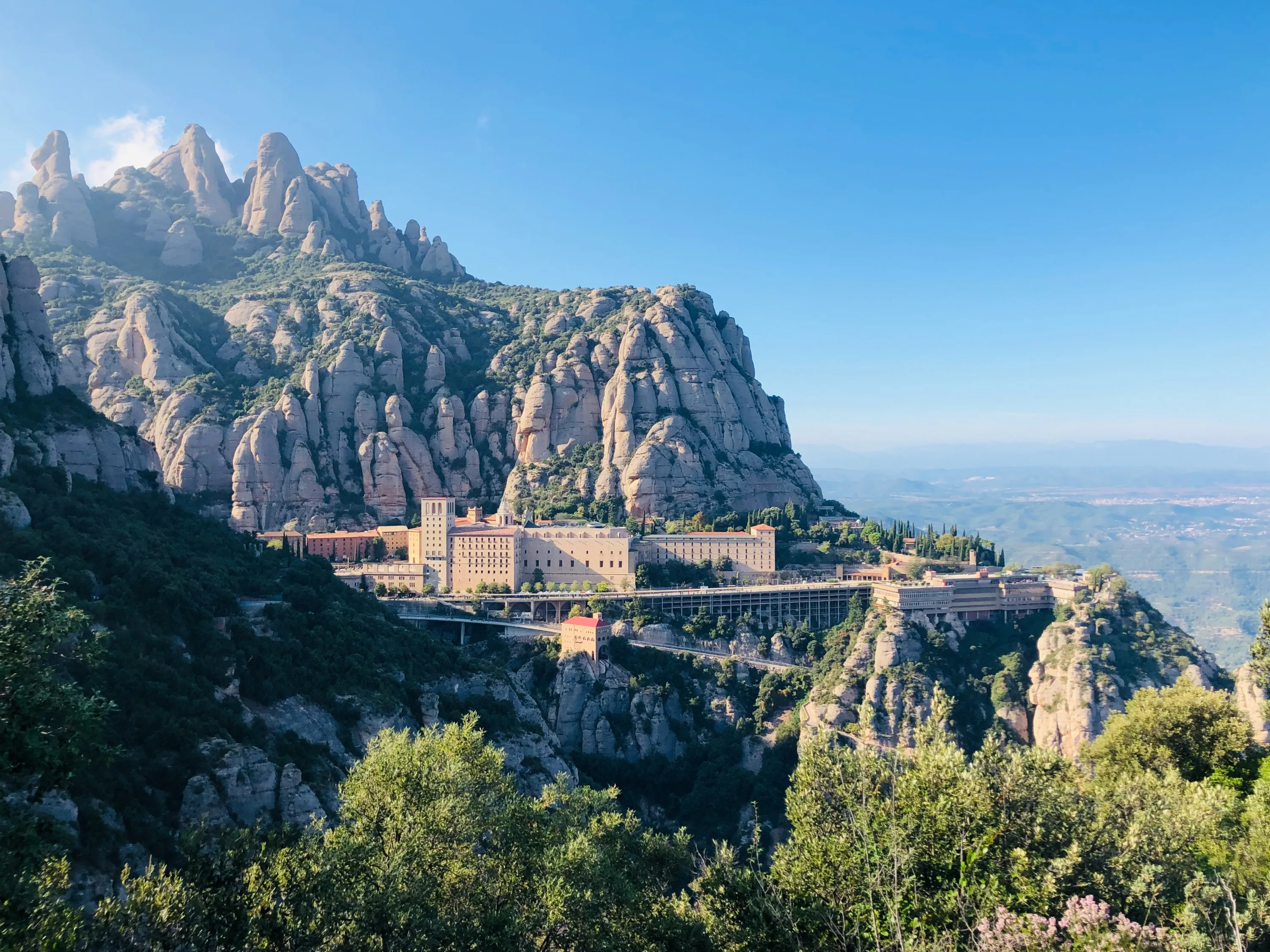
The Montserrat Monastery, located near Barcelona, is famous for housing the 12th-century Black Madonna ("La Moreneta"), a statue believed to have been discovered by shepherds in a cave in 880 AD. It is a renowned spiritual center that features one of Europe's oldest boys' choirs, the Escolania, which dates back to the 13th century.
Basilica of Montserrat
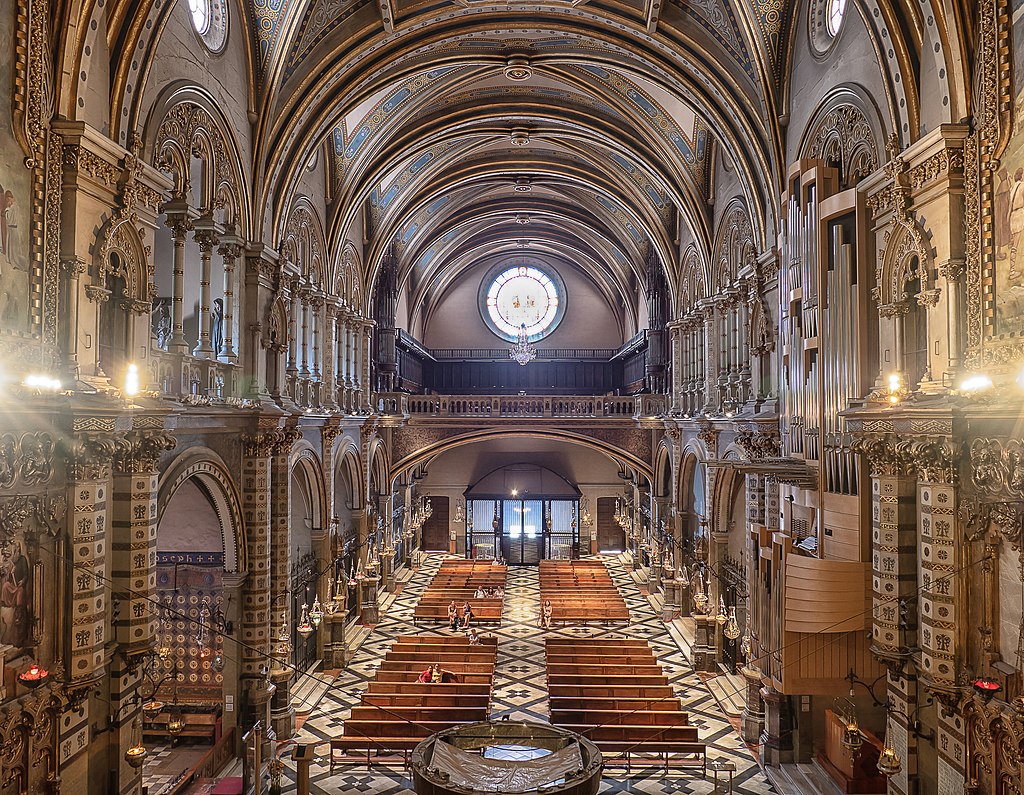
The Royal Basilica of Santa Maria de Montserrat is the spiritual heart of the complex and the primary destination for most visitors, whether they are pilgrims or tourists.
The current basilica was built between 1560 and 1592 in Romanesque Revival style, with subsequent Baroque modifications and a facade completed in the 20th century after the Napoleonic destruction. The interior is a single nave of considerable height and grandeur, with side chapels, gilded decorations, and votive offerings left by generations of pilgrims.
The Basilica is free to enter at the nave level. Walking inside and sitting for a moment in the remarkable atmosphere, with the mountain stone visible through the high windows and candles burning in the side chapels, is one of those experiences that works regardless of your personal relationship with religion. Many visitors who consider themselves entirely non-religious find themselves deeply affected by the quality of silence and presence in this space.
The Black Madonna (La Moreneta):
The defining object of the entire complex is La Moreneta, the Black Madonna of Montserrat, a 12th-century Romanesque wooden carving showing the seated Virgin Mary with the Christ child in her lap. She is called "la Moreneta" (the little dark one) for the dark colour of her face and hands, which is the result of natural darkening of the wood over centuries rather than any original pigmentation. She is the patron saint of Catalonia and one of the most venerated Marian images in Spain.
The Black Madonna is housed in the Throne of Our Lady (Cambril de la Mare de Déu), a gilded chamber above and behind the high altar reached by a staircase on the right side of the Basilica. The right hand of the Madonna holds an orb, and pilgrims traditionally touch or kiss this orb as they pass by in a gesture of devotion. The queue to reach the statue moves at a moderate pace. Timed entry with your pre-booked ticket significantly reduces waiting time; visiting during the less crowded afternoon hours (after 4:00pm) or very early in the morning is also effective.
The Black Madonna's throne is closed between 10:30am and noon and after 6:25pm, even when the Basilica itself is open. Plan your visit timing around these windows.
The Escolania de Montserrat (Boys' Choir)
The Escolania de Montserrat is one of the oldest boys' choirs in Europe, with records of its existence dating from the 13th century. Today, around 50 boys aged nine to fourteen are educated at the monastery's music school and perform as part of their studies, carrying on an unbroken tradition of sacred music that predates most European cultural institutions.
Hearing the choir perform in the Basilica is, for many visitors, the best moment of a Montserrat visit. The acoustic quality of the Basilica and the contrast between the ancient stone and the pure voices create an experience that is very difficult to describe.
Performance schedule:
Monday to Friday: 1:00pm (Salve and Virolai), with an evening performance most days after Vespers, usually around 7:15pm
Saturday: no performance on most weeks
Sunday and feast days: 11:00am (Conventual Mass) and 6:45pm (Vespers)
Critical caveat: The choir does not perform during school holiday periods. These typically include late June through early September (summer break), Christmas week, and Easter week. The exact dates vary by year. Before building your visit around the choir, check the official Escolania schedule on the monastery website. The disappointment of arriving to find the choir is on holiday is one of the most frequently mentioned visitor frustrations in recent reviews and travel forums.
A specific ticket is required for the choir performance: either the €25 combined ticket (monastery entry plus choir) or a standalone choir ticket. This must be booked in advance as slots are limited.
Museum of Montserrat
The Museum of Montserrat (Museu de Montserrat) is consistently underestimated by visitors who come primarily for the Basilica and the mountain views, and consistently praised by those who take the time to explore it properly.
The collection spans more than 1,300 works, with extraordinary breadth for a mountain monastery: ancient Egyptian artefacts including mummies and funerary objects, archaeological finds from the Montserrat landscape, a numismatic collection, and an art gallery whose holdings would be impressive in any major European city. The painting collection includes works by El Greco, Caravaggio, Luca Giordano, and significant Catalan Modernista and 20th-century work including pieces by Picasso (sketches from his early Barcelona years), Salvador Dalí, Joan Miró, and Antoni Tàpies. Claude Monet and other French Impressionists also feature in the collection.
The museum is included in the standard €23 combined ticket, making it one of the best-value art experiences in Catalonia given the quality of what is on display. If you are visiting on a resident ticket or skipping the combined ticket, museum-only admission is €12 for adults, €10 for students, seniors and groups, and €6 for children aged 8 to 16. Entry is free on 27 April, the feast day of the Virgin of Montserrat. On a practical level, the museum is also air-conditioned and relatively uncrowded even when the Basilica queue is long, making it an excellent place to spend an hour during the midday heat.
Museum hours: Daily, 10:00am to 5:45pm, extended to 6:45pm on selected days.
Hiking at Montserrat
Montserrat is a natural park as much as it is a monastery, and for many visitors the hiking is the primary reason to come. The mountain offers a wide variety of trails from easy paved walks to challenging summit ascents, all against the backdrop of the extraordinary rock formations and panoramic views across Catalonia.
Santa Cova trail (easy, 2.7 km return, approximately 1 hour):
The most popular walking trail from the monastery descends to the Santa Cova, the Holy Cave, where the Black Madonna is traditionally said to have been discovered. The route follows the Path of the Rosary, lined with modernist sculptures depicting the mysteries of the rosary, carved by artists including Josep Llimona and Enric Clarasó. The path is well-maintained and mostly paved. You can walk the whole way, or take the Santa Cova funicular part of the way down and walk only the lower section. A good option for visitors who want a taste of the landscape without a strenuous hike.
Sant Joan trail and the Sant Jeroni summit (challenging, 4 to 5 hours return from monastery):
The most rewarding and demanding hike at Montserrat leads to Sant Jeroni, the highest peak of the mountain at 1,236 metres above sea level. The views from the summit ridge are a 360-degree panorama across Catalonia that, on clear days, extends to the Pyrenees in the north and the Balearic Sea to the south-east.
To save time and elevation gain, take the Sant Joan Funicular from the monastery to the upper station before beginning the trail. From the upper station, the hike to Sant Jeroni takes approximately 90 minutes each way on rocky, well-marked terrain. Suitable footwear is essential: the trail involves some scrambling and the surfaces are loose and uneven in places. This is not a hike for trainers or sandals.
Trail of the Hermitages (moderate, 2 to 3 hours):
Starts near the lower station of the Sant Joan Funicular and follows a historic route through chapels, caves, and ruins of hermit cells that once housed the solitary monks who chose to live apart from the community in the mountain's rock formations. The route passes Sant Miquel Chapel and offers outstanding views of the monastery from above.
Practical notes for hikers:
Montserrat is an exposed mountain at altitude. Temperatures are significantly cooler than Barcelona and wind can be strong. Bring a windproof layer and sun protection regardless of the season.
Wear proper hiking shoes for anything beyond the Santa Cova trail.
Carry water. Fountains are limited on the trails.
The Sant Joan and Santa Cova funiculars are included in the Trans Montserrat and Tot Montserrat cards. If you are visiting independently, funicular tickets must be purchased separately.
The trails are well-marked but a downloaded map (the AllTrails app has good coverage of Montserrat) makes navigation easier on the upper routes.
Is Montserrat Monastery Worth Visiting?
For visitors who combine the monastery with a hike, or who plan around the choir, or who are drawn by the museum collection, it is consistently one of the most memorable day trips from Barcelona. The mountain itself is extraordinary: the serrated rock formations rising above the monastery create a landscape that feels truly unlike anywhere else in Europe, and the combination of ancient religious architecture with wild mountain terrain is something Barcelona's urban sights simply cannot replicate.
For visitors who do only the monastery and the Black Madonna queue without hiking or attending any programming, the experience can feel compressed. The monastery complex itself can feel crowded and slightly commercial at peak times, and that the food options on-site are overpriced for the quality. If your only interest is seeing the Black Madonna and the Basilica, the visit is meaningful but brief, and the travel time from Barcelona makes the day feel travel-heavy for what you may get out of it.
My view: Montserrat earns its reputation when you treat it as a mountain experience rather than a single-attraction stop. Getting up early, arriving before the midday crowds, spending an hour in the museum, attending the 1:00pm or 6:45pm choir performance if the season is right, and either hiking to Sant Jeroni or at least walking the Santa Cova trail, creates a full and deeply satisfying day that is entirely different in quality from the same compressed visit done in two hours between cable car queues.
The choir, specifically, is one of those things that can shift a visit from pleasant to unforgettable. Check the schedule before booking, and if the timing works, build your day around it.
Where Should I Eat at Montserrat?
The honest picture on food at Montserrat is that eating at the monastery complex is convenient but comes with tourist pricing and variable quality. My best tip: if you can, eat in the town of Monistrol de Montserrat at the base of the mountain rather than at the top.
At the monastery complex:
Restaurant Abat Cisneros on Plaza del Monasterio is the best sit-down option at the monastery level, set inside what feels like a stone cave interior and serving Catalan dishes. At around €35 per person including wine it is the priciest option on the mountain, but the quality is considerably above the other on-site alternatives and the setting is fantastic. Lunch service runs a narrow window, roughly 1:00pm to 3:00pm, so book ahead. I would strongly recommend it over the buffet if you want a proper meal.
Buffet Montserrat is the practical default for most visitors: a self-service operation on the second floor of the Mirador dels Apòstols building, covering pasta, salads, grilled dishes and simple plates, with dining rooms looking out over the mountain. It is efficient and relatively affordable by on-site standards, but it only runs from about 12:15pm to 4:00pm, so it will not solve an early or late lunch. If you have the Tot Montserrat all-inclusive card, your meal here is covered. Note that this is a separate place from La Cafeteria, the café on the square, which keeps much longer hours but serves lighter food.
La Botiga sandwiches and grab-and-go options: The monastery shop sells sandwiches, pastries, and drinks at reasonable prices. For a quick, inexpensive lunch, picking something up here and eating at one of the outdoor tables or a scenic spot on the trails is a practical and enjoyable option. This is the best option if you're on a budget.
At the base of the mountain:
Restaurant Vinyanova in El Bruc sits on the far side of the massif from the monastery, which means coming down the mountain road and around, so it suits a day with a car rather than a quick hop. The reward is a masia setting with a terrace facing Montserrat, traditional Catalan cooking and a seasonal menu, at a fraction of what you would pay at the top. Lunch service only, and it closes early in the week outside holidays, so check before setting out.
Can Ibars in Monistrol de Montserrat is a neighbourhood restaurant in the town at the base of the mountain, praised for its value and straightforward local cooking. Significantly more affordable than anything at the top.
What Else is There to Do Near Montserrat?
The wider Montserrat Natural Park surrounds the monastery and is worth exploring beyond the immediate complex. The park covers 3,630 hectares of protected mountain landscape, and many of the hermitages and rock formations that punctuate the trails were places of solitary religious retreat for centuries. Walking further into the mountain beyond the tourist zone quickly produces a sense of the landscape's wildness that is entirely absent from the crowded monastery square.
Manresa is a historic Catalan city 14 km from Montserrat, easily reachable by car or the FGC train. The Jesuit connection is strong here: St Ignatius of Loyola spent two years in Manresa (1522 to 1523) after his night at Montserrat, and the Cave of Sant Ignasi, where he had the spiritual experiences that became the foundation of the Jesuits' Spiritual Exercises, is now a Baroque church and pilgrimage site.
Collbató is a small village at the foot of the Montserrat massif, around four kilometres from the monastery, with the Coves del Salnitre, a set of stalactite caves open for public visits. A pleasant and quiet counterpoint to the monastery crowds.
Penedès wine region: The Penedès wine country lies south of Montserrat, and several operators run combined Montserrat and winery tours from Barcelona. If you have a car, the winding road from Montserrat toward the Sant Sadurní d'Anoia area, the capital of cava production, makes an excellent afternoon extension.
Rules, Bags, and Security
Dress code: Montserrat is an active Benedictine monastery and the dress code for the Basilica is strictly enforced. Shoulders and knees must be covered. Sleeveless tops, shorts, miniskirts, and clothing that exposes significant skin are not permitted inside the Basilica or the Throne room. A scarf or light layer in your bag is the simplest solution.
Bags and security: There is no mandatory bag size restriction for general admission. Audio guide headsets for the on-site rental units require a €50 cash deposit; however, downloading the guide app before arrival avoids this entirely.
Photography: Personal photography is permitted in the Basilica nave and throughout the monastery grounds. Photography may be restricted in the immediate area of the Black Madonna. Follow the guidance of staff and any posted signage in that area.
Silence: The Basilica is an active place of worship. Respectful quiet is expected throughout, and visitors are asked to set phones to silent before entering.
Dogs: Not permitted inside the Basilica, museum, or other enclosed areas. Dogs are generally welcome in the outdoor areas of the complex and on the hiking trails.
Accessibility at Montserrat
The cable car (Aeri de Montserrat) is accessible to wheelchair users and visitors with reduced mobility. The rack railway (Cremallera) is also accessible. The monastery complex itself has been improved for accessibility in recent years, with ramps connecting most areas of the central square and courtyard.
The Basilica nave is accessible. The route to the Black Madonna involves a staircase; visitors with reduced mobility who cannot manage stairs should enquire at the monastery information office about alternative access arrangements.
The Sant Joan Funicular is accessible to wheelchair users. The hiking trails beyond the immediate complex are mostly not accessible by wheelchair due to uneven and rocky terrain.
Final Tips for Visiting Montserrat Monastery
Book the combined monastery ticket online at €23 before you travel. It is €2 cheaper than at the ticket office and, crucially, lets you pre-select a timed slot for the Black Madonna, removing the on-site queue. Do not confuse it with the €20 ticket, which leaves out the Black Madonna.
Check the Escolania choir calendar for your exact date. The choir rests on most Saturdays and stops altogether during school holidays, and the evening performance time moves around. The Escolania publishes a day-by-day calendar, and checking it is the difference between hearing the choir and arriving to silence.
Pick up your Trans Montserrat or Tot Montserrat card the day before at the Plaça Catalunya Tourist Information Point. This lets you take the earliest train on the morning of your visit instead of waiting at the collection point.
If the cable car is suspended due to wind, take the rack railway. The Cremallera runs in all weathers. Check the cable car status on the Aeri de Montserrat website before you travel, particularly in winter.
Arrive before 11:00am or after 3:30pm. The complex is most crowded between 11:00am and 2:30pm, particularly at weekends. An early arrival makes a very significant difference to the crowd levels at both the Black Madonna and the cable car queues.
Weekdays are considerably quieter than weekends. If you have flexibility, a Tuesday to Friday visit is notably calmer than Saturday or Sunday throughout the year.
Walk the Santa Cova trail even if you are not hiking. The 2.7 km paved route to the Holy Cave takes about an hour round trip, passes beautiful modernist sculptures, and gives a completely different perspective on the mountain landscape. No specialist equipment needed.
Take the Sant Joan Funicular if you want elevated views without a strenuous climb. The views from the upper station alone, before any hiking begins, are extraordinary.
Eat before you come, or eat in Monistrol at the base. Food at the monastery complex is expensive for the quality. The Tot Montserrat meal credit at the self-service restaurant or a sandwich from the shop are the most practical on-site options.
Dress in layers and bring sun protection. The mountain is significantly cooler than Barcelona and the wind can be strong, but the sun at altitude is intense. Even in summer, a windproof layer is useful for the upper trails and viewpoints.
The monastery is Catalan, not Spanish, in its self-understanding. For Catalans, Montserrat is their most important cultural and spiritual site, and the community's survival through persecution and destruction makes it deeply meaningful. Coming with some awareness of this context makes the visit considerably richer.
Back to Barcelona Attractions
Explore other Barcelona attractions
" width="24px"><path d="M 0 0 L 24 0 L 24 21.231 L 0 21.231 Z" fill="transparent" height="21.230768474975793px" id="nL2EwDcS9" width="24px"/><path d="M 0 0.541 C 0 0.242 0.245 0 0.547 0 L 2.735 0 C 3.037 0 3.282 0.242 3.282 0.541 L 3.282 4.598 C 3.282 4.897 3.037 5.139 2.735 5.139 L 0.547 5.139 C 0.245 5.139 0 4.897 0 4.598 Z" fill="rgb(196, 217, 201)" height="5.138657337892187px" id="hZ_rlBe_S" transform="translate(0 16.092)" width="3.2820512820512358px"/><path d="M 0 0.541 C 0 0.242 0.245 0 0.547 0 L 2.735 0 C 3.037 0 3.282 0.242 3.282 0.541 L 3.282 7.843 C 3.282 8.142 3.037 8.384 2.735 8.384 L 0.547 8.384 C 0.245 8.384 0 8.142 0 7.843 Z" fill="rgb(230, 211, 160)" height="8.38412513024521px" id="HgVBxIz3e" transform="translate(5.128 12.847)" width="3.282051282051235px"/><path d="M 0 0.541 C 0 0.242 0.245 0 0.547 0 L 2.735 0 C 3.037 0 3.282 0.242 3.282 0.541 L 3.282 12.982 C 3.282 13.281 3.037 13.523 2.735 13.523 L 0.547 13.523 C 0.245 13.523 0 13.281 0 12.982 Z" fill="rgb(232, 207, 164)" height="13.522782468137464px" id="utgrDnoM9" transform="translate(10.325 7.708)" width="3.282051282051377px"/><path d="M 0 0.541 C 0 0.242 0.245 0 0.547 0 L 2.735 0 C 3.037 0 3.282 0.242 3.282 0.541 L 3.282 16.498 C 3.282 16.797 3.037 17.039 2.735 17.039 L 0.547 17.039 C 0.245 17.039 0 16.797 0 16.498 Z" fill="rgb(233, 196, 166)" height="17.038705909853153px" id="OLOhW6STz" transform="translate(15.521 4.192)" width="3.2820512820512384px"/><path d="M 0 0.541 C 0 0.242 0.245 0 0.547 0 L 2.735 0 C 3.037 0 3.282 0.242 3.282 0.541 L 3.282 20.69 C 3.282 20.989 3.037 21.231 2.735 21.231 L 0.547 21.231 C 0.245 21.231 0 20.989 0 20.69 Z" fill="rgb(217, 170, 153)" height="21.230768474975793px" id="H5Z8wcwkd" transform="translate(20.718 0)" width="3.2820512820512278px"/></g></svg>)