Barcelona • Sant Pere, Ciutat Vella
Book 1 Week Ahead
Self-Guided Tour
Book 1 Week Ahead
Guided Tour
Back to Barcelona Attractions
Palau de la Música Catalana Barcelona: Everything You Need to Know Before You Visit
Updated September 2026
The Palau de la Música Catalana is one of the most extraordinary buildings in Europe: a UNESCO World Heritage Site concert hall built between 1905 and 1908 by the Catalan architect Lluís Domènech i Montaner as the permanent home of the Orfeó Català choral society. From the outside, the building barely fits the narrow streets of the Sant Pere neighbourhood, its polychrome ceramic facade, hanging floral capitals, and stained glass overflowing the cramped site as if the architecture itself cannot be contained. Inside, it exceeds almost everything visitors expect: a concert hall whose every surface is decorated with mosaic, sculpture, wrought iron, and stained glass, with a central inverted dome of amber-tinted glass that floods the auditorium with natural light. The Palau is an active, working concert hall hosting over 300 performances a year, and the single best thing to know before you visit is that attending a concert here is a considerably richer experience than visiting on a daytime tour.
At a Glance
How Early to Book:
Book about 1 week ahead for a wide selection of guided tour times, and a few days ahead for self-guided tours. Last minute tickets may be available at the on-site ticket office pending availability. Book earlier for tickets to see a performance.
Tickets Released:
At least 4 months in advance.
Best Times to Visit:
Early mornings right at opening will have the smallest crowds, and the skylight will be at its brightest.
Ticket price:
€20 for a self-guided tour, €24 for a guided tour.
Where to Book:
Landmark Address:
Palau de la Música Catalana Tickets
The Palau de la Música offers three distinct ways to visit, each with different pricing, availability, and type of experience. Getting the right ticket type for your priorities matters more here than at most Barcelona attractions.
Daytime visits (tours of the building):
Self-guided tour: €20 per adult, including a brochure and access to the main itinerary through the building (staircase, Sala Lluís Millet, the concert hall, and the balcony). Duration is 50 minutes. Available from 9:00am to 3:30pm daily. Brochure available in 17 languages.
Audio-guided tour: €24 per adult, following the same itinerary with a guide you download to your own phone, with commentary, historical images, music, and a 360-degree film of a concert night. Bring headphones. Duration is 50 minutes.
Guided tour: €24 per adult, with a professional guide leading a group through the same itinerary with in-depth commentary on the building's history, architecture, and symbolism. Duration is 50 minutes. Available in Catalan, Spanish, French, English, Italian, German, and Chinese. An introductory film is shown at the start, and the tour includes going up on stage where the rehearsal schedule allows.
Reduced prices: €20 for over-65s and under-35s, €14 for residents of Catalonia, and free entry for children under 10. A family pack on the guided tour is €72.
Discounts: 20% off for large families, single-parent and foster families, Barcelona Card holders, City Tours pass holders, and the Ruta del Modernisme pass. These are only applied at the box office, not online, and you need to bring supporting documentation.
Concert and show tickets:
Concert tickets for the Palau's full programme of orchestral, chamber, choral, jazz, and world music performances are sold through the official website at palaumusica.cat. Prices vary by event and seat category, typically starting from around €18 to €38 for smaller concerts and rising significantly for major international performances. See the dedicated Palau de la Música Catalana Programme section below for more on what is on and how to book.
Gran Gala Flamenco tickets: From €35. See the dedicated Flamenco section below.
Where to book: Book daytime tours and concerts directly through the official website. This is the cheapest route and gives you the widest range of time slots and seat categories.
The combined ticket with Recinte Modernista de Sant Pau covers a timed self-guided visit to the Palau and free entry to the Sant Pau Art Nouveau site on the same ticket, at €32 and free for under-12s. Both buildings were designed by Domènech i Montaner and are the two most important works of his career, and the combination is an excellent one for anyone with a serious interest in Catalan Modernisme. There is also a €42 combined ticket pairing the Palau with La Pedrera if you would rather set Domènech i Montaner against Gaudí.
How far in advance to book: Guided tour slots in the morning, particularly at 9:00am and 10:00am, and at weekends year-round, sell out well in advance during peak season (April through October). Book daytime tours at least one week ahead in summer. Concert tickets for major performances should be booked as far in advance as possible, and for Gran Gala Flamenco specifically, booking a few weeks ahead is advisable for your preferred date and seat category.
Box office hours: Monday to Saturday 8:30am to 9:00pm. Sunday and public holidays 8:30am to 3:30pm, and two hours before a concert.
Palau de la Música Catalana Opening Hours
The Palau is an active concert hall, not a museum, and the building's visiting hours for daytime tours are governed by the performance schedule. This means access can vary depending on what is happening on any given day.
Standard daytime visiting hours (self-guided and guided tours):
Daily from 9:00am to 3:30pm
Extended hours apply during Easter Week and in July and August (check the official website for current extended schedules)
The box office opens from 8:30am and is staffed until 9:00pm on weekdays, making it possible to buy tickets for same-day or future visits if slots are still available. On days of back-to-back performances, afternoon visiting access to the concert hall may be limited or suspended. Check the official website before you visit if your timing is tight.
Concert performances take place throughout the day and evening, most typically at noon, 6:00pm, and 9:00pm or 9:30pm depending on the event. The Palau hosts more than 300 performances a year.
Address: Carrer del Palau de la Música, 4-6, 08003 Barcelona
What is the Best Way to Get to Palau de la Música Catalana?
The Palau sits in the Sant Pere neighbourhood, between the Gothic Quarter and El Born, in the heart of the old city.
By Metro: The closest station is Urquinaona (Line 1, red; Line 4, yellow), approximately a four-minute walk from the Palau. From Urquinaona, walk south on Via Laietana and turn left onto Carrer de Sant Pere Més Alt. Catalunya station (Lines 1 and 3) is around eight minutes on foot along Via Laietana.
On foot from key landmarks:
From the Gothic Quarter (Barri Gòtic): around 10 minutes
From the Museu Picasso: around 8 minutes through the El Born lanes
From Las Ramblas: around 10 to 12 minutes east
From Plaça de Catalunya: around 8 minutes south-east along Via Laietana
By bus: Multiple routes stop on Via Laietana, which runs immediately to the west of the Palau. Lines V15, V17, and 47 all serve this corridor. Via Laietana is currently being rebuilt, and while the works continue, lines 47, V15, V17, N8, and N28 are diverted from their usual route in the mountain direction. Services running towards the sea are unaffected, and the neighbourhood line 120 keeps its Via Laietana stops. If you are relying on the bus, check the current diversions before you set out.
By car: The narrow streets of Sant Pere are not suited to driving, and parking in the area is very limited. For concert visitors arriving by car, the nearest car park is SABA Catedral, around 400 metres away. Public transport is strongly preferable.
Practical tip: The Palau is tucked between taller buildings on a narrow street, and the approach from the Urquinaona direction gives you the best reveal of the building. Walk down Carrer de Sant Pere Més Alt and the full ceramic facade and the hanging sculptural group on the corner appear suddenly as you round the turn. It is worth approaching from this direction on a first visit for this effect alone.
How Much Time Should I Spend at Palau de la Música Catalana?
This depends on which type of visit you are making.
Daytime guided or self-guided tour: The official itinerary takes approximately 50 minutes. This covers the entrance stairs, the Sala Lluís Millet, the concert hall itself, and the balcony. After the guided portion ends, visitors are generally free to remain in the building, take photographs, and explore the foyer and café at their own pace. With this additional free time, most visitors spend between 60 and 90 minutes in total.
Gran Gala Flamenco show: Approximately 75 minutes from curtain up to close. Allow extra time before the show for the pre-concert experience of seeing the hall fill up around you, and factor in queue time at the entrance if you plan to arrive early for the best experience of the building before the performance begins.
Orchestral or chamber concert: Typically 90 minutes to two hours depending on the programme, including an interval. For a ticketed concert, arriving 30 to 40 minutes before the start is worth doing, as entering the hall when it is still relatively quiet gives you the chance to absorb the architecture before the performance takes over.
I would be honest with anyone visiting on a daytime tour: 50 minutes is a short time for €20+, and a lot of people wished they had more time inside. If architecture is your primary interest, going early and using the free exploration time after the tour to sit quietly in the hall and really look at what is around you makes a meaningful difference to the experience.
Image Credit: Josep Renalias, CC BY-SA 3.0
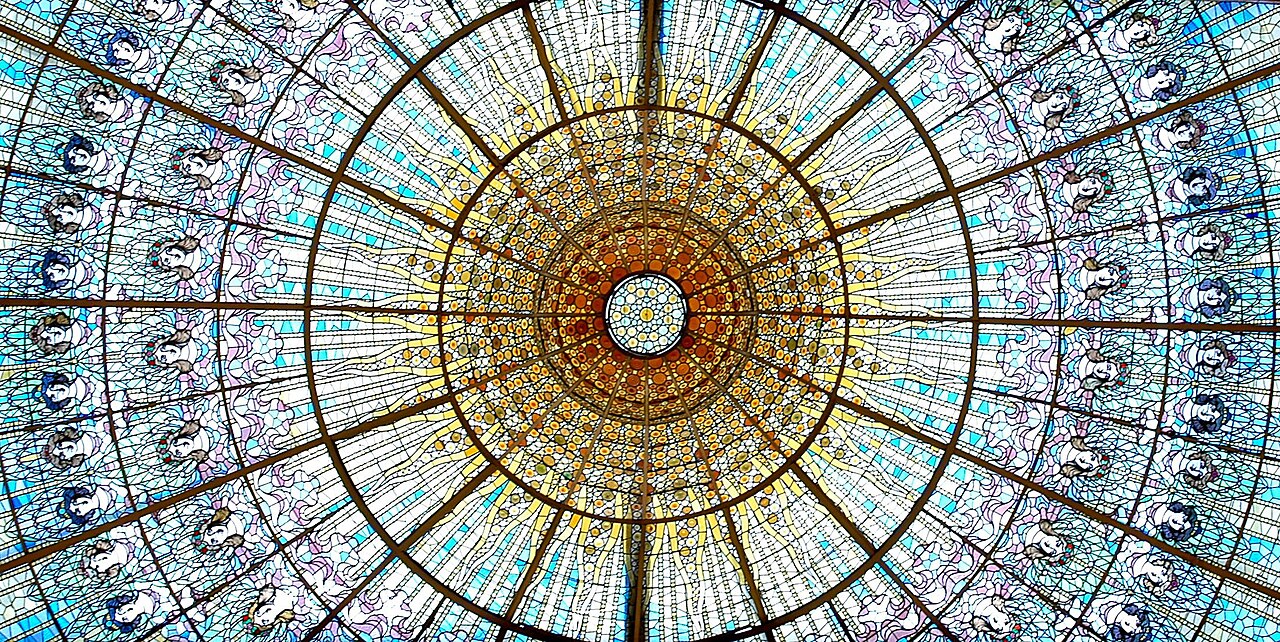
The Palau de la Música is the only concert venue in Europe that is illuminated only by natural light during the day. Its stained-glass skylight was designed by Antoni Rigalt, and its shades of gold surrounded by blue plays homage to the sun and the sky.
What is the Best Time to Visit Palau de la Música Catalana?
For daytime tours: Morning slots, particularly the first tour of the day at 9:00am, offer the best experience. The concert hall is lit entirely by natural light, and in the morning the amber tones of the stained glass dome are at their warmest and most vivid. There is also the chance of catching a choir in rehearsal, which can be a surprising and unexpected highlight of your entire visit. By late morning, tour groups from cruise ships and organised excursions begin arriving in numbers, and the experience inside the hall becomes noticeably more crowded.
For afternoon light: Late afternoon sends warm light through the hall's stained glass windows at a different angle than the morning, and this draws many photographers. However, afternoon slots from around 2:00pm onward can be more affected by performance preparations limiting access.
Best days: Weekdays in term time see fewer visitors than weekends and holidays. Tuesday through Thursday mornings in the off-peak months (October through April, excluding Easter) are the quietest daytime windows.
For a concert: Thursday and Friday evening performances offer a good midweek option with fewer tourists than weekend shows. The Sunday noon concerts are popular with locals and have a particularly lively atmosphere.
The question of tour vs. concert: Attending even a modestly-priced concert at the Palau is a better use of money and time than a daytime tour alone. For only marginally more than the tour price in some cases, you get a full evening's experience, you see the hall as it was designed to be experienced, you hear the acoustics in action, and you get to take photographs before the performance begins (photography is not permitted during concerts themselves). If there is any performance on the programme that interests you, I would always suggest going to the concert over the tour.
What is Inside Palau de la Música Catalana?
The Palau is a single primary space: the concert hall, surrounded by subsidiary rooms and public areas. Unlike a museum, there is no route through dozens of galleries. The building's power is concentrated, and most of what makes it remarkable is visible from a single vantage point in the auditorium.
The exterior facade: Before entering, spend time with the exterior. The corner of Carrer de Sant Pere Més Alt and Carrer de l'Amadeu Vives is where the sculptural programme of the facade reaches its peak: an arched sculptural composition called La Cançó Popular Catalana (The Catalan Folk Song), by Miquel Blay, showing figures representing Catalan folk music surrounding a bust of the composer Josep Anselm Clavé. Above it, busts of Beethoven, Bach, Palestrina, and Wagner are set into the facade. Every surface is ceramic: floral capitals on columns, mosaic panels in deep blues and greens, and ornamental brickwork that carries the Modernista insistence on integrated decorative and structural elements.
The entrance stairs and vestibule: The main entrance draws you up a staircase with mosaic balustrades and brick columns topped with ceramic flowers. The ceiling above is a forest of layered arches decorated with glazed ceramic tiles. The light is already extraordinary before you reach the main hall.
The Sala Lluís Millet: A long, light-filled reception room on the first floor named after one of the Orfeó Català's founders, the Sala Lluís Millet serves as a pre-concert gathering space and a meeting room. Its ceramic-tiled walls, ceramic columns, and long balcony overlooking the facade give some of the best exterior views of the building. Plaques and busts of musicians and patrons line the walls. On the balcony, you can lean out and look down at the street from between the mosaic columns. This is one of the rooms that daytime tour visitors can often explore at their leisure, and it is worth more than the few minutes most people give it.
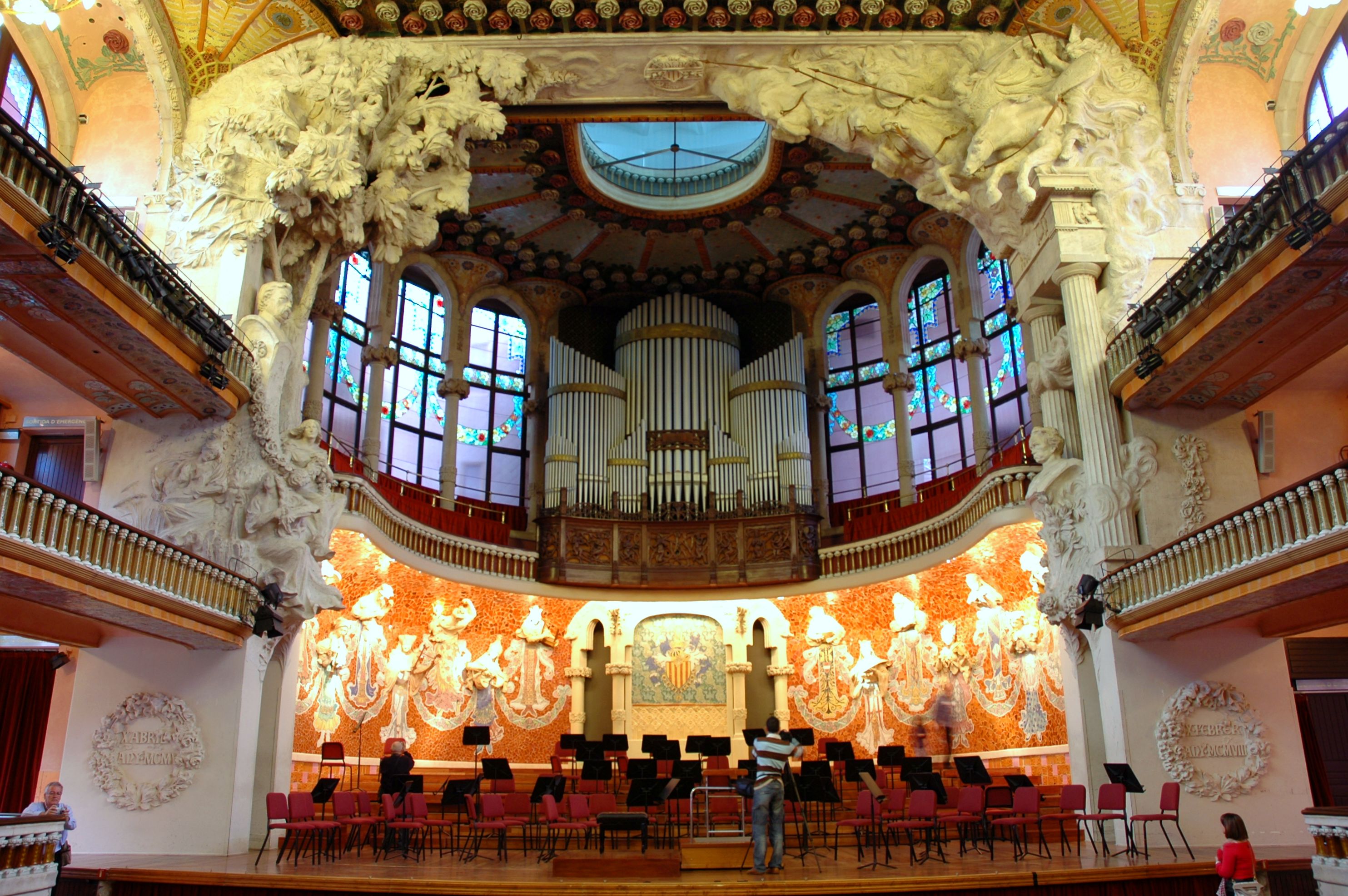
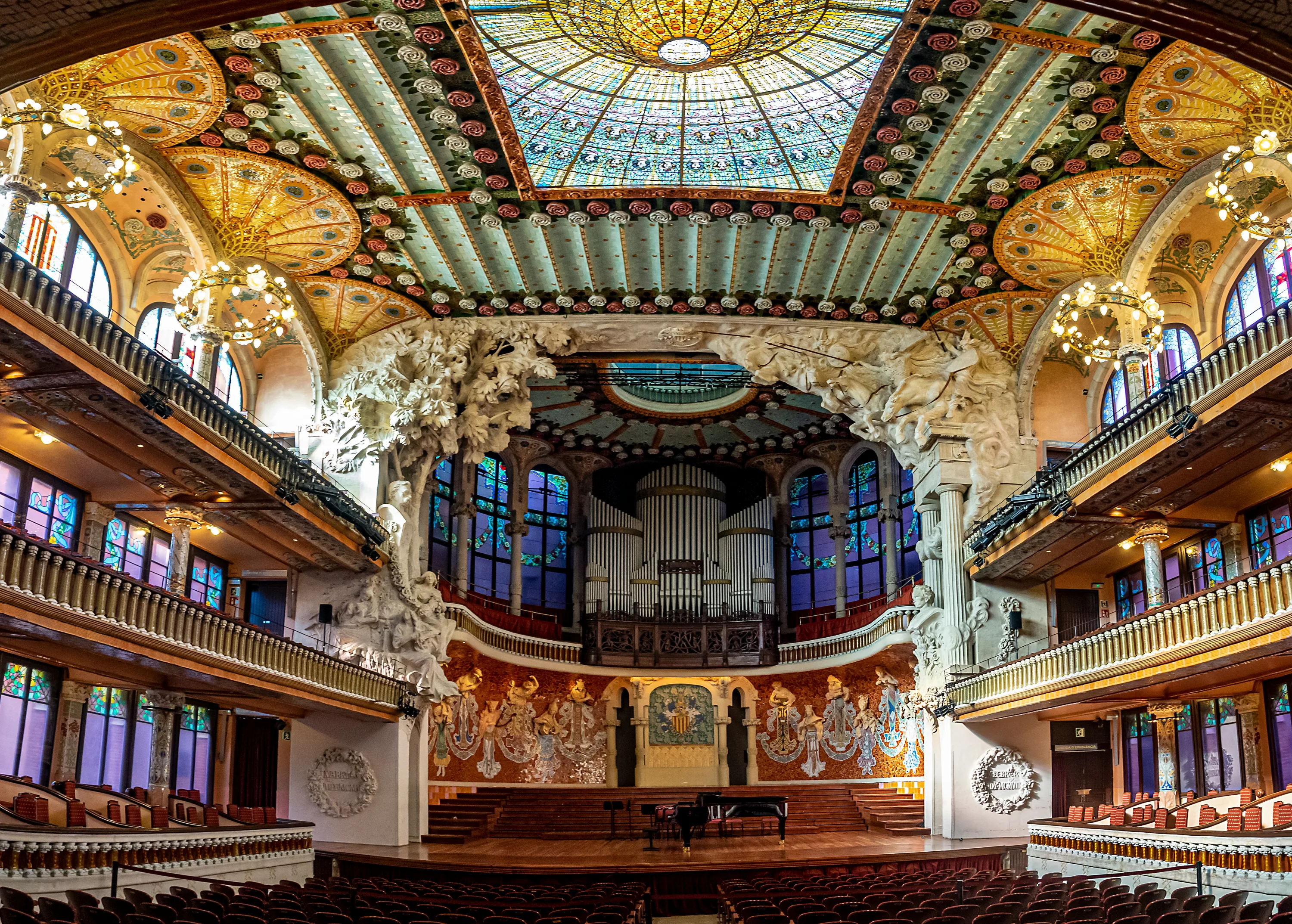
The concert hall: The auditorium is the Palau's defining space and the reason it is on every serious visitor's Barcelona list. The hall holds approximately 2,200 people and is designed as a glass-and-ceramic box: the walls on both long sides are almost entirely made up of stained glass windows, and the ceiling rises to the central inverted dome of amber, gold, and blue glass from which natural light falls directly onto the stage. During a daytime visit, the hall is illuminated solely by this natural light, producing a quality of light unlike any other concert hall in the world. Domènech i Montaner described this as his "garden of music," and the metaphor is literal: the 2,000 ceramic flowers, the horses of the Valkyries emerging from the stage proscenium, the mosaic columns, and the stone muses playing instruments across the back wall make the hall feel as if it grew from the earth rather than being constructed from it.
The proscenium and the organ: The stage is framed by a dramatic sculptural arc. On the left, a stone relief of the Valkyrie cavalry from Wagner's operas charges out of the wall in three dimensions. On the right, a terracotta female figure representing Catalan folk song leads a chorus of women. Between them, the stage is backed by a great pipe organ built in 1908 and still in regular use. Eighteen terracotta muses playing instruments line the back wall above the performers. The effect from the main seating level, particularly when the hall is in performance, is overwhelming.
The Petit Palau: Added in 2004 by architect Óscar Tusquets in the extension behind the original building, the Petit Palau is a modern 508-seat chamber concert hall with excellent acoustics. It is used for smaller ensembles, chamber performances, and some flamenco evenings. It lacks the visual drama of the main hall but is a very good room for intimate performances.
Palau de la Música Catalana Programme
The Palau hosts more than 300 performances a year across an enormous range of musical genres. Understanding what is on during your visit, and whether it is worth attending a performance, is one of the most important parts of planning a trip here.
How to check and book the programme: The full concert calendar is published on the official website. Tickets are sold directly through the site with no booking surcharge. The programme is typically published several months in advance for major events, with smaller concerts added on a rolling basis.
What tends to be on:
Orchestral concerts: the Orfeó Català choral society performs regularly, and the Palau's resident programme features chamber orchestras and visiting ensembles throughout the season
Solo recitals: international pianists, violinists, and singers perform in the main hall and the Petit Palau
Jazz and world music: the Palau has a strong programme of jazz and world music, particularly in summer
Family concerts and puppet shows: popular weekend morning programmes for younger visitors
Gran Gala Flamenco: the most widely attended show in the Palau's history, running year-round. See the dedicated section below.
Guitar and vocal ensembles: smaller ensemble shows popular with tourists, typically at lunchtime or early evening
The noon concerts: The Sunday noon concerts (and some weekday noon sessions) are among the more accessible entry points to attending a performance here. They tend to be shorter (60 to 90 minutes), priced more modestly, and attended by a mix of locals and tourists. For a first visit to the hall in performance mode, these are worth considering.
Booking in advance: Popular concerts and the Gran Gala Flamenco sell out. For any specific performance that matters to you, book as soon as tickets are released. The general principle holds: the more specific your interest in seeing a particular show, the earlier you should book.
Flamenco at Palau de la Música Catalana
The most sought-after event at the Palau among international tourists is the Gran Gala Flamenco, a production that has run here in uninterrupted programming for close to two decades and is the most widely attended flamenco show in Barcelona's history.
What it is: Gran Gala Flamenco is a full theatrical flamenco show lasting approximately 75 minutes, featuring multiple dancers, a live guitarist, a violinist, a percussionist, and singers, performing a range of flamenco styles (palos) including bulerías, soleares, alegrías, tangos, and farruca. It is choreographed as a grand spectacle rather than the intimate tablao format found in smaller venues, and the scale of the Palau's main hall gives the show a cinematic quality that smaller venues cannot replicate.
Does it live up to the venue? The combination of the architecture and the performance is honestly unbelievable, and a lot of my friends describe the experience of watching flamenco in the stained glass hall as the highlight of their Barcelona trip. That being said…
First, seat category matters considerably at this venue. The Palau is a large hall with 2,200 seats, and seating runs from Category C at the back up through Category B and Category A to VIP nearest the stage. From the two cheaper categories you may notice that the distance from the performers makes it harder to engage with the subtlety of the dancing. If you are going to attend this show, pay for Category A at minimum, and consider VIP if you want a fully immersive experience.
Second, the Gran Gala is flamenco fusion rather than traditional tablao flamenco. It is a produced theatrical show aimed at an international audience, with elaborate costumes, theatrical lighting, and choreography designed for a large hall. Visitors who want a more intimate and traditional flamenco experience are sometimes better served by smaller tablao venues. But for visitors attending flamenco for the first time, or who want to experience it in the most spectacular setting available in Barcelona, the Gran Gala is an excellent choice.
Tickets: From around €35 to €75 per person, depending on the category. Non-refundable; no cancellations. Book through the official Gran Gala Flamenco website. Some performances take place in the Petit Palau rather than the main hall; always check which space your specific date is in before booking.
Scheduling note: Three things are worth checking before you book. The show runs for most of the year but pauses through January and February, so it may not be running at all if you are visiting in deep winter. It alternates between the Palau and the Teatre Poliorama on La Rambla, which is a different building entirely, so confirm the venue and not just the date. And some Palau dates are staged in the Petit Palau rather than the main concert hall. The main hall at the Palau is the experience most visitors are booking for, so verify all three.
Is Palau de la Música Catalana Worth Visiting?
For a daytime self-guided or guided tour, the experience can go one of two ways. The building is extraordinary, and I found the concert hall truly astonishing on first sight: the stained glass dome, the muses on the back wall, the charging horses on the proscenium, all of it together in a space that is very much alive with light and surface. For anyone with an interest in architecture, Catalan Modernisme, or craftsmanship on this scale, it is an absolutely worthwhile visit. For €20 to €22, it is also reasonable value by the standards of Barcelona's major cultural attractions.
However, 50 minutes can feel brief for the price, particularly if you are not already engaged with the history and symbolism of the building. It's a bit tourist-trap-ish in this format: in, quick film, hall, balcony, out. The guided tour helps considerably, particularly when the guide explains details like the significance of the particular flowers on the capitals, the story of the building's financing by popular subscription, or the meaning of the sculptural groups on the stage. Without that context, a rapid pass through the hall can leave visitors feeling they saw something spectacular but are not entirely sure what they were supposed to take from it.
Attending a concert is a different and considerably more satisfying experience, and this is the version I would always recommend first. For often only a small premium over the tour ticket, you get to experience the hall the way it was designed to be used: with music filling the acoustic space, the dome glowing above you, and the entire composition of the room working together in real time. Tourists with decades of concert-going experience frequently describe their evening at the Palau as among the most memorable performances of their lives, almost regardless of what was being performed.
If a concert is simply not possible for your schedule, go on the guided tour rather than self-guided, take the first slot of the morning, and allow yourself time in the Sala Lluís Millet that is not on the clock.
Where Should I Eat Near Palau de la Música Catalana?
Inside the Palau:
Café Palau occupies the building's foyer, a space of remarkable atmosphere: brick arches decorated with ceramic tiles, ceramic flowers built into the pillars, and coloured glass that makes clear this cafe has been integrated into the Modernista building with care. There is indoor seating and an outdoor terrace on the small plaza directly in front of the entrance. I enjoyed a coffee here before my visit and the setting really adds to the whole experience. Sandwiches and light meals are available. However, queues can be long in the 30 minutes before a performance, so allow extra time if you plan to eat or drink here pre-show.
A short walk away:
El Xampanyet on Carrer de Montcada, around a seven to eight-minute walk south through El Born, is one of my favourite pre- or post-visit stops in the area. A standing tapas bar run by the same family since the 1930s, with house cava, anchovies, and a lively local atmosphere. Arrive at noon or early evening before the crowds. Note that it closes all day Sunday and after mid-afternoon on Saturday, which rules it out for most weekend concert nights. Budget around €12 to €18 per person.
Mercat de Santa Caterina is five minutes on foot and an excellent option for a quick and inexpensive lunch. It opens Monday to Saturday from 7:30am, closing mid-afternoon on Monday, Wednesday, and Saturday and staying open into the evening on Tuesday, Thursday, and Friday, with a shorter schedule through July and August. The bar inside the market serves tapas and simple Catalan dishes at local prices. Considerably quieter than La Boqueria, and the tiled wavy roof by Enric Miralles is worth seeing in its own right.
Tosca Palau sits directly opposite the Palau's entrance on Carrer de Sant Pere Més Alt and offers a broad selection of tapas, pintxos, wines, and cocktails. Open all day. The location makes it the most convenient option for a post-tour or pre-show drink. The food is solid rather than memorable, but the position and the outdoor seating on the narrow street are appealing.
Bar del Pla on Carrer de la Montcada in El Born, around eight minutes on foot, is a neighbourhood tapas bar that attracts a good mix of locals and visitors. The croquetes and the patatas bravas are the things to order. No reservations for lunch on weekdays; book ahead for dinner at weekends.
Caelis on Via Laietana, approximately a three-minute walk from the Palau, is a Michelin-starred restaurant in the Hotel Ohla Barcelona with a tasting menu that draws on Catalan produce and classical French technique. It opens Wednesday to Saturday only and the last dinner sitting is early by Barcelona standards, so plan it as dinner before a performance rather than after one. Book well in advance.
For a pre-concert dinner, the timing of Barcelona's eating culture works in visitors' favour: evening performances usually start late, commonly at 8:00pm or 9:30pm, which leaves room for an unhurried dinner beforehand in the surrounding streets. Check the day of the week when you plan, though. Several of the best options in El Born, El Xampanyet and Bar del Pla among them, close on Sunday, which is the night the Gran Gala Flamenco most often plays.
What Else is There to Do Near Palau de la Música Catalana?
The Palau sits at the intersection of the old city's densest cultural corridor, and the surrounding area rewards extended exploration.
Recinte Modernista de Sant Pau is the most natural companion visit to the Palau, though it is not within walking distance. It sits around 3 km north in the Eixample, and the simplest route is Line 4 from Urquinaona direct to Guinardó | Hospital de Sant Pau. Also designed by Lluís Domènech i Montaner, and begun in 1902, several years before the Palau, the former Hospital de Sant Pau is his most ambitious work: a UNESCO World Heritage campus of Art Nouveau pavilions, gardens, and underground passages spread across an entire city block. Where the Palau is concentrated and intense, Sant Pau is expansive and serene. A combined ticket covering both sites is available and represents excellent value.
Basílica de Santa Maria del Mar is around a 10-minute walk south through El Born. The 14th-century Gothic basilica built by the neighbourhood's stonemason community is considered the finest Gothic church in Barcelona, with a spatial clarity and proportional beauty that distinguishes it from more elaborate Gothic examples elsewhere. The cultural visit costs €8 and covers the interior, the crypt, the gallery museum, and the towers and roof terraces, running Monday to Saturday from 10:00am and Sunday from 1:00pm. Outside those hours entry is free, though you are then visiting a working church rather than touring it, and the towers and crypt are closed.
Museu Picasso is around 8 minutes on foot through the medieval lanes of El Born. The most important collection of Picasso's formative years, displayed across five connected medieval palaces. Advance booking required.
El Born neighbourhood is the immediate context for the Palau and rewards an hour of unhurried walking. The lanes between Carrer de la Princesa, Carrer del Rec, and Passeig del Born have a concentration of independent shops, wine bars, and tapas bars that is among the most enjoyable in Barcelona. The Passeig del Born itself, a tree-lined pedestrian promenade, is a natural endpoint to a morning or afternoon in this part of the city.
Parc de la Ciutadella is around 12 minutes on foot east, offering a calm contrast to the density of the old city with the ornamental waterfall, rowing lake, and lawns used by locals for picnics and exercise.
The Gothic Quarter is directly west, and the walk from the Palau through the medieval streets to the Cathedral and Plaça de Sant Jaume takes around 15 minutes. The Roman ruins visible through the glass floors of the MUHBA history museum on Plaça del Rei are worth a stop.
Rules, Bags, and Security
Bag policy: Small handbags and daypacks only. Larger bags and luggage are not permitted inside the building for either tours or concerts. There is no cloakroom or left-luggage service for daytime visits, so do not plan to arrive with a suitcase between hotels. On concert nights there is a wardrobe in the Petit Palau lobby where you should leave bags, backpacks, cameras, video equipment, and umbrellas.
Photography: Personal photography is permitted throughout the building during daytime tours. Photography is not permitted during concert performances. During the Gran Gala Flamenco and other shows, this rule is enforced.
Noise: During tours, the guides will indicate where groups should be quiet, particularly if a rehearsal is taking place.
Children: Children are welcome at daytime tours and at performances appropriate to their age. The Palau's family programme includes puppet shows and family concerts specifically designed for younger audiences. For the Gran Gala Flamenco, children aged 3 and over are admitted; the show runs for 75 minutes and the language barrier is not significant given the primarily visual and musical nature of the performance.
Re-entry: Not permitted during tours.
Accessibility at Palau de la Música Catalana
The Palau de la Música Catalana is fully accessible for visitors with reduced mobility. Lifts, chairlifts, and ramps provide access to all floors and balconies. Adapted restrooms are available at the reception level. Wheelchair hire is available on request.
The building's accessibility was substantially improved during the 2003 to 2004 extension project by Óscar Tusquets, which integrated step-free routes throughout the original building as part of the renovation.
Reduced-mobility parking spaces are available for holders of the PMR (mobility restriction) card.
For visitors with visual or hearing impairments: tours with a Spanish Sign Language interpreter can be arranged for groups of 15 or more, and guided tours designed for blind and low-vision visitors are available for groups of the same minimum size. Audio description on the Palau's audio guides is in development but not yet available.
Final Tips for Visiting Palau de la Música Catalana
Book the first tour of the morning at 9:00am. The natural light through the stained glass dome is at its most beautiful, the hall is at its quietest, and there is a chance of catching a choir in rehearsal, which transforms the experience entirely.
Seriously consider attending a concert instead of, or as well as, the daytime tour. The Palau was built for music. Experiencing it in performance mode is the way Domènech i Montaner intended it to be used, and the acoustics in a live concert make the architecture come alive in a way a silent daytime visit cannot replicate.
The combined ticket with Recinte Modernista de Sant Pau is excellent value and covers the two greatest works of Domènech i Montaner in a single purchase. If you are interested in Catalan Modernisme, do not miss this combination.
For the Gran Gala Flamenco, book Category A seats at minimum. Seating runs from Category C at the back up through B and A to VIP, and from the two cheaper categories you are a long way from the stage in a 2,200-seat hall, which significantly affects how much you can engage with the dancers. VIP is worth it if budget allows.
Check which space your flamenco or concert performance is in. Some performances, including some Gran Gala Flamenco dates, take place in the Petit Palau rather than the main hall. The main hall is the experience most visitors are seeking. Verify your specific date before booking.
This is NOT a Gaudí building. A common misconception is that the Palau was designed by Antoni Gaudí. It was designed by Lluís Domènech i Montaner, Gaudí's contemporary and rival, and the building reflects a distinct vision of Catalan Modernisme that is in many ways the equal of Gaudí's major works. Knowing this before you arrive lets you appreciate the building's specific character rather than seeing it through the wrong lens.
Arrive 15 to 20 minutes before your tour slot. Security checks and entrance procedures at the Palau are relatively quick, but arriving with a few minutes to spare means you start at ease rather than flustered.
Spend time in the Sala Lluís Millet. Many visitors walk through this reception room quickly on the way to the concert hall. Slow down here, go out onto the balcony, and look at the facade from above. It is one of the best views in the building and one of the most overlooked.
Pre-concert dining in the area works well. Evening performances commonly start at 8:00pm or 9:30pm, and an unhurried dinner in El Born beforehand is one of the most enjoyable evening routines in Barcelona. Check opening days before you plan around a specific place, since El Xampanyet and Bar del Pla both close on Sunday and the Gran Gala often plays that night.
The Barcelona Card gives 20% off daytime tour tickets, but only at the box office. The discount is not applied to online bookings, so you have to queue at the ticket office and show the card. The same 20% applies to the Ruta del Modernisme and City Tours passes. Box office tickets carry a €2 per-ticket surcharge compared with booking online, so weigh that and the queue against the saving.
Back to Barcelona Attractions
Explore other Barcelona attractions
" width="24px"><path d="M 0 0 L 24 0 L 24 21.231 L 0 21.231 Z" fill="transparent" height="21.230768474975793px" id="nL2EwDcS9" width="24px"/><path d="M 0 0.541 C 0 0.242 0.245 0 0.547 0 L 2.735 0 C 3.037 0 3.282 0.242 3.282 0.541 L 3.282 4.598 C 3.282 4.897 3.037 5.139 2.735 5.139 L 0.547 5.139 C 0.245 5.139 0 4.897 0 4.598 Z" fill="rgb(196, 217, 201)" height="5.138657337892187px" id="hZ_rlBe_S" transform="translate(0 16.092)" width="3.2820512820512358px"/><path d="M 0 0.541 C 0 0.242 0.245 0 0.547 0 L 2.735 0 C 3.037 0 3.282 0.242 3.282 0.541 L 3.282 7.843 C 3.282 8.142 3.037 8.384 2.735 8.384 L 0.547 8.384 C 0.245 8.384 0 8.142 0 7.843 Z" fill="rgb(230, 211, 160)" height="8.38412513024521px" id="HgVBxIz3e" transform="translate(5.128 12.847)" width="3.282051282051235px"/><path d="M 0 0.541 C 0 0.242 0.245 0 0.547 0 L 2.735 0 C 3.037 0 3.282 0.242 3.282 0.541 L 3.282 12.982 C 3.282 13.281 3.037 13.523 2.735 13.523 L 0.547 13.523 C 0.245 13.523 0 13.281 0 12.982 Z" fill="rgb(232, 207, 164)" height="13.522782468137464px" id="utgrDnoM9" transform="translate(10.325 7.708)" width="3.282051282051377px"/><path d="M 0 0.541 C 0 0.242 0.245 0 0.547 0 L 2.735 0 C 3.037 0 3.282 0.242 3.282 0.541 L 3.282 16.498 C 3.282 16.797 3.037 17.039 2.735 17.039 L 0.547 17.039 C 0.245 17.039 0 16.797 0 16.498 Z" fill="rgb(233, 196, 166)" height="17.038705909853153px" id="OLOhW6STz" transform="translate(15.521 4.192)" width="3.2820512820512384px"/><path d="M 0 0.541 C 0 0.242 0.245 0 0.547 0 L 2.735 0 C 3.037 0 3.282 0.242 3.282 0.541 L 3.282 20.69 C 3.282 20.989 3.037 21.231 2.735 21.231 L 0.547 21.231 C 0.245 21.231 0 20.989 0 20.69 Z" fill="rgb(217, 170, 153)" height="21.230768474975793px" id="H5Z8wcwkd" transform="translate(20.718 0)" width="3.2820512820512278px"/></g></svg>)