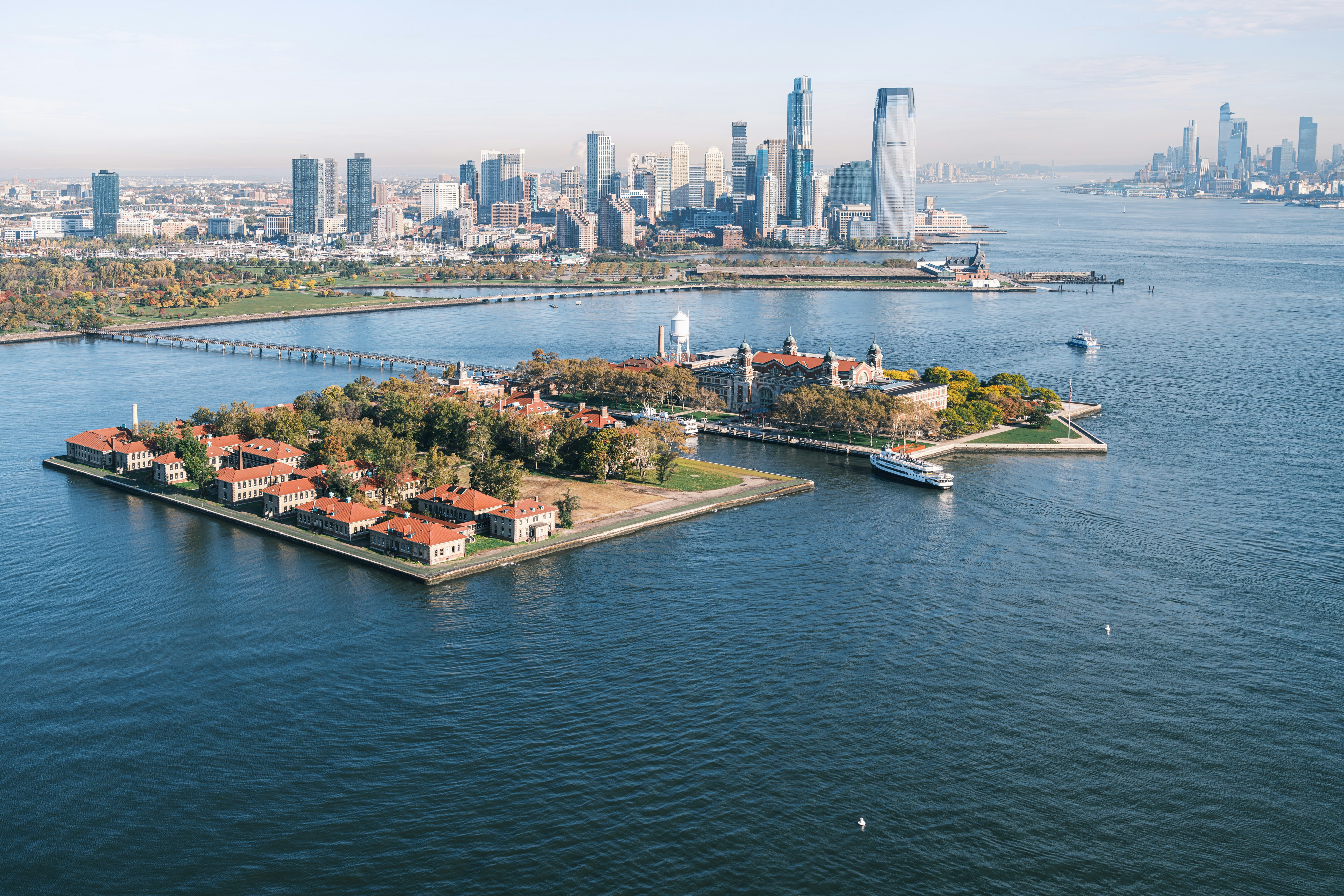
New York City • Upper New York Harbor
Ferry tickets should be booked in advance, especially during Spring and Summer months. Ferries leave from both Liberty State Park in New Jersey, and Battery Park in New York / Manhattan, and all ferries visit both Ellis Island and Liberty Island.
Book 1-3 Days Ahead
General Entry Visit
Book 2-4 Weeks Ahead
Hard Hat Tour
Back to New York City Attractions
Ellis Island New York: Everything You Need to Know Before You Visit
Updated September 2026
Ellis Island processed more than 12 million arrivals between 1892 and 1954, making it the largest federal immigration station the United States ever built and the single point of entry through which a huge share of American families can trace their arrival. The Main Building has been a museum since 1990, and it is currently in the middle of a $100 million reimagining that is rebuilding more than 100,000 square feet of exhibits while the doors stay open. But one of the trickiest aspects of visiting is figuring out the ticketing system, because the museum itself costs nothing but the ferry that gets you there is the part you need to book ahead.
At a Glance
How Early to Book:
Book a ferry ticket a few days before for general entry. For a hard-hat tour, book a week or two ahead.
Best Times to Visit:
Take the first ferry out to Ellis Island for the smallest crowds.
Ticket price:
Ellis Island is technically free, but the ferry to access it costs $26.00 for adults. It travels to Liberty Island as well. Hard hat tours cost $55.00 in addition to the ferry.
Where to Book:
Book on the Statue City Cruises Website for ferry tickets. Ellis Island itself does not require its own ticket.
Ferry Dock Addresses:
Statue City Cruises at Castle Clinton, The Battery, New York, NY 10004 (navigate to 17 State Street). In New Jersey, the CRRNJ Terminal, 1 Audrey Zapp Drive, Jersey City, NJ 07305.
Do You Need to Book Ellis Island Tickets in Advance?
Yes, you need to book a ferry ticket. There is no way to reach Ellis Island other than the ferry, and the ferry is operated by one company (Statue City Cruises) under contract to the National Park Service. Private boats are prohibited from docking, so if you do not have a ferry ticket, you do not get on the island.
Where to book: Statue City Cruises is the only authorised seller, at statuecitycruises.com. Everything else you see advertised is a reseller at a markup, a boat that circles the harbour without landing, or a scam. The perimeter of Battery Park is worked by people selling fake and overpriced tickets, and they are persistent enough that both the Park Service and the ferry operator warn about them by name on their own websites.
Prices: General admission is $26.00 for adults, $16.50 for children aged 4 to 12, and $22.50 for seniors aged 62 and over. That single ticket covers round-trip ferry transport, landing on both Liberty Island and Ellis Island, entry to the Statue of Liberty Museum, entry to the Ellis Island National Museum of Immigration, and the audio guide for both islands. Pedestal Reserve and Crown Reserve tickets exist for the Statue of Liberty and cost only a few cents more, but they are capacity-limited rather than price-limited, which is why they vanish so far ahead.
How far ahead: For Ellis Island alone, a few days is usually enough outside peak season, and a week or two in summer. Crown tickets are a different matter and routinely sell out around three months out. If your trip involves both the Crown and Ellis Island, let the Crown availability set your date and build everything else around it.
City passes: New York CityPASS, the New York Pass, and the New York Explorer Pass all include the general admission ferry, so the boat is covered if you already hold one. None of them include Crown access, Pedestal access, or the Hard Hat Tour, which have to be booked directly with Statue City Cruises.
The pass that does not work: An America the Beautiful national parks pass gets you nothing here. Because the Park Service charges no entrance fee at Ellis Island, there is no entrance fee for the pass to waive, and the ferry is classed as transport rather than admission. The same logic means NPS fee-free days make no difference either. People turn up expecting their annual pass to cover this and it does not.
Cancellation: Refunds are available on cancellations made at least 24 hours before departure, which makes booking early a low-risk move.
Nominative ticketing: General admission tickets are not tied to a name. Crown Reserve tickets are, with photo ID required to match, and there is a limit of four Crown tickets per transaction. Anyone aged 17 or under must be accompanied by an adult aged 25 or over to board.
Statue of Liberty and Ellis Island Tickets: Visiting Both Islands
This one trips people up all the time, so I'll be as clear as possible. There is no separate Ellis Island ticket and no separate Statue of Liberty ticket. One ferry ticket lands you on both islands. You cannot buy a cheaper Ellis-only fare, and you do not need to buy anything twice.
What does vary is the order that you visit. Ferries leaving from Battery Park in Manhattan stop at Liberty Island first, then Ellis Island, then return to Battery Park. Ferries leaving from Liberty State Park in New Jersey do the reverse, hitting Ellis Island first. Both routes cost the same and both give you the same access, so the choice comes down to which terminal is easier for you and which island you would rather see with fresh legs.
The trap is the clock. A security check-in time of 2pm or later will not leave enough room to do both islands, and the last outbound ferry of the day from Battery Park skips Ellis Island entirely and goes only to Liberty Island. The Park Service advice is to be on a boat leaving the mainland before 1pm if you want both. Aim earlier than that and you'll be way more relaxed.
If Ellis Island is the reason you are making the trip and the Statue is a bonus, stay on the boat at Liberty Island rather than disembarking. You will get closer views of the Statue than any sightseeing cruise in the harbour, and you will arrive at Ellis with two or three unhurried hours instead of one rushed one.

Ellis Island Admission Fee: What You Actually Pay For
There is technically no admission fee for Ellis Island. The National Park Service does not charge entry to the Ellis Island National Museum of Immigration, and it does not charge entry to the Statue of Liberty Museum either. Both are free.
What you pay for is the ferry ride. The $26.00 adult fare is a transport charge levied by the concession that runs the ferry service, not a ticket to the museum. Once you are standing on the island, everything inside the Main Building is included: all three floors of exhibits, the films, the ranger programmes, and the audio guide.
This distinction matters more than it sounds. It explains why national parks passes do not help, why there is no "museum only" discount, and why the cost of a family visit scales with the number of bodies on the boat rather than with how long you spend inside. It also means that if you are already holding a city pass that includes the ferry, your entire day on Ellis Island costs nothing further beyond whatever you spend in the café.
The only things on the island that cost extra are the Hard Hat Tour of the hospital complex and anything you buy in the bookstore or café.
Ellis Island Opening Hours and Entry Information
Ellis Island is open every day of the year except Thanksgiving, the fourth Thursday in November, and December 25. The island has no fixed opening time of its own in the way a museum on a street does, because it opens when the first ferry arrives and closes when the last one leaves.
Summer, roughly late May through early September: The first departure from Battery Park is around 8:30am on weekdays, with boats running every 20 to 30 minutes. The last outbound sailing is around 5:00pm, and the final return from Ellis Island runs as late as 7:10pm.
Autumn and spring: First ferry moves to around 9:00am and the last outbound pulls back to roughly 4:00pm, with the last boat off Ellis Island around 6:00pm.
Winter: First ferry around 9:00am, last outbound as early as 3:30pm, and the closing ferry from Ellis Island around 5:15pm.
Last entry: There is no separate last-entry time for the museum, but Ellis Island begins closing 30 minutes before the final ferry departs, so treat that as your cut-off for being inside the building.
Schedules shift several times a year and are published as PDFs on the Statue City Cruises site, with separate timetables for Battery Park weekdays, Battery Park weekends, and Liberty State Park. Check the one that matches your date rather than assuming, because the difference between the summer and winter last boat is nearly two hours.
Address: Ellis Island, Jersey City, NJ 07305. Departure points are Castle Clinton in Battery Park, New York, NY 10004, and Liberty State Park at 1 Audrey Zapp Drive, Jersey City, NJ 07305.

An estimated 40% of all current American Citizens can trace at least one ancestor back through Ellis Island. It welcomed 12 million immigrants between 1892 and 1954, including over 1 million in just 1907 alone.
The Ellis Island Ferry: Boarding, Route and Timings
The ferry is not just a formality on the way to the attraction. It takes a chunk of your time and the part that visitors don't really envision as part of their visit.
Security first: Everyone boarding goes through airport-grade screening at the departure point before they get near a boat. The time printed on your ticket is your screening slot, not a guaranteed sailing time. Arrive at least 30 minutes before it. Screening can take a few minutes on a quiet January morning and well over an hour on a July weekend.
No luggage, no lockers: There is no storage at either screening facility and no storage on the islands. Suitcases, carry-on bags, and large parcels will not be allowed through, and there is nowhere to leave them. If you are flying out the same day, sort your bags before you come.
The crossing: Battery Park to Liberty Island runs about 15 minutes. Liberty Island to Ellis Island is another short hop. From Liberty State Park in New Jersey the run is shorter still. If you stay aboard for the full loop without landing anywhere, the round trip takes roughly an hour.
Which terminal: Liberty State Park in New Jersey is the quieter option by a wide margin. The queues are shorter, the parking is plentiful and cheaper than anything in Lower Manhattan, and you reach Ellis Island first while the museum is still calm. Battery Park is more convenient if you are staying in Manhattan and want to fold the visit into a downtown day.
Between the islands: Your ticket lets you board any available inter-island ferry, so you are not locked into a return time. Boats run frequently enough that you can leave when you are ready rather than watching a clock, right up until the last sailing.
One practical detail worth knowing: the ferries have upper outdoor decks reached by stairs, and the approach to Liberty Island from the water is the best view of the Statue you will get all day. Get up there before you leave the dock if you want it.
What is the Best Way to Get to Ellis Island?
You cannot get to Ellis Island directly. What you are actually planning is how to reach one of the two ferry terminals.
To Battery Park by subway: Take the 1 to South Ferry, the 4 or 5 to Bowling Green, or the R or W to Whitehall Street. All three leave you a short walk from The Battery. The security screening facility and the ferry dock sit behind Castle Clinton on the waterfront side of the park, which moved to its current position in 2024, so old directions and older guidebooks will send you to the wrong spot.
To Battery Park on foot: It is about 10 minutes from Wall Street, 15 from the 9/11 Memorial, and 20 from Brookfield Place. The walk down through the Financial District is pleasant and gets you past Bowling Green and the Charging Bull on the way.
To Battery Park by bus: The M15 and M20 run down to the Battery area.
To Liberty State Park: The Hudson-Bergen Light Rail has a Liberty State Park stop, though it leaves you with a walk of 15 to 20 minutes to the ferry terminal in the historic railroad terminal building. PATH to Exchange Place or Newport plus a short rideshare is quicker if you are carrying anything.
Driving: Do not attempt this on the Manhattan side. Parking near Battery Park is scarce and expensive. Liberty State Park has ample car and bus parking at lower rates, which is the main reason families driving in from outside the city should use the New Jersey terminal.
A tip specific to this trip: buy online before you leave your hotel. The only authorised on-site ticket window in Manhattan is inside Castle Clinton, and joining that queue before joining the security queue can add an hour to a busy morning for no benefit.
Is Ellis Island in New York or New Jersey?
It's actually located in both. A 1998 Supreme Court ruling settled a long-running border dispute by splitting the island between the two states. The original natural island, including the Main Building that houses the museum, sits within New York State. The 27.5 acres of landfill added over the following decades, which is most of the island's current area including the hospital complex on the south side, fall within New Jersey.
None of this will impact your visit, but it does explain two things that confuse people. The museum's mailing address is in Jersey City even though the museum is technically in New York, and the entire island has been federal property since 1808 regardless of which state line it sits inside.
How Much Time Should I Spend at Ellis Island?
On the island itself: Two hours covers the museum comfortably at a normal pace with the audio guide. Three hours is better if you want to sit through a film, catch a ranger talk, and spend real time in the Registry Room rather than passing through it. If you are pushed, an hour will get you the Great Hall, the Baggage Room, and the second-floor processing exhibits, which is the emotional core of the place.
The whole day, both islands: Budget four to six hours door to door from Manhattan. That breaks down as 30 to 45 minutes for screening and boarding, 15 minutes to Liberty Island, an hour to 90 minutes there, the short hop to Ellis, two hours or more at the museum, and the return sailing.
Ellis Island only: Around three hours in total if you stay aboard at Liberty Island. This is the option I would take on a second visit to New York, and it is a much calmer day.
Adding the Hard Hat Tour: Add at least 90 minutes for the tour itself plus buffer either side. Realistically that turns Ellis Island into a half-day on its own, so pair it with a light Liberty Island stop or skip Liberty entirely.
What is the Best Time to Visit Ellis Island?
Time of day: The first ferry is the best option by far. The museum is quietest before about 11am, and the difference is not marginal. By late morning in season the Main Building fills with school groups and tour parties, and the acoustics of a vaulted hall built to process thousands of people mean noise carries brutally. The Registry Room in particular is worth seeing before the crowd arrives, because the whole point of the space is its emptiness.
Day of week: Weekdays outside term time are best. Weekends bring larger crowds to the ferry queue but fewer school groups inside. If your only option is a weekday in spring or autumn, get there early and do the museum before the coaches land.
Season: Winter is the underrated choice. Ferry queues shrink dramatically, the museum is calm, and the harbour crossing in cold clear air is spectacular. The trade-off is a much shorter operating day and a real chance of weather cancelling sailings. Summer gives you the longest day and the worst queues, and the Main Building can get uncomfortably warm on the upper floors.
Weather: The screening facilities offer limited shelter, and standing in a slow security line in heavy rain is a miserable start to a day. If the forecast is bad and your ticket is flexible, moving it is worth the trouble.
Free days: There are none in the useful sense, because there is no entrance fee to waive. Federal fee-free days do not reduce the ferry fare.

What is Inside the Ellis Island National Museum of Immigration?
The museum occupies three floors of the restored Main Building, and the layout roughly follows the path an arriving immigrant would have taken.
The Baggage Room, first floor. This is where you enter, as arrivals did, and where the information desk, audio guide pick-up, and bookstore sit. The room is currently being reworked as part of the wider renovation, with a temporary wall in place.
The Registry Room, second floor. Also called the Great Hall, this is the reason to come. Restored in 1986 to its 1918 appearance, it is a vast tiled hall with a vaulted Guastavino ceiling where arrivals queued for legal and medical inspection, sometimes for hours. Standing in it empty is the moment the numbers stop being abstract. Look for the Kissing Post, the spot near the stairs where families were reunited after processing.
Through America's Gate and Peak Immigration Years, second floor. These walk through the inspection process in detail, from the buttonhook used to check eyelids for trachoma to the chalk marks inspectors used to flag people for further examination. The chalk mark exhibit is the one that tends to stay with people.
Third floor. Restored dormitory rooms, Treasures from Home with objects arrivals carried with them, Silent Voices on the decades of abandonment after 1954, and Ellis Island Chronicles tracing the physical growth of the island itself. The changing exhibit gallery on this floor is currently closed.
Outside. The American Immigrant Wall of Honor sits on the seawall facing Manhattan, inscribed with names sponsored by families. Nearby, a statue of Annie Moore, the seventeen-year-old from County Cork who was the first person processed here on 1 January 1892.
A word on the renovation. The museum is thirty years old and mid-way through a substantial rebuild funded by the Statue of Liberty-Ellis Island Foundation. Expect construction noise, equipment, and the occasional short-notice closure of part of an exhibit. The building remains open throughout, and the first and second floors, which hold the best material, are currently fully open.
Ellis Island Records: Searching for Your Ancestors
For a lot of visitors this might be the entire reason they are visiting. However, the family history centre on Ellis Island is closed at the time of writing. The Foundation is rebuilding it as a new Records Discovery Center, and until it opens there is no on-site record search terminal to sit down at.
The good news is that the database is free online and better than it has ever been. The Foundation's Arrival Records Collection was relaunched in 2026 with more than 100 million records, expanding through the year toward a target of over 150 million. It reaches well beyond Ellis Island, covering arrivals at New York, Texas, Florida, Hawaii, Massachusetts, California, and other ports, from the 1790s through the 1970s. That range matters, because it now includes the Castle Garden era before Ellis Island opened in 1892 and the years after it closed in 1954. Searching is free, and viewing the original scanned ship manifest needs only a free account. The same New York passenger lists are also searchable free on FamilySearch.
Do the search before you go, not on the island. Pull up your ancestor's manifest at home, note the ship, the arrival date, and the line number, then walk the Registry Room knowing they stood in it on a specific morning. That will make the visit much more powerful. Doing it the other way round means arriving with a question you cannot answer on site.
Two things to know if your search comes up empty. First- and second-class passengers were generally processed aboard ship in the harbour rather than at Ellis Island, so a wealthier ancestor may never have set foot on the island. And plenty of arrivals came through other ports entirely, including Boston, Baltimore, New Orleans, and Philadelphia. Names are also frequently indexed under old-country spellings rather than the version the family later used, which accounts for a large share of failed searches.
The Ellis Island Hard Hat Tour
The south side of Ellis Island holds a 29-building hospital complex, once one of the largest public health facilities in the United States, abandoned since 1954 and left almost entirely unrestored. The only way in is a guided Hard Hat Tour run by Save Ellis Island, and it is consistently the best thing on the island.
What you see: A 90-minute guided walk through the laundry building, infectious disease wards, kitchens and service areas, medical examination rooms, the mortuary, and the outdoor courtyards and passageways linking them. Peeling paint, empty wards, weeds through the floors. The specific highlights vary with preservation work, so no two tours are identical.
The art: The buildings house Unframed – Ellis Island, an installation by the French artist JR that pastes life-size historic photographs of immigrants, doctors, and nurses onto the walls and windows of the rooms they actually occupied. It is the reason a tour of an empty hospital turns into something people talk about for years.
Price and booking: $74 through Statue City Cruises, which includes the ferry, and this is the version to book because it guarantees your date and time. Tickets are also sold on the island itself at the Eastern National bookstore for $55 if you already have a ferry ticket, but these are unreserved and frequently unavailable. Availability through the official site is limited and worth booking well ahead.
Timings: Standard tours run from late morning through mid-afternoon, with your security check-in time roughly two to two and a half hours before the tour start. There is also an Early Bird tour starting at 10:30am with a 9:00am check-in, which gets you into the hospital before the day's crowds land. If the Early Bird slot is available, take it.
Restrictions: Minimum age 13, and under-18s must be accompanied by a parent or guardian throughout. Hard hats are provided and must be worn. Closed-toe shoes are required. The buildings are unrestored, so the tour involves stairs and uneven ground and cannot accommodate wheelchairs or mobility scooters.
Guided Tours and Audio Guides
The audio guide is free and included with every ferry ticket, available in 12 languages plus ASL, with headsets collected and returned on the island. Take it. Opinions on it are mixed and it is not the slickest audio guide in New York, but the museum leans heavily on text panels and the guide gives you voices, first-hand accounts, and structure that the wall boards do not. Without it, a lot of visitors end up skimming.
Ranger-led tours are free and cannot be reserved. They run on a first-come, first-served basis, with the day's programme posted at the Ellis Island information desk in the Baggage Room when you arrive. Frequency depends on staffing levels, so check the board as soon as you walk in rather than assuming a tour will be available later. When a good ranger is on, these are the highest-value 45 minutes on the island.
Private and third-party tours operate from Battery Park, typically bundling a guided walk of the Financial District with priority ferry boarding. They cost two to three times the ferry fare. The priority boarding is real and can save you a long queue in August, but the guiding on the island itself rarely beats a ranger talk plus the audio guide. I would spend the money on the Hard Hat Tour instead.
Junior Ranger activity booklets are available for children, with a badge to earn at the end, and they do a decent job of holding attention in a museum that is otherwise heavy on reading.
Is Ellis Island Worth Visiting?
If you have any personal connection to the place, it is extraordinary and a really powerful visit. Standing in the Registry Room having found your great-grandmother's name on a manifest the night before is 100% worth it. That is the entire reason the museum was even built, and it delivers.
If you are coming as a general tourist with no family link, temper your expectations. The museum is text-heavy. A lot of the interpretation is large printed boards, and if you are not in the mood to read, the experience flattens out into a history lesson on a wall. I have seen this frustrate people who arrived expecting artifacts and drama, and the criticism is fair. The audio guide is the difference between engaged and bored, so do not skip it.
Timing changes the verdict more than anything else. Arriving at 10am and arriving at 1pm are two different museums. In the afternoon in season the Main Building fills with school groups, the noise in the hall makes it hard to hear the audio guide or think clearly, and the Registry Room stops feeling solemn and starts feeling like a train station. Several people I would otherwise expect to love this place have come away flat purely because of when they went.
The renovation is the wildcard right now. Exhibits do sometimes sit behind hoardings, and a gallery you have read about may be shut on the day you turn up. Currently the first and second floors are fully open, which is where the best material is, so the impact is manageable. But it is worth checking the closure list before you commit a whole day.
For families, it is a mixed bag. The building itself impresses children, the Junior Ranger programme helps, and the ferry ride is a highlight in itself. But under-10s will run out of patience with the exhibits well before their parents do.
For history buffs and anyone who books the Hard Hat Tour, this is an easy recommendation and one of the best value experiences in the city. The hospital tour is the thing almost everyone enjoys the most, ahead of the museum and often ahead of the Statue of Liberty itself.
Where Should I Eat Near Ellis Island?
On the island: There is a café in the Main Building run by the park concessionaire, doing sandwiches, salads, and hot food, with outdoor seating facing the water. It isn't the best, and it gets swamped at lunchtime when school groups descend. You are allowed to bring your own food, and given the prices and the queues, a packed lunch eaten on the seawall looking at the Manhattan skyline is a better plan than it sounds. Large coolers will not clear security.
Back in Lower Manhattan, you land at Battery Park with plenty within a ten-minute walk.
Leo's Bagels, 3 Hanover Square, is where I would go before an early ferry. Proper New York bagels, open from 6am on weekdays, cheap, and the line moves fast even when the shop is full. Grab one for the boat.
Stone Street is the obvious lunch destination, a cobbled pedestrian lane five minutes from the ferry lined with taverns that put tables out in good weather. Stone Street Tavern at number 52 is the reliable pick for pub food and a cold drink, and Toro Loco at number 15 does good tacos and a lively room. The whole street is loud and busy at lunchtime, which is either the appeal or the problem depending on your mood.
Luke's Lobster FiDi, 26 South William Street, is a five-minute walk and does a straightforward, high-quality lobster roll. It is not cheap for the portion size and you should know that going in, but the lobster is excellent and it is fast.
Fraunces Tavern, 54 Pearl Street, is the upscale option and a piece of history in its own right, the building where Washington said goodbye to his officers in 1783. There is a museum upstairs and a proper dining room below. The fish and chips have a following. Book if you want dinner on a weekend.
Lox Café inside the Museum of Jewish Heritage at 36 Battery Place is the quiet one nobody mentions. Kosher, cures its own salmon in house, and sits right by the water on the Battery Park City side. If Stone Street sounds like too much after a long day, go here.
Avoid the tourist-facing places immediately ringing the ferry terminal and the carts along the Battery promenade. You are paying a captive-audience premium for food that is worse than anything four blocks inland.
What Else is There to Do Near Ellis Island?
Castle Clinton National Monument sits in Battery Park where you queue for tickets, and most people walk past it. It is free, it takes fifteen minutes, and it is the direct prequel to Ellis Island: as Castle Garden, this fort was New York's immigration station from 1855 to 1890, processing arrivals before the federal government took the job over. Seeing both in one day is the single best pairing in Lower Manhattan.
The Statue of Liberty is on the same ferry ticket and needs no extra booking unless you want inside the monument.
National Museum of the American Indian, 1 Bowling Green, is a two-minute walk from the ferry and free to enter. It occupies the old Alexander Hamilton Custom House, and the rotunda alone justifies the stop. Worth an hour.
Museum of Jewish Heritage, 36 Battery Place, is a ten-minute walk along the waterfront. Closed Mondays, Tuesdays, and Saturdays, which catches people out.
Fraunces Tavern Museum, 54 Pearl Street, five minutes away, covers Revolutionary New York in the building where it partly happened.
The 9/11 Memorial and Museum is about a fifteen-minute walk north. The memorial pools are free and open to all; the museum requires timed tickets and books up, so sort that before you travel if you want both in one day.
The Battery itself is worth twenty minutes on the way back, with the SeaGlass Carousel, harbour views, and the Sphere, the sculpture recovered from the World Trade Center plaza.
Rules, Bags, and Security
Security: Airport-style screening for every passenger before boarding, at both Battery Park and Liberty State Park. Allow at least 30 minutes, and considerably more in peak season.
Bags: No suitcases, carry-on luggage, or large parcels. There are no lockers at either screening facility and no storage anywhere on Ellis Island, so anything you bring you carry all day. Day packs and handbags are fine.
Prohibited items: Drones, scooters, skateboards, firearms, explosives and flammables, knives and sharp objects, pepper spray, mace, and all markers, both permanent and erasable. Large coolers will not pass screening.
Photography: Permitted throughout the museum. Tripods and professional setups need a permit.
Children: Anyone 17 or under must be accompanied by an adult aged 25 or over. There is no minimum age for the museum. The Hard Hat Tour requires participants to be 13 or older.
Pets: Not permitted on the ferries or on either island. Documented service animals are exempt.
Re-entry: Your ticket covers the full day, so you can move between Liberty Island and Ellis Island on any available inter-island ferry until the last sailing.
Lost property: Reports are taken at the information desk in the Baggage Room, and you can still file one after you have left the park.
Accessibility at Ellis Island
The security screening entrances have ramps and handrails, and Statue City Cruises staff assist on the ferry gangways. Ferries have enclosed main-deck cabins with priority seating near the entrance. Any deck above the main deck is reached by stairs only, and the restrooms aboard the ferries are not wheelchair accessible.
At Ellis Island, ramps and railed staircases lead from the ferry landing into the first floor of the Main Building. Two elevators serve all three floors, located on the left and right sides of the first floor with directional signage; staff at the information desk will point you to the nearest one. The exhibit floors themselves are level and navigable throughout.
A limited number of wheelchairs are available to borrow free of charge on a first-come, first-served basis. They cannot be reserved, and picture ID is required to take one out. Staff at the information desk in the Baggage Room handle this.
The Hard Hat Tour of the hospital complex does not meet ADA accessibility requirements. It runs through unrestored buildings with stairs and uneven surfaces, and wheelchairs and mobility scooters are not permitted on it.
For visitors who are deaf or hard of hearing, the audio guide is available in ASL and films in the museum are open-captioned. For blind and low-vision visitors, the museum holds a tactile three-dimensional model of the island alongside other described resources. The current renovation includes accessibility upgrades to wayfinding and navigation throughout the building.
Final Tips for Visiting Ellis Island
Book the ferry online and take the earliest slot you can stand. Everything good about this visit depends on beating the mid-morning crowd, and everything frustrating about it comes from arriving late.
Search the arrival records at home the night before. Free at the Foundation's site or on FamilySearch. Walking into the Registry Room already knowing your ancestor's ship and arrival date is a completely different experience, and the on-site record centre is closed while the new one is built.
Sail from Liberty State Park in New Jersey if you have a car or are staying downtown. Shorter queues, cheaper parking, and you reach Ellis Island first while it is still quiet.
Do not expect your America the Beautiful pass to work. There is no entrance fee to waive, and the ferry is not covered by any national parks pass.
Take the free audio guide even if you normally skip them. The museum is text-heavy, and the guide is what turns wall panels into people.
Book the Hard Hat Tour if you have any interest at all in the island's story. At $74 including the ferry, the abandoned hospital complex and the JR photographs are better than anything in the main museum. Take the Early Bird slot if it is available.
Sort your luggage before you come. No lockers, no storage, no exceptions, and people get turned away at screening every day.
Pair it with Castle Clinton in Battery Park on the way back. It is free, it takes a quarter of an hour, and it is where New York processed immigrants for the 35 years before Ellis Island opened.
Back to New York City Attractions
Explore other New York City attractions



" width="24px"><path d="M 0 0 L 24 0 L 24 21.231 L 0 21.231 Z" fill="transparent" height="21.230768474975793px" id="nL2EwDcS9" width="24px"/><path d="M 0 0.541 C 0 0.242 0.245 0 0.547 0 L 2.735 0 C 3.037 0 3.282 0.242 3.282 0.541 L 3.282 4.598 C 3.282 4.897 3.037 5.139 2.735 5.139 L 0.547 5.139 C 0.245 5.139 0 4.897 0 4.598 Z" fill="rgb(196, 217, 201)" height="5.138657337892187px" id="hZ_rlBe_S" transform="translate(0 16.092)" width="3.2820512820512358px"/><path d="M 0 0.541 C 0 0.242 0.245 0 0.547 0 L 2.735 0 C 3.037 0 3.282 0.242 3.282 0.541 L 3.282 7.843 C 3.282 8.142 3.037 8.384 2.735 8.384 L 0.547 8.384 C 0.245 8.384 0 8.142 0 7.843 Z" fill="rgb(230, 211, 160)" height="8.38412513024521px" id="HgVBxIz3e" transform="translate(5.128 12.847)" width="3.282051282051235px"/><path d="M 0 0.541 C 0 0.242 0.245 0 0.547 0 L 2.735 0 C 3.037 0 3.282 0.242 3.282 0.541 L 3.282 12.982 C 3.282 13.281 3.037 13.523 2.735 13.523 L 0.547 13.523 C 0.245 13.523 0 13.281 0 12.982 Z" fill="rgb(232, 207, 164)" height="13.522782468137464px" id="utgrDnoM9" transform="translate(10.325 7.708)" width="3.282051282051377px"/><path d="M 0 0.541 C 0 0.242 0.245 0 0.547 0 L 2.735 0 C 3.037 0 3.282 0.242 3.282 0.541 L 3.282 16.498 C 3.282 16.797 3.037 17.039 2.735 17.039 L 0.547 17.039 C 0.245 17.039 0 16.797 0 16.498 Z" fill="rgb(233, 196, 166)" height="17.038705909853153px" id="OLOhW6STz" transform="translate(15.521 4.192)" width="3.2820512820512384px"/><path d="M 0 0.541 C 0 0.242 0.245 0 0.547 0 L 2.735 0 C 3.037 0 3.282 0.242 3.282 0.541 L 3.282 20.69 C 3.282 20.989 3.037 21.231 2.735 21.231 L 0.547 21.231 C 0.245 21.231 0 20.989 0 20.69 Z" fill="rgb(217, 170, 153)" height="21.230768474975793px" id="H5Z8wcwkd" transform="translate(20.718 0)" width="3.2820512820512278px"/></g></svg>)