
Paris • 14th arrondissement
Timed entry tickets currently required at the Pars Catacombs. And you will want to set your alarm; tickets are released only 7 days in advance, and time slots will sell out nearly immediately.
Book 1 Week Ahead
All seasons
Back to Paris Attractions
Warning: Timed-entry tickets are currently required for the Paris Catacombs. Same-day tickets are not sold.
Do You Need to Book Paris Catacombs Tickets in Advance?
Updated September 2026
Twenty metres beneath the streets of the 14th arrondissement lies one of the most extraordinary and sobering experiences Paris has to offer. The Catacombs of Paris are the world's largest underground ossuary, housing the remains of more than six million Parisians in 1.5 kilometres of tunnels carved from former limestone quarries that have existed beneath the city since the Middle Ages. After a five-month, €5.5 million closure that began in November 2025, the Catacombs reopened on 8 April 2026 with dramatically improved lighting, a new immersive audio guide, restored bone walls, and updated environmental controls designed to preserve this unique site for future generations. Tickets sell out days in advance and the booking system opens only seven days before your visit, which means planning ahead is not optional: it is the single most important thing you can do before your trip.
At a Glance
How Early to Book:
Immediately when tickets are released 7 days ahead of visit.
Tickets Released:
Exactly 7 days in advance, on a rolling basis through the day. Check the official ticketing page early on the morning your window opens.
Best Times to Visit:
The earliest time slots will be the least chaotic. Because the experience is underground, temperature will be about the same no matter when you visit.
Ticket price:
€31 for adults.
Where to Book:
The Official Paris Catacombs website
Landmark Address:
Paris Catacombs Tickets
This is where almost every visitor goes wrong, and it is worth reading carefully before you do anything else.
All visitors must have a pre-booked timed-entry ticket. There is no walk-up entry. Unlike many Paris attractions where walk-ups are inconvenient but possible, the Catacombs operate a fully digital ticketing system with no on-site ticket sales for standard admission. Arriving without a ticket and hoping to get in is a guarantee of disappointment.
Ticket prices:
Adults (27 and over): €31 (audio guide included)
Reduced rate, 18 to 26 and students of any age: €25 (audio guide included; valid ID required on the day)
Children aged 8 to 17: €15 (audio guide included)
Children under 8: Free
Free entry is available for the following categories, but cannot be booked online. Present relevant documentation at the front desk on the day of your visit and you are guaranteed entry, even if the online system shows as fully booked:
Disabled visitors and one personal care attendant
Job seekers and recipients of RSA, allocation parents isolés, allocation personnalisée d'autonomie, or state social aid for refugees
Journalists and art press reporters
Art world professionals, including museum guides, curators, ICOM and ICOMOS members, and members of the Commission du Vieux Paris
Professional visual artists, with written evidence
City of Paris employees and councillors, serving or retired, and residents of Rome
Where to buy: Tickets are sold on the official Paris Catacombs website, which hands off to the Paris Musées ticketing system. This is the authorised booking channel and the cheapest available source.
When tickets are released: Tickets go on sale exactly seven days in advance, released in rolling time-of-day slots at 10:00am Paris time. The 10:00am entry slot for a given day becomes bookable at 10:00am, seven days earlier; the 11:00am slot opens at 11:00am, and so on. Set a reminder for exactly seven days before your preferred visit time and be ready to book the moment slots open. Popular time slots, particularly weekend mornings and summer afternoons, can sell out within minutes of release.
What if the official site is sold out? See the dedicated sections on last-minute tickets and guided tours below. Tour operators maintain separate ticket allocations that are often available even when official self-guided slots are exhausted.
Ticket validity: Tickets are timed and date-specific, non-transferable, and non-refundable. Arrive on time for your slot; late arrivals may be refused entry without refund.
Paris Catacombs Prices
The pricing structure is straightforward but has changed sharply in recent years. At €31 for an adult, the Catacombs cost roughly double what they did in the early 2020s, and the audio guide is now bundled into every paid ticket rather than sold separately.
Standard prices at a glance:
Adults: €31 (audio guide included)
Reduced rate, 18 to 26 and students: €25 (audio guide included; valid ID required)
Children 8 to 17: €15 (audio guide included)
Under 8s: Free
Guided tours vary in price depending on format. Small-group licensed tours start from around €60 to €80 per person; specialist VIP tours with access to restricted areas can reach €150 to €200 per person.
Are there discounts or cheaper ways to visit? The cheapest way to visit the standard self-guided route is to book directly on the official website at €31 per adult. There are no loyalty discounts, no early-bird rates, and no promo codes for the standard ticket. The free-entry categories listed in the Tickets section are the only route to visiting at no cost.
Catacombs Paris Museum Pass
No. The Paris Museum Pass is not accepted at the Catacombs and gives no discount or priority access. This is one of the most common and most frustrating discoveries visitors make, particularly those who have invested in a Museum Pass expecting it to cover this attraction.
The Catacombs are managed by Paris Musées, the same body that oversees many of the city's major municipal museums, but the site operates under a separate ticketing policy and is explicitly excluded from the Paris Museum Pass scheme. No other city pass, tourist card, or discount scheme currently covers admission. Every visitor must purchase a separate ticket through the official channel.
If you have a Paris Museum Pass and were planning to use it here, budget and book the Catacombs ticket separately. The pass remains useful for a wide range of other Paris museums and monuments, but not this one.
Paris Catacombs Skip the Line
Since the introduction of online-only timed entry, the concept of a skip-the-line ticket has changed significantly at the Catacombs.
There is no longer a physical walk-up queue to skip. Under the old system, visitors could wait for hours outside Place Denfert-Rochereau for a chance at entry. That system no longer exists. Today, all visitors must have a pre-booked timed-entry ticket, and every official ticket booked through the site functions as a skip-the-line ticket by default, because no walk-up alternative remains.
What third-party operators mean by skip the line: When tour operators market "skip the line" Catacombs tickets, they typically mean one of two things: a standard timed-entry ticket bundled with a guide or audio commentary at a higher price, or a small-group guided tour with a separate operator ticket allocation. The second option is practically valuable when the official self-guided slots are sold out, as operators secure their own allocation independently of the public release system.
When a skip-the-line guided tour makes sense: If official tickets are sold out for your preferred date and time, a licensed guided tour is often the most practical solution. Always verify that the operator appears on the authorised seller list on the official Catacombs website before booking through any third party.
Image Credit: Diego Delso, CC BY-SA 4.0
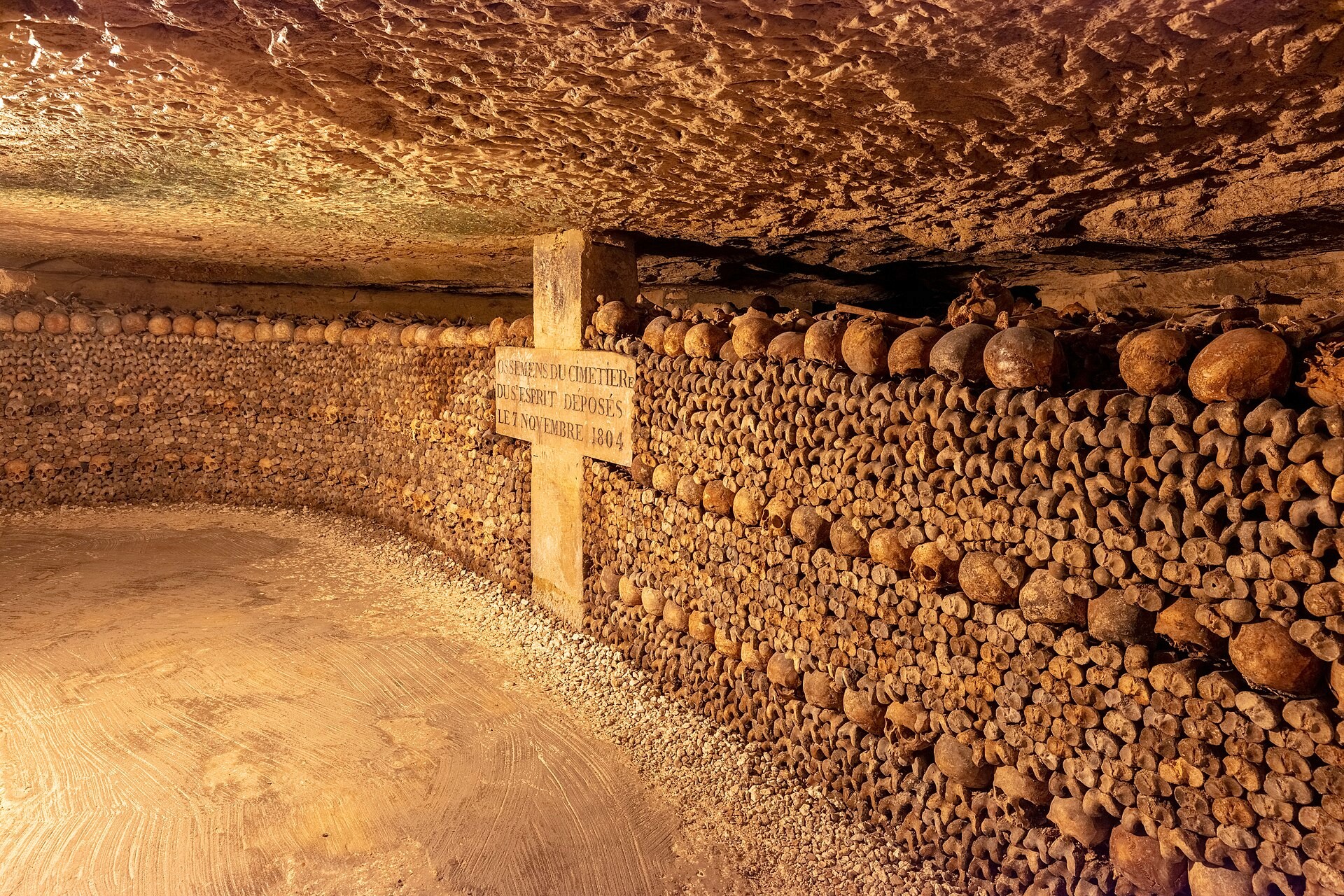
The Paris Catacombs are a massive underground ossuary holding the remains of over 6 million people, created in the late 18th century to alleviate overflowing cemeteries. The public route runs 1.5 kilometres through a wider network of roughly 300 kilometres of former limestone quarries, where bones are meticulously stacked into artistic walls, crosses, and heart shapes.
Paris Catacombs Last Minute Tickets
Finding last-minute Catacombs tickets is incredibly difficult, and the ticketing system is designed in a way that makes it harder than most people expect.
The seven-day rolling release means that if you are looking for a ticket within the next week, your options depend on what remains from the allocation that opened seven days ago. In summer and during school holidays, this frequently means sold out across all remaining slots.
What to try if tickets are sold out:
Check the official site repeatedly throughout the day. Cancellations do appear and can come available at any time.
Check around 10:00am Paris time, when the rolling release for the furthest-ahead day opens, and when overnight cancellations are most likely to have processed.
Book a licensed guided tour. Operators maintain separate allocations and can often accommodate visitors on shorter notice than the self-guided system allows.
Consider a weekday visit in the low season (November through March). Availability is significantly better, and same-day checking is occasionally successful.
One important warning: The scarcity of official last-minute tickets has created a significant market for fraudulent and counterfeit tickets around the Catacombs. The seven-day limit exists specifically as an anti-fraud measure. Do not purchase from street sellers or any platform not on the official authorised seller list on the Catacombs website. Invalid tickets are refused at entry with no refund.
Paris Catacombs Opening Hours and Entry Information
Open Tuesday to Sunday, 9:45am to 8:30pm
Last entry: 7:30pm
Closed on Mondays
Closed on: 1 January, 1 May, 25 December
Open on: 14 July (Bastille Day), 15 August (Assumption), 1 November (All Saints' Day), 11 November (Armistice Day)
The maximum capacity at any one time is 200 visitors. This is strictly enforced and is the reason timed ticketing is non-negotiable.
Entry and exit locations are in different streets:
Entrance: 1, Avenue du Colonel Henri Rol-Tanguy, 75014 Paris (Place Denfert-Rochereau)
Exit: 21 bis, Avenue René-Coty, 75014 Paris (approximately 700 metres from the entrance)
This is an important practical detail. You will not return to where you started. Do not leave anything at the entrance expecting to retrieve it at the end, and factor the separate exit point into any transport or meeting arrangements.
What is the Best Way to Get to the Paris Catacombs?
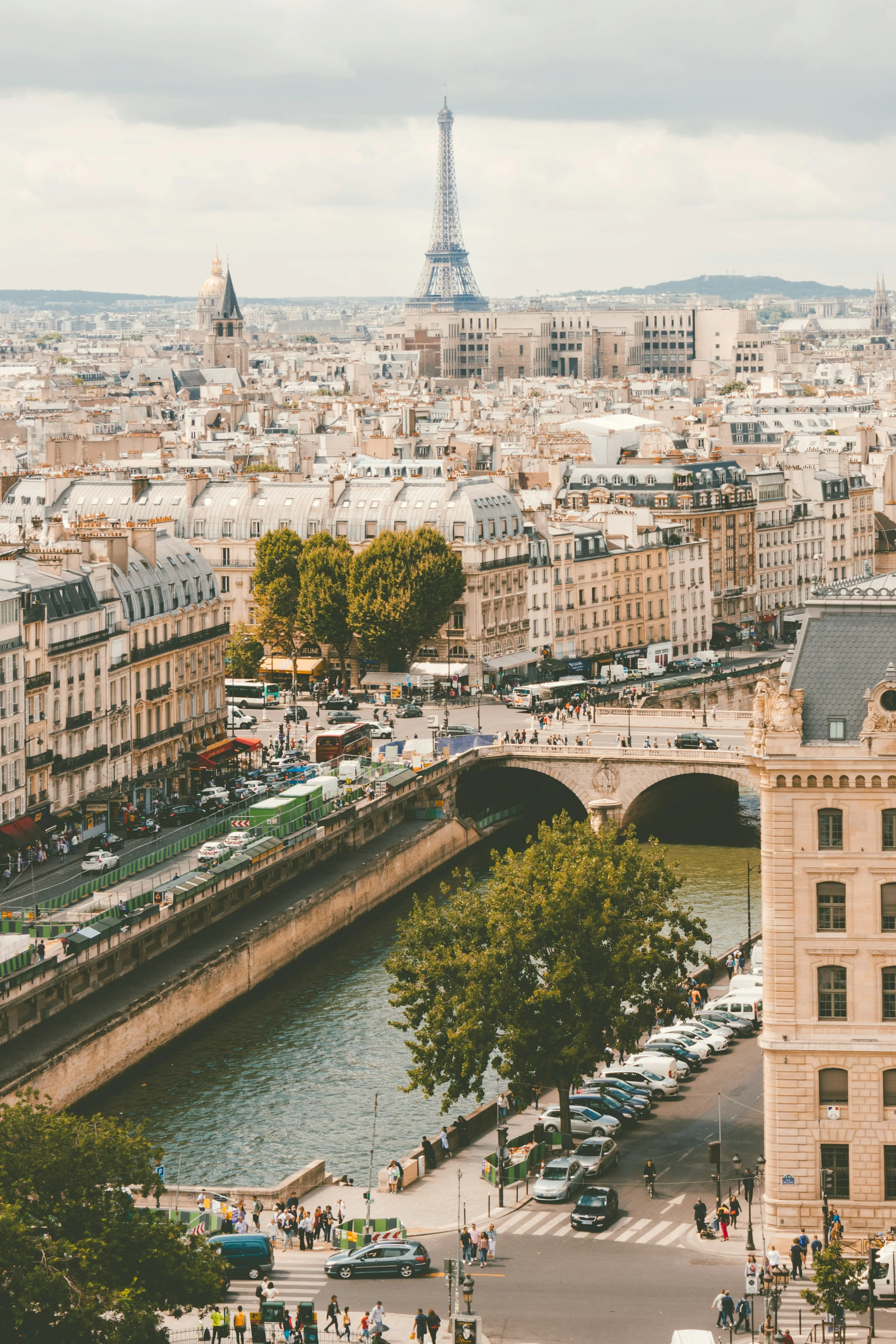
The entrance is at Place Denfert-Rochereau in the 14th arrondissement, one of the most easily reached locations in southern Paris.
By Metro: The entrance is directly opposite Denfert-Rochereau station, served by Metro lines 4 and 6. It is also a stop on RER B, making it convenient from both airports (Charles de Gaulle and Orly) and from central Paris stations including Gare du Nord and Châtelet-Les-Halles. The journey from Châtelet on the RER B takes around five minutes.
By bus: Several routes stop at Place Denfert-Rochereau, including lines 38, 68, and 88. Tram line T3a has a nearby stop.
On foot: The Catacombs are around 20 minutes on foot from Montparnasse station, 15 minutes from the Luxembourg Gardens, and 25 minutes from the Panthéon. The walk through the residential streets of the 14th arrondissement is pleasant and passes the excellent food street Rue Daguerre en route.
By Vélib': Several docking stations are within a short walk of Place Denfert-Rochereau.
Practical tip on the exit: Remember that you emerge from a different street entirely, approximately 700 metres from where you entered. If you have arranged to meet someone, a bicycle, or a car, plan around Avenue René-Coty as your end point, not Place Denfert-Rochereau.
How Much Time Should I Spend at the Paris Catacombs?
The underground route is 1.5 kilometres long and is a one-way circuit. Most visitors spend 45 minutes to one hour in the tunnels themselves.
Allow additional time for:
The security check and entry procedure, even with a timed ticket (approximately 10 to 15 minutes)
The descent (131 steps down) and ascent (112 steps up), which are built into the route and take time for most visitors
For a guided tour rather than the self-guided audio experience, allow 90 minutes to two hours for the full underground circuit with commentary.
From arriving at Place Denfert-Rochereau to emerging at the exit on Avenue René-Coty, budget approximately one and a half hours for a self-guided visit including the entrance procedure.
What is the Best Time to Visit the Paris Catacombs?
Best time of day: The first session of the day, from 9:45am, is the calmest. The midday window from around 11:00am to 2:00pm draws the most visitors, including group tours, and can feel more congested at the entrance and security check. Afternoon slots after 4:00pm are also relatively calm. The underground experience itself is consistent regardless of time of day, as capacity is always capped at 200.
Best days: Weekdays are quieter than weekends throughout the year. Saturday and Sunday morning slots are the most sought after and sell out the fastest when they open seven days in advance.
Best season: The underground temperature is a constant 14°C year-round, so the experience does not vary with the weather. Summer (July and August) brings the most intense competition for tickets and the largest crowds at the entrance. Spring (April to June) and autumn (September to October) offer a better balance of availability and pleasant conditions above ground. November through March is when tickets are most accessible, including occasionally on the same day.
Halloween: Demand peaks sharply in late October. Book as far ahead as the seven-day system allows if your visit falls near the end of October.
What is Inside the Paris Catacombs?
The visit follows a single one-way underground route. After descending 131 steps, the route passes through former limestone quarry galleries before entering the ossuary itself.
The quarry galleries: The first section of the route covers the history of the quarries that once undermined Paris so severely that streets were at risk of collapse. The Inspection Générale des Carrières was created in the late 18th century to survey and consolidate the tunnels. The stone used to build Notre Dame, the Louvre, and much of historic Paris came from these galleries. Inscriptions carved by quarry engineers into the limestone throughout the route mark their work: initials, dates, and measurements preserved exactly as they left them centuries ago.
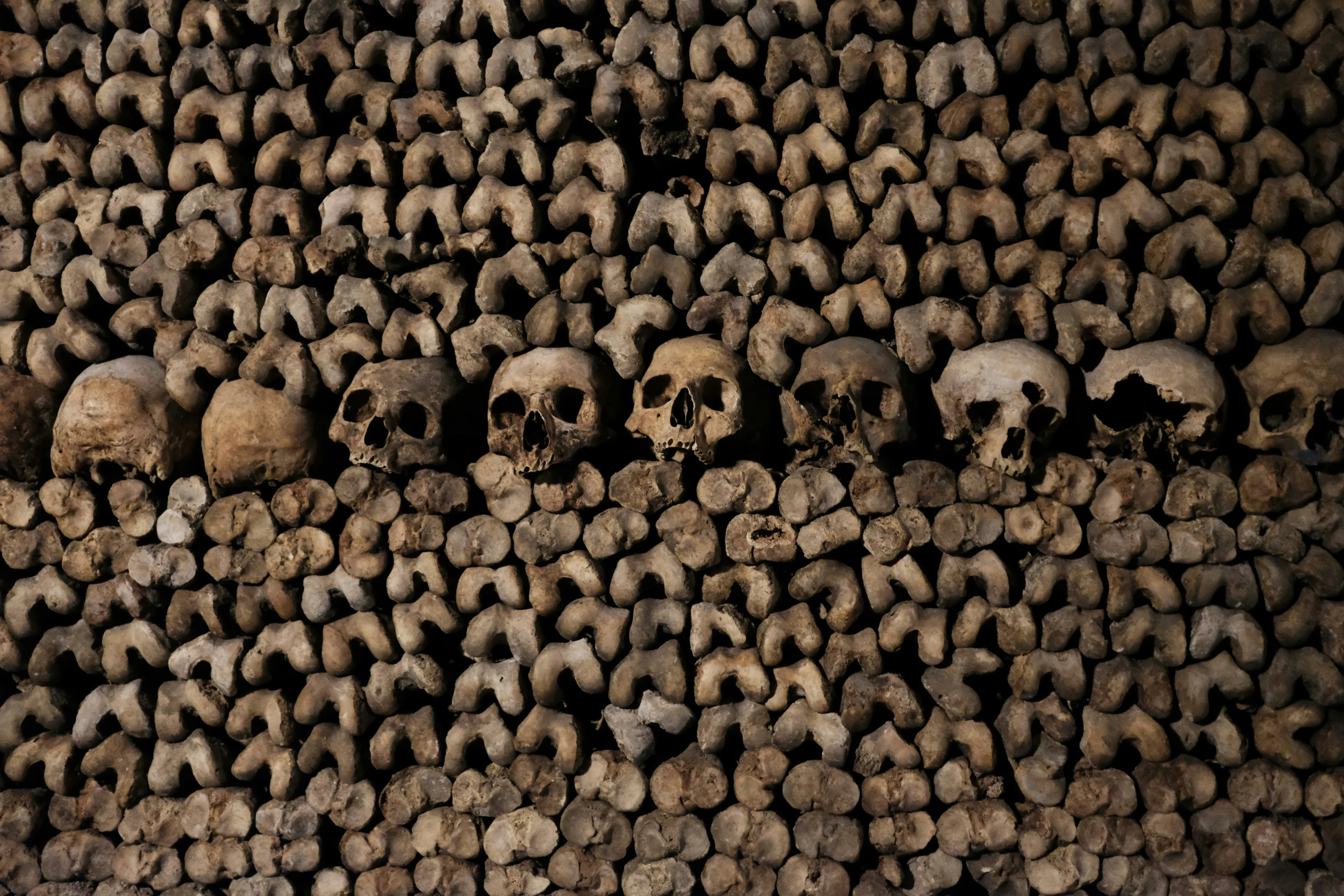
The ossuary: From 1786 onward, the remains of Parisians whose cemeteries had become dangerously overcrowded were transferred to the quarry tunnels and arranged in the distinctive formations that define the site today. The bones are stacked in deliberate architectural patterns called "hagues": walls of femurs and skulls that line the galleries across the ossuary's 11,000 square metres. The total length of stacked bone walls is approximately 800 metres, arranged in 217 separate formations. The remains represent Parisians who died between the 10th and 18th centuries, including figures from the French Revolution. Maximilien de Robespierre is believed to be among them, though the bones here carry no individual identification.
The September Martyrs Wall: One of the most historically significant points in the route commemorates the victims of the September Massacres of 1792, when more than 1,000 prisoners, including priests who refused to swear an oath to the Revolution's Constitution, were murdered in Parisian prisons. A stele topped by a quote from Homer's Odyssey in Greek, the only Greek inscription on the route, marks this section. The restoration of this wall was the centrepiece of the 2023 to 2026 renovation, using dry-stone walling techniques derived from original quarry methods.
Latin and French inscriptions: Throughout the ossuary, inscriptions carved into stone offer reflections on mortality, resurrection, and memory, from formal religious texts to more personal and poetic observations. The audio guide is the most reliable way to understand these in context.
What the 2026 renovation changed: Three significant improvements distinguish the post-renovation experience from anything visitors saw before November 2025. The lighting has been entirely redesigned to create a theatrical, atmospheric effect that highlights both the bone formations and the carved stone details of the tunnels; it also makes flash-free photography considerably more effective than before. The audio guide has been re-recorded with dramatised narration, delivered in the voice of Louis-Etienne Héricart de Thury, the Inspector General of Quarries who shaped the ossuary as it exists today. New environmental control systems now regulate temperature, humidity, and carbon dioxide levels to protect both the site and its visitors.
What the Catacombs are not: The 1.5 kilometres of the official route represent a tiny fraction of the roughly 300 kilometres of tunnel beneath Paris. The wider network, explored illegally by some (known as cataphile culture), is entirely separate from the official ossuary.
Paris Catacombs Tour
Guided tours of the Catacombs are worth serious consideration, particularly for visitors with a deeper interest in the history, geology, or cultural significance of the site.
Why a guided tour adds value here: The Catacombs are underground, dimly lit, and carry no printed interpretation panels on the walls. The audio guide provides solid coverage of the highlights, but a licensed guide can answer questions, adapt the focus to your group's interests, and provide historical depth that a fixed narration cannot. The quarry engineering, the mechanics of the bone transfers from the cemeteries, the inscriptions, and the stories of specific individuals whose remains are here all reward a knowledgeable guide.
Standard small-group guided tours: Licensed small-group tours of 8 to 14 people include entry, an English-speaking guide, and the standard 1.5-kilometre route. These run for approximately 90 minutes to two hours and start from around €60 to €80 per person. Their key practical advantage is a separate ticket allocation: when official self-guided slots are sold out, guided tour bookings are often still available.
VIP and restricted-access tours: A small number of specialist operators offer access to areas not on the standard public route, including tunnels and chambers accessible only with special authorisation. These are small groups, sometimes six people or fewer, considerably more expensive (from around €150 to €200 per person), and require well-advance booking.
Always verify the operator: Check that any operator you book through appears on the authorised seller list on the official Catacombs website. Fraudulent ticketing activity around this attraction is well-documented and actively monitored by the official site.
Is the Paris Catacombs Worth Visiting?
The Catacombs are a profoundly unusual experience. There is nothing quite like them in Europe in terms of scale, historical weight, and the visceral effect of walking through corridors lined with the remains of six million people. The post-renovation lighting and audio guide have made the experience substantially more engaging than it was before 2025. For visitors interested in French history, the archaeology of the quarries, or the development of Paris as a city, the site is exceptional.
The caveats are worth stating plainly. At €31 per adult with no museum pass discount, it is among the more expensive per-hour attractions in Paris for a 45 to 60-minute underground walk. The bones, while arranged with care and accompanied by thoughtful inscriptions, are real human remains; visitors should be confident this is an experience they want before booking. The site is physically demanding (131 steps down, 112 up, uneven and sometimes slippery ground), consistently cold (14°C year-round), and not recommended for visitors with claustrophobia, cardiac or respiratory conditions, or significant mobility difficulties. And the ticketing system, with its seven-day release window and rapid sell-out times, is a little bit stressful to navigate.
For visitors who have considered all of this: book early, dress in layers, wear proper shoes, and take the first session of the day.
Where Should I Eat Near the Paris Catacombs?
The area around Place Denfert-Rochereau and the 14th arrondissement is one of the least touristy parts of central Paris, which works strongly in your favour when it comes to food. Prices and quality here reflect a local rather than tourist clientele.
Rue Daguerre, a pedestrianised market street five minutes from the Catacombs entrance, is one of the best food streets in the 14th arrondissement. On weekday mornings and Saturday mornings it hosts an open-air market of cheese, charcuterie, fish, bread, and produce. At any time it is lined with independent food shops, bakeries, and neighbourhood cafes that see virtually no tourist traffic. Picking up provisions here before or after your visit is one of the most satisfying things you can do in this part of Paris.
I Grappoli on Place Denfert-Rochereau is an Italian trattoria directly on the square, with a terrace and a menu of fresh pasta and wood-fired pizza. Well positioned for both pre-visit lunches and post-visit dinners, and the terrace is especially good in warm weather.
Slow, on Rue Danville just off Rue Daguerre, is a small, creative restaurant run by a passionate team, serving fusion dishes that change with the seasons and with strong vegan and gluten-free options. Book ahead for dinner; tables are limited and the neighbourhood is loyal.
A Mi-Chemin, on a side street near Rue Daguerre, offers Franco-Tunisian fusion cooking with dishes that bring together Tunis and Paris in a warm, unfussy neighbourhood setting. One of the more distinctive and affordable dinner options in the area.
Baladna on Place Denfert-Rochereau is a Lebanese restaurant on the square itself, with well-reviewed mezze, hummus, and a convivial atmosphere. A reliable, filling, and reasonably priced option close to the entrance.
For coffee and a pastry before your visit, any of the boulangeries on and around Rue Daguerre will serve you better and more cheaply than anything tourist-facing.
What Else is There to Do Near the Paris Catacombs?
Musée de la Libération de Paris is directly across the street from the Catacombs entrance on Place Denfert-Rochereau. It covers the German Occupation of Paris and the French Resistance, and includes the actual underground bunker where Colonel Rol-Tanguy, head of the French Interior Forces for the Paris region, ran his command post during the liberation of the city. The permanent collection is free; temporary exhibitions are ticketed separately. It is one of the most compelling and undervisited museums in Paris, and combining it with the Catacombs creates a morning of extraordinary historical depth in two of Paris's most significant underground spaces.
The Barrière d'Enfer and the Lion of Belfort are on Place Denfert-Rochereau itself, and you walk past both without necessarily noticing. The two neoclassical pavilions flanking the avenue are a surviving tollgate from the Wall of the Farmers-General, built in the 1780s to the designs of Claude-Nicolas Ledoux, and only four of the original 55 gates leave any trace. The Catacombs entrance is inside one pavilion and the Musée de la Libération occupies the other. At the centre of the square, Bartholdi's Lion of Belfort commemorates the defence of Belfort in 1870, by the sculptor who went on to make the Statue of Liberty. Five minutes and no ticket.
Parc Montsouris is a 10-minute walk south from the Catacombs exit on Avenue René-Coty. One of the four great English-style parks of Paris, laid out under Napoleon III with sweeping lawns, century-old trees, and a lake, it is almost entirely unknown to tourists and is one of the most peaceful green spaces in the city. Spending time here after the intensity of the Catacombs allows for a useful sense of recovery.
Montparnasse Cemetery is a 10-minute walk northwest. Considerably quieter and less visited than Père Lachaise, it contains the graves of Samuel Beckett, Simone de Beauvoir, Jean-Paul Sartre, Guy de Maupassant, Serge Gainsbourg, and Man Ray among many others. Entry is free.
Tour Montparnasse is around 20 minutes on foot northwest, but its 56th-floor observation deck closed on 31 March 2026 for a redevelopment expected to run for years, with no reopening date announced. If you want a high view of Paris on the same day, plan for somewhere else in the city instead.
Rules, Bags, and Security
Bag size is strictly enforced: Only bags with maximum dimensions of 40 x 30 x 20 cm are permitted inside. Bags must be carried by hand or worn on the front, not the back. There is no cloakroom at either the entrance or the exit. If you arrive with a larger bag, you will be refused entry. Luggage storage options are available near Denfert-Rochereau station; search online for current providers before your visit.
Strollers: Not permitted inside the Catacombs.
Photography: Photography without flash is permitted throughout the ossuary. Tripods are not allowed.
Food and drink: Not permitted inside the underground galleries.
Temperature: It is 14°C underground year-round. In summer this is a sharp contrast to outdoor temperatures. Bring a light layer.
Ground conditions: The floor throughout the route is uneven, damp in sections, and can be slippery. Wear proper walking shoes. High heels and sandals without ankle support are not suitable.
Age and health warnings:
Children under 14 must be accompanied by an adult
Not recommended for visitors with claustrophobia
Not recommended for visitors with cardiac or respiratory conditions
Re-entry: Not permitted.
Accessibility at the Paris Catacombs
The Paris Catacombs are not accessible to visitors with reduced mobility. The descent involves 131 steps with no lift, the ground throughout the route is uneven and sometimes slippery, and the tunnels are narrow in places. Despite the comprehensive 2026 renovation, the geological fragility of the underground structure makes it impossible to install accessibility infrastructure without compromising the site.
Visitors in the free-entry categories (disabled visitors and one accompanying person) can collect their free ticket at the front desk on the day with appropriate documentation, but this applies to the entry fee only, not to physical access to the underground galleries.
Guide dogs are permitted for visually impaired visitors, provided an accompanying person is also present. White canes are not allowed inside. The audio guide introduced with the 2026 renovation includes a French audio-described version for visually impaired visitors, with descriptions of the tactile models installed along the route.
Final Tips for Visiting the Paris Catacombs
Set a reminder for exactly seven days before your visit and check early in the day, Paris time. Slots are released on a rolling basis and popular ones sell out within minutes. This is the most effective strategy available.
The Paris Museum Pass is not accepted. No city pass, tourist card, or discount scheme covers entry here. Budget and book separately.
If the official site is sold out, check for a licensed guided tour. Tour operators hold separate ticket allocations and can often take bookings when self-guided slots are fully exhausted.
The entrance and exit are in completely different streets. Do not leave belongings at the entrance, and plan transport and meeting points around the exit on Avenue René-Coty, not Place Denfert-Rochereau.
Bag size is strictly enforced: maximum 40 x 30 x 20 cm, no cloakroom. Store larger bags near Denfert-Rochereau station before you arrive.
Wear proper walking shoes and bring a light layer. The ground is uneven and sometimes slippery; it is 14°C underground regardless of the season.
The first slot of the day at 9:45am is the calmest. Afternoon slots after 4:00pm are also relatively quiet. Midday is the busiest window.
Visit the Musée de la Libération de Paris immediately after. It is directly across the street from the entrance, completely free, and one of the most compelling and undervisited museums in the city.
Allow time on Rue Daguerre. The pedestrianised market street five minutes from the entrance is one of the best food streets in Paris, entirely oriented toward local residents, with excellent bakeries, cheese shops, and cafes.
Back to Paris Attractions
Explore other Paris attractions
" width="24px"><path d="M 0 0 L 24 0 L 24 21.231 L 0 21.231 Z" fill="transparent" height="21.230768474975793px" id="nL2EwDcS9" width="24px"/><path d="M 0 0.541 C 0 0.242 0.245 0 0.547 0 L 2.735 0 C 3.037 0 3.282 0.242 3.282 0.541 L 3.282 4.598 C 3.282 4.897 3.037 5.139 2.735 5.139 L 0.547 5.139 C 0.245 5.139 0 4.897 0 4.598 Z" fill="rgb(196, 217, 201)" height="5.138657337892187px" id="hZ_rlBe_S" transform="translate(0 16.092)" width="3.2820512820512358px"/><path d="M 0 0.541 C 0 0.242 0.245 0 0.547 0 L 2.735 0 C 3.037 0 3.282 0.242 3.282 0.541 L 3.282 7.843 C 3.282 8.142 3.037 8.384 2.735 8.384 L 0.547 8.384 C 0.245 8.384 0 8.142 0 7.843 Z" fill="rgb(230, 211, 160)" height="8.38412513024521px" id="HgVBxIz3e" transform="translate(5.128 12.847)" width="3.282051282051235px"/><path d="M 0 0.541 C 0 0.242 0.245 0 0.547 0 L 2.735 0 C 3.037 0 3.282 0.242 3.282 0.541 L 3.282 12.982 C 3.282 13.281 3.037 13.523 2.735 13.523 L 0.547 13.523 C 0.245 13.523 0 13.281 0 12.982 Z" fill="rgb(232, 207, 164)" height="13.522782468137464px" id="utgrDnoM9" transform="translate(10.325 7.708)" width="3.282051282051377px"/><path d="M 0 0.541 C 0 0.242 0.245 0 0.547 0 L 2.735 0 C 3.037 0 3.282 0.242 3.282 0.541 L 3.282 16.498 C 3.282 16.797 3.037 17.039 2.735 17.039 L 0.547 17.039 C 0.245 17.039 0 16.797 0 16.498 Z" fill="rgb(233, 196, 166)" height="17.038705909853153px" id="OLOhW6STz" transform="translate(15.521 4.192)" width="3.2820512820512384px"/><path d="M 0 0.541 C 0 0.242 0.245 0 0.547 0 L 2.735 0 C 3.037 0 3.282 0.242 3.282 0.541 L 3.282 20.69 C 3.282 20.989 3.037 21.231 2.735 21.231 L 0.547 21.231 C 0.245 21.231 0 20.989 0 20.69 Z" fill="rgb(217, 170, 153)" height="21.230768474975793px" id="H5Z8wcwkd" transform="translate(20.718 0)" width="3.2820512820512278px"/></g></svg>)