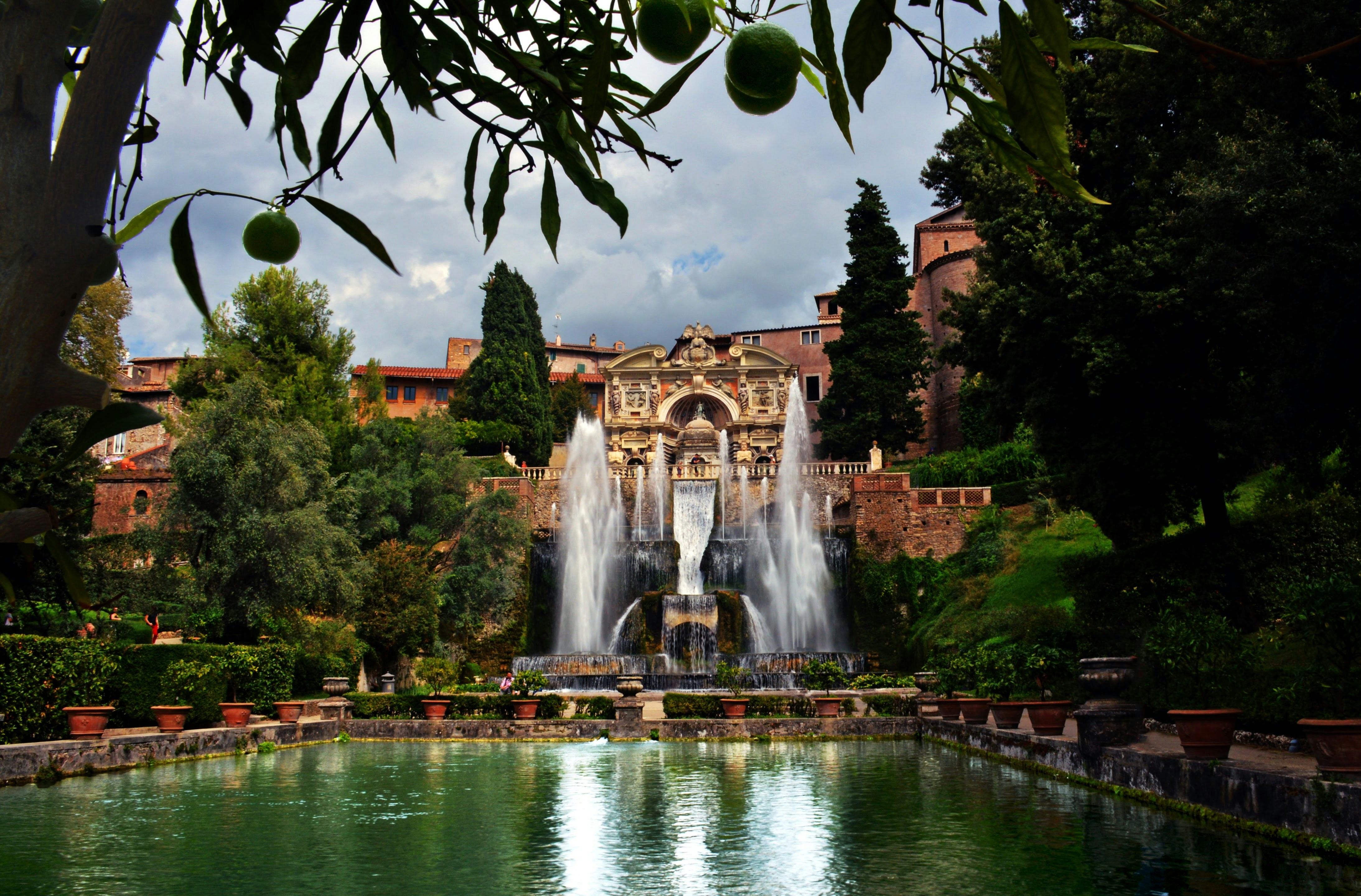
Tivoli • Lazio, Italy
Pre-booking a timed entrance ticket a few days in advance is recommended during summer months and weekends; tickets occasionally sell out. Timed-entry tickets are available online and at the ticket office.
Book 1-3 Days Ahead
Peak Season
No Booking Needed
Off-season
Back to Rome Attractions
Villa d'Este Tivoli: Everything You Need to Know Before You Visit
Updated September 2026
Built from 1550 onward for Cardinal Ippolito II d'Este on a steep hillside above the town of Tivoli, Villa d'Este is one of the defining achievements of Italian Renaissance garden design and a UNESCO World Heritage Site since 2001. The villa and its terraced gardens are fed by a hydraulic system of extraordinary ingenuity that channels water from the River Aniene through hundreds of fountains, cascades, grottoes, and jets across five terraces descending the hillside, with the centrepiece being a hydraulic organ that plays music driven by water pressure, first completed in 1571 and brought back to life in 2003 after two centuries of silence. Less than an hour from Rome by train, Villa d'Este rewards an early start and a full morning, and combines naturally with the nearby ancient ruins of Hadrian's Villa for one of the most rewarding full days available as a day trip from Rome.
At a Glance
How Early to Book:
Book 2-3 days in advance to guarantee quick entry, the on-site ticket office also sells same day tickets.
Best Times to Visit:
The first hour after opening, from 8:30am to 9:30am, is the quietest window of the day. The last hour before closing is a good second option.
Ticket price:
€15 for adults.
Where to Book:
Landmark Address:
Do You Need to Book Villa d'Este Tickets in Advance?
Advance booking is recommended during the high season, but not necessarily strictly required as the on-site ticket office does sell same-day tickets. The villa is a managed site with capacity limits, and at peak periods walk-up entry may be restricted or unavailable.
Where to book: The official booking platform is the Italian Ministry of Culture's ticketing site. This is the cheapest authorised route. Third-party platforms also carry tickets, often bundled with guided tours or transport from Rome.
Ticket prices:
Adults: €15
Reduced (EU citizens aged 18 to 25): €2
Children under 18: Free
Disabled visitors and one accompanying person: Free
Free entry dates:
First Sunday of every month
25 April (Liberation Day)
2 June (Republic Day)
4 November (National Unity and Armed Forces Day)
8 March (International Women's Day, free for women)
On the first Sunday of the month, 25 April, 2 June, and 4 November, free tickets cannot be booked online. They are issued only at the ticket office on the day, and no reservations are taken, including for groups.
Roma Pass: The Roma Pass does not cover Villa d'Este, which is located outside the Rome municipal boundary. The villa is managed separately by the national cultural heritage ministry.
Villae Pass: A combined ticket covers one entry each to Villa d'Este, Hadrian's Villa, and the Sanctuary of Hercules Victor, and is valid for three days from your first entry. Compare the price against two single tickets before buying.
Cancellation: Tickets purchased through the official site are generally non-refundable. Check current terms at the time of booking.
One critical thing to check before booking: The fountains can be shut down for maintenance or suspended when heavy rainfall causes the River Aniene to swell, which cuts the water supply to the hydraulic system. You may arrive to find that a significant number of fountains are not working, which substantially impacts the experience.
Villa d'Este Opening Hours and Entry Information
The villa is open every day except Monday mornings and the two annual closure dates. From Tuesday to Sunday it opens at 8:30am, and closing time moves through the year with the daylight. Last entry is one hour before closing.
Closing times, Tuesday to Sunday:
January, November, and December: 5:00pm
February: 5:30pm
March: 6:15pm, then 7:15pm once the clocks go forward
April: 7:30pm
May to August: 7:45pm
September: 7:15pm
October: 6:30pm, then 5:30pm once the clocks go back
Monday:
The villa is closed in the morning on Mondays
Monday afternoon opening: 2:00pm, closing at the usual time for that month
Always verify current hours on the website before your visit, as the schedule can change around public holidays and special events.
Closed: 1 January and 25 December. When a Monday falls on a public holiday, the villa opens in the morning instead, and the following Tuesday opens at 2:00pm.
Address: Piazza Trento 5, 00019 Tivoli (Roma)
The entrance is in the piazza at the upper level of the gardens. You walk through the villa first and descend into the gardens, which means the most dramatic fountain views and vistas unfold as you move downhill.
How to Take the Train to Villa d'Este from Rome
Villa d'Este is approximately 30 kilometres east of central Rome, in the hill town of Tivoli. The journey is straightforward by public transport and takes between 45 minutes and just over an hour, depending on the route. Three practical options cover most visitors.
The train is the fastest and most reliable option, and the one I recommend most often.
The route: Take the FL2 Trenitalia regional train from Roma Tiburtina or Roma Termini toward Avezzano, getting off at Tivoli station. Services depart approximately every hour throughout the day. The journey from Tiburtina takes around 60 minutes; from Termini it is slightly shorter for some services (around 47 minutes for the fastest). Tickets cost approximately €2.60 to €3 each way.
Practical note on departure stations: More FL2 trains serve Roma Tiburtina than Roma Termini in a given day. If you are staying near Termini, check the timetable to confirm a direct connection on the day of your visit; you may need to get to Tiburtina first, which is a short hop by train or four stops on Metro Line B.
From Tivoli station to Villa d'Este: Tivoli train station is at the bottom of the hill, and Villa d'Este is in the upper town, approximately 1.2 kilometres away. This is an uphill walk of around 20 to 25 minutes through the old town streets of Tivoli, which is pleasant in mild weather and worth doing at least once for the sense of the town itself. Alternatively, take a local CAT bus (lines 2, 4C, or 4D) from outside the station toward the town centre, which drops you within a short walk of the villa. Taxis are also available at the station.
The train journey itself passes through the Roman countryside east of the city, with views of the Sabine Hills as you approach Tivoli. It is noticeably more scenic than the bus alternative.
Getting to Villa d'Este by Bus (COTRAL)
The COTRAL regional bus service offers the most direct drop-off to Villa d'Este for visitors coming by public transport, stopping in the centre of Tivoli within a short walk of the entrance.
The route: Take Metro Line B from central Rome (from Termini, the metro journey is straightforward) to the end of the line at Ponte Mammolo. From outside Ponte Mammolo station, COTRAL buses to Tivoli depart regularly throughout the day. On weekdays the service runs every 10 to 15 minutes; on Sundays the frequency drops, so check the timetable in advance. The bus journey to Tivoli takes approximately 45 minutes in normal traffic, though this can extend to over an hour when the A24 motorway or Via Tiburtina is congested.
Ticket cost: The COTRAL bus ticket from Rome to Tivoli costs approximately €2.70 each way.
Drop-off: The bus drops you near Piazza delle Nazioni Unite or Piazza Garibaldi in central Tivoli, from which Villa d'Este is around a five-minute walk.
The bus option is slightly slower overall than the train but gives you a closer drop-off in town, which some visitors, particularly those who want to explore Tivoli itself, find convenient.
Getting to Villa d'Este by Guided Tour from Rome
Multiple operators run half-day and full-day guided tours from Rome combining Villa d'Este with Hadrian's Villa (Villa Adriana), typically with hotel pick-up, return transport by minibus or air-conditioned coach, guided entry to both sites, and skip-the-queue ticketing included. Prices typically start from around €60 to €80 per adult for a group tour and rise for private options.
A guided tour is the most practical choice for visitors with limited time, those who prefer not to navigate Italian public transport, or those who want the full Tivoli day without logistical planning. The journey time from Rome in a private vehicle is approximately 40 minutes depending on traffic. Several operators offer morning departures of 8:00am to 8:30am, which arrive before the main tourist wave and make a significant difference to the experience at both sites.
A practical combined day: Most guided tours arrive at Hadrian's Villa first (which benefits from an early morning visit before the heat builds) and then move to Villa d'Este in the late morning or early afternoon. This sequence works well and is worth replicating if you are visiting independently.
How Much Time Should I Spend at Villa d'Este?
I'd personally recommend a minimum of 90 minutes to two hours inside the villa and gardens for a comfortable self-guided visit. This is enough time to walk through the main villa rooms, descend through all five terraces, see the major fountains, reach the panoramic viewpoints at the bottom, and hear at least one performance of the hydraulic organ.
Visitors who like to linger, sit by the fountains, and take photographs without rushing should allow two to two and a half hours.
If you are timing your visit around the Organ Fountain performance (daily from 10:30am, every two hours), plan to arrive so that you reach the organ terrace approximately 15 minutes before a scheduled performance. The fountain is in the lower section of the gardens; if you enter at 9:00am, you can descend through the upper terraces and arrive at the organ level around 10:15am, in good time for the 10:30am performance.
If you are combining Villa d'Este with Hadrian's Villa in the same day, budget a total of five to six hours across both sites, plus transport time between them (around 20 minutes by taxi or local bus).
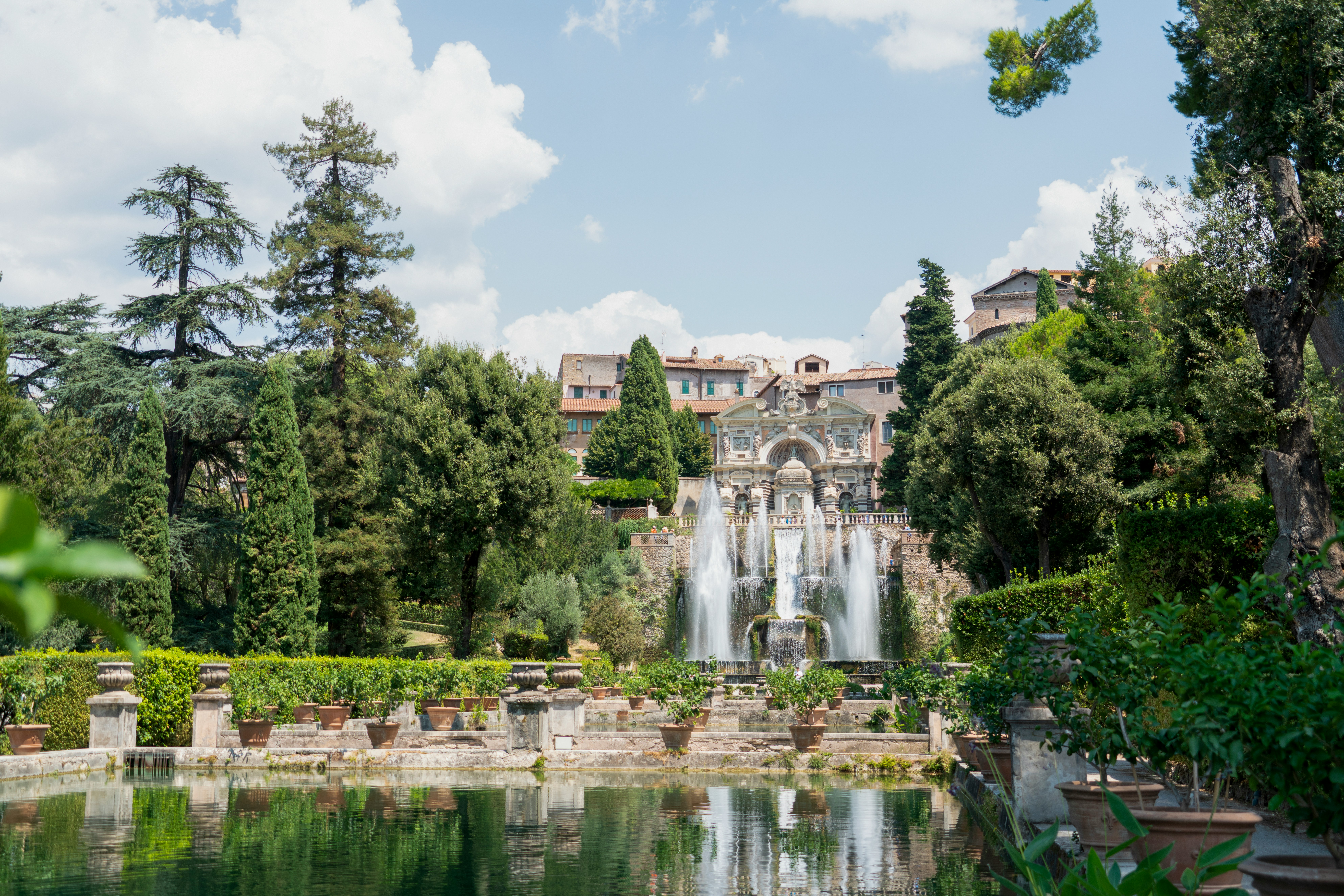
The Villa d'Este in Tivoli is a UNESCO World Heritage site famous for its 16th-century Italian Renaissance gardens. The Fountain of the Organ (Fontana dell'Organo) uses water to push air through pipes, creating musical notes, a technological marvel of the 16th century
What is the Best Time to Visit Villa d'Este?
Best season: Spring (April through June) is consistently described as the most rewarding time to visit. The gardens are in full bloom, the fountains run at full capacity with the spring water supply, the light is warm without the intensity of midsummer, and the grounds are greener and more lush than later in the year. I find that photographs of Villa d'Este in May capture it at its most extraordinary: the combination of deep green ilex and cypress trees, flowering terraces, and the rush of water in the fountains is at its most complete.
Summer (July and August) is the busiest period and can be very hot. The gardens provide considerable shade, but the steep terrain and the midday heat make a morning arrival (before 10:00am) strongly advisable in high summer. The fountains run through summer and the long opening hours allow for late afternoon visits when the light is beautiful.
Autumn is pleasant and quieter than summer, but the water supply from the Aniene can be reduced, and some fountains may be partially shut down for post-season maintenance. October and November visits carry a higher risk of encountering non-operational fountains than spring and summer visits.
Best day of week: Weekdays are significantly less crowded than weekends and are strongly preferred for the relaxed experience the garden is designed to produce. On a busy Saturday in July, the Alley of the Hundred Fountains becomes a narrow corridor of moving people rather than a contemplative garden walk. On a Tuesday morning in May, the same path can feel almost like you're the only one there.
Arriving at opening time (8:30am) gives you the coolest temperatures of the day, the most light in the gardens before the canopy closes over them, and the quietest experience of the major fountains. The trade-off is that the Organ Fountain does not begin its first performance until 10:30am, so if this is your priority, arriving at 9:00am is the better balance.
What is Inside Villa d'Este?
Villa d'Este divides into two distinct sections: the villa building at the top, and the terraced gardens below. The visit begins in the villa and descends through the gardens.
The Villa Rooms:
The villa was built over a former Franciscan convent whose cloister structure remains visible in the architectural bones of the building. The rooms of the piano nobile are decorated with large-scale fresco cycles covering mythological and allegorical subjects drawn primarily from Ovid's Metamorphoses, commissioned by Cardinal d'Este and executed by leading Mannerist painters of the mid-16th century, including Livio Agresti, Girolamo Muziano, and Federico Zuccari.
The Hall of Hercules takes its theme from the labours of Hercules, a deliberate reference to Cardinal d'Este's family mythology. The Room of the Hunt celebrates Diana, the classical goddess of the hunt. The Sala della Fontana at the base of the villa contains an internal fountain set into a grotto wall, a preview of the hydraulic theatre outside.
The frescoes are extraordinary in their scale and ambition, and it is a common mistake to rush through the villa rooms in eagerness to reach the gardens. The Hall of Hercules alone, with its ceiling covered in an architectural illusion designed to seem much higher than it is, rewards five to ten minutes of unhurried looking before you descend outside.
The Terrace Gardens:
The gardens cover four and a half hectares on five descending terraces. The hydraulic system that feeds them, engineered by Orazio Olivieri and working from 1565, channels water from the Aniene through a tunnel around 600 metres long dug beneath the town, creating sufficient pressure to operate hundreds of fountains, cascades, jets, and water organs simultaneously. The entire system is gravity-fed and uses no pumps.
The Alley of the Hundred Fountains (Via delle Cento Fontane): The horizontal axis of the garden, running the full width of the terraces at mid-level, this long path is flanked on one side by a continuous wall of 99 sculpted stone spouts in three tiers, carved with boats, dragons, eagles (the d'Este symbol), owls, and the she-wolf of Rome, each pouring water into basins below. The spray from the wall keeps the path cool even in summer. At one end, the path opens to the Rometta fountain; at the other, to the Oval Fountain. Walking it slowly, with the sound of water running on both sides, is one of the more unexpectedly affecting experiences the gardens offer.
Fountain of the Organ (Fontana dell'Organo): The most famous and technically extraordinary feature of the entire complex. The organ was completed in 1571 and caused a sensation across Europe: it is a hydraulic instrument whose 144 pipes were driven by a water wheel that forced air through them in controlled patterns to produce music. The organ then fell silent for around two centuries; the current instrument, rebuilt to follow the original late Renaissance scheme, was inaugurated in 2003 and performs daily. Performances run at 10:30am and then every two hours throughout the day. The organ sits in a niche above the central cascade, flanked by two caryatids and framed by elaborate mosaic decoration. The first time I heard it begin to play, unexpectedly, on a morning visit, it felt like something out of this world: the sound of an organ emerging from what is functionally a large ornamental fountain is disorienting in the best way.
Fountain of the Ovato (Fontana dell'Ovato / Oval Fountain): The most architecturally elegant fountain in the garden, designed by Pirro Ligorio and completed in 1565. It is named for its oval shape: a deep basin backed by a semicircular nymphaeum with pilasters from which water falls in curtains, flanked by niches containing statues of nymphs pouring water from vases. The figure of Pegasus appears at the top, and beside him the Tiburtine Sibyl holds the hand of the young Hercules. The bottom of the basin is covered in ceramic tiles in the colours of the d'Este coat of arms. This is the fountain most visitors photograph and the one that most clearly illustrates what the word "nymphaeum" means in practice: a place where water, stone, and myth are deliberately combined.
Fountain of the Dragons (Fontana dei Draghi): Four bronze dragons at the centre of the garden shoot jets of water from their mouths into a round basin. The fountain was supposedly created in a single night for an unannounced visit by Pope Gregory XIII in 1572 (whose heraldic symbol was the dragon), and the design preserves the rushed energy of that story, being more theatrical than precise.
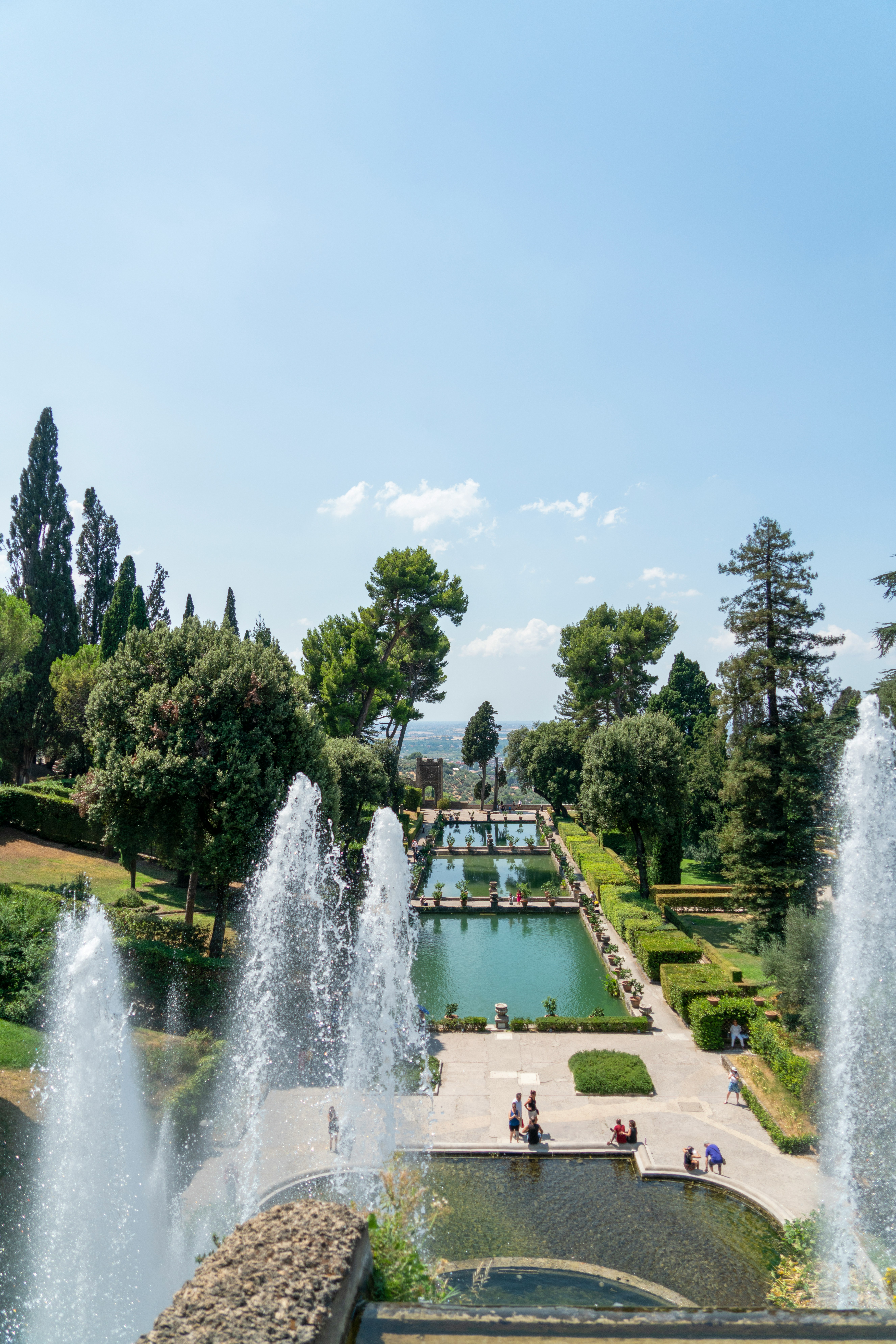
Fountain of Neptune and the Fish Ponds: At the bottom of the garden, a large 20th-century fountain of Neptune replaced a 17th-century cascade. Below it, a long formal fishpond (peschiera) stretches across the lowest terrace, backed by a double row of cypresses. The view looking back up from here, with the terraces rising above and the sound of water falling from multiple levels simultaneously, gives the clearest sense of the garden's total ambition.
The Rometta Fountain: A miniature recreation of ancient Rome, built at the far end of the Alley of the Hundred Fountains, with model representations of the Tiber Island, the she-wolf, and key Roman monuments set among jets and pools.
The Bicchierone Fountain: A graceful later addition designed by Bernini in 1660, shaped like an oversized goblet (bicchierone in Italian) with water spilling over its rim. More intimate than the great theatrical fountains and worth finding in the upper garden.
Views from the Lower Terraces: The lower terraces and the gate at the bottom of the gardens face south-west toward the Roman Campagna and, on clear days, toward the outline of Rome itself. The long view from this vantage point, with the terraces of the garden behind you and 30 kilometres of Lazio spread below, gives a sense of why Cardinal d'Este chose this hilltop for his villa of worldly power.
Is Villa d'Este Worth Visiting?
Yes, it is absolutely worth a visit especially if you have an extra day in Rome.
This is one of the most extraordinary garden experiences in Europe. The combination of the scale of the hydraulic engineering, the beauty of the individual fountains, the sound and movement of water at every level, and the views over the Roman countryside from the lower terraces creates an experience that is unlike any other single day trip available from Rome. The Organ Fountain alone, hearing it perform for the first time, will freak you the heck out.
However, that being said, the first caveat is the fountains themselves. When the fountains are operating at full capacity, Villa d'Este is magnificent. When they are not, whether due to seasonal maintenance, low water levels in the Aniene, or renovation work, the gardens are pleasant but the defining quality of the visit disappears. This risk is real, and checking the fountain status before you travel is not optional, it is essential.
The second caveat is the terrain. The gardens involve significant descent and ascent on stone steps and occasionally uneven paths. The overall height difference between the upper entrance and the lower terraces is approximately 40 metres, which you walk down and then back up, or up and then back down depending on your route. Visitors with significant mobility difficulties should check with the villa in advance about accessible routes and the availability of the lift that serves some sections. For visitors who are physically comfortable with stairs and slopes, this is not a problem; for those who are not, it is worth thinking about before booking.
For anyone visiting Rome for more than three or four days with a free day and good weather, Villa d'Este is a strong recommendation, particularly in combination with Hadrian's Villa. The combination of the two sites, one the most complete surviving ancient Roman complex in the world, the other the defining achievement of Renaissance garden design, makes for a day of extraordinary historical and sensory range.

Guided Tours and Audio Guides
Official guided tours are available through the villa's booking system for groups and individual visitors. A standard guided tour of the villa and gardens takes approximately 90 minutes and is available in Italian and English on selected dates; check the official calendar for current tour schedules and booking.
Independent audio guides are available at the entrance. These cover the principal rooms of the villa and the major garden features, and are particularly useful in the villa's frescoed rooms, where the iconographic programme is complex enough that it benefits from explanation.
Private and small-group tours combining Villa d'Este with Hadrian's Villa are available through numerous Rome-based operators and provide transport as well as guiding for both sites. The advantage of a guide is significant at Hadrian's Villa, where the archaeological remains require considerable context to make sense; at Villa d'Este, the fountains and gardens are more immediately accessible without narration, but a guide deepens the visit through knowledge of the hydraulic engineering and the Renaissance mythological programme of the decorative scheme.
Where Should I Eat Near Villa d'Este?
In Tivoli town:
The centre of Tivoli, within a five to ten-minute walk of Villa d'Este, has several decent restaurants that cater primarily to local residents and day-trippers rather than tourists. Eating in the town itself, before or after your visit, is preferable to any food available inside the villa complex.
Ristorante Sibilla on Via della Sibilla is the "gold standard" restaurant in Tivoli, positioned on the edge of the gorge with terrace views directly over the Temple of Vesta and the waterfalls of Villa Gregoriana below. The food is traditional Lazio cooking: rigatoni alla carbonara, saltimbocca, abbacchio al forno (roast lamb). The setting is one of the most dramatic of any restaurant within day-trip distance of Rome. Book ahead, particularly for weekend lunches.
Caffè Pasticceria near Piazza Garibaldi and several other small bars and cafes in the centre are good for a coffee and a cornetto before your morning visit to the villa. Eating a proper breakfast in the town before entering the gardens avoids the need for the limited and not particularly affordable food options inside the villa.
Inside the villa complex: There is a café at the villa with limited food and drink options. It is convenient as a break point mid-visit but is not a reason to delay eating before you arrive.
What Else is There to Do Near Villa d'Este?
Hadrian's Villa (Villa Adriana): The most important companion visit to Villa d'Este and a UNESCO World Heritage Site in its own right. Built by Emperor Hadrian from 118 AD and covering more than 120 hectares, it is the most ambitious ancient Roman complex to survive outside Rome. The ruins of the Pecile (a monumental portico modelled on a Greek stoa), the Maritime Theatre (a private island retreat in an artificial moat), the Canopus pool with its Egyptian-inspired sculptures, the Greek and Latin Libraries, and the astonishing Serapeum are all within walking distance of each other. At its height, Hadrian's Villa was effectively a city of leisure spaces, libraries, baths, and theatres that Hadrian could retreat to from the obligations of the imperial capital. Even in ruin, the scale and the quality of what remains is humbling.
Hadrian's Villa is approximately five to six kilometres from Villa d'Este. It cannot be walked between the two conveniently; a local bus, taxi, or car is necessary. Guided day trips from Rome typically include both sites.
Villa Gregoriana: A natural park managed by the FAI (Italian National Trust) immediately below the town of Tivoli, containing dramatic limestone gorges carved by the Aniene, two enormous waterfalls (the Grande Cascata is 120 metres high), grottos, and the ruins of Roman temples on the cliff edges. This is an undervisited alternative to Villa d'Este that rewards those with an appetite for wilder, less manicured landscape. The paths require good footwear as they descend steeply into the gorge. Entry is separate from Villa d'Este.
The Temple of Vesta and the Temple of the Sibyl are two well-preserved Roman temples on the lip of the gorge at Piazza della Gavinella in Tivoli town, dating from the 1st century BC. Both are accessible on foot from Villa d'Este in about ten minutes and can be viewed from outside for free. The round Temple of Vesta in particular, with its intact colonnade standing above the gorge, is one of the most photographed classical buildings in Italy and appears in paintings by Claude Lorrain and countless other artists.
Rules, Bags, and Security
Bags: There is no specific size restriction listed for general entry, though bulky luggage and large wheelie bags are not permitted. A day bag is perfectly acceptable.
Prohibited inside the gardens: Throwing objects into fountains or pools, touching the frescoes or furniture, eating outside designated areas, playing amplified music, and professional photography or videography without prior authorisation from the management.
Comfortable shoes: The gardens involve significant changes in level across stone and sometimes slightly uneven paths. Sandals with ankle support are workable; high heels are not.
Photography: Personal photography is permitted throughout, without flash inside the villa rooms. The gardens and fountains are among the most photogenic subjects of any Italian heritage site, and a cloudless day in spring produces extraordinary light in the lower terraces.
Water: Bring a water bottle. The fountains are not drinking water, and the café options inside the complex are limited. In summer, water is essential throughout a garden visit of this length.
Accessibility at Villa d'Este
The gardens involve significant changes in level and include a number of stone staircases that are not wheelchair accessible. The villa does have a lift serving certain sections and accessible entrance routes; visitors with mobility difficulties are encouraged to contact the villa in advance to discuss the most appropriate route for their needs and to confirm which sections are accessible during their planned visit. The official website also publishes an accessible map of the gardens that includes a golf-cart route, which is worth asking about when you get in touch.
Accessible toilets are available near the entrance area. Strollers for young children are permitted, though they require management on the steeper paths.
Final Tips for Visiting Villa d'Este
Always check the fountain status before you go. Contact the villa or check the official website for any notice of maintenance work or water supply issues. If the fountains are not working, the experience is fundamentally different from what the site is known for.
Book tickets in advance through the official site. During spring and summer weekends, walk-up queue times at the ticket office can reach 30 to 60 minutes. Advance booking is cheap and guarantees entry at your preferred time.
The organ fountain performs daily from 10:30am, every two hours. Plan your route down the garden to arrive at the organ terrace shortly before a performance. It is the single most extraordinary thing the villa offers.
Arrive at 8:30am on a weekday for the quietest experience. Spring weekday mornings are the ideal conditions. Avoid Saturday and Sunday afternoons in summer.
The villa opens Monday afternoons only, from 2:00pm. This is an easy trap. If you are planning a Monday visit, plan to arrive after 2:00pm.
The gardens descend steeply. Wear proper walking shoes and avoid heels and slippery-soled footwear. Bring water.
Take time in the villa rooms. Most visitors rush through the frescoed rooms to get to the gardens. The Hall of Hercules ceiling fresco and the Sala della Fontana at the lower level are worth pausing at for more than a quick glance.
Go by train from Roma Tiburtina or Termini. The FL2 line takes around 47 to 60 minutes and costs about €3. From Tivoli station, walk uphill through the town or take a local bus to the entrance. The walk is about 25 minutes and is a pleasant way to see Tivoli.
From the bus, take COTRAL from Ponte Mammolo (Metro Line B terminus). The bus drops you closer to the villa than the train does and takes about 45 minutes.
Combine with Hadrian's Villa for a full and extraordinary day. The two sites are about 20 minutes apart by taxi or local bus. Hadrian's Villa is best visited in the morning; Villa d'Este in the late morning or early afternoon.
Eat lunch at Ristorante Sibilla in Tivoli if you can book a table. The terrace view over the gorge and the Temple of Vesta is one of the most spectacular restaurant settings within day-trip range of Rome.
Spring is the best season. April through June combines full fountain capacity, flowering gardens, comfortable temperatures, and the best photographic light of the year.
Back to Rome Attractions
Explore other Rome attractions
" width="24px"><path d="M 0 0 L 24 0 L 24 21.231 L 0 21.231 Z" fill="transparent" height="21.230768474975793px" id="nL2EwDcS9" width="24px"/><path d="M 0 0.541 C 0 0.242 0.245 0 0.547 0 L 2.735 0 C 3.037 0 3.282 0.242 3.282 0.541 L 3.282 4.598 C 3.282 4.897 3.037 5.139 2.735 5.139 L 0.547 5.139 C 0.245 5.139 0 4.897 0 4.598 Z" fill="rgb(196, 217, 201)" height="5.138657337892187px" id="hZ_rlBe_S" transform="translate(0 16.092)" width="3.2820512820512358px"/><path d="M 0 0.541 C 0 0.242 0.245 0 0.547 0 L 2.735 0 C 3.037 0 3.282 0.242 3.282 0.541 L 3.282 7.843 C 3.282 8.142 3.037 8.384 2.735 8.384 L 0.547 8.384 C 0.245 8.384 0 8.142 0 7.843 Z" fill="rgb(230, 211, 160)" height="8.38412513024521px" id="HgVBxIz3e" transform="translate(5.128 12.847)" width="3.282051282051235px"/><path d="M 0 0.541 C 0 0.242 0.245 0 0.547 0 L 2.735 0 C 3.037 0 3.282 0.242 3.282 0.541 L 3.282 12.982 C 3.282 13.281 3.037 13.523 2.735 13.523 L 0.547 13.523 C 0.245 13.523 0 13.281 0 12.982 Z" fill="rgb(232, 207, 164)" height="13.522782468137464px" id="utgrDnoM9" transform="translate(10.325 7.708)" width="3.282051282051377px"/><path d="M 0 0.541 C 0 0.242 0.245 0 0.547 0 L 2.735 0 C 3.037 0 3.282 0.242 3.282 0.541 L 3.282 16.498 C 3.282 16.797 3.037 17.039 2.735 17.039 L 0.547 17.039 C 0.245 17.039 0 16.797 0 16.498 Z" fill="rgb(233, 196, 166)" height="17.038705909853153px" id="OLOhW6STz" transform="translate(15.521 4.192)" width="3.2820512820512384px"/><path d="M 0 0.541 C 0 0.242 0.245 0 0.547 0 L 2.735 0 C 3.037 0 3.282 0.242 3.282 0.541 L 3.282 20.69 C 3.282 20.989 3.037 21.231 2.735 21.231 L 0.547 21.231 C 0.245 21.231 0 20.989 0 20.69 Z" fill="rgb(217, 170, 153)" height="21.230768474975793px" id="H5Z8wcwkd" transform="translate(20.718 0)" width="3.2820512820512278px"/></g></svg>)