Tivoli • Lazio, Italy
Pre-booking not needed; entrance queues are short. Timed-entry tickets are available online, they will usually not sell out for any of the time-slots.
Book 1-3 Days Ahead
Peak Season
No Booking Needed
Off-season
Back to Rome Attractions
Hadrian's Villa Tivoli: Everything You Need to Know Before You Visit
Updated October 2026
Built by Emperor Hadrian between 118 and 138 AD in the hills east of Rome, Villa Adriana is the most ambitious and most complete example of imperial Roman architecture surviving anywhere in the world. What Hadrian created here was not a retreat in any sense: it was a miniature empire, a complex of palaces, temples, baths, libraries, theatres, gardens, and guest quarters covering more than 120 hectares of the Tiburtine countryside, drawing architectural inspiration from Greece, Egypt, and the Eastern provinces Hadrian had toured extensively as emperor. Approximately 40 hectares of this extraordinary complex remain open to visitors today, encompassing some of the most evocative ruins in Italy. A UNESCO World Heritage Site since 1999, Hadrian's Villa is less visited than the Colosseum or the Roman Forum, far larger than either, and in many ways more extraordinary: the scale of what an emperor chose to build for himself, away from the formal obligations of Rome, tells you as much about the Roman world as anything the city itself contains.
At a Glance
How Early to Book:
Book 1-2 days ahead especially on weekends to avoid queues; the on-site ticket office sells same day tickets.
Best Times to Visit:
The first hour after opening, from 8:30am to 9:30am, is the quietest window of the day and also the coolest in terms of temperature. Late afternoon, arriving shortly before last entry, is a good secondary option.
Ticket price:
€12 for adults.
Where to Book:
Landmark Address:
Hadrian's Villa Tickets
Advance booking is recommended for visits during peak season (April through October) and on any weekend year-round. Tickets can sell out for popular morning slots on summer weekends, and walk-up ticket queues at the site can easily add 30 to 40 minutes to your arrival on busy days. In a site of this scale, every minute saved at the entrance is a minute better spent inside.
Where to book: The official booking platform is villae.midaticket.com, the ticketing site of the Istituto Villa Adriana e Villa d'Este, which also manages Villa d'Este. This is the authorised and cheapest online source. A presale fee is added to each ticket bought online, so tickets bought at the on-site ticket office cost slightly less.
Ticket prices:
Adults: €12
Reduced (EU citizens aged 18 to 25, and residents of Tivoli and the immediately surrounding municipalities): €2
Children under 18: Free
Disabled visitors and one accompanying person: Free (no reservation required; present documentation at the entrance)
Teachers and tourist guides working in Italy: Free (professional documentation required)
Free entry dates:
First Sunday of every month
8 March (International Women's Day, free for women)
25 April (Liberation Day)
2 June (Republic Day)
4 November (National Unity and Armed Forces Day)
No bookings can be made on free days: free tickets are issued only in person at the ticket office.
VILLÆ Pass: The VILLÆ Pass covers Hadrian's Villa, Villa d'Este and the Sanctuary of Hercules Victor, with one entry to each within 72 hours of your first visit. It costs €30, or €4 for visitors aged 18 to 25, and is sold on the official booking platform. This is the most convenient option for visitors planning to visit both villas in the same day, which is the recommended approach for a full Tivoli day trip.
VILLÆ 365: The VILLÆ 365 card gives unlimited entry to Hadrian's Villa, Villa d'Este and the Sanctuary of Hercules Victor for twelve months from first use. It costs €40, or €10 for visitors aged 18 to 25, and is personal to the holder.
Important on free-entry Sundays: The first Sunday of the month is free for all visitors, but the site is noticeably busier than usual and tickets cannot be booked in advance. Arriving at 8:30am is strongly advised on free Sundays.
Hadrian's Villa Opening Hours and Entry Information
The site opens daily at 8:30am, and closing time changes through the year. Specific seasonal hours are as follows:
January: 8:30am to 5:00pm (last entry 3:30pm)
February: 8:30am to 5:30pm (last entry 4:00pm)
March 1 to last Saturday of March: 8:30am to 6:30pm (last entry 5:00pm)
Last Sunday of March to September 30: 8:30am to 7:30pm (last entry 6:00pm)
October 1 to last Saturday of October: 8:30am to 6:30pm (last entry 5:00pm)
Last Sunday of October to October 31: 8:30am to 5:30pm (last entry 4:00pm)
November and December: 8:30am to 5:00pm (last entry 3:30pm)
The site's ticket office closes one and a half hours before the main closing time. Late arrivals should arrive well ahead of last entry to allow a good amount of time inside.
Closed: 1 January and 25 December. The site operates on all other days including public holidays.
On-site museum: The Mouseia (Musei del Canopo), beside the Canopus, house the original sculpture found on the site, including the Canopus caryatids. The museum and the scale model pavilion open at 9:00am and close half an hour before the site.
Address: Largo Marguerite Yourcenar, 1, 00019 Tivoli (RM)
How to Get to Hadrian's Villa from Rome
Hadrian's Villa is located approximately 28 kilometres east of central Rome, just outside the town of Tivoli but in a different area of it from Villa d'Este. This is a critical point: the site is not in central Tivoli but in a lower, separate district called Villa Adriana, about five kilometres downhill from the historic town centre. The transport logistics for Hadrian's Villa and Villa d'Este are therefore different, and visitors combining the two in a single day need to plan connections carefully.
Bus to Hadrian's Villa from Rome
The bus is the most direct public transport option from central Rome to Hadrian's Villa, with the most favourable drop-off close to the entrance.
Route: Take Metro Line B (blue line) from Roma Termini to the terminus at Ponte Mammolo. From Ponte Mammolo station, board a COTRAL bus in the direction of Via Prenestina toward Tivoli. This service stops approximately 300 metres from the entrance to Hadrian's Villa. Journey time from Ponte Mammolo is around 40 to 50 minutes in normal traffic, though the Via Tiburtina and approaches to Tivoli can be slow at peak times.
Alternative COTRAL routes: The COTRAL bus in the direction of Via Tiburtina also serves the area but stops approximately one kilometre from the site, requiring a short walk. The Via Prenestina service is more convenient.
Local CAT buses within Tivoli: If you are already in Tivoli (for example, after arriving by train and visiting Villa d'Este first), the local CAT bus lines 4 and 4X run from the town centre (Piazza Garibaldi / Piazzale Nazioni Unite) to the Villa Adriana stop, which is directly in front of the site entrance. Journey time from central Tivoli is around 15 to 20 minutes. Tickets cost €1.50 and are sold at bars and newsagents in Tivoli.
The CAT bus 4X is particularly useful for combining both UNESCO sites in a single day: it runs between the Villa Adriana stop and central Tivoli, from where Villa d'Este is a short walk.
Getting to Hadrian's Villa by Train
The train from Rome to Tivoli station is reliable and runs approximately hourly throughout the day. However, it requires an additional bus connection to reach the villa itself.
Route: Take the FL2 Trenitalia regional train from Roma Tiburtina (or Roma Termini for some services) toward Avezzano, stopping at Tivoli station. The journey takes approximately 50 to 60 minutes from Tiburtina. Tickets cost around €2.60 to €3 each way.
From Tivoli station, board the local CAT bus 4 or 4X toward Villa Adriana. The bus stop is at Tivoli station, and the journey to the Villa Adriana stop, directly in front of the entrance, takes approximately 15 to 20 minutes. Buses run approximately every 40 minutes.
Trenitalia combined ticket: Trenitalia offers a combined train and connecting bus ticket bookable online, routing you from Roma Termini to Bagni di Tivoli (Tivoli Terme) station, with a connecting "Ville di Tivoli Link" bus to the entrance of Hadrian's Villa. This combined ticket simplifies planning if you are comfortable with the Trenitalia booking system. It is available through the Trenitalia website and through GetYourGuide.
Getting to Hadrian's Villa by Car
Driving from Rome takes approximately 30 to 40 minutes via the A24 motorway (Rome-L'Aquila). Exit at Tivoli and follow signs for Villa Adriana. A paid car park is available directly in front of the site entrance at Largo Marguerite Yourcenar.
Driving is the most practical option for combining Hadrian's Villa with Villa d'Este in a single day, as the road between the two sites (approximately five to six kilometres) is not conveniently covered by public transport without a change in Tivoli town. Visitors driving can move between the two sites in around 15 minutes.
Getting to Hadrian's Villa by Guided Tour from Rome
Guided day trips from Rome combining Hadrian's Villa with Villa d'Este are the most popular way to visit both sites and avoid the complexity of public transport connections. These tours typically include hotel pick-up, return transport in an air-conditioned minibus, guided entry to both sites, and some include lunch at a Tivoli trattoria. Prices start from around €60 to €80 per adult for group tours and from around €150 per person for private options.
The practical advantage of a tour is significant at Hadrian's Villa in particular. The site is vast, signage is minimal, and the archaeological context is not easily absorbed without preparation. A knowledgeable guide makes the difference between a memorable exploration and a confusing walk through indistinguishable ruins. For first-time visitors to Roman archaeology, a guided tour of Hadrian's Villa is one of the most worthwhile investments available on a Rome day trip.
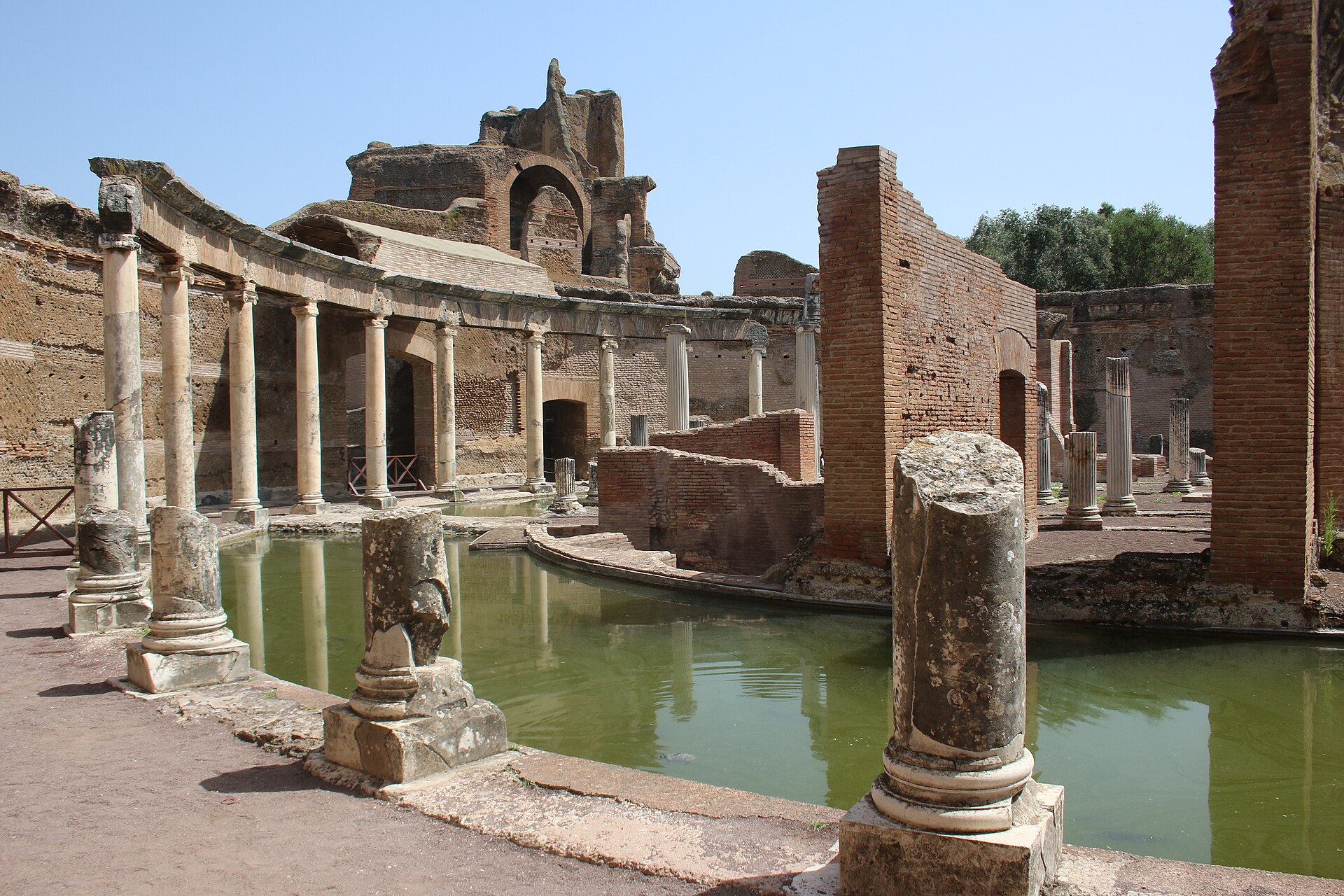
Image Credit: Andy Hay, CC BY 2.0
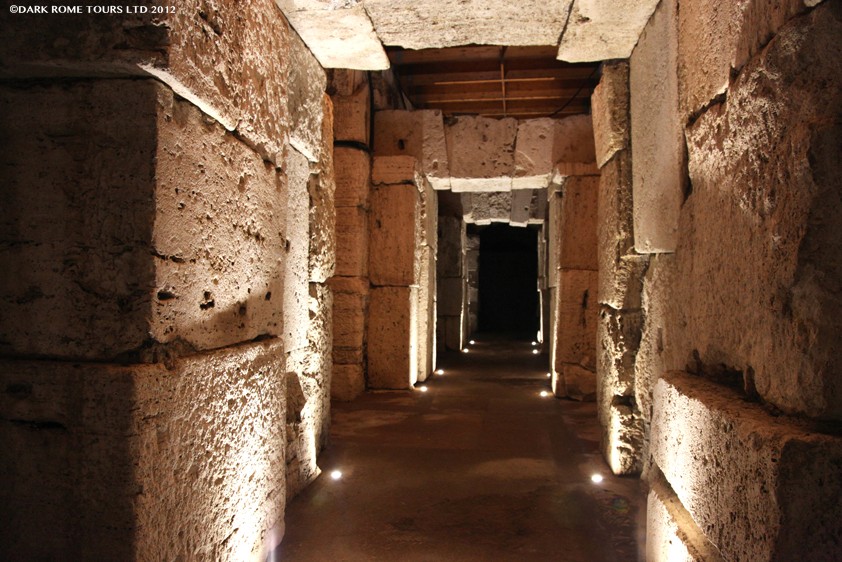
Hadrian's Villa boasted kilometers of underground tunnels used for service, allowing hundreds of servants and slaves to transport goods and manage the estate without being seen by the Emperor.
How Much Time Should I Spend at Hadrian's Villa?
I'd recommend a minimum of two hours for a good visit covering the major monuments, including the Canopus, the Maritime Theatre, the Pecile, and the on-site museum.
Visitors with a deeper interest in Roman archaeology, architecture, or history will find three hours is needed to properly explore the full open area, including the Imperial Palace, the Baths, the Libraries, and the outer areas of the site that many visitors miss.
The site is largely flat, which is a meaningful practical contrast to Villa d'Este's steep terraces. Walking is comfortable and the paths, while sometimes uneven underfoot, are well maintained. Comfortable shoes are essential regardless.
If you are combining Hadrian's Villa and Villa d'Este in the same day, visit Hadrian's Villa in the morning (arriving at 8:30am) and Villa d'Este in the afternoon. This sequence works well because Hadrian's Villa benefits most from the cooler morning temperatures (it is largely exposed to the sky, with limited shade outside the grove of olive trees), and Villa d'Este's gardens and fountains are at their most magical in the afternoon light.
What is the Best Time to Visit Hadrian's Villa?
Best time of day: Arriving at 8:30am, when the site opens, is the best. The site is largely open to the sky and becomes very hot in summer by mid-morning. Arriving early means cooler conditions, fewer people, and the specific quality of early morning light on the Canopus pool, which is one of the most photogenic moments the site offers at any time of year.
Best season: Spring (April to June) is the ideal time to visit. The grass between the ruins is green, the light is warm and long, and crowd levels are lower than in summer. Autumn (September and October) is also excellent. Summer (July and August) is hot and exposed; if you visit in these months, beginning at 8:30am and spending no more than two to three hours on-site avoids the most punishing midday conditions.
Winter visits: The site is quiet and atmospheric in winter, with a stillness that is harder to find in warmer months. The trade-off is shorter opening hours, with last entry at 3:30pm from November to January. Winter light on pale Roman stone is often beautiful.
Best days: Weekdays throughout the year are considerably quieter than weekends. The site receives fewer of the coach-party group tours that visit Villa d'Este, so the difference between weekday and weekend is less extreme here than at the upper town, but weekday mornings remain the most comfortable window.
History of Hadrian's Villa
Emperor Hadrian acceded to the Roman throne in 117 AD and soon began the construction of a new imperial residence in the countryside outside Tivoli, in what had been ancient Tibur. Construction continued until Hadrian's death in 138 AD. The villa was essentially built from scratch on a site that had previously belonged to Hadrian's wife Vibia Sabina, transforming it from a modest country estate into a complex that, at its height, was larger than the entire city of Pompeii.
What makes Hadrian's Villa historically unique is the biographical programme embedded in its architecture. Hadrian had travelled more extensively than any emperor before him, visiting Greece, Egypt, the Near East, North Africa, and the Western provinces. The buildings he created at Tivoli were named after places and structures he had encountered on these journeys: the Canopus recalled an Egyptian canal town; the Pecile reproduced the painted portico (Stoa Poikile) of Athens; the Vale of Tempe evoked the Thessalian landscape; the Serapeum referenced the shrine of the god Serapis. The villa was, in a sense, a physical memory palace of an empire.
After Hadrian's death in 138 AD, the villa remained in imperial use through the reign of several successive emperors. It was subsequently abandoned as Rome's power declined, and from the medieval period onward it was systematically stripped of its marble and stone to supply building materials for Rome and for Tivoli's own buildings. Many of the greatest sculptures now in the Vatican Museums, the Louvre, and the Capitoline Museums were excavated here in the Renaissance and Baroque periods. What remains is the structural skeleton of the most ambitious private building project in ancient Roman history.

What to See at Hadrian's Villa
The open visitor area covers approximately 40 hectares. No single visit can cover everything at a relaxed pace, and I'd recommend prioritizing the following:
The Scale Model: At the start of the visit route, a small pavilion holds a large-scale model of the entire complex as it would have appeared at its height. The pavilion opens at 9:00am, half an hour after the site. Spending ten minutes with this model before walking into the ruins transforms what follows: the model makes the relationship between the various buildings legible, and visitors who skip it often find the site confusing and disconnected. I would strongly recommend starting here.
The Pecile: Immediately beyond the model pavilion, the Pecile is a monumental rectangular enclosure modelled on the Stoa Poikile in Athens. Its outer wall, still standing to a considerable height in sections, once supported a portico beneath which Hadrian walked for exercise regardless of weather. The long central garden within is bordered on two long sides by covered walkways. The scale of this single element, approached on foot for the first time, gives the clearest first impression of the ambition of the entire complex. The sheer wall of Roman opus mixtum brickwork, unbroken for hundreds of metres, is one of the most striking architectural experiences the site offers.
Maritime Theatre (Teatro Marittimo): The most famous and most discussed individual building at Villa Adriana. The Maritime Theatre is a circular structure built on an artificial island approximately 45 metres in diameter, surrounded by a moat. Hadrian accessed the island via retractable wooden drawbridges, which he could then raise behind him to achieve complete isolation from the court and the administrative demands of the empire. The island itself contained everything needed for self-sufficiency: a small set of rooms, a miniature bath suite, a library, and a garden. The ring canal and the surviving fragments of the ionic colonnade that once surrounded the island make this the most visually distinctive and the most psychologically resonant structure in the villa. Restoration work is ongoing in certain sections, and some areas of the immediate interior may have restricted access on any given visit.
The Hall of the Philosophers (Sala dei Filosofi): A large rectangular hall adjacent to the Pecile, with seven deep niches along its south-facing wall. The niches are generally believed to have held busts of the seven sages of ancient Greece, though an alternative interpretation suggests the room functioned as a library with the niches serving as scroll cabinets. The combination of philosophical gathering space and reference library in the room nearest to Hadrian's private retreat says something about how he understood the purpose of his villa.
The Canopus: See the dedicated section below.
The Antinoeion: See the dedicated section below.
The Baths: Two bath complexes survive in significant condition: the Grandi Terme (Large Baths) and the Piccole Terme (Small Baths). The Large Baths were intended for the general court population and contain a well-preserved frigidarium, a circular domed room whose ceiling formed one of the most innovative structural experiments of the Hadrianic period. The Small Baths are believed to have been reserved for the emperor and his immediate circle, and their interior decoration was accordingly more elaborate. Several sections of intact vaulted ceiling survive in the smaller complex.
The Imperial Palace and State Rooms: The heart of Hadrian's governmental operations at the villa, a large complex of interconnected courtyards, reception halls, and living apartments. The Hospitalia, a well-preserved block of guest rooms within this area, still shows the intricate geometric mosaic floor patterns in some rooms, with each guest suite having a slightly different design. These are among the best-preserved Roman interior floors accessible at any outdoor site.
The Libraries: Two libraries, labelled the Greek Library and the Latin Library, overlook a colonnaded garden. The distinction between the two reflects Hadrian's bilingual intellectual world and the formal separation of the two great literary traditions he moved between.
Canopus at Hadrian's Villa
The Canopus is the most visually spectacular and most extensively photographed area of Hadrian's Villa, full stop.
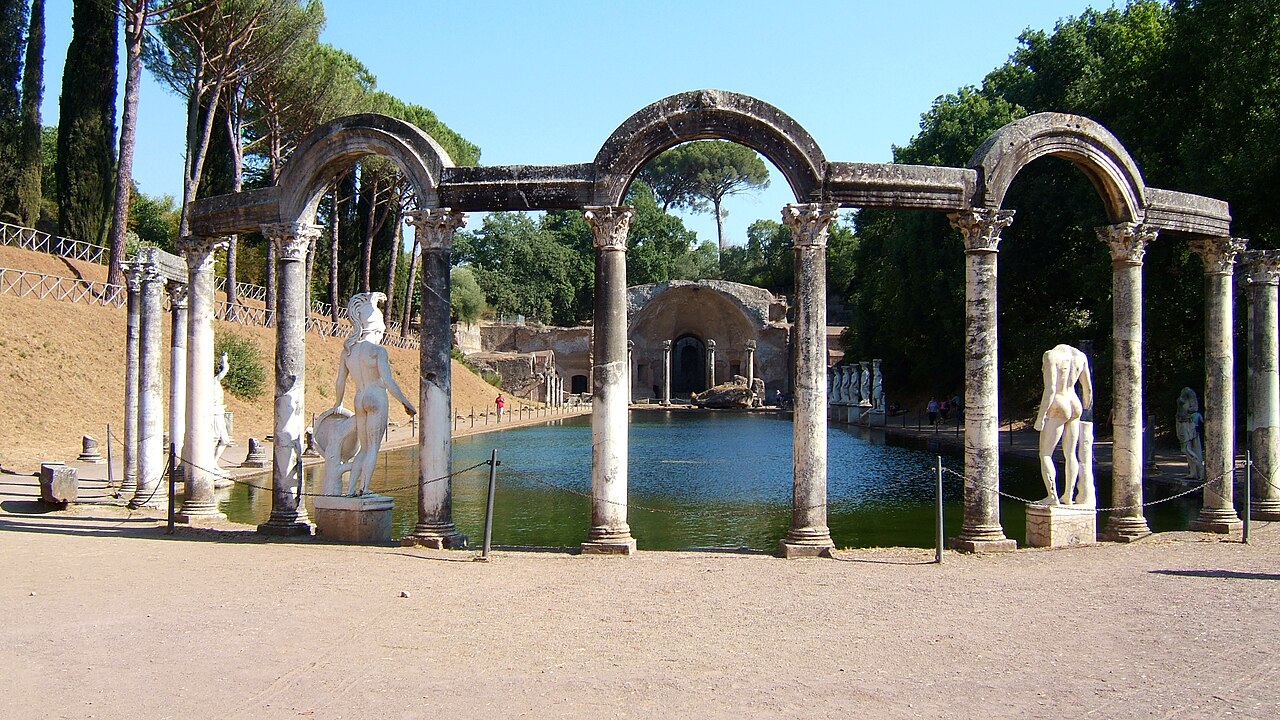
Hadrian named this area after Canopus, an Egyptian port town on the western branch of the Nile delta, which contained a famous sanctuary of the god Serapis. His version at Tivoli consists of a long, narrow reflecting pool approximately 119 metres in length, bordered on three sides by a colonnade alternating smooth round columns and caryatids (female figure columns derived from the famous Erechtheion on the Athenian Acropolis). The caryatids visible today are high-quality replicas; the originals are in the Mouseia (Musei del Canopo), the museum beside the pool.
At the curved southern end of the pool stands the Serapeum, a monumental semicircular exedra originally roofed with a half-dome in a style derived from Egyptian architecture. The Serapeum functioned as a summer triclinium: a dining hall where Hadrian would host guests at elaborate banquets, with water cascading from the interior walls to cool the space and food served on tables that floated on the pool's surface. The combination of Egyptian imagery, Greek sculptural forms, and Roman engineering is the Hadrianic synthesis in its most concentrated form.
In early morning, the pool perfectly reflects the colonnade and the sky above it, creating a mirror image that is one of the most striking photographic subjects in Roman archaeology. I find that sitting at the Serapeum end of the pool, looking north along its length, gives the best possible sense of what this space looked like in use, with the reflected colonnade doubling the visual rhythm of the columns.
The Antinoeion at Hadrian's Villa
The Antinoeion is the most emotionally charged and the least straightforwardly ruinous part of Hadrian's Villa, and understanding what it represents transforms the experience of the entire site.
Antinous was a young man from the Greek province of Bithynia (in present-day Turkey) who became Hadrian's intimate companion. He drowned in the Nile in 130 AD at approximately nineteen years of age, in circumstances that ancient sources describe variously as accidental, sacrificial, and deliberate. Hadrian's grief at his death was, by contemporary accounts, extraordinary in its public expression: he named a city after him in Egypt (Antinoopolis), declared him a god, and commissioned hundreds of sculptures of his likeness that were distributed across the empire. More portraits of Antinous survive from antiquity than of almost any other figure except emperors.
The Antinoeion at Tivoli was a sanctuary built in Antinous's honour within the villa grounds. Discovered in 1998 and excavated between 2002 and 2004 under the direction of the Italian archaeologist Zaccaria Mari, it has been identified as a major religious complex incorporating Egyptian architectural elements, two facing temples, and a large semicircular exedra. The hieroglyphic inscriptions on the Obelisk of Antinous, which now stands on the Pincian Hill in Rome and which the excavators believe originally stood here, describe Antinous in terms drawn from Egyptian religion, identifying him with Osiris. The sanctuary lies in front of the Cento Camerelle, beside the ancient road leading to the Great Vestibule.
The story of Hadrian and Antinous is one of the most documented and most debated in the ancient world, and no visit to Villa Adriana fully engages with what the place represents without knowing it. Marguerite Yourcenar's novel Memoirs of Hadrian (1951), written in Hadrian's first-person voice and describing his relationship with Antinous in extensive and deeply researched detail, is the most celebrated literary response to this site.
Hadrian's Villa Tour Options
Guided tours from Rome: Full-day guided tours combining Hadrian's Villa and Villa d'Este are available from numerous Roman operators and are the standard format. These depart from central Rome in the morning (typically 8:00am to 9:00am), arrive at Villa Adriana by 9:30am, spend two to three hours with an expert guide, and then move to Villa d'Este for the afternoon. Prices start from around €60 to €80 per adult for group tours of up to 20 people, rising to €100 to €150 and above for small-group experiences and private options.
Self-guided with audio guide: An official audio guide is available at the site for a small additional fee. It covers the major monuments and is particularly useful in the Baths and the Imperial Palace areas, where standing ruins without inscriptions or signage are difficult to interpret independently. Several third-party apps also offer Hadrian's Villa audio content; downloading one before your visit is advisable as Wi-Fi is not reliably available on site.
Guided tours from within the site: The official booking platform sells a 75-minute guided tour for €7 on top of the entry ticket, and a private tour for families and small groups of up to seven people for €110 on top of entry. Both are offered in Italian only. Groups can book English-language tours through the groups office on 0774 768279, with a €10 surcharge.
The value of a guide specifically at this site: Hadrian's Villa is one of those archaeological sites where the ruins are extensive enough to feel overwhelming without structure. Much of what made the complex extraordinary, its decoration, its sculpture, its hydraulic systems, its views, is no longer physically present. A guide who can reconstruct what Hadrian's architects achieved here, using the surviving evidence, transforms the experience from impressive-but-confusing to truly illuminating. This is more true at Villa Adriana than at almost any other site covered in these pages, including the Colosseum and the Roman Forum.
Is Hadrian's Villa Worth Visiting?
Hadrian's Villa is one of the greatest archaeological sites in the world by any scholarly measure. The physical scale of what survives, the historical significance of the emperor who built it, and the quality of the art that was created for and found here make it arguably the most important single site within day-trip distance of Rome. For visitors who come prepared, with some knowledge of what they are about to see and an audio guide or a knowledgeable companion, it is consistently described as one of the most memorable experiences of an Italy trip.
For visitors who arrive without preparation and without a guide, the experience can be hard to read. The site is large, the ruins require imagination to inhabit, the signage is modest, and the temptation to find it "just a pile of old rocks" is real if you have not understood in advance what specifically you are looking at and what it represented in its time.
If you have time for only one thing before your visit, read the Wikipedia article on Villa Adriana, look at the scale model photograph, and note the positions of the Canopus, the Maritime Theatre, and the Pecile before you arrive. Fifteen minutes of preparation converts a confusing walk into something memorable.
The site is also, in physical terms, one of the most pleasant archaeological experiences in Italy. The grounds are beautifully maintained, old olive trees provide shade in the central areas, and the combination of ruins, open sky, and the sounds of the countryside makes it a rewarding place simply to be, even before considering the historical content.
Where Should I Eat Near Hadrian's Villa?
On site: There is a small café near the entrance. It is basic but functional and serves coffee, cold drinks, sandwiches, and snacks. There is no restaurant on-site. If you are planning to spend two to three hours inside, particularly in summer, bring water, as the café is only accessible before you enter and after you exit.
In Tivoli town: The best dining near Hadrian's Villa is in the historic centre of Tivoli, about five kilometres uphill by bus or taxi. Most visitors combine Hadrian's Villa in the morning with a lunch break in Tivoli before heading to Villa d'Este in the afternoon, and this is the recommended sequence for a full day.
Ristorante Sibilla on Via della Sibilla is the best restaurant in Tivoli, positioned on the edge of the Aniene gorge with terrace views over the Temple of Vesta and Villa Gregoriana's waterfalls below. The menu centres on traditional Lazio cooking: coda alla vaccinara (oxtail stew), rigatoni alla carbonara, roast lamb, and seasonal vegetables. The setting is extraordinary for the quality of the view, and the food matches the location. I had one of my most enjoyable lunches near Rome at a table on this terrace, looking at the round Temple of Vesta across the gorge. Booking ahead is essential at weekends.
Picnicking inside the villa is possible in the olive grove areas between the ruins, and this is a popular choice for visitors who bring provisions from Rome or from the cafes and markets in Tivoli. The site is large enough that a picnic spot away from the main tourist paths is easy to find.
What Else is There to Do Near Hadrian's Villa?
Villa d'Este is the most natural companion visit, five to six kilometres uphill in the historic centre of Tivoli. The Renaissance gardens of the Cardinal d'Este, with their extraordinary hydraulic fountain system and the hydraulic organ, offer a completely different category of experience from the ancient ruins below: one is about the ambition of empire, the other about the elegance of the 16th century. The standard Tivoli day trip combines both, and the contrast between them is part of what makes the day satisfying.
Villa Gregoriana is a natural park immediately beside Tivoli town, containing dramatic limestone gorges, two waterfalls, and Roman temple ruins on the cliff edge. Managed by the Italian National Trust (FAI), it offers a wilder and less curated experience than either of the UNESCO villas, with walking paths descending into the gorge and through caves. Entry requires a separate ticket. The Grande Cascata waterfall, at 120 metres, is one of the largest in Italy.
The temples of Tivoli: The Temple of Vesta (round, 1st century BC) and the Temple of the Sibyl (rectangular, also 1st century BC) stand on the edge of the Aniene gorge in Tivoli's historic centre and are among the best-preserved Republican-era Roman temples in Italy. They can be viewed from outside for free at any time, and the view of the round temple framed against the gorge is one of the most-painted and most-photographed views in Italian landscape tradition.
Rules, Bags, and Security
All visitors pass through security checks at the entrance, including bag inspection and metal detectors.
Bags: There is no published size restriction for general entry. Day bags and backpacks are permitted. Large suitcases and wheeled luggage are not appropriate for this site and there is no luggage storage.
Photography: Personal photography is permitted throughout the site without flash. The site is an archaeological area and the lighting and angles are mostly determined by natural conditions; a camera or smartphone with a wide-angle option produces the best results in the Canopus and the Pecile.
Prohibited: Climbing on or touching the ruins, including walls and architectural fragments. This applies universally and is enforced. The ruins are structurally fragile in some areas and physically irreplaceable.
Dogs: Permitted on a lead throughout the outdoor areas of the site.
Physical conditions: Comfortable walking shoes are essential. The paths are mostly level but surface conditions vary, with some areas of uneven stone and compacted earth. The site is predominantly exposed to the sun; sun protection and water are necessary in summer.
Electric vehicle service: For disabled visitors who cannot walk the site, an electric vehicle service operates and can be booked in advance through the official site (villae.cultura.gov.it). The vehicle cannot carry standard wheelchairs, and the site's uneven surfaces mean that even with the electric vehicle, some areas are not accessible. Contact the villa in advance for specific accessibility information.
Accessibility at Hadrian's Villa
Hadrian's Villa is largely flat, which makes it more accessible than many Italian heritage sites with significant changes in level. The main visitor paths across the 40 open hectares are maintained and usable by most visitors, though the surface underfoot is uneven in places and some sections become muddy after rain.
The electric vehicle service for disabled visitors must be booked in advance and is provided free of charge. Disabled visitors and one accompanying person enter the site free.
The on-site museum has step-free access. Accessible toilets are available near the entrance.
Final Tips for Visiting Hadrian's Villa
Book tickets in advance. Summer weekend slots fill up.
Start with the scale model. Its pavilion is at the start of the route, and ten minutes there makes the entire site legible. Without it, the ruins are impressive but disconnected. With it, you understand what you are walking through.
Arrive at 8:30am. The site is largely exposed to the sky, and summer heat builds quickly. The Canopus in early morning light, with the pool reflecting the colonnade, is one of the finest sights in Roman archaeology.
Bring water. The café is only accessible at the entrance and exit. The site is large and exposed, and in summer a one-litre bottle per person is a minimum.
Wear proper walking shoes. The paths are mostly level but uneven underfoot in sections.
A guide or audio guide makes a significant difference here. More so than at many other sites, the ruins require context to inhabit. The on-site audio guide, a downloaded third-party app, or a licensed guided tour all substantially improve the visit.
The Canopus is the unmissable highlight. Stand at the Serapeum end of the pool and look back north along its length in the morning light.
The Maritime Theatre is the most evocative building. Understanding what Hadrian used it for, a private island he could seal off completely from the outside world, gives it a human scale that the grand monuments do not always have.
Read about Antinous before you visit. The Antinoeion is the most personal part of the entire complex, and the story behind it is one of the most extraordinary in Roman history.
Combine with Villa d'Este in the same day. Visit Hadrian's Villa first (morning), have lunch in Tivoli town, then Villa d'Este in the afternoon. Take the CAT bus 4X from Villa Adriana to Tivoli for the connection between the two. The contrast between the two sites, ancient empire and Renaissance elegance, makes the day as a whole greater than either visit alone.
If driving, the A24 from Rome takes 30 to 40 minutes. Parking is available at the entrance. Driving is the most practical way to combine both Tivoli sites without bus connections.
Free-entry Sundays are more crowded than usual. Tickets cannot be booked in advance on free days, so if your visit falls on the first Sunday of the month, arrive at 8:30am.
Back to Rome Attractions
Explore other Rome attractions
" width="24px"><path d="M 0 0 L 24 0 L 24 21.231 L 0 21.231 Z" fill="transparent" height="21.230768474975793px" id="nL2EwDcS9" width="24px"/><path d="M 0 0.541 C 0 0.242 0.245 0 0.547 0 L 2.735 0 C 3.037 0 3.282 0.242 3.282 0.541 L 3.282 4.598 C 3.282 4.897 3.037 5.139 2.735 5.139 L 0.547 5.139 C 0.245 5.139 0 4.897 0 4.598 Z" fill="rgb(196, 217, 201)" height="5.138657337892187px" id="hZ_rlBe_S" transform="translate(0 16.092)" width="3.2820512820512358px"/><path d="M 0 0.541 C 0 0.242 0.245 0 0.547 0 L 2.735 0 C 3.037 0 3.282 0.242 3.282 0.541 L 3.282 7.843 C 3.282 8.142 3.037 8.384 2.735 8.384 L 0.547 8.384 C 0.245 8.384 0 8.142 0 7.843 Z" fill="rgb(230, 211, 160)" height="8.38412513024521px" id="HgVBxIz3e" transform="translate(5.128 12.847)" width="3.282051282051235px"/><path d="M 0 0.541 C 0 0.242 0.245 0 0.547 0 L 2.735 0 C 3.037 0 3.282 0.242 3.282 0.541 L 3.282 12.982 C 3.282 13.281 3.037 13.523 2.735 13.523 L 0.547 13.523 C 0.245 13.523 0 13.281 0 12.982 Z" fill="rgb(232, 207, 164)" height="13.522782468137464px" id="utgrDnoM9" transform="translate(10.325 7.708)" width="3.282051282051377px"/><path d="M 0 0.541 C 0 0.242 0.245 0 0.547 0 L 2.735 0 C 3.037 0 3.282 0.242 3.282 0.541 L 3.282 16.498 C 3.282 16.797 3.037 17.039 2.735 17.039 L 0.547 17.039 C 0.245 17.039 0 16.797 0 16.498 Z" fill="rgb(233, 196, 166)" height="17.038705909853153px" id="OLOhW6STz" transform="translate(15.521 4.192)" width="3.2820512820512384px"/><path d="M 0 0.541 C 0 0.242 0.245 0 0.547 0 L 2.735 0 C 3.037 0 3.282 0.242 3.282 0.541 L 3.282 20.69 C 3.282 20.989 3.037 21.231 2.735 21.231 L 0.547 21.231 C 0.245 21.231 0 20.989 0 20.69 Z" fill="rgb(217, 170, 153)" height="21.230768474975793px" id="H5Z8wcwkd" transform="translate(20.718 0)" width="3.2820512820512278px"/></g></svg>)