Back to Amsterdam Attractions
Royal Palace Amsterdam: Everything You Need to Know Before You Visit
Updated August 2026
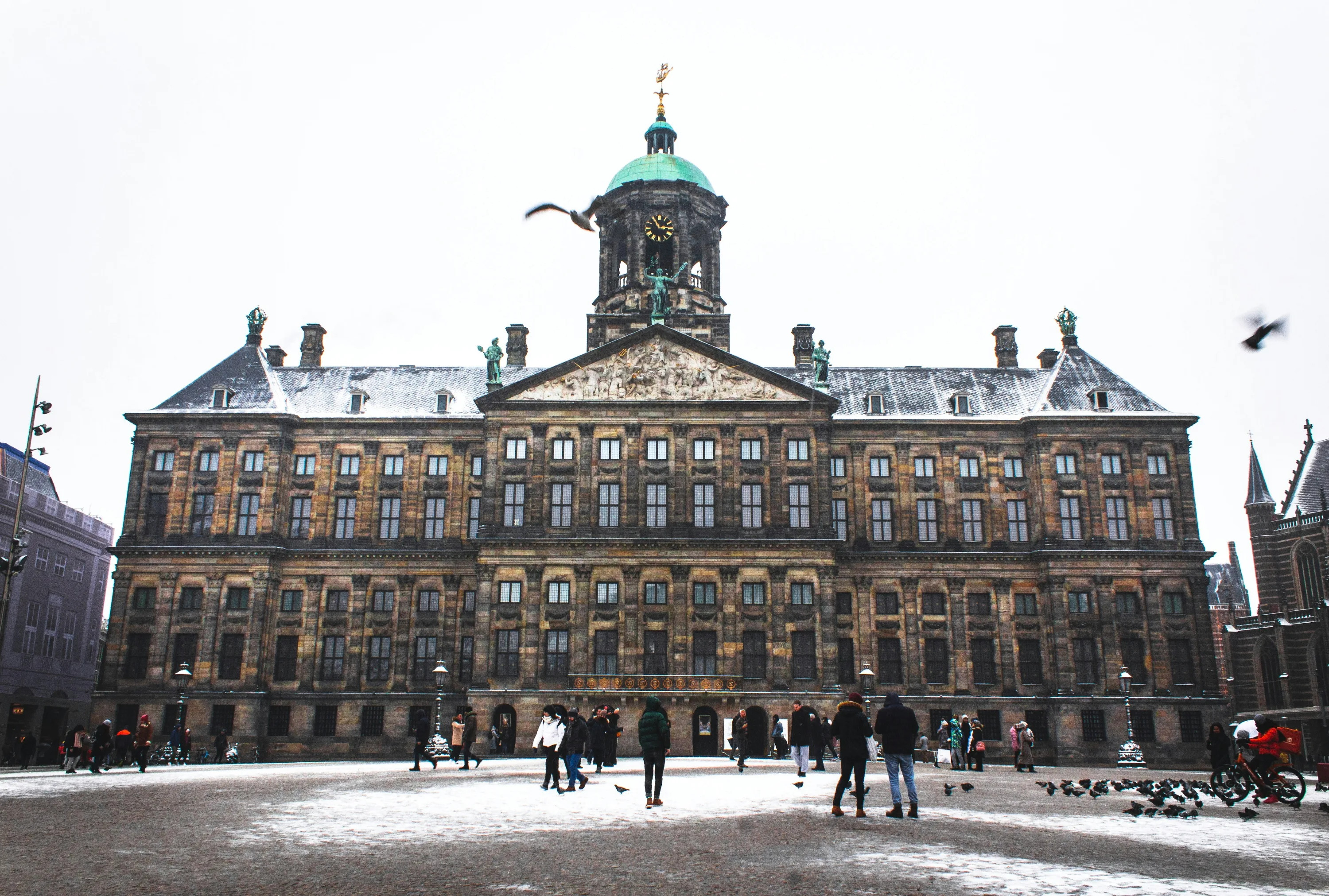
The Royal Palace Amsterdam dominates the west side of Dam Square, and despite its name it was built between 1648 and 1665 as the city's town hall, a deliberate statement of Amsterdam's wealth at the height of its trading power, resting on around 13,500 wooden piles driven into the marsh. It became a palace only in 1808, when Napoleon installed his brother Louis Bonaparte as king, and it remains King Willem-Alexander's official reception palace today, which is why it opens to visitors roughly 230 days per year rather than the full 365. That closure pattern, and the fact that Amsterdam's most widely bought city card does not work here, are the two things that usually derail visits here.
At a Glance
How Early to Book:
No need to book ahead; tickets do not sell out. However, opening hours vary significantly due to Royal Engagements, and the schedule should be checked well ahead of time.
Best Times to Visit:
Weekday mornings at the 10am opening are the best time, especially from Monday through Thursday when the crowds are at their smallest.
Ticket price:
€13.50 for adults.
Where to Book:
Landmark Address:
Do You Need to Book Royal Palace Amsterdam Tickets in Advance?
You usually do not need to book ahead of time, but you should check the calendar before you go, which matters more here than almost any other place in Amsterdam.
Tickets are sold online and at the ticket desk inside the Palace, at the same price either way, and walk-up availability is normal on weekday mornings and in low season. Queues build in summer afternoons and on rainy days, when every visitor in central Amsterdam is looking for something indoors, so booking online saves time on those days rather than guaranteeing entry.
Where to book: Buy directly at tickets.paleisamsterdam.nl. You pick a date and a starting time, and both are printed on the ticket.
The thing that actually matters: the Palace is a working royal building and it closes for state visits, gala dinners, investitures, award ceremonies and New Year receptions, often at short notice. That is roughly 135 closed days across the year, and they are not evenly spread. The official calendar on paleisamsterdam.nl shows opening days and times up to six months ahead, and it is the most important thing to check before you plan a visit around this.
Cancellations: Tickets bought online cannot be refunded. There is no cancellation window and no date change. Given that, and given walk-up tickets cost the same, there is a reasonable argument for simply buying at the desk unless you are visiting in peak summer.
Payment: Card only at the ticket desk, debit or credit. No cash.
Groups: Bookings for more than 15 people go through the group visit form rather than the standard ticket system.
How Much Does the Royal Palace Amsterdam Cost?
Entry is €13.50 for adults, which is pretty inexpensive by Amsterdam standards and includes the multimedia audio tour.
Adults: €13.50
Students: €9.00
Ages 17 and under: free
Dutch Museum Pass (Museumkaart): free
ICOM card: free
Carers: free, one per disabled visitor who could not visit alone, and no ticket is needed
Guided tours for groups from 10 people cost €105 on weekdays and €135 at weekends, on top of admission.
Museumkaart holders still book a ticket, which acts as a reservation showing your date and time. It will not carry a barcode, which is correct rather than an error, and the Museumkaart itself gets scanned on entry. You cannot buy a Museumkaart at the Palace desk.
The I Amsterdam City Card does not work here. This catches out a lot of people off guard, because the card covers most of the city's major museums and visitors reasonably assume a state palace on Dam Square is among them. It is not, and there is no discount either. If you are working through an I Amsterdam Card itinerary, budget €13.50 separately for this one.
Children under 18 going free makes this one of the better value family visits in central Amsterdam. Two adults and two teenagers costs €27 in total.

Royal Palace Amsterdam Opening Hours and Entry Information
When open, the Palace runs daily from 10:00 to 18:00. There is no weekly closing day, because the closures follow the royal calendar rather than a fixed pattern.
Opening days: More than 230 days in 2026. The remaining days are given over to royal and state functions. Hours can also be shortened on a given day rather than the Palace closing entirely, so a date being listed as open is not quite the same as a full day.
Seasonal pattern: Summer is the most reliably open stretch and is when the annual exhibition runs. February and March are the least reliable, because the Royal Award for Modern Painting is presented then and the associated exhibition and ceremonies take over parts of the building.
Currently on: The Netherlands and Japan: Links through Time runs from 26 June to 11 November 2026. Exhibitions here are included with standard admission, and the rest of the Palace stays open while they run, so an exhibition is never a reason to postpone.
Last admission is before closing rather than at it, so arriving after about 17:00 will leave you rushed. With the audio tour taking around an hour, arriving by 16:30 is the practical cut-off.
Address: Nieuwezijds Voorburgwal 147, 1012 RJ Amsterdam. The visitor entrance is on the Dam Square side of the building, not on Nieuwezijds Voorburgwal, despite the postal address.
What is the Best Way to Get to the Royal Palace?
The Palace sits on Dam Square, which is the geographic and historical centre of Amsterdam, so almost any central route works.
On foot: 10 minutes from Amsterdam Centraal, straight down Damrak. This is how most visitors arrive and it is the simplest option. Around 15 minutes from the Anne Frank House, 20 from the Rijksmuseum.
By tram: Lines 2, 4, 11, 12, 13, 14, 17 and 24 all serve Dam or Nieuwezijds Kolk within a couple of minutes' walk. Trams 2 and 12 connect from Museumplein, trams 13 and 17 from the Jordaan and west.
By metro: Rokin station on the Noord/Zuidlijn is about four minutes' walk south.
By bike: Central and easy to reach, but Dam Square itself is congested and bike parking around it fills fast. The large underground bike garage at Amsterdam Centraal, or the racks along Nieuwezijds Voorburgwal, are more reliable than anything on the square.
By car: Not realistic. Dam Square is effectively closed to through traffic, central parking runs above €7.50 an hour, and the P+R sites on the city edge with a public transport ticket are the only sensible option if you are driving into Amsterdam at all.
The practical tip: the Palace has a free cloakroom but cannot take large backpacks or rolling suitcases at all. If you are arriving from Centraal with luggage, use the lockers at the station or one of the central luggage points first. There is nowhere to leave a suitcase here, and you will not be allowed in with one.
The Rembrandt House Museum in Amsterdam is the restored 17th-century home and studio where the Dutch master lived and worked from 1639 to 1658. It is the only museum worldwide entirely dedicated to Rembrandt and houses an almost complete collection of his iconic etchings.
How Much Time Should I Spend at the Royal Palace?
About an hour is what I'd recommend for a standard visit with the free audio tour, and that is also the Palace's own estimate.
90 minutes to two hours if you take the audio tour seriously, spend time in the Citizens' Hall, and read the exhibition. The building rewards this more than the one-hour figure suggests.
45 minutes is enough if you skip the introductory film in the foyer, which most visitors find adds little, and move steadily through the state rooms.
Combined with the Nieuwe Kerk next door, this makes a comfortable half day on Dam Square without either visit feeling rushed.
The pinch point is not the size of the building but the glass barriers. Several rooms, including the Balcony Chamber, are viewed from behind glass, which creates small bottlenecks when a group arrives. Those clear in a few minutes.
What is the Best Time to Visit the Royal Palace?
Best time of day: Weekday mornings, from opening at 10:00. The Palace is quiet then, and you can stand in the Citizens' Hall with room to look up, which is the whole point of that space. Afternoons fill steadily, and the busiest hours are 14:00 to 16:00.
Best days: Monday to Thursday. Weekends bring the Dam Square crowd indoors, and Sunday afternoons are the worst combination.
Best season: Any, given the interior focus, but note the closure pattern. Summer offers the most open days and the annual exhibition. Late autumn and winter are quieter inside but carry a higher chance of a royal closure, and February and March are the least dependable months of the year.
Rainy days are the exception to all of this. This is one of central Amsterdam's best wet-weather options and everyone knows it. If it is raining and you want a quiet visit, come at 10:00 sharp or accept the crowd.
For photography: Photography without flash is permitted throughout. The Citizens' Hall floor and the Tribunal are the two spaces worth the effort, and morning light through the high windows of the Citizens' Hall is noticeably better than afternoon. Tripods and selfie sticks are not allowed, and neither is filming or vlogging of any kind.
What is Inside the Royal Palace Amsterdam?
Almost all rooms on the main floor are open, plus the Tribunal on the ground floor. This is a state building rather than a residence, so what you are seeing is ceremonial architecture and sculpture rather than bedrooms and private quarters.
The Citizens' Hall is the centrepiece and the reason to come. It rises 25 metres, finished in marble, and was conceived by architect Jacob van Campen as a model of the universe with Amsterdam at its centre. Three maps are inlaid in the floor, two hemispheres and the northern night sky, each 624cm across, and they remain the largest maps in the world. Marble reliefs of the four elements and garlands of flora and fauna make up the terrestrial layer, statues of Roman gods in the surrounding galleries stand for the planets, and the Maid of Amsterdam is enthroned above the entrance. At the far end, a colossal Atlas carries the heavens on his shoulders, with Justice crushing Greed and Envy below him. It is an overwhelming room and photographs consistently fail to convey the scale.
The Tribunal, or Vierschaar, on the ground floor, is the space most visitors remember. This is where death sentences were pronounced when the building was a town hall, on average three or four times a year. It is a cold, high marble chamber carved by Artus Quellinus, and the condemned entered to face the sheriff and magistrates on a long bench with three depictions of good judgement behind them, the Judgement of Solomon at the centre. Female figures representing guilt and remorse buckle under the weight of the walls. The room opens onto Dam Square, where the executions themselves took place, and the crowd watched from outside. Louis Bonaparte later used it as a court chapel and covered the reliefs with blue curtains rather than removing them. The audio tour tells a specific case here, and it lands.
The Throne Room was installed by Louis Bonaparte in 1808 and is still used for investitures. King Willem-Alexander was inaugurated here in 2013. The throne is deliberately restrained, which is very much the Dutch point.
The Balcony Chamber leads to the balcony where new monarchs are presented to the crowd and royal couples appear after weddings. It is viewed from behind glass.
The Moses Hall and the surrounding council chambers carry paintings by Rembrandt's pupils Govert Flinck and Ferdinand Bol, along with work by Jacob Jordaens and Jan Lievens. The Mayor's Chamber holds the most technically accomplished painting in the building, a Continence of Scipio ceiling, a moral instruction to the four burgomasters who met beneath it.
Louis Bonaparte's Empire furniture remains throughout, one of the finest collections of its kind anywhere, and it is still used during royal receptions rather than roped off as a museum set.
One detail worth looking for: above the spot in the Tribunal where the accused stood, the carved ceiling element forms a coffin shape when viewed from the right angle. The audio tour does not mention it.
Does the King Live in the Royal Palace?
No, he doesn't, despite nearly everyone who comes to the place thinking he does.
King Willem-Alexander and Queen Máxima live at Huis ten Bosch in The Hague, and the working seat of government is also in The Hague rather than Amsterdam. The Royal Palace Amsterdam is the King's official reception palace: it is where foreign heads of state are received on state visits, where gala dinners and New Year receptions are held, where awards are presented, and where Dutch monarchs are inaugurated.
That distinction explains almost everything practical about visiting. There are no private apartments to see because nobody lives here. The building closes without much notice because a state function takes precedence over ticket sales. And what you are walking through is not a home but a stage set for statecraft, which is why the rooms are grand and impersonal rather than intimate.
It also means the odds of encountering any royal presence are effectively zero. If the King is in the building, you won't be let in.
Guided Tours and the Audio Guide
The multimedia tour is free and included with every ticket, including children's tickets, and it is available in Dutch, English, German, French, Spanish, Italian, Chinese and Russian. It cannot be reserved in advance and is subject to availability, though running out is rare. Pick your language at the desk before you start.
I would not visit without it. The building is largely unlabelled, and the sculpture programme is dense with allegory that means nothing without explanation. The Tribunal in particular is a beautiful marble room and not much else until you understand what happened in it.
Guided tours run for groups from 10 people, at €105 on weekdays and €135 at weekends on top of admission, and can be booked on themes including Highlights, From City Hall to Royal Palace, Masters of Morality, Myth and Monument, and Traces of Slavery. That last one is worth flagging: it addresses the building's connection to the trade that funded seventeenth-century Amsterdam, and it is the kind of context the standard audio route touches only lightly.
Family activities and a dedicated children's tour run at various times through the year, and the family programme changes seasonally.
Third-party operators sell "skip the line" Palace tickets, but there is no separate fast-track entry here and the queue is rarely long enough to justify a markup. Buy direct.
Is the Royal Palace Amsterdam Worth Visiting?
At €13.50, the value case is stronger than at most Amsterdam attractions. But you should know exactly what you're getting into before you commit a whole morning to visiting.
The main thing to know is that it does not feel like a palace. People who have done Versailles, Schönbrunn or Buckingham Palace arrive expecting gilt, private apartments and lived-in opulence, and instead find a severe seventeenth-century civic building with one floor open. Some come away describing it as feeling more like a very grand government building than a royal residence, and that is a fair description. The exhibitions vary in ambition from year to year, and a thin one can leave the visit feeling short. Several rooms are behind glass.
What it does have is the Citizens' Hall and the Tribunal, and those two rooms carry the visit. The Citizens' Hall is one of the great interiors in northern Europe and it is not on most visitors' radar at all. The Tribunal is quietly devastating: a room built to be beautiful specifically so that the condemned would be softened by it before hearing their sentence, with the scaffold visible through the door.
For first-time visitors to Amsterdam, it is worth spending an hour, particularly if you have a rainy afternoon or you are already on Dam Square. But it should not come before the Rijksmuseum or the Anne Frank House.
For anyone interested in the Dutch Golden Age, this is the building that period built to describe itself, and it does the job better than any painting of it. Pair it with the Rijksmuseum and the two complement each other very nicely.
For families, free entry under 18, a one-hour visit, a free audio tour for children and the Atlas statue make it an easy win. The Tribunal may be too much for very young children.
For architecture and sculpture, Quellinus's marble work here is the reason art historians care about this building, and 2026 visitors have particularly good context for it after the Rijksmuseum's Quellinus retrospective was staged in these rooms.
For anyone expecting royal glamour, adjust your expectations or skip it. This is a civic monument that a monarchy later moved into, and it never stopped being the former.
Where Should I Eat Near the Royal Palace?
There is no café inside the Palace, no restaurant and nowhere to sit with a coffee, so plan to eat before or after. Dam Square itself is one of the weakest eating areas in central Amsterdam, ringed with Argentinian steakhouse chains and photo-menu tourist restaurants. Walking three minutes in almost any direction fixes this.
Van Kerkwijk, on Nes just south of the square, is the local answer and has been for years. No printed menu, the dishes are recited at the table, and the cooking is consistently good. Small, no reservations, and worth the wait.
Café de Jaren, five minutes south on Nieuwe Doelenstraat, is a large grand café with a terrace over the Amstel. It is the reliable option for lunch, coffee or a beer with a view, and it stays sane even at peak times.
Bakers & Roasters and the smaller specialist coffee places around the Nine Streets, about eight minutes west, are the better breakfast and brunch direction if you are visiting at opening time.
Nam Kee and the cluster of Chinese restaurants on Zeedijk, seven minutes east towards Nieuwmarkt, are cheap, fast and very good, and locals eat there.
Bird on Zeedijk is the Thai institution in the same direction, busy and worth booking in the evening.
De Bijenkorf Kitchen, on the top floor of the department store directly across Dam Square, is a self-service option with a view over the square. Not a destination, but useful and quicker than anything at street level.
For something Dutch, Moeders in the Jordaan does the best stamppot in the city, though it is a 15-minute walk and needs booking.
I'll keep my warning simple: the restaurants with laminated photo menus directly on Dam Square and along Damstraat charge central-Amsterdam prices for food that would not survive anywhere else. Nes, Zeedijk and the Nine Streets are all within a few minutes and all better.
What Else is There to Do Near the Royal Palace?
The Nieuwe Kerk is physically attached to the Palace on Dam Square and is the natural pairing. It is where Dutch monarchs are inaugurated, and it now runs as an exhibition space rather than a working church. Check the current programme, since the visit is only as good as the show inside.
The National Monument, the white obelisk across the square, is the Dutch war memorial and the focus of the Remembrance Day ceremony each 4 May.
Madame Tussauds is on the square itself, and De Bijenkorf, the grand department store, sits on the east side.
The Amsterdam Museum and the Begijnhof are five to eight minutes south, the latter a walled medieval courtyard that is free, quiet and completely unlike the streets around it.
Nieuwmarkt and the Waag, eight minutes east, give you a proper square with cafés that Amsterdammers actually use.
The Anne Frank House is a 15-minute walk west and requires advance booking, with tickets released on a strict schedule and selling out fast.
Rules, Bags, and Security
Bags: Only small hand bags up to 30 x 30 x 15cm may be carried inside. Anything larger goes in the free cloakroom.
What cannot be brought at all: large backpacks and rolling suitcases cannot be accepted even at the cloakroom, so there is nowhere to leave them. Umbrellas, scooter and motorcycle helmets, back-mounted child carriers and any other large protruding object are also prohibited inside, though these can be left at the cloakroom. Water bottles are not allowed in but can be checked.
What is allowed: wheelchairs, rollators, prams and walking sticks.
Photography: Permitted without flash. Filming, vlogging, tripods and selfie sticks are all prohibited, as is wedding photography anywhere in the building.
Animals: Not permitted, with the exception of guide dogs.
Food and drink: There are no café facilities and no eating inside.
Accessibility at the Royal Palace Amsterdam
The Palace is well set up for visitors with access needs, which is not always true of seventeenth-century buildings.
Getting around: There is a lift serving the visitor floors, and wheelchair-accessible toilets. Wheelchairs and walking sticks are available on site to borrow.
Carers: Admission is free for one carer per disabled visitor who would not be able to visit alone, and no ticket is required for the carer.
Deaf and hard-of-hearing visitors: A printed guide book covering the visit is available free at the ticket desk, in English, German, French, Spanish and Italian.
Mobility aids: Wheelchairs, rollators and walking sticks are all permitted throughout.
Final Tips for Visiting the Royal Palace Amsterdam
Check the opening calendar before you plan anything around this visit. The Palace is closed around 135 days a year for royal functions, and the calendar on the official site runs six months ahead.
Do not rely on your I Amsterdam City Card. It is not valid here at all, with no discount, and this is the most expensive assumption you can make on Dam Square.
Buy at the desk rather than online unless you are visiting in peak summer, since the price is identical and online tickets cannot be refunded or rescheduled.
Come at 10:00 on a weekday and you will have the Citizens' Hall close to yourself, which is the difference between seeing that room and standing in it.
Take the free audio tour and skip the introductory film. The tour makes the building legible; the film adds little.
Deal with your luggage first. Rolling suitcases and large backpacks cannot be left at the cloakroom or brought inside, so use the lockers at Centraal on the way.
Look for the coffin shape in the Tribunal ceiling, carved above where the accused stood, and visible only from the right angle. It is not on the audio tour.
Pair it with the Nieuwe Kerk next door for a half day on Dam Square, or with the Rijksmuseum on another day so the Golden Age building and the Golden Age paintings explain each other.
Back to Amsterdam Attractions
Explore other Amsterdam attractions
" width="24px"><path d="M 0 0 L 24 0 L 24 21.231 L 0 21.231 Z" fill="transparent" height="21.230768474975793px" id="nL2EwDcS9" width="24px"/><path d="M 0 0.541 C 0 0.242 0.245 0 0.547 0 L 2.735 0 C 3.037 0 3.282 0.242 3.282 0.541 L 3.282 4.598 C 3.282 4.897 3.037 5.139 2.735 5.139 L 0.547 5.139 C 0.245 5.139 0 4.897 0 4.598 Z" fill="rgb(196, 217, 201)" height="5.138657337892187px" id="hZ_rlBe_S" transform="translate(0 16.092)" width="3.2820512820512358px"/><path d="M 0 0.541 C 0 0.242 0.245 0 0.547 0 L 2.735 0 C 3.037 0 3.282 0.242 3.282 0.541 L 3.282 7.843 C 3.282 8.142 3.037 8.384 2.735 8.384 L 0.547 8.384 C 0.245 8.384 0 8.142 0 7.843 Z" fill="rgb(230, 211, 160)" height="8.38412513024521px" id="HgVBxIz3e" transform="translate(5.128 12.847)" width="3.282051282051235px"/><path d="M 0 0.541 C 0 0.242 0.245 0 0.547 0 L 2.735 0 C 3.037 0 3.282 0.242 3.282 0.541 L 3.282 12.982 C 3.282 13.281 3.037 13.523 2.735 13.523 L 0.547 13.523 C 0.245 13.523 0 13.281 0 12.982 Z" fill="rgb(232, 207, 164)" height="13.522782468137464px" id="utgrDnoM9" transform="translate(10.325 7.708)" width="3.282051282051377px"/><path d="M 0 0.541 C 0 0.242 0.245 0 0.547 0 L 2.735 0 C 3.037 0 3.282 0.242 3.282 0.541 L 3.282 16.498 C 3.282 16.797 3.037 17.039 2.735 17.039 L 0.547 17.039 C 0.245 17.039 0 16.797 0 16.498 Z" fill="rgb(233, 196, 166)" height="17.038705909853153px" id="OLOhW6STz" transform="translate(15.521 4.192)" width="3.2820512820512384px"/><path d="M 0 0.541 C 0 0.242 0.245 0 0.547 0 L 2.735 0 C 3.037 0 3.282 0.242 3.282 0.541 L 3.282 20.69 C 3.282 20.989 3.037 21.231 2.735 21.231 L 0.547 21.231 C 0.245 21.231 0 20.989 0 20.69 Z" fill="rgb(217, 170, 153)" height="21.230768474975793px" id="H5Z8wcwkd" transform="translate(20.718 0)" width="3.2820512820512278px"/></g></svg>)