Back to New York City Attractions
American Museum of Natural History New York: Everything You Need to Know Before You Visit
Updated July 2026
The American Museum of Natural History (AMNH) on the Upper West Side is one of the largest natural history museums on Earth, holding over 34 million specimens across more than 40 halls, from a 94-foot blue whale suspended over the Hall of Ocean Life to the towering Titanosaur and the museum's famous dinosaur fossils. The 2023 addition of the Richard Gilder Center, with its cave-like sculpted architecture, a four-story butterfly vivarium, and an insectarium, gave the 150-year-old institution its biggest expansion in decades. The key to a smooth visit is understanding the ticket structure: general admission never sells out, but the Hayden Planetarium Space Show and other timed exhibitions do, and knowing which to pre-book will shape your whole day.
At a Glance
How Early to Book:
Get tickets for the permanent collection the night before to bypass queues. Tickets are valid for any time during the selected day; there are no time-slots. Same-day tickets can also be purchased at the door. Book special exhibits in advance as these may sell out.
2-4 weeks ahead for the permanent collection.
Best Times to Visit:
Right at opening at 10am, especially in the middle of the week, will have the smallest crowds. The crowds also die down around 2pm when school groups leave.
Ticket price:
$37 for adults.
Where to Book:
Museum Address:
Do You Need to Book Natural History Museum Tickets in Advance?
The good news: General admission does not sell out, and you can walk up and buy a ticket at any entrance on any open day. What does sell out, especially on weekends and during school holidays, are the timed ticketed exhibitions: the Hayden Planetarium Space Show, the Davis Family Butterfly Vivarium, the Invisible Worlds immersive experience, and rotating special exhibitions. If any of those are on your list, book online in advance to lock in an entry time.
Buying general admission online still helps, letting you skip the ticket desks and head straight through security to the galleries. The security bag check applies to everyone and can back up at peak times, so travelling light speeds things along.
Where to book: The only official platform is the museum's own site, amnh.org. GetYourGuide and Viator also sell legitimate admission, useful if you are bundling with other attractions, but for the museum alone the official site is simplest and cheapest. .
Standard ticket prices (visitors from outside New York State):
General Admission: adults $37, seniors (60+) and students $30, children (3 to 12) $22
General Admission + One Ticketed Exhibition: adults $43, seniors and students $35, children $26
General Admission + All Ticketed Exhibitions: adults $48, seniors and students $39, children $30
Children under 3: free
Members: free
How the "+ One" and "+ All" tickets work: General admission alone covers more than 40 permanent halls, the Rose Center for Earth and Space, and the Gilder Center. It does not include the Space Show, the Butterfly Vivarium, Invisible Worlds, or the Impact dinosaur-extinction exhibition. Add one of those with the "+ One" ticket, or all of them with "+ All." For most first-time visitors, general admission plus the Space Show is the sweet spot.
City passes: Unlike the Met a few blocks east, the Natural History Museum is included in the New York CityPASS, which bundles general admission plus one ticketed exhibition with several other top attractions. It is also on the Go City Explorer Pass. If you are visiting several paid attractions, a pass can pay for itself here.
How far ahead to book: For general admission, the day before is fine. For a specific Space Show time on a summer weekend, book several days out.
Is the Natural History Museum Free? Pay What You Wish Explained
The museum is free for children under 3 and for members, and effectively free for New Yorkers, but not for out-of-state or international visitors.
Who qualifies: New York State residents can pay whatever they choose for general admission, with valid ID showing a New York address. The suggested amounts are $25 for adults, $20 for seniors and students, and $14 for children, but you set the figure. Accepted ID includes a driver's licence, state ID, IDNYC, student ID, a utility bill with an address, or a voter registration card.
The catch: Pay-what-you-wish covers general admission only. It cannot be combined with the Space Show, Butterfly Vivarium, Invisible Worlds, or other ticketed exhibitions, and these cannot be added online to a pay-what-you-wish reservation. To include them, New York residents buy resident-priced tickets instead, or add the exhibitions at a ticket desk on arrival.
Free for others: All U.S. military and their families enter free during the Blue Star programme (Armed Forces Day through Labor Day), and military personnel plus one guest enter free the rest of the year. IDNYC members, Cool Culture pass holders, caregivers accompanying visitors with disabilities, and anyone arriving in the last hour of the day also qualify for waived general admission, though a ticket is still required.
Natural History Museum Opening Hours and Entry Information
Hours: Open daily 10am to 5:30pm.
Closed days: Thanksgiving Day and Christmas Day are the only two closures of the year. Occasional extended-hours evenings run to 8pm around holidays; check the site for dates.
Last entry and last hour: There is no separate last-entry cutoff before the 5:30pm close, but arriving in the final hour leaves nowhere near enough time. Anyone entering in the last hour of the day gets waived general admission, a small perk if you only want a quick look at the whale and the dinosaurs.
Address: 200 Central Park West, New York, NY 10024, on the Upper West Side facing Central Park between 77th and 81st Streets.
Entrances: Three ways in, and you want to pick the right one. The grand Central Park West entrance at 79th Street, up the steps past the Theodore Roosevelt statue site, is the classic way to enter. The 81st Street entrance at the Rose Center and the Columbus Avenue entrance at the Gilder Center (415 Columbus Avenue) are both step-free and often quicker. Families with strollers should use the Rose Center or Gilder entrances, since the Central Park West steps require folding the stroller.
Hall closures: The museum rotates renovations through its older halls, so an occasional gallery may be closed on the day you visit. The temporary hall closures page onthe website will list what is currently affected.
What is the Best Way to Get to the Natural History Museum?
By subway: The B (weekdays only) and C trains stop directly at the 81st Street/Museum of Natural History station, which connects underground straight into the museum. The 1 train stops at 79th Street and Broadway, two blocks west. Note that the 81st Street station is not wheelchair accessible; the nearest accessible station is 72nd Street on the 1, 2, and 3 lines, with a connecting M7 bus.
By bus: The M79 crosstown bus runs across Central Park and stops beside the museum on West 81st Street, handy if you are coming from the Upper East Side or the Met. The M7, M10, M11, M86, and M104 also stop at or near the museum.
On foot from the Met: The two great museums face each other across Central Park. Walking through the park from the Met takes 20 to 25 minutes on a fine day and is far nicer than the bus, though doing both museums properly in one day is ambitious.
By car: The museum parking garage (enter at 81st Street between Central Park West and Columbus) runs 6am to 11pm weekdays and 8am to 11pm weekends, with rates climbing from $33 for two hours to $55 for the day, plus a surcharge for oversized vehicles. Driving to the Upper West Side is rarely worth it over the subway.
One practical tip: Download the free AMNH Explorer app before you arrive. The museum is a real maze across interconnected floors, and the app gives turn-by-turn directions to specific exhibits and accessible routes. It is the best tool for not getting hopelessly lost in the labyrinth of hallways.
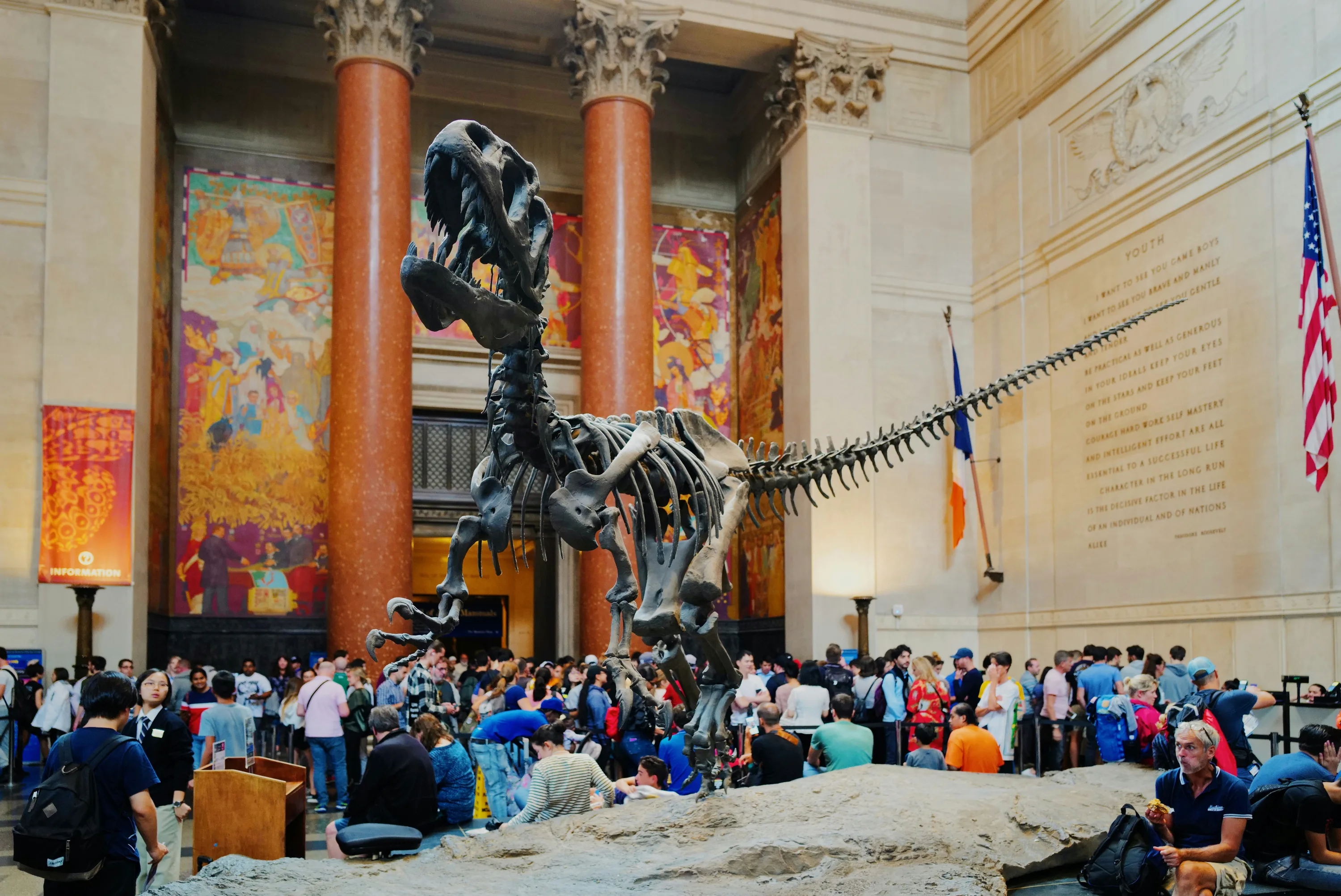
When the museum first mounted the first-ever discovered Tyrannosaurus rex skeleton in 1915, it was posed upright like a kangaroo. The museum didn't correct it to the scientifically accurate horizontal stance until 1993.
How Much Time Should I Spend at the Natural History Museum?
Plan on 3 to 4 hours for a solid first visit covering the headline halls: the Fossil Halls with the T. rex and Titanosaur, the blue whale in the Hall of Ocean Life, the Rose Center and Hall of the Universe, the mammal dioramas, and the Gilder Center. Adding the Space Show pushes this toward 4 to 5 hours, since the show runs around 25 minutes plus queuing.
A focused highlights run hitting the whale, the dinosaurs, and one or two other halls can be done in about 2 hours if you move with a pep in your step and use the app to navigate. Families with children who want to linger at the interactive stations, the butterfly vivarium, and the fossil dig should budget a full day.
The museum is enormous, and the most common visitor mistake is trying to see all 40-plus halls in one go, which will absolutely destroy your legs. Pick your priorities before you walk in.
What is the Best Time to Visit the Natural History Museum?
Best time of day: Right at 10am opening. The first hour is the quietest window, letting you reach the Fossil Halls and the blue whale with room to breathe. A second, lesser-known window opens around 2pm on weekdays, when the morning school groups leave ahead of afternoon dismissal.
Worst window: Midday, roughly 11:30am to 2pm, is peak density, when school groups, tour groups, and lunch crowds overlap. The food court and the popular halls are at their busiest.
Best days: Tuesday to Thursday are the calmest. Weekends, especially Saturday afternoons, are the busiest, and rainy weekends draw the whole city indoors.
Best season: January and February, plus early September, are the quietest stretches. Summer and every school holiday bring heavy family traffic, and holiday weeks are packed throughout the day.
Watch the school calendar: This is the museum most affected by school groups and camp trips in all of New York. Avoiding school-holiday weeks does more for your experience here than at almost any other attraction in the city.
What is Inside the Natural History Museum? Dinosaurs, the Blue Whale, and Must-See Halls
The AMNH is organised into more than 40 permanent halls across cultural, biological, geological, and cosmic themes. These are the exhibits first-time visitors most want to find.
The Fossil Halls (Floor 4): The museum's crown jewels and the reason many visitors come. The fourth-floor fossil halls hold one of the world's great dinosaur collections, including a fearsome mounted Tyrannosaurus rex and the vast Titanosaur, a cast so long its head stretches out of the gallery to greet you at the lift. The halls are arranged as an evolutionary walk through deep time.
The Blue Whale (Milstein Hall of Ocean Life): A 94-foot life-sized model of a blue whale hangs suspended over a dim, blue-lit hall, and it stops nearly everyone in their tracks. Lying on the floor beneath it to take it in is a museum tradition.
The Rose Center for Earth and Space: A giant illuminated sphere housing the Hayden Planetarium, surrounded by the Hall of the Universe and the Hall of Planet Earth. The 15-ton Willamette Meteorite and the scale-model cosmic pathway winding down from the sphere are highlights, and this whole area is included in general admission (the Space Show inside the sphere is the paid add-on).
The Richard Gilder Center (2023): The museum's newest wing, a flowing, cave-like structure of sculpted concrete. Inside is the Davis Family Butterfly Vivarium, where hundreds of live butterflies flutter freely (a ticketed exhibition), the Solomon Family Insectarium, and the Invisible Worlds immersive theatre. Even without the ticketed elements, the architecture alone is worth walking through.
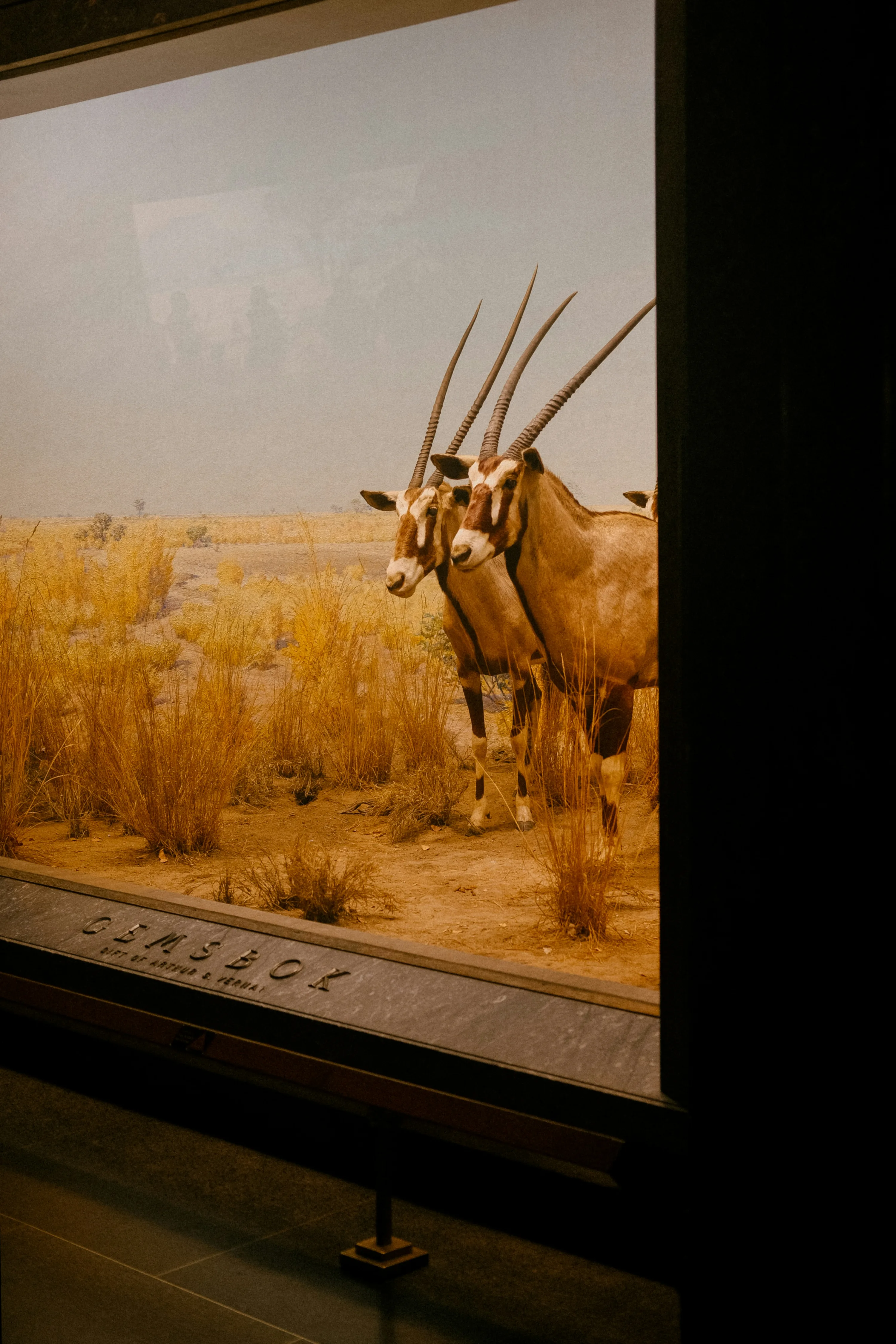
The dioramas (Hall of North American Mammals, Akeley Hall of African Mammals): Meticulously painted habitat dioramas, some nearly a century old, that remain among the most atmospheric spaces in any museum. The elephants in the African Mammals hall are unforgettable.
The Hall of Gems and Minerals: A dazzling, recently redesigned gallery of crystals, gemstones, and giant geodes, including some of the finest specimens in the world.
The Northwest Coast Hall and cultural halls: The oldest gallery in the museum, reopened in 2022 after a major renovation done in collaboration with Indigenous communities. Some of the older cultural halls elsewhere feel dated by modern standards, a point worth setting expectations around.
Night at the Museum fans: The 2006 film was set here, and the museum runs a self-guided trail of the "characters" that inspired it, including the Easter Island head, the T. rex, and the African elephants. Kids who know the film will love hunting them down.
The Hayden Planetarium and Space Show
The Hayden Planetarium Space Show is the museum's signature paid experience and one of its most searched-for features. The current show, Encounters in the Milky Way, is narrated by Pedro Pascal and takes audiences on a time-travelling journey through the movements that shaped our galaxy, projected across the planetarium's vast domed screen inside the upper half of the Hayden Sphere.
Booking: The Space Show requires a timed ticket, included in the "+ One" or "+ All" admission options, and popular showtimes sell out on busy days. Book online in advance to guarantee a slot, or add it at a ticket desk on arrival if you qualify for pay-what-you-wish (which cannot include it online).
Worth knowing: The show runs about 25 minutes. The dome darkens fully and the motion can overwhelm very young children, so consider how your child handles the dark before paying for the upgrade. For space-loving families, it is the highlight of the visit; for others, the free Rose Center halls around the sphere may be enough.
No photography is permitted inside the planetarium or the LeFrak Theater.
Guided Tours and the Explorer App
Free guided tours: The museum runs free guided highlights tours throughout the day, included with admission, along with foreign-language and accessibility tours on scheduled dates. Check the schedule at the information desks or on the website. These are an efficient way to give a first visit shape.
The Explorer app: The free AMNH Explorer app is effectively a self-guided audio tour and GPS navigator combined. It offers themed self-guided trails (dinosaurs, the whole-museum highlights, the Night at the Museum characters) with turn-by-turn directions, and it is the most useful free tool for navigating the building. Connect to the museum wifi and bring headphones.
Private and group tours are bookable through third-party operators, usually with skip-the-desk admission included, though everyone still passes through security.
Is the Natural History Museum Worth Visiting?
Yes, especially for families, and it is one of the best-value big attractions in New York for anyone travelling with children. The dinosaurs and the blue whale deliver exactly what kids hope for, and the Gilder Center has given the museum a real jolt of new energy.
That being said, here's the other side of the coin. First, the scale can defeat you: trying to see everything produces two hours of aimless wandering and sore feet, so choose your halls in advance. Second, it gets properly crowded, and midday on a weekend or during a school holiday can feel like a crush, particularly around the dinosaurs and the food court. Third, some of the older cultural and habitat halls feel dated, and a few carry information that lags behind current scientific thinking; the museum is steadily renovating these, but not all at once. Fourth, the ticket structure can be a little daunting: the "extra" experiences (Space Show, butterfly vivarium) add up quickly for a family, so decide what you actually want before buying.
Who will love it: Families with children of almost any age, dinosaur and space enthusiasts, and anyone who grew up on Night at the Museum. The interactive Gilder Center exhibits are a hit with younger kids.
Who should think twice: Adults chasing fine art will get more from the Met or MoMA; this is a science and natural history museum, not an art gallery. And anyone expecting a quick in-and-out will find the building's size is gargantuan.
For me, the move is a weekday morning, arriving at 10am, straight to the Fossil Halls and the whale before the school groups land, with the Space Show booked for late morning. Done that way, it is a wonderful few hours and money well spent.
Where Should I Eat Near the Natural History Museum?
Inside the museum, the lower-level Food Court has the widest choice, with pizza, burgers, salads, and kid-friendly options, though prices add up for a family. The Restaurant at Gilder offers proper table service with a view over the Gilder atrium (closed Mondays and Tuesdays), and there are two smaller cafes on Floors 1 and 4 for lighter bites. Eating is not allowed in the galleries, and you can leave and re-enter on the same ticket.
For something better nearby, the Upper West Side around the museum has strong casual options within a few minutes' walk.
Shake Shack, on Columbus Avenue at 77th Street, is a reliable and affordable burger stop right by the Gilder entrance, popular with families leaving the museum.
Jacob's Pickles, on Amsterdam Avenue between 84th and 85th, serves generous Southern comfort food (biscuits, fried chicken, mac and cheese) in a lively room. It is a short walk and a local favourite, though it can be busy at weekend brunch.
Levain Bakery, the original location on West 74th just off Amsterdam, is worth the detour for its famous thick chocolate chip cookies. Grab a couple and eat them in Central Park across the street.
For a picnic, Central Park is directly across Central Park West. Pick up sandwiches from a Columbus Avenue deli or from Zabar's (a New York institution up at 80th and Broadway) and eat on a park bench, weather permitting.
What Else is There to Do Near the Natural History Museum?
Central Park begins directly across the street. The Great Lawn, Belvedere Castle, the Ramble, and Bethesda Terrace are all within a 10 to 20 minute walk, making the park the natural pairing with a museum morning.
The New-York Historical Society, one block south at 77th and Central Park West, is a quieter museum covering the city's and nation's history, and rarely crowded. It makes a calm contrast if the AMNH crowds wear you down.
The Met (Metropolitan Museum of Art) sits directly across Central Park on the Upper East Side, a 20 to 25 minute walk through the park or a short M79 bus ride. Doing both mega-museums in one day is a marathon; splitting them across two days is more comfortable.
Lincoln Center, about 15 minutes south down Broadway, is worth a look for its fountain plaza and architecture even without a performance booked.
Zabar's and the Upper West Side food scene along Broadway and Amsterdam reward a wander, from classic delis to bakeries, if you want a taste of residential Manhattan away from the tourist core.
Rules, Bags, and Security
Bags: All visitors pass through a security bag check at the entrances, which can slow down at peak times. Large bags, backpacks, and luggage are not permitted in the galleries. Storage lockers are available for $7 (small) or $12 (large) per day, but they will not hold oversized luggage, so do not arrive with a suitcase on the way to the airport.
Photography: Personal, hand-held photography using available light or flash is allowed in most halls. Selfie sticks, tripods, and additional lighting are not permitted, and no photography or filming is allowed inside the Hayden Planetarium Space Theater or the LeFrak Theater.
Strollers: Welcome throughout the museum except in the theaters, where stroller parking is provided. Use the step-free Rose Center or Gilder entrances. Double strollers are generally not allowed inside ticketed exhibition galleries.
Food and drink: Not allowed in the galleries. Water bottles must be stowed while in the halls.
Re-entry: You can leave and return on the same ticket the same day, re-entering at the 81st Street or Central Park West entrances and passing back through security.
Accessibility at the Natural History Museum
The museum is wheelchair accessible, with step-free entrances at the Rose Center (81st Street) and the Gilder Center (Columbus Avenue at 79th Street). Lifts connect all floors, and the free Explorer app maps step-free routes with turn-by-turn directions, which is the best way to navigate the building's many level changes.
Visitors with disabilities can purchase admission at the discounted student/senior rate, on-site or by phone through Central Reservations, and a caregiver accompanying a visitor with a disability enters free.
Accessible restrooms are located on every floor, concentrated in the Rose Center and Gilder Center. Lactation stations are available in the Rose Center (Lower Level) and the Gilder Center (Floor 3), and a companion care room is on Gilder Floor 1. Manual wheelchairs are available, and sensory resources are offered for visitors who need them.
One accessibility note on transport: the 81st Street subway station serving the B and C is not wheelchair accessible. The nearest accessible station is 72nd Street on the 1, 2, and 3 lines, with a connecting northbound M7 bus on Amsterdam Avenue.
Final Tips for Visiting the Natural History Museum
Pre-book only what actually sells out. General admission never sells out, so buying online mainly saves the ticket-desk queue. The Hayden Planetarium Space Show and the Butterfly Vivarium do sell out on busy days, so reserve a timed slot for those in advance.
Arrive at 10am on a weekday and head straight to the Fossil Halls and the blue whale before the school groups fill the building. A second quiet window opens around 2pm as morning groups leave.
Download the Explorer app before you go. The museum is a maze; the free app gives turn-by-turn directions to specific exhibits and accessible routes, and doubles as a self-guided audio tour.
Avoid school-holiday weeks if you possibly can. No New York museum is more affected by camp trips and school groups, and dodging those weeks transforms the visit.
Decide on the Space Show before you buy. It is a paid add-on, runs about 25 minutes, and the dark can frighten very young children. For space-loving families it is the best part; for others the free Rose Center halls suffice.
Check whether a city pass fits your trip. Unlike the Met, the AMNH is included on the New York CityPASS and Go City Explorer Pass, so a pass can save money if you are visiting several attractions.
Pair it with Central Park, not another mega-museum. The park is across the street, and a picnic and a walk to Belvedere Castle rounds out the day far better than attempting the Met on the same legs.
Back to New York City Attractions
Explore other New York City attractions



" width="24px"><path d="M 0 0 L 24 0 L 24 21.231 L 0 21.231 Z" fill="transparent" height="21.230768474975793px" id="nL2EwDcS9" width="24px"/><path d="M 0 0.541 C 0 0.242 0.245 0 0.547 0 L 2.735 0 C 3.037 0 3.282 0.242 3.282 0.541 L 3.282 4.598 C 3.282 4.897 3.037 5.139 2.735 5.139 L 0.547 5.139 C 0.245 5.139 0 4.897 0 4.598 Z" fill="rgb(196, 217, 201)" height="5.138657337892187px" id="hZ_rlBe_S" transform="translate(0 16.092)" width="3.2820512820512358px"/><path d="M 0 0.541 C 0 0.242 0.245 0 0.547 0 L 2.735 0 C 3.037 0 3.282 0.242 3.282 0.541 L 3.282 7.843 C 3.282 8.142 3.037 8.384 2.735 8.384 L 0.547 8.384 C 0.245 8.384 0 8.142 0 7.843 Z" fill="rgb(230, 211, 160)" height="8.38412513024521px" id="HgVBxIz3e" transform="translate(5.128 12.847)" width="3.282051282051235px"/><path d="M 0 0.541 C 0 0.242 0.245 0 0.547 0 L 2.735 0 C 3.037 0 3.282 0.242 3.282 0.541 L 3.282 12.982 C 3.282 13.281 3.037 13.523 2.735 13.523 L 0.547 13.523 C 0.245 13.523 0 13.281 0 12.982 Z" fill="rgb(232, 207, 164)" height="13.522782468137464px" id="utgrDnoM9" transform="translate(10.325 7.708)" width="3.282051282051377px"/><path d="M 0 0.541 C 0 0.242 0.245 0 0.547 0 L 2.735 0 C 3.037 0 3.282 0.242 3.282 0.541 L 3.282 16.498 C 3.282 16.797 3.037 17.039 2.735 17.039 L 0.547 17.039 C 0.245 17.039 0 16.797 0 16.498 Z" fill="rgb(233, 196, 166)" height="17.038705909853153px" id="OLOhW6STz" transform="translate(15.521 4.192)" width="3.2820512820512384px"/><path d="M 0 0.541 C 0 0.242 0.245 0 0.547 0 L 2.735 0 C 3.037 0 3.282 0.242 3.282 0.541 L 3.282 20.69 C 3.282 20.989 3.037 21.231 2.735 21.231 L 0.547 21.231 C 0.245 21.231 0 20.989 0 20.69 Z" fill="rgb(217, 170, 153)" height="21.230768474975793px" id="H5Z8wcwkd" transform="translate(20.718 0)" width="3.2820512820512278px"/></g></svg>)