
Paris • 9th arrondissement
Palais Garnier
All guided tour types must be booked in advance. The box office does not sell same-day tickets. Tours often become booked up a few days before, especially on weekends.
Book 2-4 Weeks Ahead
Peak season
Book 1-3 Days Ahead
Off-season
Back to Paris Attractions
NOTE: You must pre-book all tours in advance. There are no tours that are sold on-site. Please also note that no ticket of any kind, self-guided or guided, guarantees access to the auditorium, as this depends on the rehearsal schedule for the Paris Opera.
Do You Need to Book Palais Garnier Tours in Advance?
Updated August 2026
When Napoleon III commissioned a new opera house for Paris in 1860, he had no idea that the young architect who won the competition, a 35-year-old named Charles Garnier who had never built anything at this scale, would produce a building so extraordinary that it would eventually overshadow the institution it was built to house. The Palais Garnier, inaugurated on 5 January 1875 after fifteen years of interrupted construction, is one of the most opulent and theatrically conceived buildings in the world: a place where the approach up the broad exterior staircase, the passage through the Subscribers' Rotunda, the ascent of the Grand Staircase in white marble and onyx, and the arrival in the gilded Grand Foyer were all choreographed by the architect as a social spectacle in their own right, before a single note of music was played. Today, with most of the Paris Opera's main productions staged at the Opéra Bastille, the Palais Garnier is open daily to visitors, welcoming more than a million people a year to see its interiors, to look up into the auditorium and its controversial Marc Chagall ceiling, and to stand in one of the most extraordinary buildings that the nineteenth century produced. This guide covers everything you need to know before you go.
At a Glance
How Early to Book:
Book a tour at least 1-2 weeks ahead to ensure a wide selection of tours are available. Some tours may still have openings closer to the date.
About 1 month in advance.
Best Times to Visit:
Weekday mornings, Tuesday through Friday will be the least busy.
Ticket price:
€11 to €42 depending on the tour type and format
Where to Book:
The Official Palais Garnier tour website
Landmark Address:
Do You Need to Book Palais Garnier Tickets in Advance?
Yes, and this is not optional. Online booking is mandatory for visiting the Palais Garnier. No tickets of any kind are sold on site. Visitors who arrive without a pre-booked ticket will not be admitted. This is a firm policy of the Paris Opera and applies to self-guided visits, guided tours, and all other visit formats.
Book through the official Paris Opera website. This is the only officially authorised online booking platform for the visit, and booking directly here ensures you are not charged additional commission by third-party sellers.
Tickets are strictly non-refundable and non-exchangeable once purchased. There is no flexibility on this policy. If your travel plans might change, build your Palais Garnier visit into a day where you have confirmed flexibility.
The Paris Museum Pass is accepted for the self-guided visit to the public areas of the Palais Garnier and is good value if you are visiting multiple Paris monuments over two, four, or six days. You can read our blog post about Museum Passes here.
Guided tours (see the Guided Tours section below) are booked separately and must also be reserved online in advance through the official website or through authorised tour operators.
Palais Garnier Opening Hours and Entry Information
The Palais Garnier is open for visits daily, with the following standard hours:
Standard hours: Entry from 10:00am to 4:00pm; building closes at 5:00pm
August: Entry from 10:00am to 5:00pm; building closes at 6:00pm
Last admission: One hour before closing
Guided tours depart daily from 10:00am to 3:30pm (4:30pm in August). Arrive at least 30 minutes before your scheduled tour start time.
Important: The Palais Garnier is a working opera and ballet house. It closes without advance notice on days with afternoon rehearsals or performances, and individual areas may be restricted at any time for operational reasons. Before your visit, always check the calendar of occasional closures on the website. The official website shows which days are confirmed open for visits in the coming weeks, and this is the only reliable way to confirm your date. Planning to visit on a day when a performance is scheduled and then discovering the building is closed is one of the most common frustrations for prospective visitors.
The box office for visits is located at the corner of rue Scribe and rue Auber (behind the statue of Charles Garnier), and is open on days when the building is open to visitors, from 11:00am to 4:00pm (5:00pm during the summer season). The box office handles queries but does not sell visit tickets, which remain exclusively online.
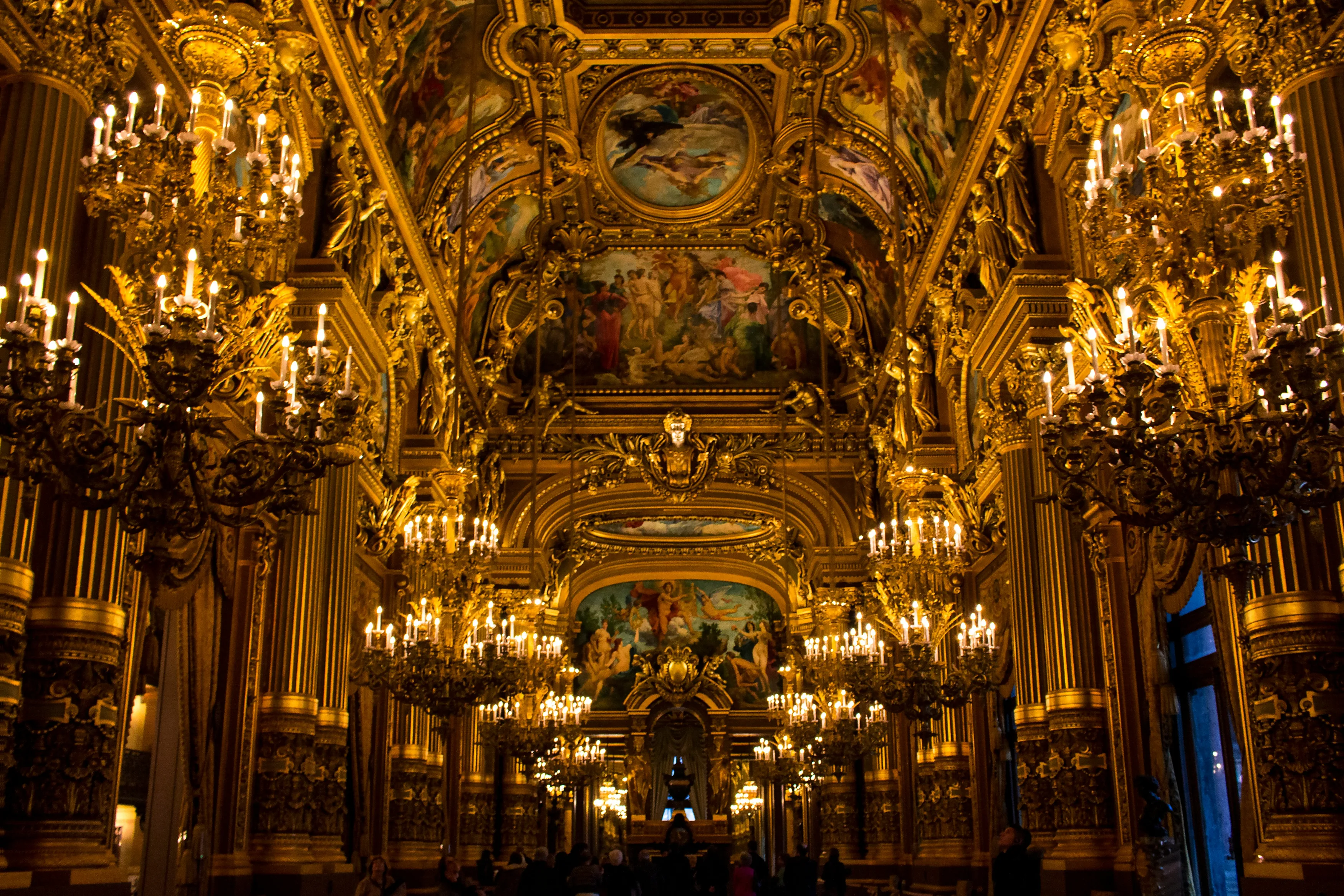
A Critical Note: The Auditorium Is Not Always Viewable
This is the single most important practical fact to understand before booking. Rehearsals cause frequent and unpredictable closures of the auditorium. No ticket of any kind, self-guided or guided, guarantees access to the auditorium. On any given day, the auditorium may be open to visitors, partially restricted, or completely closed, and this decision is made by the Paris Opera based on artistic and technical requirements that take priority over the visit programme.
The Marc Chagall ceiling, the great crystal chandelier, and the red-and-gold horseshoe of seats are all inside the auditorium, and they are the elements that most visitors specifically want to see. On days when the auditorium is accessible, they are visible and extraordinary. On days when it is not, the visit covers the Grand Staircase, the Grand Foyer, the Avant-Foyer, the Subscribers' Rotunda, the library-museum, and the other public areas, all of which are magnificent in their own right, but which do not include the Chagall ceiling.
The Revelacio multimedia tablet (available from €6.50, bookable online or on site at the multimedia desk) uses augmented reality to show visitors the Foyer de la Danse and other normally inaccessible areas of the building, and to overlay the auditorium with archival and contextual material. In conditions where the auditorium is closed, the tablet becomes particularly valuable as the only way to experience those spaces during the visit.
If seeing the auditorium is the primary reason for your visit, check the visit calendar as close to your date as possible, understand that even a confirmed open day can change without notice, and consider attending a performance (see the Performances section below), where auditorium access is guaranteed for ticket holders.
What is the Best Time to Visit the Palais Garnier?
Weekday mornings from Tuesday to Friday are the quietest time for the self-guided visit. Arriving at opening at 10:00am gives you the Grand Staircase and Grand Foyer in considerably calmer conditions than peak afternoon hours, and the morning light through the arched windows and mirrors of the Grand Foyer is particularly beautiful.
Weekends are noticeably busier, and the Grand Foyer and Grand Staircase can feel crowded on a Saturday or Sunday afternoon. If visiting at a weekend is unavoidable, arriving at opening time is by far the most effective strategy for a comfortable experience.
The shoulder seasons of spring and autumn (April to May and September to October) offer the best combination of visitor numbers and Parisian weather. Summer (June to August) brings the highest visitor numbers and the highest likelihood of queues forming at the visitor entrance, even with pre-booked tickets.
Winter visits (November to February) tend to be quieter for the self-guided route, and the atmosphere in the Grand Foyer in the low light of a December or January morning is one of the most intimate and theatrically charged experiences the building offers.
If attending a performance: Being in the building on a performance evening is a categorically different experience from a daytime tourist visit. The Grand Foyer, which functions as a promenade for the audience during intervals, is transformed when filled with an audience in evening dress. Even for visitors with no particular attachment to opera or ballet, attending one performance during a Paris visit is one of the most memorable things the city offers.

The novel and subsequent musical The Phantom of the Opera were inspired by real events that occurred at the Palais Garnier, including an incident in 1896 where a counterweight from the 7-ton chandelier fell, killing a concierge.
What is the Best Way to Get to the Palais Garnier?
The Palais Garnier is located at Place de l'Opéra in the 9th arrondissement and is one of the most easily accessible major attractions in Paris.
By Métro (strongly recommended): The dedicated station is Opéra, served by Lines 3, 7, and 8, which exits directly onto the Place de l'Opéra in front of the building. It is difficult to find a major attraction in Paris better served by a single station. Chaussée d'Antin-La Fayette (Lines 7 and 9) and Madeleine (Lines 8 and 14) are both within a few minutes' walk and useful for visitors approaching from different directions.
By RER: Auber (RER Line A) is the most useful RER station, located immediately adjacent to the Opéra station and providing fast connections from CDG Airport, Versailles (Rive Droite), and stations along the RER A across Paris. Haussmann-Saint-Lazare (RER E) is around a five-minute walk and useful from the eastern suburbs.
By Bus: Multiple lines serve the Opéra stop directly, including lines 20, 21, 27, 29, 32, 45, 52, 66, 68, and 95. Night buses N15 and N16 also serve the area.
On foot: The Palais Garnier is walkable from the Louvre (around 20 minutes), from Place Vendôme (around 10 minutes), from the Galeries Lafayette and Printemps department stores (around 5 minutes), and from the Madeleine church (around 10 minutes). The approach up the Boulevard des Capucines or the Boulevard des Italiens through the Grands Boulevards neighbourhood is a pleasant walk through one of the most historically interesting parts of central Paris.
By car: Driving is not recommended. Parking in the 9th arrondissement is limited and expensive. Two nearby Q-Park car parks (Edouard VII at 16 rue Bruno Coquatrix and Meyerbeer at 4 rue de la Chaussée d'Antin) offer reduced-rate pre-booking for Paris Opera visitors and are the most practical option if driving is unavoidable. Public transport is significantly faster for all but the most exceptional circumstances.
Is the Palais Garnier Worth Visiting?
For anyone drawn to architecture, to the decorative arts of the Second Empire, or simply to buildings that were made to produce an effect of awe, the Palais Garnier is one of the most rewarding interiors in Paris. The critical caveat, covered above, is that what you see depends on whether the auditorium is open on the day.
The public areas that are always open are extraordinary on their own terms. The Grand Staircase (Escalier d'Honneur) is the most theatrically conceived staircase in Paris: a broad double flight in white Carrara marble, its balustrades in a combination of onyx, red and green marble, its vaulted ceiling painted and gilded, designed so that the act of ascending it is itself a performance. Garnier intended the audience to see and be seen while climbing, and the spatial choreography of the staircase makes this unavoidably, and delightfully, apparent even to a visitor in jeans in the 21st century.
The Grand Foyer, at the top of the staircase, is Garnier's most dazzling interior space: a long, gilded gallery of columns, mirrors, painted ceilings, and arched windows overlooking the Boulevard des Capucines that functions simultaneously as a promenade, an art gallery, and a statement of Second Empire ambition. Its closest architectural comparison is the Hall of Mirrors at Versailles, though Garnier's room is more intimate and more intensely decorated. The paintings on the ceiling, the carved caryatid figures, the gilded columns, the interplay of natural light and candlelight reflected in the mirrors: it is one of the finest rooms in France.
The Subscribers' Rotunda and the Avant-Foyer add further layers of richness, with porphyry columns, mosaic floors, paintings by Benjamin Constant, and the kind of decorative consistency that speaks to a single controlling artistic intelligence across every surface.
When the auditorium is accessible, the experience of standing inside it and looking up at Marc Chagall's 1964 ceiling, a swirl of colour depicting scenes from fourteen operas and ballets by composers from Gluck to Stravinsky, above Garnier's original 7-tonne crystal chandelier, is one of the most charged moments Paris offers. Chagall was commissioned by his friend André Malraux, France's Minister of Culture, and the Parisian establishment was famously horrified by the result: a modernist canvas painted over the classical programme Garnier had specified. The controversy has long since subsided into admiration.
The Phantom of the Opera connection adds a layer of narrative fascination that the building wears rather well. Gaston Leroux published his novel in 1910, and many of its most memorable elements are drawn directly from the building's architecture and history. In 1896, one of the counterweights of the great chandelier broke free during a performance and killed a concierge in the auditorium; the chandelier falling in the musical is a direct reference to this event. The underground cistern beneath the building, constructed during the foundation work to stabilise the structure during the 1870 Franco-Prussian War, became Leroux's underground lake. The building is, in this sense, the protagonist of the novel, and recognising its rooms and spaces as you move through them adds a particular pleasure to the visit.
How Much Time Should I Spend at the Palais Garnier?
For a self-guided visit covering the main public areas, plan for 60 to 90 minutes at a comfortable pace. With the Revelacio multimedia tablet and access to the auditorium, 90 minutes to two hours is more appropriate.
A 90-minute guided tour should be treated as a minimum two-hour commitment including arrival, security, and orientation. The 45-minute flash lunchtime tour available on certain days (see Guided Tours section) is suited to visitors with limited time who want to see the key spaces with commentary.
A rough guide to planning your time:
Subscribers' Rotunda and Pythia Basin: 5 to 10 minutes
Grand Staircase: 10 to 15 minutes (longer for photography)
Grand Foyer and Avant-Foyer: 15 to 25 minutes
Auditorium (when accessible): 10 to 15 minutes
Library-Museum: 15 to 20 minutes
Revelacio tablet augmented reality experience: 20 to 30 minutes
Photography note: The Grand Staircase and Grand Foyer are among the most photographed interiors in Paris and for good reason. The building is designed for theatrical effect, and the photographs are as spectacular as the reality. Allocating more time in these spaces for photography is entirely reasonable.
Guided Tours and Audio Guides at the Palais Garnier
The Paris Opera offers a range of guided and audio-enhanced visit options, all of which must be booked in advance online.
Classic guided tour (1h30): The standard guided visit with a Paris Opera guide, covering the Subscribers' Rotunda, the Pythia Basin, the Grand Staircase, the Grand Foyer, and the auditorium (subject to availability on the day). Audio headsets are provided so guides can speak at normal volume without raising their voice. Available daily from 10:00am to 3:30pm (4:30pm in August). This is the most comprehensive and informative way to visit for first-timers with a serious interest in the architecture and history.
Family tour (1h, for children aged 7 to 11): A specifically designed tour exploring the history, mythology, architecture, music, and ballet of the Palais Garnier through the public areas, calibrated for the curiosity and attention of younger visitors. Accessible and engaging for adults accompanying children, and a notably better option than a standard tour with young children in tow.
Evening after-hours tour: Once the Palais Garnier closes to the general public at 5:00pm, evening guided tours are available on selected dates, allowing a small group to explore the building in an exclusive and calm atmosphere. These tours are among the most special Paris experiences available at any price, and they sell out. The Phantom of the Opera narrative is often woven into the evening format, and some operators include the after-hours access within a Phantom-themed itinerary. Book well in advance.
Flash lunchtime tour (45 minutes): A condensed tour of the key highlights (the Rotunda, the Grand Staircase, the Grand Foyer, and the auditorium subject to availability), running at noon, 12:30pm, 1:00pm, and 1:30pm on selected days. Aimed at visitors with limited time. Minimum group booking requirements apply for some operators offering this format.
Revelacio multimedia tablet (from €6.50): An iPad mini loaded with a 90-minute multimedia audio tour including augmented reality, archival images, and interviews with Paris Opera specialists. The AR feature allows you to visit the Foyer de la Danse and the Costume Depository, areas inaccessible to regular visitors, by overlaying them onto the spaces you are physically standing in. Available in French, English, and other languages, with an accessibility version in French sign language and French audio-descriptive format. Bookable online when purchasing your visit ticket, or from the on-site desk on the day.
Attending a Performance: Opera, Ballet, and Concerts at the Palais Garnier
For visitors whose Paris evenings allow it, attending a performance at the Palais Garnier is a categorically richer experience than a daytime tourist visit, and it should be considered seriously by anyone with even a passing interest in opera, ballet, or simply in being inside one of the world's great buildings when it is functioning at full capacity.
The Palais Garnier hosts ballet productions from the Paris Opera Ballet and its own opera programme alongside performances at the Opéra Bastille. With 172 performances per season, the programme is substantial and covers a wide range of repertoire. Productions at the Palais Garnier tend to be ballet-focused given the building's stage dimensions, though opera and concert performances feature regularly.
Performance tickets range from €10 (category 6 restricted view, sold at the box office two hours before the performance) to several hundred euros for premium orchestra seats. Category 5 tickets, priced from €10 to €25 depending on the production, are available at both box offices up to the day of the performance, subject to availability. A dedicated allocation is reserved for under-28s at reduced rates.
Musical Middays are shorter daytime concerts at the Palais Garnier held throughout the season, priced from €10 to €30 depending on the seat category. These are an excellent option for visitors who want a performance experience without the full evening commitment, and they run during hours that fit easily into a daytime sightseeing schedule.
If attending an evening performance, note that the building is dressed differently from its daytime visitor presentation. The interval bars are open, the cloakroom is staffed, and the Grand Foyer is used as a promenade during the intervals in precisely the way Garnier intended.
Where Should I Eat at and Near the Palais Garnier?
The building itself has an on-site restaurant, Restaurant Coco, open daily from noon to 2am (last dinner order 11pm) and bookable in advance. For eating outside the building, the 9th arrondissement and the surrounding Grands Boulevards also offer an extremely varied range of options.
The Grands Boulevards area immediately surrounding the Palais Garnier has a long history as one of Paris's great entertainment districts, and the streets around the building are lined with brasseries, cafés, wine bars, and restaurants at every price point. The quality of individual establishments varies considerably; the most tourist-facing spots immediately on the Place de l'Opéra tend to offer less value than those a block or two back.
The Passage des Panoramas, around a 10-minute walk along the Boulevard Montmartre, is one of Paris's oldest and most beautiful covered passages and has a concentration of excellent independent restaurants including several well-regarded wine-focused bistros.
Rue du Faubourg-Montmartre and the Passage Verdeau area, around 10 minutes on foot to the north-east, is a more local and authentic stretch with well-priced cafés and restaurants popular with Parisians.
Café de la Paix, at the corner of the Place de l'Opéra directly adjacent to the Palais Garnier, is one of the great Paris historic cafés, a listed monument in its own right, and the traditional gathering point of the opera-going public. It is expensive and unreservedly theatrical; the terrace is one of the best positioned in the 9th arrondissement.
For a wider range of excellent restaurants at lower prices, the South Pigalle (SoPi) neighbourhood around the rue Notre-Dame-de-Lorette and rue des Martyrs is around 15 minutes on foot to the north and is one of Paris's most consistently rewarding dining streets.
Accessibility at the Palais Garnier
The Palais Garnier has improved its accessibility significantly, though some areas remain challenging due to the nature of the 19th-century building.
Wheelchair users and visitors with reduced mobility have safe access to the principal public areas of the building including the Grand Staircase, the Grand Foyer, and the Avant-Foyer. The box office, toilets, and main visitor route are accessible.
Temporary exhibitions in the Library-Museum are not accessible to visitors with reduced mobility. This is a firm limitation of the building's structure and is unlikely to change in the near term.
Evening after-hours visits (mystery and themed tours after 5:00pm) are not accessible to people with reduced mobility after that hour.
Disabled visitors and one accompanying companion receive free entry with valid documentation.
The Revelacio multimedia tablet is available in a French audio-descriptive version and a French sign language version, making it the most accessible route to experiencing the full range of spaces in the building, including those that are physically inaccessible.
Rules, Bags, and Security
No luggage of any kind is accepted inside the Palais Garnier, and there is no left-luggage storage on site. This is an absolute rule with no exceptions. Visitors who arrive with suitcases, large backpacks, or oversized bags will be refused entry. There are no lockers at the venue. If you are spending the day in Paris with luggage, deposit it at a dedicated left-luggage service (consigne) before travelling to the Palais Garnier; Paris consigne services are available at major train stations and at several independently operated luggage storage points around the city.
Scooters, rollerblades, skateboards, and electric scooters are strictly prohibited throughout the building.
Security: As part of France's Vigipirate security alert system, all visitors pass through a security control at the entrance. The following items are not permitted inside the building in any circumstances: weapons and ammunition of all categories, small pocket knives, tools, any blunt object or object that could be used as a weapon, aerosol dispensers, teargas, flammable or volatile substances, and similar items.
Photography for personal, non-commercial use is permitted throughout the public areas of the building. Flash photography is not permitted in the auditorium. Tripods require advance permission.
Food and drink are not permitted in the galleries and public visit areas. The restaurant, interval bars, and the surrounding terraces are the designated areas for eating and drinking.
What Else is There to Do Near the Palais Garnier?
The Palais Garnier sits in one of the most historically rich and commercially vibrant parts of Paris, with several major attractions within comfortable walking distance.
Galeries Lafayette and Printemps, two of Paris's most spectacular department stores, are around five minutes on foot up the Boulevard Haussmann. Galeries Lafayette in particular is worth visiting even for non-shoppers: the building's central hall, with its enormous Belle Époque cupola in stained glass and wrought iron, is one of the great commercial interiors in the world, and the rooftop terrace offers a panoramic view that includes the Palais Garnier's roof and dome. Entry to both stores is free.
The Musée Jacquemart-André, around 15 minutes on foot to the west on the Boulevard Haussmann, is one of the finest private-collection museums in Paris, housed in a sumptuous 19th-century mansion with an outstanding collection of Italian Renaissance and Dutch Golden Age painting and a café in the former dining room that is one of the most pleasant in the city.
Place Vendôme, around 10 minutes on foot to the south-west through the elegant streets of the 1st arrondissement, is one of the most architecturally harmonious public squares in Paris, lined with the jewellers and luxury houses that have occupied it since the 18th century.
The Palais Royal and its gardens, around 20 minutes on foot to the south, are one of the most rewarding and undervisited spaces in central Paris: a garden arcaded on three sides by the galleries of the former royal palace, with independent bookshops, restaurants, and galleries at ground level and the Comédie-Française at the northern end. Daniel Buren's striped columns in the courtyard are one of the most divisive public artworks in Paris and one of the most photographed.
The Grands Boulevards themselves, stretching east and west from the Palais Garnier, are worth walking as a piece of Haussmann's Paris at its most legible. The concentration of Belle Époque architecture, the covered passages (Passages Jouffroy, Verdeau, and des Panoramas) branching off from the boulevards, and the historic cinemas, theatres, and café-brasseries that line the route make for an absorbing hour on foot.
The Opéra Bastille, the Paris Opera's second and main production house, is about 30 minutes away on the Métro (Line 8 from Opéra to Bastille). It also offers guided tours, a different and more industrial architectural character, and backstage access that gives a fascinating complement to the historic ceremonial grandeur of the Palais Garnier.
Final Tips for Visiting the Palais Garnier
Book online before you go. No exceptions. Tickets are not sold on site in any format.
Check the visit calendar for your date on the official website. The building closes for afternoon performances and rehearsals without advance notice, and the auditorium is frequently inaccessible. Confirming that your chosen date is confirmed open for visits before you book is the single most useful thing you can do in planning your trip.
Arrive 30 minutes before your guided tour time. The Paris Opera instructs guided tour participants to arrive 30 minutes before the scheduled departure. Security queues can extend this time during peak periods.
Consider the Revelacio multimedia tablet. At around €6.50, it adds substantially to the self-guided visit by bringing to life the areas, including the Foyer de la Danse and the Costume Depository, that are otherwise invisible to visitors. On a day when the auditorium is closed, it is practically essential.
Attend a performance if you can. The Palais Garnier is one of the great performance venues in the world, and the experience of being in the building in the evening with a full audience in the Grand Foyer during the interval is one that the daytime visit, however beautiful, cannot replicate. Category 5 and 6 tickets from €10 to €25 are available close to performance dates at the box office and make this accessible even on a tight budget.
Walk the Grands Boulevards before or after. The Palais Garnier sits in the middle of one of the great urban set pieces of 19th-century Paris, and taking time to walk east along the Boulevard des Italiens and the Boulevard Montmartre to the Passage des Panoramas, or west towards the Madeleine and Place Vendôme, adds depth to the neighbourhood that the interior of the building alone cannot provide.
Back to Paris Attractions
Explore other Paris attractions


" width="24px"><path d="M 0 0 L 24 0 L 24 21.231 L 0 21.231 Z" fill="transparent" height="21.230768474975793px" id="nL2EwDcS9" width="24px"/><path d="M 0 0.541 C 0 0.242 0.245 0 0.547 0 L 2.735 0 C 3.037 0 3.282 0.242 3.282 0.541 L 3.282 4.598 C 3.282 4.897 3.037 5.139 2.735 5.139 L 0.547 5.139 C 0.245 5.139 0 4.897 0 4.598 Z" fill="rgb(196, 217, 201)" height="5.138657337892187px" id="hZ_rlBe_S" transform="translate(0 16.092)" width="3.2820512820512358px"/><path d="M 0 0.541 C 0 0.242 0.245 0 0.547 0 L 2.735 0 C 3.037 0 3.282 0.242 3.282 0.541 L 3.282 7.843 C 3.282 8.142 3.037 8.384 2.735 8.384 L 0.547 8.384 C 0.245 8.384 0 8.142 0 7.843 Z" fill="rgb(230, 211, 160)" height="8.38412513024521px" id="HgVBxIz3e" transform="translate(5.128 12.847)" width="3.282051282051235px"/><path d="M 0 0.541 C 0 0.242 0.245 0 0.547 0 L 2.735 0 C 3.037 0 3.282 0.242 3.282 0.541 L 3.282 12.982 C 3.282 13.281 3.037 13.523 2.735 13.523 L 0.547 13.523 C 0.245 13.523 0 13.281 0 12.982 Z" fill="rgb(232, 207, 164)" height="13.522782468137464px" id="utgrDnoM9" transform="translate(10.325 7.708)" width="3.282051282051377px"/><path d="M 0 0.541 C 0 0.242 0.245 0 0.547 0 L 2.735 0 C 3.037 0 3.282 0.242 3.282 0.541 L 3.282 16.498 C 3.282 16.797 3.037 17.039 2.735 17.039 L 0.547 17.039 C 0.245 17.039 0 16.797 0 16.498 Z" fill="rgb(233, 196, 166)" height="17.038705909853153px" id="OLOhW6STz" transform="translate(15.521 4.192)" width="3.2820512820512384px"/><path d="M 0 0.541 C 0 0.242 0.245 0 0.547 0 L 2.735 0 C 3.037 0 3.282 0.242 3.282 0.541 L 3.282 20.69 C 3.282 20.989 3.037 21.231 2.735 21.231 L 0.547 21.231 C 0.245 21.231 0 20.989 0 20.69 Z" fill="rgb(217, 170, 153)" height="21.230768474975793px" id="H5Z8wcwkd" transform="translate(20.718 0)" width="3.2820512820512278px"/></g></svg>)