Back to Barcelona Attractions
Do you Need to Book Tickets in Advance for Fundació Joan Miró?
Updated August 2026
In 1975, the year Francisco Franco died and Catalonia began its slow return to cultural life, Joan Miró opened a foundation on the hill of Montjuïc dedicated to his own work and to the promotion of contemporary art. The timing was deliberate. The building, designed by his close friend the architect Josep Lluís Sert, was intended from the outset as a republican and Catalan institution, a statement of cultural ambition and civic identity at a moment when both were recovering from four decades of suppression. Sert's design, built around a series of light-filled rooms, open courtyards, and terraces that look out over the city and the sea, has aged into one of the masterpieces of 20th-century Mediterranean architecture, and the collection it holds, donated largely by Miró himself, encompasses more than 14,000 works spanning the entire arc of his career from early figurative drawings made in 1901 to the monumental canvases of his final years. Today the Fundació Joan Miró is one of the three most visited museums in Barcelona and, for many visitors, the most purely pleasurable. The combination of the art, the architecture, the terraces, the gardens, and the extraordinary quality of the light throughout makes it one of the best hours and a half you can spend on Montjuïc, or anywhere in the city. This guide covers everything you need to know before you go.
At a Glance
How Early to Book:
Pre-booking a ticket online is not required, as tickets will not sell-out. However, online tickets are slightly cheaper.
Best Times to Visit:
Early morning weekdays have the smallest crowds, and late afternoon weekdays are surprisingly underutilized, especially since the sunsets are quite nice.
Ticket price:
€17 for adults online, €18 at the on-site ticket office.
Where to Book:
Do You Need to Book Fundació Joan Miró Tickets in Advance?
Advance booking is recommended for a guaranteed entry time and for a €1 saving on the ticket price, but the museum does not operate a strict timed-entry system for the permanent collection and walk-up tickets can be purchased at the desk on arrival. On most weekdays outside the peak summer season, queues at the box office are short. In summer and at weekends, a brief queue at the desk is common; buying online in advance bypasses this.
Book through the official Fundació Joan Miró website. Buying directly from the official site avoids the commission charged by third-party resellers and guarantees the lowest available price.
Free admission is available on certain dates throughout the year. Check the official website for the complete and current schedule, as free days are announced seasonally and may include International Museums Day (18 May), the Diada Nacional de Catalunya (11 September), and other civic occasions. Some Saturday afternoons also offer reduced or free access. A free or reduced ticket must still be reserved online on these occasions to manage capacity.
Multi-museum passes:
The Articket BCN (currently €38) covers free entry to six of Barcelona's leading art institutions: the Fundació Joan Miró, MNAC, MACBA, Museu Picasso, Fundació Antoni Tàpies, and CCCB. For visitors spending three or more days in Barcelona with a serious interest in art, this is one of the most cost-effective cultural passes in any European city. Priority access is included at all six museums.
The Barcelona Card (from €59 for three days) includes free entry to the Fundació Joan Miró and free unlimited use of public transport, plus discounts at numerous other museums and attractions around the city. You can read our blog post about Museum Passes here.
A combined Fundació Joan Miró and MNAC ticket is available, covering both Montjuïc art institutions at a small discount on separate admission prices. This is the most practical option for visitors planning both in the same day or on consecutive days.
Fundació Joan Miró Opening Hours and Entry Information
The Fundació Joan Miró operates two seasonal schedules and is closed every Monday, with a small number of exceptions when a Monday falls on a public holiday.
Winter hours (1 November to 31 March):
Tuesday to Sunday: 10:00am to 7:00pm
Mondays: Closed
Summer hours (1 April to 31 October):
Tuesday to Saturday: 10:00am to 8:00pm
Sundays: 10:00am to 7:00pm
Mondays: Closed
Last admission is 30 minutes before closing. Visitors arriving after this point will not be admitted regardless of having a valid ticket.
Mondays open in 2026 (exceptional opening on public holidays): 6 April, 18 May, 25 May, 12 October, and 28 December 2026.
Annual closures: 1 January and 25 December. The museum may also close partially for private events or installation changes. Check the official website if your visit date falls around a major transition in the exhibition programme.
The gift shop, bookshop, and bar-restaurant are accessible free of charge during museum opening hours and do not require a museum ticket to enter.
What is the Best Way to Get to the Fundació Joan Miró?
The museum is located in the Parc de Montjuïc and is accessible by several routes, all of which are straightforward.
By Bus (most straightforward options):
Bus 150 runs from Plaça d'Espanya (Metro Lines L1 and L3) directly through Montjuïc and stops closest to the museum entrance. This is the most direct route for visitors arriving from central Barcelona and combines naturally with a visit to the MNAC on the same day.
Bus 55 runs from Paral·lel Metro station (Lines L2 and L3) and stops near the museum. This route is useful for visitors arriving from the Barceloneta, the Gothic Quarter, or the Gràcia area.
The Barcelona Bus Turístic (Red Route) has a dedicated stop at the Fundació Joan Miró. This is a practical option for visitors using the hop-on, hop-off bus across multiple days.
By Funicular:
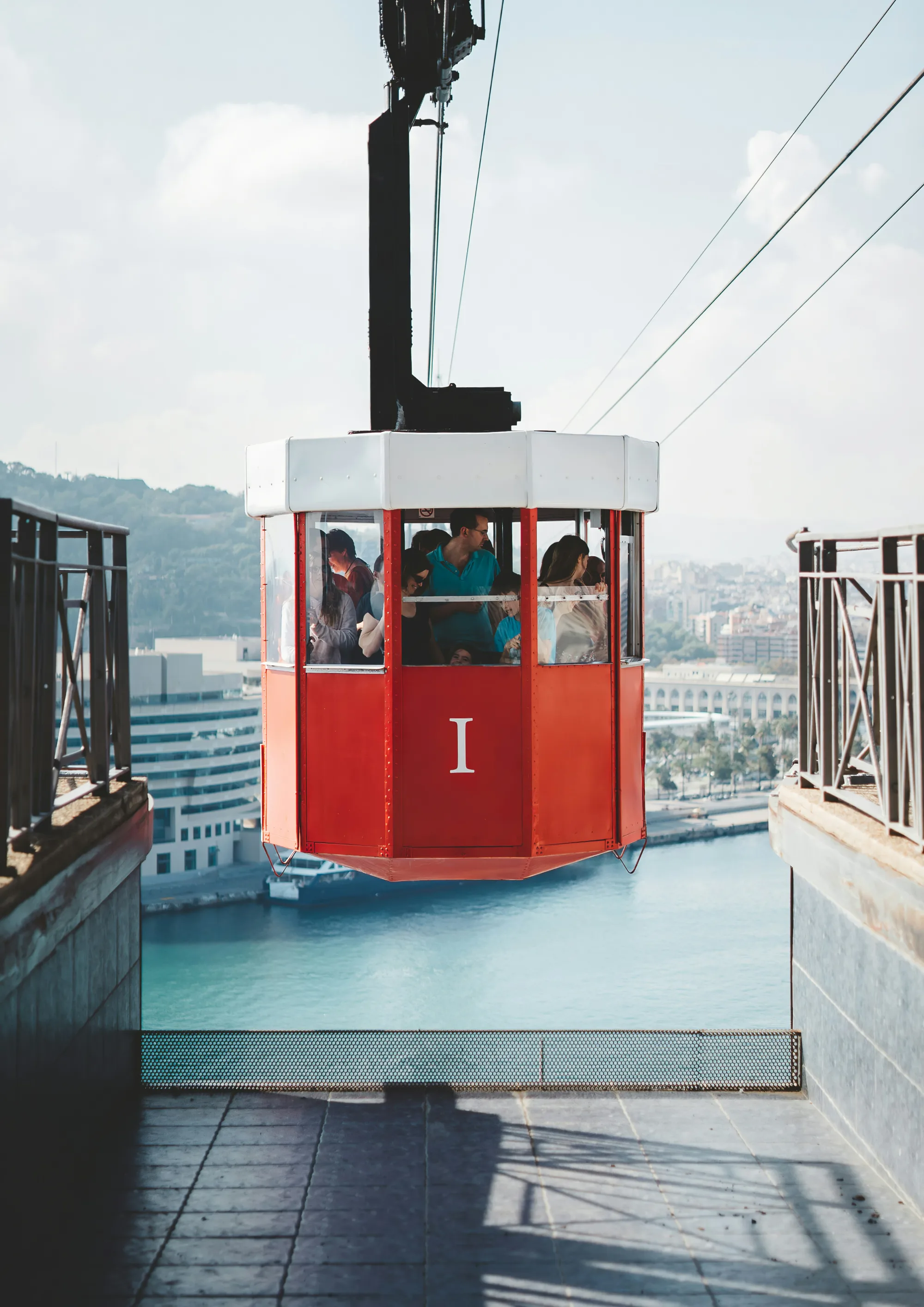
The Montjuïc Funicular from Paral·lel Metro station (Lines L2 and L3) connects with the Montjuïc Cable Car for the approach from the east side of the hill.
On foot from the MNAC: The Fundació Joan Miró is around a 20 to 25-minute walk from the Palau Nacional through the Montjuïc hillside gardens on a signed walking route. This is the most rewarding approach for visitors combining both museums in a single day, and the walk through the gardens is pleasant in all but the hottest summer conditions.
By taxi: Taxis can drive directly to the museum entrance. Two dedicated accessible parking spaces are available 35 metres from the main entrance, accessible via a 30-metre ramp with no steps.
What is the Best Time to Visit the Fundació Joan Miró?
Weekday mornings from Tuesday to Friday in the first hour of opening are consistently the quietest time. Arriving at 10:00am on a Wednesday or Thursday gives you the permanent collection in near-solitude, particularly the rooms dedicated to Miró's mature work and the outdoor courtyards. Sert's building was designed around natural light, and the light in the interior rooms in the morning, filtering through skylights and the white walls of the courtyard spaces, is the light the building was conceived for.
Late weekday afternoons in summer (from around 6:00pm to 8:00pm on Tuesday to Saturday) are a significantly underused window. The extended summer closing at 8:00pm draws far fewer visitors than the midday and early afternoon peak, the terraces and rooftop sculpture areas are calmer, and the views across the city in the evening light are exceptional.
Weekends are noticeably busier, particularly on Sunday mornings. If visiting at a weekend, arriving at 10:00am is the most effective strategy.
Sundays close at 7:00pm year-round, one hour earlier than Saturday in summer. Build this into your timing when planning a Sunday visit.
The shoulder seasons (April to May and September to October) offer the best combination of weather, visitor numbers, and quality of light. Spring visits, when the Cypress Garden is at its freshest, are especially rewarding.
Image Credit: Robertgombos, CC BY-SA 4.0
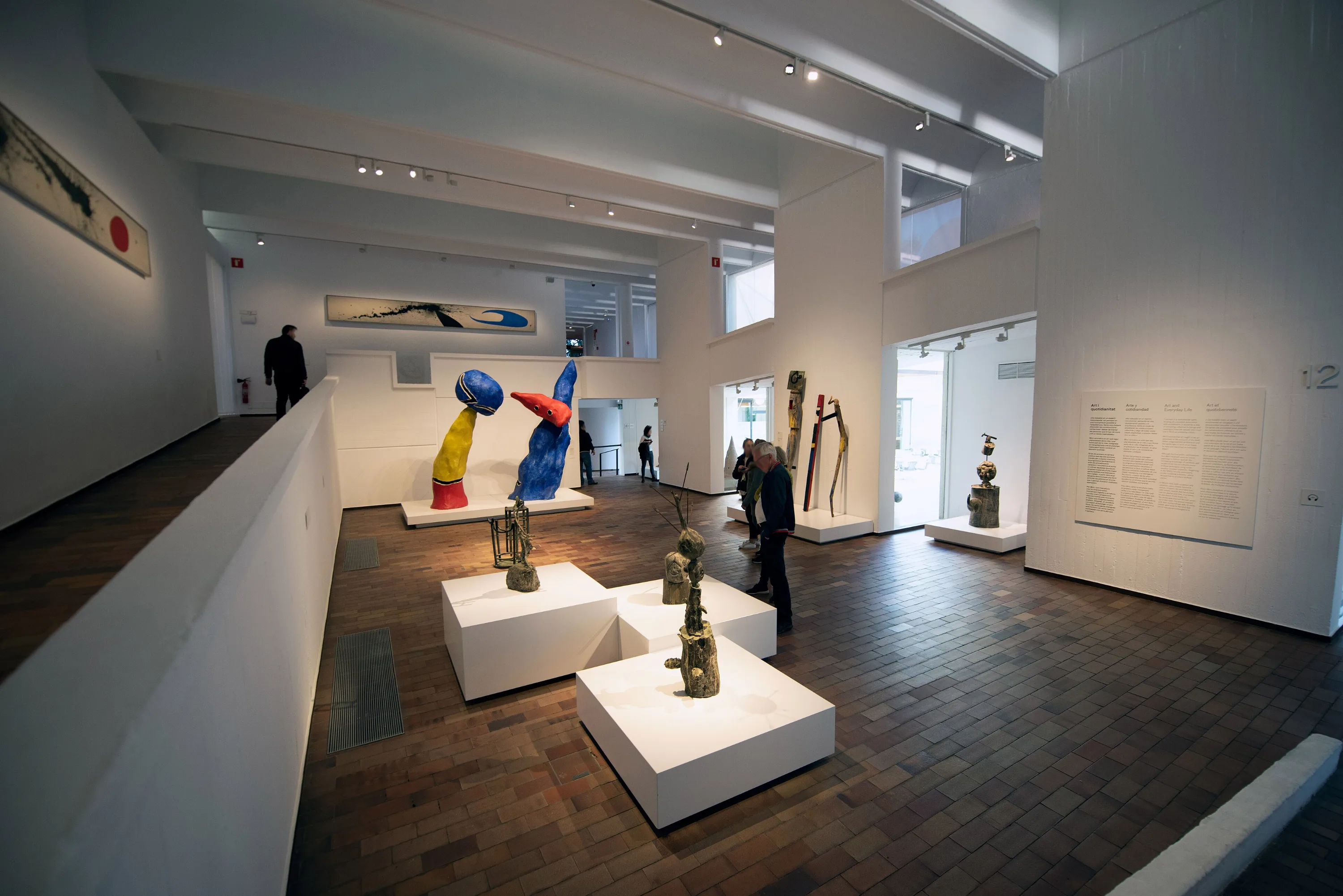
Created by Joan Miró and his friend Joan Prats, the Fundació Joan Miró was designed to be an open, research-driven space rather than a traditional museum. It focuses on contemporary art, particularly the avant-garde.
Is the Fundació Joan Miró Worth Visiting?
Yes, and it is worth being specific about what makes it so, because it offers a different kind of museum experience from the vast institutions that dominate many visitors' Barcelona itineraries.
The Fundació Joan Miró is a focused, human-scale museum, purpose-built for a single artist's vision and conceived with his direct involvement. Where the MNAC offers a thousand years of history across dozens of rooms, the Miró Foundation offers a single creative life viewed from every angle, in a building specifically designed for the purpose, in the city that shaped the man. The combination is intimate in a way that large encyclopaedic museums rarely achieve.
The permanent collection spans the full arc of Miró's output, from early paintings that show the influence of the Fauves and Cézanne, through the development of his distinctive visual language of stars, birds, women, and primordial shapes in red, blue, yellow, and black, to the monumental late canvases. Among the permanent highlights:
The Tapestry of the Foundation (Tapis de la Fundació), a monumental woven work in the main hall, is one of the most immediately striking objects in the building. Its bold symbolic forms fill an entire wall in woven wool and hemp at a scale that commands the room.
The Morning Star (L'Étoile Matinale, 1940) is among the most admired paintings in the collection, part of the Constellations series Miró created in wartime France during a period of acute personal and political anxiety. The series is widely regarded as his finest sustained achievement in painting.
Calder's Mercury Fountain, a kinetic sculpture that circulates actual liquid mercury across a shallow basin, was originally built for the Spanish Republican Pavilion at the 1937 Paris International Exposition, displayed alongside Picasso's Guernica. It is one of the most politically charged objects in the museum and one of the most hypnotically beautiful. Displayed behind glass for safety, the mercury is real and its fluid motion is unlike anything else in any museum in Barcelona.
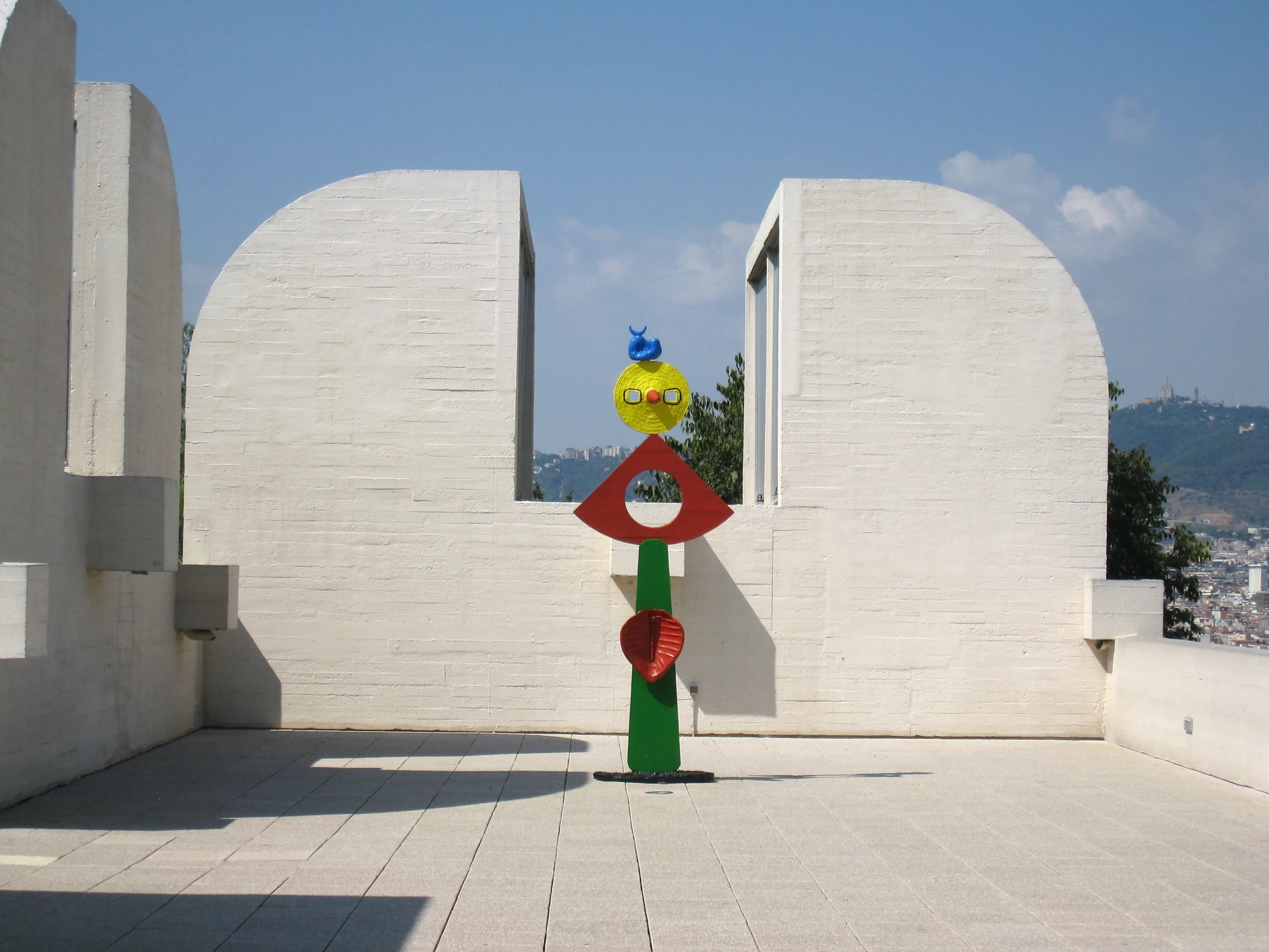
The outdoor terraces and sculpture courts distribute Miró's three-dimensional work through the building's exterior in a way that feels discovered rather than arranged. The rooftop terrace in particular offers both the sculptures and panoramic views across Barcelona and the Mediterranean on a clear day.
Espai 13, the foundation's dedicated gallery for emerging and experimental contemporary artists, runs a curated programme of rotating solo exhibitions. It is one of the most consistently interesting spaces for contemporary art in the city and is included in general admission.
The building itself is a major part of the experience. Sert designed it as a sequence of white rooms and open courtyards calibrated to admit natural light at different intensities, with flat roofs, skylights, arched loggias, and the Cypress Garden opened to the public for the 50th anniversary in 2025. The architecture refuses to compete with the art; it holds it in the best possible light. On a bright day, the luminosity throughout the building is extraordinary, and the relationship between the spaces and the works becomes clear.
How Much Time Should I Spend at the Fundació Joan Miró?
Most visitors will find that 90 minutes to two hours is sufficient for a thorough and unhurried visit covering the permanent collection, the current temporary exhibitions, the outdoor sculpture areas, and the rooftop terrace. Visitors with a deeper interest in Miró's work, or who want to spend time in the bookshop and café, should allow up to three hours.
A rough guide to planning your time:
Permanent collection (main gallery rooms): 45 to 60 minutes
Outdoor courtyards, rooftop terrace, and sculpture areas: 15 to 25 minutes
Current temporary exhibitions: 20 to 40 minutes depending on scale
Espai 13 experimental gallery: 10 to 15 minutes
Bar-restaurant terrace and garden: as long as you wish
For visitors with limited time: If you have only an hour, spend it in the permanent collection and on the rooftop terrace. The rooftop, with its sculptures and panoramic views, is the spatial and experiential high point of the museum and should not be rushed through.
Guided Tours and Audio Guides
The audio guide is available for hire at the information desk and covers the permanent collection in multiple languages including Catalan, Spanish, English, French, and German. It is particularly useful for visitors who want structured commentary on Miró's visual language and symbolic system, which are significantly more legible with explanation than without.
Guided group tours of the permanent collection are available in Catalan, Spanish, and English on selected dates and must be booked in advance through the official website. These run for approximately one hour and provide the richest contextual experience of the collection for visitors who want to understand Miró's biography and visual language in depth. Tours in English are scheduled on select weekends; check the current calendar.
Guided tours for families with children are available on selected dates and must be reserved in advance. The foundation provides specific family-friendly activities designed to make Miró's visual world accessible and engaging for younger visitors.
Workshops and activity sessions for both adults and families run throughout the year, often connected to the current temporary exhibition. These are practical sessions using materials and techniques connected to Miró's own practice and are among the most rewarding participatory cultural activities in Barcelona.
Where Should I Eat at and Near the Fundació Joan Miró?
The bar-restaurant within the museum is one of the best reasons to linger beyond the galleries. Occupying a room with a central garden terrace, it seats 70 people inside and 60 on the outdoor terrace. Its position within the Sert building, with a courtyard of plants and natural light, makes it one of the more pleasant places to sit in any Barcelona museum. It is open during museum hours and accessible free of charge to non-ticket holders as well as visitors. Reservations are available and recommended for groups and weekend lunches.
For eating beyond the museum, the Montjuïc hill and its neighbouring districts offer good options at every price point.
Poble-sec, the neighbourhood at the eastern foot of Montjuïc, is one of Barcelona's most rewarding dining areas and is around 15 to 20 minutes on foot from the museum through the hillside gardens, or a short metro or bus ride from Paral·lel. Carrer de Blai, with its high concentration of pintxos bars, is the most animated street for casual eating. The broader neighbourhood, including the streets around Carrer de Parlament and Carrer de Tamarit, has excellent independent restaurants at accessible prices.
Plaça d'Espanya area: The streets around Plaça d'Espanya and the Arenas de Barcelona shopping centre (the converted 19th-century bullring) offer cafés and a food court for visitors passing between Montjuïc sites and the city centre. Convenient rather than destination options.
Restaurant Óleum at the MNAC is around 20 to 25 minutes on foot through the park and is worth considering if combining both museums in a single day. Its setting in the former Throne Room of the Palau Nacional is exceptional. Advance booking is recommended for weekends.
Accessibility at the Fundació Joan Miró
The Fundació Joan Miró is one of the more accessible museums on Montjuïc, with a building designed at ground level without the internal staircases that create problems at many historic museum buildings.
The ground floor permanent collection rooms are mostly level and fully accessible to wheelchair users. The auditorium in the basement is accessible via lift with staff assistance; request this at the information desk on arrival. The first floor rooms and the Espai Taller are not accessible to wheelchair users.
Disabled visitors receive free admission. One accompanying companion receives a reduced-rate ticket. Companions may also receive free admission depending on the documented degree of the disabled person's need for third-person assistance. Valid disability documentation must be presented at the entrance.
The foundation regularly organises accessible activities for visitors with visual impairments, hearing impairments, cognitive diversity, and social inclusion groups. Details are published on the official website and can be requested in advance from the visitor services team.
Assistance dogs are welcome throughout the museum with appropriate EU-recognised documentation presented to security staff at the entrance.
Rules, Bags, and Security
Photography for personal, non-commercial use is permitted in the permanent collection rooms. Flash photography is not permitted anywhere in the museum. Tripods and professional equipment require advance permission. Restrictions in temporary exhibitions are posted at the entrance to each show.
Bags: Large bags and rucksacks are not permitted in the galleries. A cloakroom is available at the entrance and is free of charge.
Food and drink are not permitted in the gallery rooms. The bar-restaurant terrace and the exterior courtyard areas are the designated eating and drinking spaces.
Children are welcome throughout the museum. The scale of Miró's visual language, with its bold colours and symbolic forms, makes it particularly engaging for younger visitors.
Free Wi-Fi is available to all visitors throughout the building.
What Else is There to Do Near the Fundació Joan Miró?
The Fundació Joan Miró sits in the heart of Montjuïc's cultural cluster, and a day built around it can be one of the most satisfying in Barcelona.
MNAC (Museu Nacional d'Art de Catalunya) is around 20 to 25 minutes on foot through the hillside gardens, and the combination of the two museums in a single day gives a remarkable sweep of Catalan art from the 11th century to the 20th. The contrast between MNAC's Romanesque grandeur and the Miró Foundation's sun-filled modernism is one of the more rewarding museum pairings in Europe. A combined ticket is available, and the Articket BCN covers both.
Montjuïc Castle is accessible by continuing along the hillside paths from the museum towards the summit, or by cable car. The castle, with its historically charged past and 360-degree panoramas, is a natural third stop on a Montjuïc day. A morning at the Miró Foundation, a lunch break at the museum restaurant, and an afternoon at the castle is a well-paced combination for a full day.
Poble Espanyol (Spanish Village) is around 15 to 20 minutes on foot from the Fundació Joan Miró. It holds the Fundació Fran Daurel collection of 300 works by Miró, Dalí, Picasso, and other major 20th-century artists, making it a natural extension of a Miró-focused day. It also has craft workshops, restaurants, and a Flamenco tablao.
The Jardins de Laribal, the terraced gardens on the northern slope of Montjuïc between the Fundació Joan Miró and the Teatre Grec, are one of the most beautiful and least visited green spaces in Barcelona. The pergola walks, the water staircase, and the views over the city from the upper terrace are exceptional in spring.
The Teatre Grec is the main venue for the Grec Festival of performing arts each July. Performances in this open-air Greek theatre, with the Barcelona skyline behind the stage on summer evenings, are among the finest live performance experiences the city offers.
Final Tips for Visiting the Fundació Joan Miró
Book online to save €1 and skip the desk. The official website gives you the lowest available price and a guaranteed entry without any wait at the box office. Third-party sites add commission without adding anything.
Arrive knowing a little about Miró. Unlike a general museum where you can browse without context, the Fundació Joan Miró is built around a single creative intelligence. A brief familiarity with Miró's biography and the meaning of his symbolic forms, the stars, the birds, the ladders, the women, the shapes that resemble an invented alphabet, makes the collection significantly more readable and rewarding.
Do not rush the rooftop terrace. The outdoor sculpture areas, particularly the rooftop, are the most spatially generous parts of the museum and are underused by visitors who move quickly through the interior and then leave. The combination of Miró's sculptures, the Sert architecture, and the view across Barcelona to the sea is the most complete expression of what this place is. Allow time for it.
Pay attention to Calder's Mercury Fountain. It is easy to walk past, but this is one of the most historically significant objects in the building. Made for the Spanish Republican Pavilion alongside Guernica in 1937, filled with actual liquid mercury, and displayed behind glass for safety, it is a kinetic sculpture, a political statement, and a relic from one of the most charged cultural moments of the 20th century.
Combine with the MNAC on the same day. The combined ticket exists for good reason, and the walk between the two museums through the Montjuïc gardens is pleasant at almost any time of year. The Articket BCN covers both, along with four other institutions, and is one of the best-value cultural passes in Barcelona.
Back to Barcelona Attractions
Explore other Barcelona attractions
" width="24px"><path d="M 0 0 L 24 0 L 24 21.231 L 0 21.231 Z" fill="transparent" height="21.230768474975793px" id="nL2EwDcS9" width="24px"/><path d="M 0 0.541 C 0 0.242 0.245 0 0.547 0 L 2.735 0 C 3.037 0 3.282 0.242 3.282 0.541 L 3.282 4.598 C 3.282 4.897 3.037 5.139 2.735 5.139 L 0.547 5.139 C 0.245 5.139 0 4.897 0 4.598 Z" fill="rgb(196, 217, 201)" height="5.138657337892187px" id="hZ_rlBe_S" transform="translate(0 16.092)" width="3.2820512820512358px"/><path d="M 0 0.541 C 0 0.242 0.245 0 0.547 0 L 2.735 0 C 3.037 0 3.282 0.242 3.282 0.541 L 3.282 7.843 C 3.282 8.142 3.037 8.384 2.735 8.384 L 0.547 8.384 C 0.245 8.384 0 8.142 0 7.843 Z" fill="rgb(230, 211, 160)" height="8.38412513024521px" id="HgVBxIz3e" transform="translate(5.128 12.847)" width="3.282051282051235px"/><path d="M 0 0.541 C 0 0.242 0.245 0 0.547 0 L 2.735 0 C 3.037 0 3.282 0.242 3.282 0.541 L 3.282 12.982 C 3.282 13.281 3.037 13.523 2.735 13.523 L 0.547 13.523 C 0.245 13.523 0 13.281 0 12.982 Z" fill="rgb(232, 207, 164)" height="13.522782468137464px" id="utgrDnoM9" transform="translate(10.325 7.708)" width="3.282051282051377px"/><path d="M 0 0.541 C 0 0.242 0.245 0 0.547 0 L 2.735 0 C 3.037 0 3.282 0.242 3.282 0.541 L 3.282 16.498 C 3.282 16.797 3.037 17.039 2.735 17.039 L 0.547 17.039 C 0.245 17.039 0 16.797 0 16.498 Z" fill="rgb(233, 196, 166)" height="17.038705909853153px" id="OLOhW6STz" transform="translate(15.521 4.192)" width="3.2820512820512384px"/><path d="M 0 0.541 C 0 0.242 0.245 0 0.547 0 L 2.735 0 C 3.037 0 3.282 0.242 3.282 0.541 L 3.282 20.69 C 3.282 20.989 3.037 21.231 2.735 21.231 L 0.547 21.231 C 0.245 21.231 0 20.989 0 20.69 Z" fill="rgb(217, 170, 153)" height="21.230768474975793px" id="H5Z8wcwkd" transform="translate(20.718 0)" width="3.2820512820512278px"/></g></svg>)