Back to Barcelona Attractions
Do you Need to Book Tickets in Advance for the Museum of the History of Barcelona (MUHBA)?
Updated July 2026
There is a square in the heart of Barcelona's Gothic Quarter that most visitors walk through in a hurry on their way to the cathedral, glance at, and file away as a photogenic medieval backdrop. Plaça del Rei is one of the finest medieval civic spaces in Spain, and what lies beneath and within it is one of the most remarkable museum experiences in the country. The Museu d'Història de Barcelona, known universally as the MUHBA, has its headquarters here, in a complex of buildings that includes a relocated 15th-century Gothic palace, the great ceremonial hall of the medieval Kings of Aragon, a 14th-century royal chapel, and beneath all of it, under 4,000 square metres of glass walkways, one of the largest and most complete underground Roman cities ever excavated anywhere in Europe. The museum takes you from the founding of Barcino as a Roman colony in the first century BC through Visigothic Barcelona, through the medieval royal court that received Christopher Columbus on his return from the Americas in 1493, and up to the present day through a permanent synthesis exhibition on the upper floors of Casa Padellàs. At €7.30 for a combined ticket valid for six months across all MUHBA sites in the city, it is one of the most remarkable value propositions in Barcelona. This guide covers everything you need to know before you go.
At a Glance
How Early to Book:
Pre-booking a ticket online is not required, as tickets will not sell-out. Tickets can be purchased at the on-site ticket office.
Best Times to Visit:
Weekday mornings will the the most quiet, but the museum rarely gets crowded.
Ticket price:
€7.30 for adults.
Where to Book:
Museum Address:
Do You Need to Book MUHBA Tickets in Advance?
Advance booking is not mandatory. Tickets can be purchased at the museum ticket desk on arrival during opening hours, and on most weekday mornings outside the peak summer season queues are short or non-existent. Walk-up entry is the standard approach for most visitors.
That said, during the peak summer months of July and August, and on free-entry Sundays when visitor numbers are higher, a small queue at the ticket desk is possible. Booking online in advance provides a confirmed slot and avoids any wait. The official MUHBA ticketing platform is accessible through the Barcelona City Council's museum website.
Free admission for all visitors:
All day on the first Sunday of every month.
Every Sunday from 15:00 until closing.
Note that the audio guide is not available on free-entry occasions: it is unavailable on the first Sunday of the month and every Sunday from 15:00 onwards. If an audio guide matters to your visit, avoid Sunday afternoons.
The six-month ticket validity means that a visitor spending more than a day in Barcelona can return for a second visit without paying again, or use the same ticket to visit other MUHBA sites across the city, including Refugi 307 (the Spanish Civil War air-raid shelter) and the Centre d'Interpretació del Call (the medieval Jewish quarter interpretation centre). This is covered in more detail in the Other MUHBA Sites section below.
The Barcelona Card provides free entry to MUHBA as part of its wider network and is worth considering for visitors planning to cover multiple Barcelona museums over several days. You can read our blog post about museum passes here.
MUHBA Opening Hours and Entry Information
The MUHBA at Plaça del Rei is open Tuesday to Sunday, closed every Monday.
Tuesday to Saturday: 10:00 to 19:00
Sunday: 10:00 to 20:00
Monday: Closed
Annual closures: 1 January, 1 May, 24 June, and 25 December.
Reduced hours (10:00 to 14:00) apply on: 6 January, 28 May, 15 August, 12 October, 1 November, 6 December, and 26 December.
The Sunday extended closing to 20:00 is one hour later than on weekdays.
The museum ticket desk closes 30 minutes before the published closing time. The audio guide desk closes earlier on busy days; collecting any audio equipment promptly after entry is advisable.
What is the Best Way to Get to MUHBA?
The museum's entrance is on Plaça del Rei in the Barri Gòtic, approached from Carrer del Veguer.
By Metro: The closest station is Jaume I (Line 4, yellow), around three to four minutes on foot from the museum entrance. This is the recommended approach from most parts of central Barcelona. Liceu (Line 3, green) on Las Ramblas is around eight to ten minutes on foot through the Gothic Quarter streets and is useful for visitors approaching from the western side of the old city.
On foot: The museum is around a five-minute walk from the Barcelona Cathedral, around ten minutes from Las Ramblas, and around eight to ten minutes from the Born neighbourhood and Santa Maria del Mar. The approach through the narrow lanes of the Gothic Quarter from any direction is part of the experience; the streets have changed very little since the medieval period and several sections of Roman wall are visible from the pavement before you even enter the museum.
Buses: Lines 120, V17, and 45 serve the Gothic Quarter area close to Plaça del Rei. The Barcelona Bus Turístic south (red) route has a stop at Barri Gòtic, around a five-minute walk from the museum.
By car: Driving is not recommended. The Gothic Quarter is largely pedestrianised and has no public parking within it. The nearest multi-storey car parks are on Via Laietana to the east or Avinguda de la Catedral to the north.
Is the MUHBA Worth Visiting?
Yes MUHBA is definitely worth a visit, and in my opinion it's significantly undervisited relative to its quality. The MUHBA at Plaça del Rei consistently ranks as one of Barcelona's most rewarding museums among visitors who have been, but it draws far smaller crowds than the Sagrada Família, the Picasso Museum, or Park Güell. On a weekday morning, the underground ruins can feel close to private.
The museum works on two registers simultaneously: below ground is archaeology and physical immersion in the Roman city; above ground is medieval architecture and accumulated centuries of political history. Together they provide the deepest available account of how Barcelona came to be the city it is, and visiting the MUHBA early in a Barcelona trip gives the rest of the city's streets and buildings a context and a legibility that no other single experience in the city can match.
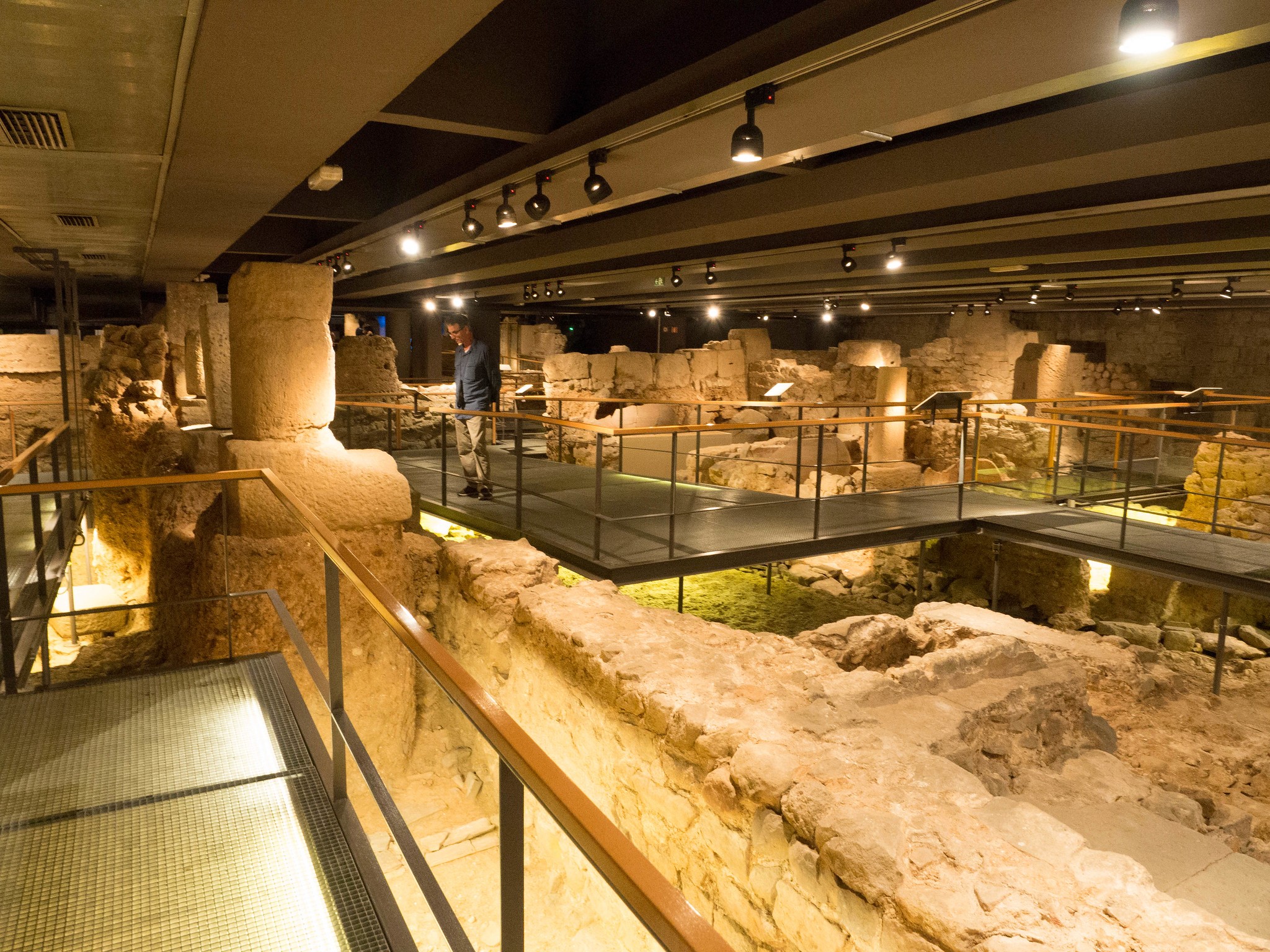
The underground archaeological site is the centrepiece and the most immediately extraordinary element. Descending by lift from the Casa Padellàs entrance into the basement, visitors walk on raised glass walkways through a preserved section of the Roman city of Barcino as it existed between the first century BC and the seventh century AD. The site covers over 4,000 square metres, making it the largest Roman archaeological site in situ in Europe outside Rome itself, and the remains are remarkably complete and legible. You walk above the preserved floors of a Roman laundry (fullonica), where cloth was trodden and whitened, past the tanks of a fish-salting and garum factory (garum being the fermented fish sauce that was one of Rome's primary condiment exports across the Empire), past a wine press and storage vessels, past the interior of a Roman house with its atrium and storage rooms, past sections of the Roman city wall, and through the remains of Barcelona's first Christian community, including what is believed to be the earliest Christian baptistery in Catalonia. Blue light strips running along the floor indicate the original boundaries of Roman streets, so that even where the buildings are fragmentary, you can understand the urban grid you are moving through.
The material ranges from the purely structural (walls, floors, drainage channels) to the intimately domestic: dye vats stained with the residue of their last use nearly two thousand years ago, the distribution channels of a Roman water supply, the threshold stones of doorways worn smooth by feet that last crossed them in the third century. The experience is one of the closest encounters with a lived Roman city available to any visitor in Europe.
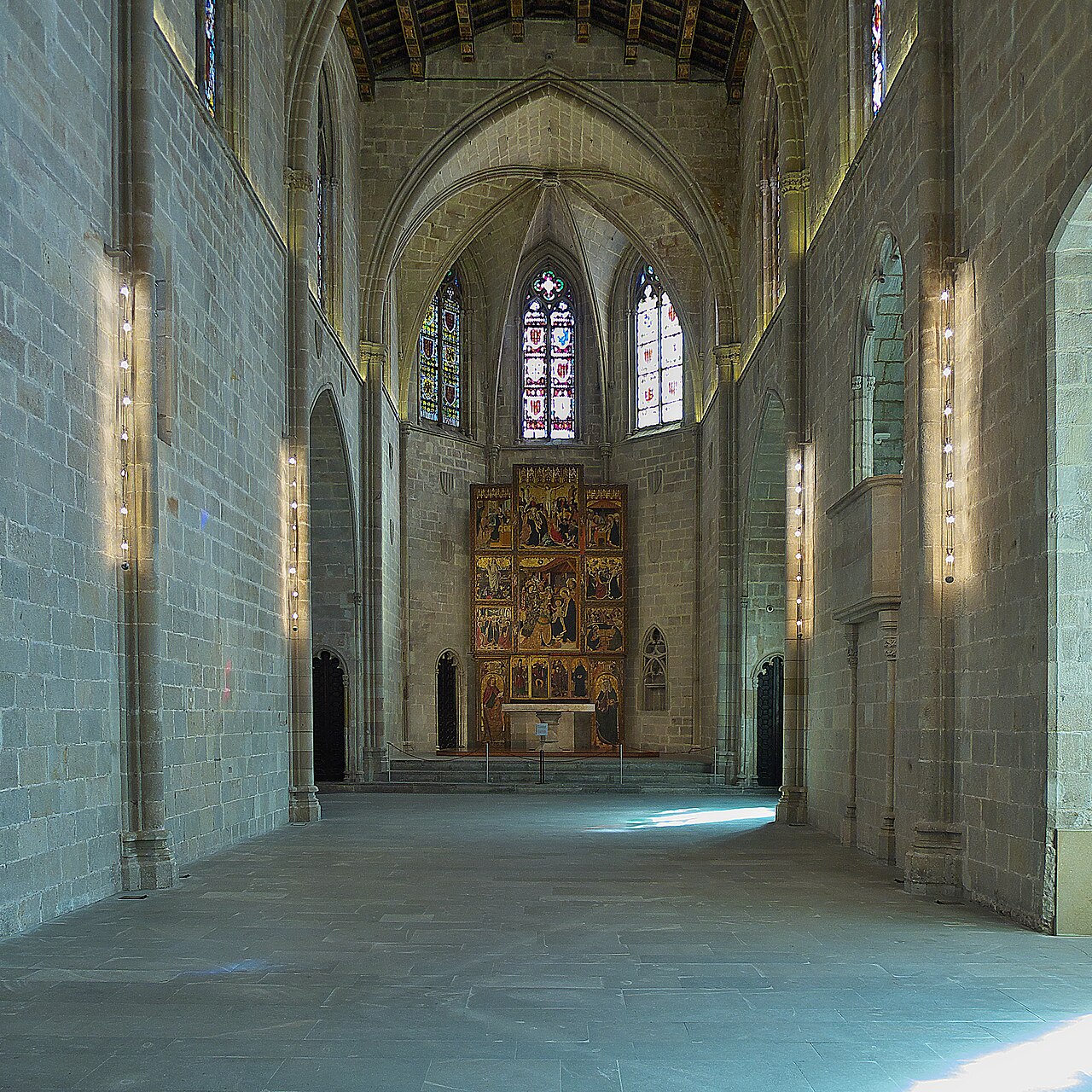
The Saló del Tinell, reached from the underground via stairs or lift, is the great ceremonial hall of the Palau Reial Major, the former royal palace of the Counts of Barcelona and later the Kings of Aragon. Built between 1359 and 1370 for King Peter III (the Ceremonious) by the master builder Guillem Carbonell, it is one of the finest examples of Catalan Gothic secular architecture in existence: a vast barrel-vaulted hall of six semicircular stone arches spanning 17 metres without columns, the largest unsupported medieval hall in Catalonia. This is the room where, in 1493, Fernando and Isabel received Christopher Columbus on his return from his first voyage to the Americas, the moment at which the known world changed. Standing in the Tinell with this history in mind, in a room that has not substantially changed since that conversation took place, is one of the more quietly staggering experiences Barcelona offers.
The Chapel of Santa Àgata, at one end of the Saló del Tinell, is a 14th-century royal palatine chapel built by James II of Aragon over a section of the Roman wall. Its centrepiece is the altarpiece of the Constable, painted by Jaume Huguet in 1465, depicting the Adoration of the Magi with the constable Pedro of Portugal and his court as donors. Huguet is the master of the Catalan Gothic school of painting, and this altarpiece is one of his finest surviving works, hanging in the chapel for which it was commissioned, in a setting as close to its original context as any altarpiece in Spain. The chapel tower, the Mirador del Rei Martí, rises above the complex but has been closed to visitors in recent periods; check the current status at the ticket desk on arrival.
Casa Padellàs is the entrance building of the museum and a remarkable piece of urban history in its own right. A 15th-century Gothic private palace that originally stood on Carrer dels Mercaders in the Gothic Quarter, it was moved stone by stone to its current location on Plaça del Rei in 1931 when the construction of Via Laietana would otherwise have demolished it. The move was the first major stone-by-stone relocation of a historic building in Barcelona, and it was during the reconstruction of its foundations in their new location that the Roman ruins beneath the plaza were first discovered. The upper floors of Casa Padellàs now hold the Barcelona Flashback: Historical Synthesis permanent exhibition, a panoramic overview of two thousand years of Barcelona's history told through documents, objects, architecture, and landscape photography.
Image Credit: JosepBC, CC BY-SA 3.0
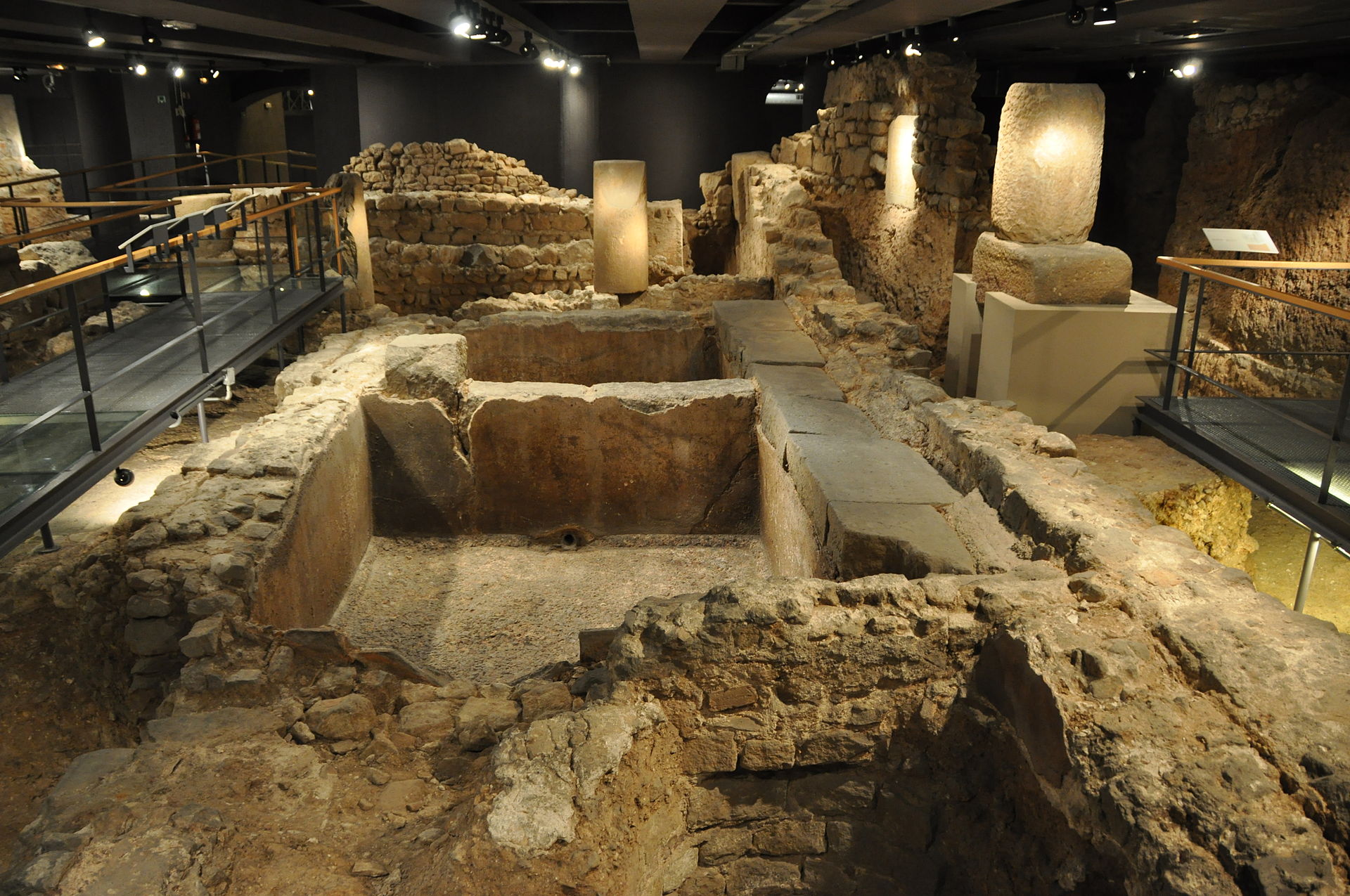
The MUHBA preserves significant remains of a 3rd-century AD Roman fish-salting factory located in the basement of the Palau Reial Major in Plaça del Rei. These excavated ruins include large, stone-cut vats used for fermenting fish and manufacturing garum (a prized salty fermented fish sauce), along with fish-processing areas.
What is the Best Time to Visit the MUHBA?
Weekday mornings from Tuesday to Friday are the best time for the underground ruins. The site is at its most atmospheric when quiet; even in a space this significant, the experience of moving through the Roman city with few other visitors is dramatically more immersive than navigating the walkways in a crowd. Arriving at opening at 10:00am on a Tuesday or Wednesday gives you the closest thing to a private visit.
Sunday afternoons from 15:00 offer free admission for all visitors, which is the most cost-effective window if budget matters. Be aware that these are the busiest hours of the week at the underground site, and that the audio guide is not available during the free Sunday afternoon window.
The first Sunday of each month is free all day. These are consistently the most popular days and the most crowded. If visiting on a first Sunday, arriving at 10:00am is strongly advisable.
Avoid the reduced-hours days if you want a full visit. On 6 January, 28 May, 15 August, 12 October, 1 November, 6 December, and 26 December, the museum closes at 14:00. This is easily overlooked and leaves insufficient time for a thorough visit if you arrive mid-morning.
Seasonally: The underground site maintains a constant cool temperature year-round, making it one of the more comfortable places in the city on a hot Barcelona summer day. In the height of summer (July and August), the museum is a welcome retreat from the heat of the streets and is worth factoring into a day's itinerary partly on these grounds.
MUHBA Audio Guides and Guided Tours
An audio guide is available for hire at the museum entrance. It covers the underground archaeological site and the above-ground buildings with commentary in multiple languages and is the most practical tool for navigating the Roman remains, where interpretation of fragmentary structures benefits considerably from contextual explanation. The audio guide is not available on the first Sunday of the month or on any Sunday from 15:00 onwards.
Guided tours of the complex are offered by the museum on selected dates and must be booked in advance. Guided tours cover the Roman underground, the Saló del Tinell, and the Chapel of Santa Àgata with expert historical commentary, and are particularly recommended for visitors with a serious interest in Roman Barcelona, the Crown of Aragon, or the development of the Gothic Quarter.
Many third-party Gothic Quarter walking tours include Plaça del Rei as a significant stop and provide good surface-level context for the buildings and the square, though they do not include access to the underground ruins. If a fuller account of the Roman layer is your primary interest, a dedicated MUHBA guided tour or the audio guide is the more rewarding option.
Other MUHBA Sites Covered by the Same Ticket
The €7.30 ticket purchased at Plaça del Rei is a combined ticket valid for six months at all MUHBA sites across the city. Several of these are highly worthwhile in their own right and represent strong additions to a visit to Plaça del Rei for visitors with more than a day in Barcelona.
Refugi 307 (Carrer Nou de la Rambla 175, Poble-sec): One of the most historically resonant MUHBA sites and one of the most affecting experiences in the city. A Republican air-raid shelter built during the Spanish Civil War in the tunnels beneath Poble-sec, it sheltered hundreds of civilians during the Francoist bombing of Barcelona between 1937 and 1939. Guided visits run every Sunday at 10:30 in English, 11:30 in Spanish, and 12:30 in Catalan. Visits are not available without a booking. The shelter is included in the combined MUHBA ticket.
Centre d'Interpretació del Call (Placeta de Manuel Ribé, Gothic Quarter): A small but carefully curated interpretation centre dedicated to the history of El Call, Barcelona's medieval Jewish quarter, which occupied the streets immediately west of the Plaça del Rei between approximately the 9th and 15th centuries. Artefacts include ritual lamps, cooking vessels, and tombstones recovered from excavations. Open Wednesday and Friday 11:00 to 14:00; Saturday and Sunday 11:00 to 19:00. Free with the MUHBA ticket; free to all on first Sundays.
Espai Santa Caterina (Carrer Joan Capri, beneath the Santa Caterina Market): An archaeological site beneath the floor of the Enric Miralles-designed Santa Caterina market in the Born neighbourhood, displaying the evolution of this area from prehistoric times to the present beneath the colourful mosaic roof. Open Monday to Saturday 07:30 to 15:30; closed Sundays. Free with the MUHBA ticket.
Accessibility at the MUHBA
The MUHBA at Plaça del Rei is wheelchair accessible throughout the main visitor route, including the underground archaeological site. The lift provides step-free access from the Casa Padellàs entrance level to the Roman underground. The Saló del Tinell and the Chapel of Santa Àgata are accessible via ramp and adapted routes. Some areas of the historic building complex involve uneven cobbled surfaces or narrow passages; staff at the ticket desk can advise on the most accessible routes in advance.
Recognised disability card holders enter free; one accompanying assistant also enters free with documentation.
Accessible toilet facilities are available within the complex.
Rules and Practical Information
Photography without flash or tripod is permitted inside the exhibition halls throughout the museum, including the underground site. The official guidance requests that visitors silence mobile phones and avoid using them in the exhibition halls, which is worth following both out of courtesy and because the underground site is more immersive when experienced without a phone in hand.
Umbrellas and sharp objects must be left at the entrance.
Food and drinks are restricted to the designated reserved space within the complex. There is a small café area accessible to visitors.
Animals are not permitted inside the museum, with the exception of assistance dogs.
The bookshop at the museum entrance stocks a well-curated range of publications on Roman Barcelona, medieval Catalan history, and the broader history of the city, and is worth browsing before or after the visit.
Where to Eat Near the MUHBA
The MUHBA at Plaça del Rei is surrounded by the Gothic Quarter and the Born neighbourhood, both of which offer a wide range of eating options within a short walk.
Immediately around Plaça del Rei, the streets branching off the square towards Carrer de la Pietat and Carrer dels Comtes have a mixture of neighbourhood cafés and tourist-facing restaurants. The quality of the most immediately obvious options closest to the square varies; walking a block or two in any direction generally improves both quality and value.
El Call, the medieval Jewish quarter immediately west of the museum, is one of the quieter and more characterful parts of the old city for eating and drinking, with several independent wine bars and small restaurants in the narrow lanes around Carrer del Call and Carrer de Sant Domènec del Call.
The Born neighbourhood, around eight to ten minutes on foot east of the MUHBA through the Gothic Quarter, is one of Barcelona's most rewarding and varied areas for eating at any price point. The streets around the Mercat de Santa Caterina and the Basílica de Santa Maria del Mar have an excellent concentration of independent tapas bars, restaurants, and cafés. This is the natural direction for a post-museum lunch or dinner.
Carrer de la Mercè, running east through the southern Gothic Quarter towards the waterfront, is a traditional street for affordable eating and wine served from barrels, with several bars and taverns that have served the neighbourhood for generations.
What Else is There to Do Near the MUHBA?
The MUHBA sits in the heart of the area of Barcelona with the greatest concentration of medieval and Roman remains, and any visit pairs naturally with several other nearby sites.
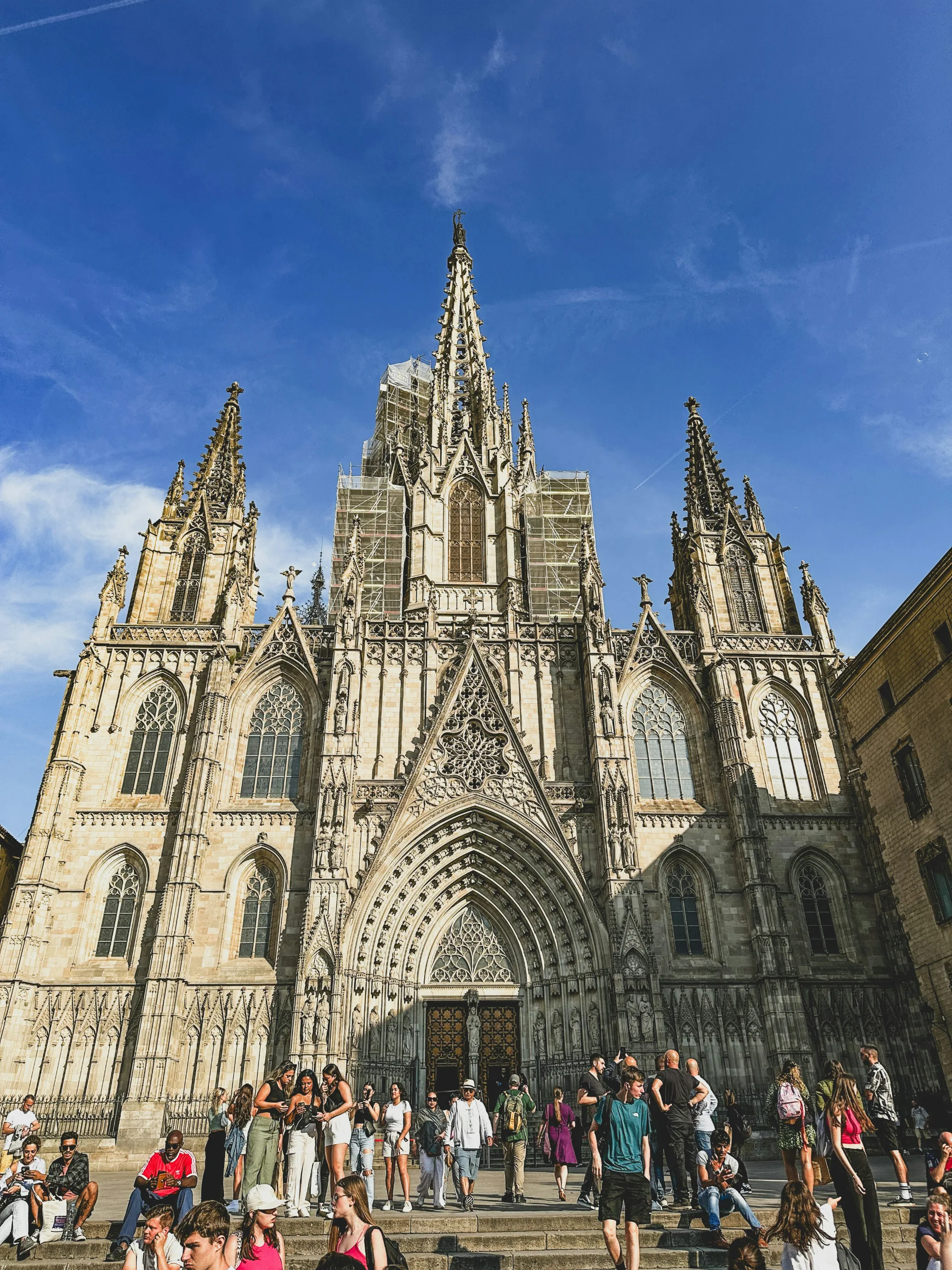
The Barcelona Cathedral (La Seu) is around a three to five-minute walk from Plaça del Rei, making the combination of the two an obvious morning pairing. The cathedral covers the Christian and ecclesiastical history of the site from the fourth century to the present; the MUHBA covers the Roman and political layers beneath and around it. Together they give a remarkably complete account of the Barri Gòtic's two-thousand-year history.
The Picasso Museum, around eight minutes on foot from Plaça del Rei through the Gothic Quarter into the Born, is one of the most important Picasso collections in the world, housed across five connected medieval palaces. Advance booking is strongly recommended.
The Museu Frederic Marès is immediately adjacent to the MUHBA on Plaça de Sant Iu, sharing the same walled compound of the Palau Reial Major. Founded in 1946 and holding the extraordinary personal collection of sculptor Frederic Marès, it covers medieval religious sculpture from across Catalonia and an eccentric and absorbing collection of everyday objects from the 19th century. Free entry on first Sundays and Sunday afternoons from 15:00.
The Temple d'August (Roman Temple of Augustus) is around five minutes on foot from the MUHBA at Carrer del Paradís 10, inside the Centre Excursionista de Catalunya. Four Corinthian columns from the temple built at the centre of Roman Barcino in honour of the Emperor Augustus survive intact within the courtyard of a medieval building. They are among the most striking Roman remains in the city, free or nominally priced to visit, and make a natural complement to the underground tour: the temple stood at the highest point of the Roman forum, which is the same forum whose streets you walk beneath the MUHBA.
The Born neighbourhood and the Mercat de Santa Caterina are around eight to ten minutes on foot east through the Gothic Quarter. The Born offers the Espai Santa Caterina MUHBA site (covered above), the Basílica de Santa Maria del Mar, and the El Born Centre de Cultura i Memòria, which holds the archaeological remains of the Ribera neighbourhood destroyed by Philip V's forces in 1714 in the aftermath of the War of the Spanish Succession, covered by glass beneath the 19th-century Born market building.
Final Tips for Visiting the MUHBA
Go on a weekday morning. The underground Roman site is significantly more immersive when quiet. Tuesday and Wednesday mornings are consistently the calmest. The site is worth visiting at any time, but the difference between a crowd-free and a crowded visit in the tunnels is substantial.
Take the audio guide. The Roman remains are fragmentary by nature, and knowing that the vat you are standing above was used to ferment fish sauce for distribution across the Empire, or that the troughs in front of you are the washing basins of a laundry where clothes were trodden in a mixture of water and urine to bleach them, changes what you are looking at from rubble into a living city. The audio guide provides this context; visiting without it means missing a significant portion of what the site has to offer.
Stand in the Saló del Tinell and think about 1493. Columbus returned from his first voyage to the Americas on 15 March 1493 and was received by Fernando and Isabel in this room. The conversation that took place in the Tinell was one of the hinge moments of world history, and the room itself is unchanged. This is not a reconstruction or a replica; it is the room.
Use the combined ticket across multiple days. The six-month validity of the €7 ticket means that a visit to Refugi 307 on a subsequent day, or the Centre d'Interpretació del Call, or the Espai Santa Caterina beneath the Born market, extends the value of a single purchase across several distinct and worthwhile experiences.
Combine with the Temple d'August and the Museu Frederic Marès. Both are within five minutes of the MUHBA, both are free or very low cost, and both contribute directly to the same story the MUHBA is telling. A morning covering the MUHBA, the Temple d'August, and the Marès is one of the most historically coherent and least expensive mornings available in any European city.
Visit in summer for the cool. The underground Roman site maintains a constant cool temperature regardless of the weather above. On a hot July or August day in Barcelona, two hours in the underground Barcino is a welcome respite as well as an excellent museum visit.
Back to Barcelona Attractions
Explore other Barcelona attractions
" width="24px"><path d="M 0 0 L 24 0 L 24 21.231 L 0 21.231 Z" fill="transparent" height="21.230768474975793px" id="nL2EwDcS9" width="24px"/><path d="M 0 0.541 C 0 0.242 0.245 0 0.547 0 L 2.735 0 C 3.037 0 3.282 0.242 3.282 0.541 L 3.282 4.598 C 3.282 4.897 3.037 5.139 2.735 5.139 L 0.547 5.139 C 0.245 5.139 0 4.897 0 4.598 Z" fill="rgb(196, 217, 201)" height="5.138657337892187px" id="hZ_rlBe_S" transform="translate(0 16.092)" width="3.2820512820512358px"/><path d="M 0 0.541 C 0 0.242 0.245 0 0.547 0 L 2.735 0 C 3.037 0 3.282 0.242 3.282 0.541 L 3.282 7.843 C 3.282 8.142 3.037 8.384 2.735 8.384 L 0.547 8.384 C 0.245 8.384 0 8.142 0 7.843 Z" fill="rgb(230, 211, 160)" height="8.38412513024521px" id="HgVBxIz3e" transform="translate(5.128 12.847)" width="3.282051282051235px"/><path d="M 0 0.541 C 0 0.242 0.245 0 0.547 0 L 2.735 0 C 3.037 0 3.282 0.242 3.282 0.541 L 3.282 12.982 C 3.282 13.281 3.037 13.523 2.735 13.523 L 0.547 13.523 C 0.245 13.523 0 13.281 0 12.982 Z" fill="rgb(232, 207, 164)" height="13.522782468137464px" id="utgrDnoM9" transform="translate(10.325 7.708)" width="3.282051282051377px"/><path d="M 0 0.541 C 0 0.242 0.245 0 0.547 0 L 2.735 0 C 3.037 0 3.282 0.242 3.282 0.541 L 3.282 16.498 C 3.282 16.797 3.037 17.039 2.735 17.039 L 0.547 17.039 C 0.245 17.039 0 16.797 0 16.498 Z" fill="rgb(233, 196, 166)" height="17.038705909853153px" id="OLOhW6STz" transform="translate(15.521 4.192)" width="3.2820512820512384px"/><path d="M 0 0.541 C 0 0.242 0.245 0 0.547 0 L 2.735 0 C 3.037 0 3.282 0.242 3.282 0.541 L 3.282 20.69 C 3.282 20.989 3.037 21.231 2.735 21.231 L 0.547 21.231 C 0.245 21.231 0 20.989 0 20.69 Z" fill="rgb(217, 170, 153)" height="21.230768474975793px" id="H5Z8wcwkd" transform="translate(20.718 0)" width="3.2820512820512278px"/></g></svg>)