Back to Rome Attractions
How Early to Book Tickets to the Baths of Caracalla in Rome
Updated August 2026
The Baths of Caracalla are the best-preserved ancient thermal complex in Rome and one of the most awe-inspiring archaeological sites in Italy. Built between 212 and 216 AD under Emperor Caracalla, the walled complex covered around 11 hectares, accommodated up to 1,600 bathers at one time, and included not just hot, warm, and cold pools but also gymnasiums, libraries, gardens, shops, and a temple dedicated to the Persian god Mithras. The walls in places still stand 30 metres high. Unlike the Colosseum, which rarely disappoints but rarely surprises, the Baths of Caracalla tend to catch visitors off guard: the sheer physical scale of what remains is extraordinary, and the site receives a fraction of the crowd that the more famous ruins attract. At €8 for most adults, it is also one of the best-value major archaeological sites in Rome.
At a Glance
How Early to Book:
Pre-booking is not required; same-day tickets are available at the on-site ticket office and queues are always fairly short. You can also book tickets online to save time.
Best Times to Visit:
Mornings before 11am, and afternoons after 4pm, will have the least crowds.
Ticket price:
€8 for adults.
Where to Book:
Landmark Address:
Do You Need to Book Baths of Caracalla Tickets in Advance?
Advance booking is not strictly required in the way it is at some other Rome sites. Walk-up tickets can be purchased at the on-site ticket office on the day. However, online booking ahead of your visit saves time at the entrance and guarantees your preferred time window, and it can be worth doing during peak season (April to October) or on weekends.
Where to book: Tickets are sold only through Musei Italiani, the Italian Ministry of Culture's official portal, through the Musei Italiani app, or at the desks and card-only automatic totems at the site entrance. There is no booking fee on any of these channels. Tickets bought through other resellers carry no guarantee.
Tickets are personal. Each ticket carries the visitor's name, so you will be asked for details for everyone in your party at the time of booking. Carry photo ID, and carry it in particular if you are claiming a reduced or free ticket, since staff check eligibility at the entrance.
Prices: €8 for adults and €2 for EU citizens aged 18 to 25. Under 18s enter free regardless of nationality, as do disabled visitors and one companion. When a temporary exhibition is running, a €5 supplement is added to both the full and the reduced ticket.
Roma Pass: The Baths of Caracalla are included in the Roma Pass, making them one of the free site inclusions for 48-hour and 72-hour pass holders. If you plan to use the Roma Pass, the Baths represent solid value given the ticket price and the flexibility of including them as one of your covered attractions. The pass also gives a reduced rate on the Terme di Caracalla 4D virtual reality visit and on the nearby Circo Maximo Experience.
Audio guides and virtual reality: A free app, Roma X-PAND, covers the site room by room and is the option the museum itself points visitors towards. Download it before you arrive. A separate 4D virtual reality visit is sold by third-party operators and collected at the ticket desk, placing you inside the baths as they appeared in the 3rd century AD, complete with marble floors, painted ceilings, and Romans going about their daily routines. If you are visiting with children or want a more immersive sense of what the place looked like in its prime, the VR might be worth considering.
Keep the existing link on "Musei Italiani" in the "Where to book" paragraph, pointed at the Caracalla page rather than the generic museums index.
Baths of Caracalla Opening Hours and Entry Information
The Baths of Caracalla are closed every Monday. The site is open Tuesday to Sunday, and closing times change five times a year.
1 March to 28 March: 9:00am to 5:30pm (last entry 4:30pm)
29 March to 31 August: 9:00am to 7:15pm (last entry 6:00pm)
1 September to 30 September: 9:00am to 7:00pm (last entry 6:00pm)
1 October to 25 October: 9:00am to 6:30pm (last entry 5:30pm)
26 October to 28 February: 9:00am to 4:30pm (last entry 3:30pm)
The ticket office closes at the last entry time, not at closing time, so aim to arrive well before it. Always check the official website before your visit, as the seasonal changeover dates shift slightly from year to year.
Monday openings and closures: The site opens on some public holidays that fall on a Monday, and when it does, the weekly closure moves to the Tuesday of that week instead. Check before travelling if your visit falls near a holiday.
Performance days: During the summer performance season the site sometimes closes early to allow for setup, occasionally by as much as two hours. These dates are published on the official site shortly beforehand.
Address: Viale delle Terme di Caracalla, 52, 00153 Roma
What is the Best Way to Get to the Baths of Caracalla?
The Baths are located in the southern part of central Rome, roughly between the Colosseum area to the north and the Circus Maximus to the west. They are not as centrally placed as the Pantheon or Piazza Navona, but they are easily reachable by public transport.
By Metro: Two lines serve the site. Circo Massimo on Line B is around a 10-minute walk from the entrance and is the most convenient option for most visitors, including anyone coming from Termini on Line B southbound. Porta Metronia on Line C is a similar distance from the eastern side of the complex.
By bus and tram: Routes 628, 760, and 75 stop at Circo Massimo, as does tram 3. Several other routes run along Viale delle Terme di Caracalla itself, with stops close to the entrance.
On foot: The Baths are around a 15-minute walk from the Colosseum, 10 minutes from the Circus Maximus, and 25 to 30 minutes from the Pantheon. Walking from the Colosseum along Viale delle Terme di Caracalla is a pleasant way to arrive.
By bike: The area is well served by cycle paths, and dockless bikes and scooters are usually available nearby. The gentle terrain between the Circus Maximus and the Baths makes cycling a comfortable option.
Driving is possible and there is some parking in the surrounding streets, though the area is busy during peak hours. Given the easy Metro connection, public transport is the preferred option for most visitors.
How Much Time Should I Spend at the Baths of Caracalla?
Most visitors spend 1.5 to 2 hours exploring the site, which is enough time to walk through the main complex, visit the underground levels, and take in the surviving mosaics and architectural details at a comfortable pace.
If you are using an audio guide or the virtual reality add-on, allow 2 to 2.5 hours. Visitors joining a guided tour should plan for 1.5 to 2 hours for most standard tour formats.
Because the site is predominantly open-air and spread across a large area, the Baths reward visitors who take their time and allow their eyes to adjust to the scale. The best approach is not to rush from point to point but to pause inside the larger halls and try to reconstruct in your imagination what these spaces looked like when roofed in marble and decorated with frescoes and colossal sculptures.
Image Credit: Ethan Doyle White, CC BY-SA 4.0
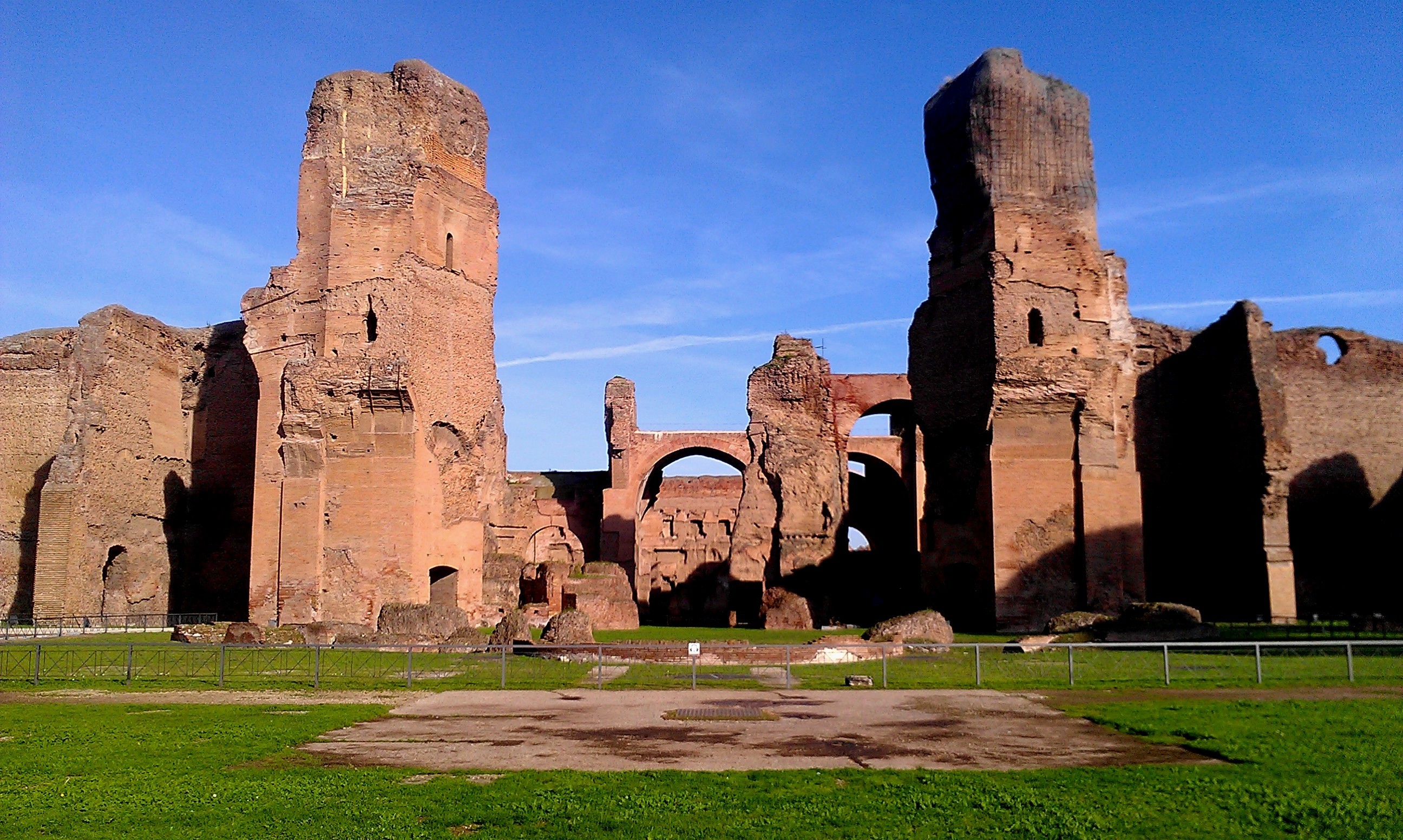
The Baths of Caracalla, completed 216 CE, were a massive, 27-acre ancient Roman leisure complex that accommodated up to 10,000 daily visitors with gyms, libraries, and pools. The entire complex was heated by 49 underground furnaces.
What is the Best Time to Visit the Baths of Caracalla?
Best time of day: Early morning, from opening until around 11:00am, is the quietest period. The Baths are predominantly open-air, so morning visits also avoid the most intense heat during summer months. Late afternoon, particularly after 4:00pm, is another good window, with lower visitor numbers and more atmospheric light on the ruins. In the winter months, when the site closes at 4:30pm, the late-afternoon window disappears entirely.
Best days: The Baths are less affected by day-of-week variations than the Colosseum or the Vatican, but weekday mornings are noticeably calmer than weekend afternoons. Remember that Monday is not an option.
Best season: Spring (late March to May) and autumn (September to October) offer the most balanced combination of comfortable temperatures and manageable crowds. The ruins are partially shaded but predominantly exposed, making summer visits hot and requiring adequate sun protection. Winter visits are very quiet and the ruins have their own stark quality in cooler light, though the site closes in the middle of the afternoon.
Summer performances: From late June the Baths host an outdoor performance season, including the Teatro dell'Opera di Roma's summer opera programme and a contemporary dance festival. Tickets for these are sold separately by the companies staging them. The practical thing to know as a daytime visitor is that performance days can bring the site's closing time forward by an hour or two, so check the official site for the current season's dates before planning a late-afternoon visit in July or August.
Evening openings: The site occasionally opens for evening visits outside the performance season, with entry in the early evening and access to the bath complex, the underground, and the Mithraeum. These are one-off dates rather than a regular programme, ticketed at a higher rate than daytime entry, and announced on the official site a week or two in advance.
Free Sundays: The first Sunday of every month offers free entry to all visitors. Arrive as early as possible if you plan to visit on one of these days, as crowds are noticeably larger. The Domus di Vigna Guidi frescoes are closed on free Sundays to protect them from the additional footfall, so if that part of the site matters to you, come on a different day.
What is Inside the Baths of Caracalla?
The Baths of Caracalla are an archaeological site, not a museum. What you see are the stripped ruins of an extraordinary building: the brick shells of rooms that were once lined floor to ceiling in coloured marble, mosaics, and frescoes, decorated with colossal bronze and marble statues, and filled with thousands of people going about the daily business of Roman life. Reaching the site requires using your imagination as much as your eyes, and the free Roma X-PAND app and the VR experience are both useful for reconstructing what is no longer physically there.
The central bathing block: The heart of the complex is a vast rectangular building nearly 220 metres long. Its surviving brick walls, in places three storeys high, enclose the three main bathing rooms: the caldarium (hot bath), the tepidarium (lukewarm bath), and the frigidarium (cold bath), along with the natatio, the large open-air cold swimming pool at the northeast end. The scale is almost impossible to convey. The frigidarium alone was larger than many modern sports arenas.
The caldarium: The southernmost and most distinctive room of the central block, the caldarium is a circular domed space whose ruins form one of the most recognisable silhouettes of the site. Originally topped with a dome comparable in diameter to the Pantheon's, it was heated to very high temperatures and designed to function like a steam chamber. Even in ruin it gives a powerful sense of the engineering involved.
Mosaics: Significant fragments of the original black-and-white mosaic floors survive, particularly in the gym areas (palaestra) and in parts of the underground complex. The mosaics predominantly depicted sea creatures, athletes, and mythological scenes, and the remaining sections are among the most visited details of the site. Look for them at ground level throughout the main complex.
The underground tunnels (Sotterranei): Below the main complex lies one of the most evocative parts of the site: around two kilometres of tunnels, wide and high enough for mule-drawn carts to circulate, used by the hundreds of slaves and specialist workers who kept the baths running. This subterranean infrastructure was the functional heart of the building, holding the furnaces and boilers, the water system, a mill, and the timber stores. Around 50 furnaces burned wood constantly to heat the water and the rooms above. Which underground sections are open varies, so ask at the ticket desk what is accessible on the day and whether it is covered by your ticket.
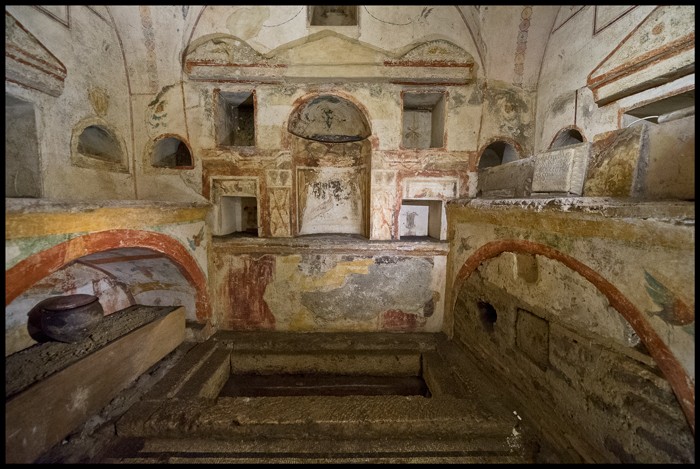
The Mithraeum: Within the underground complex is one of the largest mithraea surviving anywhere in Rome, found during excavations in 1912. Mithraism was a mystery cult popular with Roman soldiers and working men during the 2nd and 3rd centuries. The cult excluded women. The large rectangular room features an impressive fresco and the architectural arrangement typical of Mithraic meeting halls, along with the fossa sanguinis used in initiation rituals. Access to the Mithraeum can vary depending on the day and any restoration work in progress; check when you arrive whether it is open on the day of your visit.
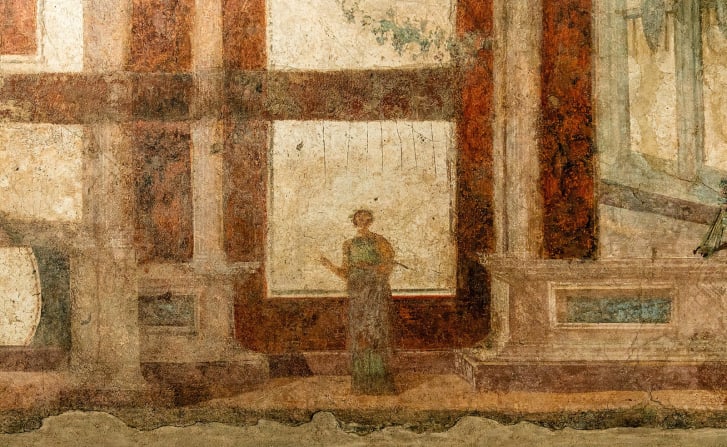
The Domus di Vigna Guidi: On the southeast side of the site are the restored frescoes of a house that stood here before the Baths were built. Discovered in the 1860s, reburied, then excavated again from 1970, the paintings returned to public display in 2022 and are now part of the standard visitor route. The small shrine, showing the Egyptian gods Anubis and Isis facing Jupiter, Juno, and Minerva, has no known parallel anywhere else. It closes on very busy days, including free Sundays.
The gardens and outer precinct: The baths stood within a much larger precinct that included gardens, a stadium-track, exedras (semicircular recesses used as meeting spaces and shops), libraries at the southern end, and reservoirs. Much of the outer precinct can be walked, and the surviving walls of the outer enclosure give a sense of the total scale of the complex, which was approximately 340 by 330 metres.
What Happened to the Art from the Baths of Caracalla?
The Baths of Caracalla were lavishly decorated and their contents were systematically looted over many centuries. Several of the most famous sculptures in Europe were discovered here during 16th-century excavations. The colossal Farnese Hercules and the Farnese Bull (officially known as the Punishment of Dirce), both now in the Museo Archeologico Nazionale di Napoli, came from the Baths. Numerous other statues and architectural fragments ended up in the Vatican Museums and in private collections across Europe.
Some of the granite and marble basins from the baths now serve as the fountains in Piazza Farnese in central Rome. Understanding this dispersal helps explain why the ruins feel stripped: almost everything that could be moved was moved, and what remains is the structural skeleton of a once magnificently decorated building.

Guided Tours and Audio Guides
The free app: Roma X-PAND is the museum's own app, free on iOS and Android, and it describes the various rooms as you move through them. It is the closest thing to an official audio guide and the option the site itself recommends. Download it before you arrive rather than relying on signal at the site.
Virtual reality: The 4D virtual reality visit is sold by third-party operators and collected at the ticket desk. You put on a headset and are placed inside the baths as they appeared in the early 3rd century AD, complete with marble-clad walls, frescoes, light streaming through high windows, and Romans moving through the space. It is a particularly useful tool for comprehending what is otherwise quite difficult to visualise from the ruins alone. Availability varies, so check when booking rather than assuming headsets will be free on arrival.
Guided tours: The site does not run its own guided tours and does not sell skip-the-line entry, so anything of that kind comes from a licensed operator working independently. Tours typically run around 90 minutes and cover both the main complex and the underground. Several operators offer combination tours that pair the Baths with the Circus Maximus, the Colosseum, or a broader walk through ancient Rome's southern districts. A tour adds substantial value at a site where the physical remains require significant contextualisation.
Are the Baths of Caracalla Worth Visiting?
Yes, particularly for visitors who want to experience something of the scale and ambition of ancient Roman public building without fighting the crowds that characterise the Colosseum and the Forum. The Baths are impressive in person in a way that photographs underrepresent. The walls are simply enormous, and the experience of walking through room after room of a building of this size, knowing it was built nearly 1,800 years ago and used by ordinary Romans as a daily leisure facility, is remarkable.
The site also offers something the Colosseum cannot: relative quiet. You can stand in the middle of the frigidarium's ruins in near-silence on a weekday morning, with only a handful of other visitors in sight. For a site of this historical and architectural significance, that is an unusual and worthwhile experience.
At €8 for adults, the Baths are also one of the more affordable major paid sites in Rome, making the value-for-time equation particularly favourable.
Where Should I Eat Near the Baths of Caracalla?
The Baths of Caracalla sit at the edge of two of Rome's most interesting residential neighbourhoods: the Aventine Hill to the west, and Testaccio to the northwest. Both offer significantly better food options than the area immediately around the baths, and Testaccio in particular is considered one of the best places in Rome to eat traditional Roman cooking.
Testaccio (10 to 15 minutes on foot): Testaccio is the neighbourhood most associated with quinto quarto cooking, the traditional Roman style built around the offcuts and organ meats that local butchers were historically paid with. Even if offal is not your thing, Testaccio has excellent trattorias serving Roman pasta classics (carbonara, cacio e pepe, amatriciana, gricia) at prices far below what the tourist areas charge. The neighbourhood market, the Mercato Testaccio, is also one of the best food markets in Rome and a good option for a quick, inexpensive lunch. Among the most recommended restaurants in the area is Flavio al Velavevodetto on Via di Monte Testaccio, a well-regarded Roman trattoria partially built into the ancient amphorae hill, serving generous portions of traditional Roman food in an atmospheric setting.
Near the site:
Al Callarello on Piazzale Numa Pompilio is one of the most affordable and local-feeling restaurants in the immediate vicinity of the Baths, popular with residents of the Aventine and Testaccio area. Solid Roman cooking with a relaxed neighbourhood feel.
The streets around Piazza di Albania and the lower Aventine have a handful of neighbourhood bars and small restaurants that offer a less tourist-oriented experience than the historic centre.
For a drink with a view: The orange garden (Giardino degli Aranci) on the Aventine Hill is free to enter and offers one of the most beautiful panoramic views of Rome, looking west over the Tiber toward St Peter's Basilica. There are no restaurants in the garden itself, but it is worth visiting immediately before or after the Baths, and the surrounding Aventine streets have quiet cafes and bars popular with locals.
What Else is There to Do Near the Baths of Caracalla?
The area around the Baths connects naturally with several of Rome's less-visited but rewarding sights, making it easy to build a full and satisfying day around this part of the city.
Circus Maximus is a 10-minute walk west and is the site of ancient Rome's largest chariot-racing track, capable of holding 250,000 spectators. Today it is an open grassy valley with the outline of the original track still clearly visible. Entry to the exterior area is free. An underground museum and visitor centre has opened in recent years with exhibits covering the history of the site.
The Aventine Hill is a peaceful, largely residential hilltop area directly west of the Baths, reached by a 10 to 15-minute walk. It is home to two of Rome's more unusual sights. The Knights of Malta Keyhole on Piazza dei Cavalieri di Malta is a small circular hole in a garden gate through which, if the queue of other visitors allows you a moment, you can see a perfectly framed view of the dome of St Peter's Basilica, aligned by the garden's formal hedges. The Giardino degli Aranci (Orange Garden) next door has one of the best free panoramic views in Rome. Both are quiet, largely non-touristy, and a contrast to the busier sights of the historic centre.
The Pyramid of Cestius is around 15 minutes on foot northwest from the Baths, near the Porta San Paolo. Built in 12 BC as a tomb for the magistrate Caio Cestio, it is a remarkably well-preserved ancient Egyptian-style pyramid in the middle of Rome, and one of the more bizarre and striking things the city has to offer. Entry to the interior requires advance booking and is only available at specific times; check the official site before visiting.
The Protestant Cemetery (Cimitero Acattolico) is immediately beside the Pyramid and is one of the most beautiful and atmospheric places in Rome. John Keats is buried here, as is Percy Bysshe Shelley and the son of Goethe. The cemetery is meticulously maintained by volunteers and asks for a donation of around €5 on entry. Its opening days are limited and change from time to time, so check before making the walk. It is one of those places that visitors discover by accident and remember for a long time.
The Colosseum, Roman Forum, and Palatine Hill are around 15 minutes on foot north of the Baths, making a combined visit perfectly feasible in a single day if you start early. The Colosseum requires advance booking well in advance; the Roman Forum and Palatine Hill are included in the same ticket.
Rules, Bags, and Security
All visitors pass through a security check on arrival, including bag inspection.
Tickets and ID: Tickets carry the visitor's name. Bring photo ID, particularly if you are entering on a reduced or free ticket, as staff verify eligibility at the entrance.
Bags: Large bags, backpacks, and suitcases are subject to security checks. The site is an open-air archaeological area rather than a museum, and there is no cloakroom. Travelling light is advisable.
What you cannot bring in: Glass bottles and any sharp or blunt objects are not permitted anywhere on the site. Bring water in a plastic or metal bottle instead.
Photography: Personal photography is permitted throughout the site. The underground sections and the Mithraeum, when accessible, may have specific lighting conditions that make photography challenging; a phone with a decent camera in low-light conditions is useful.
Children: There are no age restrictions. The open space and scale of the ruins tend to appeal to older children with an interest in history. The VR experience is a particularly engaging element for younger visitors, though headsets are not recommended for under-12s. Children under 18 enter free.
Accessibility at the Baths of Caracalla
The Baths of Caracalla are generally accessible for visitors with reduced mobility. The main complex has no significant ground-level gradients on the principal visitor routes, and the surface is mostly compacted ground. A reserved parking area is available near the entrance, and accessible toilets are available on site.
Access to the underground tunnels and the Mithraeum normally involves stairs. A separate step-free entrance on via Antoniniana has been used to reach the underground during some special openings, so it is worth contacting the site in advance if underground access matters to you.
Disabled visitors and one accompanying person receive free entry; documentation confirming disability status should be presented at the entrance.
Final Tips for Visiting the Baths of Caracalla
Book tickets online in advance, particularly in peak season (April to October) and on weekends. It is not mandatory but saves time and guarantees your slot.
The Roma Pass covers entry. If you have a Roma Pass and are planning to include the Baths, it is a cost-effective inclusion given the ticket price.
The First Sunday of the month is free. If your visit falls on this day, arrive early to avoid the additional crowds that free admission brings.
Monday hours are shorter. The site closes at 2:00pm on Mondays. Do not plan a morning arrival on a Monday and expect a full afternoon there.
Do not skip the underground. The subterranean tunnel network and the Mithraeum are among the most atmospheric parts of the visit and are included in the standard ticket. Ask at the entrance which sections are currently accessible.
Bring sun protection. The site has limited shade, and in summer the open areas become very hot by midday. A hat, sunscreen, and water are essential between June and September.
The virtual reality experience is useful at this site. Unlike some VR experiences at tourist attractions, which feel like a novelty, the reconstructed view of the baths in their full marble-clad state helps significantly in understanding what you are walking through. It is particularly worthwhile for visitors without a background in Roman archaeology.
The Farnese sculptures are in Naples. If you want to see the colossal Hercules and the Farnese Bull that were excavated from this site, you need to visit the Museo Nazionale Archeologico in Naples. Several other pieces are in the Vatican Museums. Knowing this in advance prevents disappointment at finding the site relatively bare.
Combine with the Circus Maximus and Aventine for a half-day in this part of Rome that covers very different kinds of history, from imperial engineering to Christian pilgrimage sites to Keats's grave, all within walking distance of each other.
The Baths of Caracalla inspired New York's Pennsylvania Station. The original Penn Station, demolished in 1963, was directly modelled on the frigidarium of the Baths of Caracalla. That connection gives some sense of the influence these ruins had on architects in the 19th and early 20th centuries, and of what Penn Station's passengers once experienced.
Back to Rome Attractions
Explore other Rome attractions
" width="24px"><path d="M 0 0 L 24 0 L 24 21.231 L 0 21.231 Z" fill="transparent" height="21.230768474975793px" id="nL2EwDcS9" width="24px"/><path d="M 0 0.541 C 0 0.242 0.245 0 0.547 0 L 2.735 0 C 3.037 0 3.282 0.242 3.282 0.541 L 3.282 4.598 C 3.282 4.897 3.037 5.139 2.735 5.139 L 0.547 5.139 C 0.245 5.139 0 4.897 0 4.598 Z" fill="rgb(196, 217, 201)" height="5.138657337892187px" id="hZ_rlBe_S" transform="translate(0 16.092)" width="3.2820512820512358px"/><path d="M 0 0.541 C 0 0.242 0.245 0 0.547 0 L 2.735 0 C 3.037 0 3.282 0.242 3.282 0.541 L 3.282 7.843 C 3.282 8.142 3.037 8.384 2.735 8.384 L 0.547 8.384 C 0.245 8.384 0 8.142 0 7.843 Z" fill="rgb(230, 211, 160)" height="8.38412513024521px" id="HgVBxIz3e" transform="translate(5.128 12.847)" width="3.282051282051235px"/><path d="M 0 0.541 C 0 0.242 0.245 0 0.547 0 L 2.735 0 C 3.037 0 3.282 0.242 3.282 0.541 L 3.282 12.982 C 3.282 13.281 3.037 13.523 2.735 13.523 L 0.547 13.523 C 0.245 13.523 0 13.281 0 12.982 Z" fill="rgb(232, 207, 164)" height="13.522782468137464px" id="utgrDnoM9" transform="translate(10.325 7.708)" width="3.282051282051377px"/><path d="M 0 0.541 C 0 0.242 0.245 0 0.547 0 L 2.735 0 C 3.037 0 3.282 0.242 3.282 0.541 L 3.282 16.498 C 3.282 16.797 3.037 17.039 2.735 17.039 L 0.547 17.039 C 0.245 17.039 0 16.797 0 16.498 Z" fill="rgb(233, 196, 166)" height="17.038705909853153px" id="OLOhW6STz" transform="translate(15.521 4.192)" width="3.2820512820512384px"/><path d="M 0 0.541 C 0 0.242 0.245 0 0.547 0 L 2.735 0 C 3.037 0 3.282 0.242 3.282 0.541 L 3.282 20.69 C 3.282 20.989 3.037 21.231 2.735 21.231 L 0.547 21.231 C 0.245 21.231 0 20.989 0 20.69 Z" fill="rgb(217, 170, 153)" height="21.230768474975793px" id="H5Z8wcwkd" transform="translate(20.718 0)" width="3.2820512820512278px"/></g></svg>)