Back to Amsterdam Attractions
Oude Kerk Amsterdam: Everything You Need to Know Before You Visit
Updated August 2026
The Oude Kerk is the oldest building in all of Amsterdam, a Gothic parish church begun in the early 14th century that has survived the Reformation, the collapse of its own foundations, and the growth of the Red Light District around its walls. Since the 1950s it has doubled as one of the more provocative contemporary art venues in the Netherlands, commissioning two major solo exhibitions a year that are installed directly onto a floor made almost entirely of gravestones. Knowing what your ticket covers, and which months the tower is open, is the difference between a twenty-minute look around and one of the more memorable hours you will spend in Amsterdam.
At a Glance
How Early to Book:
Book a day or two ahead for general entry during high season for both general entry and tower tours. Tickets are sold both online and at the on-site ticket office.
Best Times to Visit:
The way the outside light comes in through the windows makes mornings the best by far, and the middle of the week will have the least crowds.
Ticket price:
€14.50 for adults, up to €22.00 if you include tower access.
Where to Book:
Landmark Address:
Do You Need to Book Oude Kerk Tickets in Advance?
Advance booking is optional here, which makes the Oude Kerk unusually relaxed by Amsterdam standards. Tickets are sold both online and at the desk inside the entrance, and on most days you can walk straight up and buy one without queueing. The church absorbs visitors easily because the main hall is enormous and there is no bottleneck to funnel people through.
Where to book: oudekerk.nl is the official platform. Third-party resellers list the same ticket at a markup and there is nothing to gain from them.
The timeslot is not binding. You select an arrival time at checkout, but it is used for estimating visitor numbers rather than controlling entry. Arrive at any point during opening hours on the date printed on your ticket and you will be let in. This is worth knowing because it removes almost all the pressure that timed entry usually creates elsewhere in the city.
Admission prices:
Adult: €14.50
Student: €7.50
Youth 13 to 17: €7.50
Children 0 to 12: free
CJP pass: €7
Free entry applies with the Museumkaart, the I amsterdam City Card, an ICOM or AICA card, a VriendenLoterij VIP Card, a Stadspas, or the Oude Kerk Friends Pass. Both of the main Amsterdam passes cover this attraction in full, which is a rarity worth flagging, since several central Amsterdam sites cover one but not the other. You can also buy a Museumkaart at the Oude Kerk itself, so if you are early in a longer Netherlands trip this is a reasonable place to pick one up.
Combined ticket with the tower:
Adult: €22
Student and youth 13 to 17: €15.50
Youth 6 to 12: €7.50
Children 0 to 5: no access
Museumkaart, I amsterdam City Card, ICOM, Stadspas or CJP holders: €7.50
A tower ticket cannot be bought on its own. It is only sold in combination with church admission, so if the climb is your main reason for coming you are paying for both regardless.
What the ticket includes: the art exhibition in the main church hall, the historic side chapels with their archival displays, and a free audio tour in Dutch, English, German, French, Spanish and Italian. You also get a printed booklet on the way in. There are no paid extras inside beyond the tower.
Refunds: paid tickets cannot be cancelled, though they can be rescheduled to another date through the ticketing system. Free tickets can be cancelled.
Payment: the Oude Kerk is entirely cashless, including the shop. Debit card, credit card and digital payments only.
How far ahead to book: for a normal visit, the same morning is fine. Book a few days ahead for the tower in July and August, since only four tour slots run per day and each takes a small group.
Oude Kerk Opening Hours and Entry Information
Monday to Saturday: 10:00 to 18:00.
Sunday: 13:00 to 17:30. The later Sunday opening exists because the building is still an active church on Sunday mornings, with a service at 11:00 and a vesper at 18:00.
Closed days: 27 April for King's Day and 25 December for Christmas Day. On 24 December the church closes early at 17:00. All other public holidays are normal opening days.
Exhibition changeover closures: because the Oude Kerk installs large-scale work directly into the church, it shuts completely while exhibitions are built and dismantled. In 2026 these fall from 28 September to 2 October and from 9 to 12 November. These dates are easy to miss and there is no partial opening during them, so check the homepage before committing to a date in late September or November.
Light matters more here than at most attractions. The church is lit largely by daylight through its windows. During the winter exhibition period, roughly 21 November to 6 April, the interior begins to darken after 16:00. If you are coming primarily to see the building rather than the art, come in the morning during those months.
Address: Oudekerksplein 23, 1012 GX Amsterdam.

What is the Best Way to Get to the Oude Kerk?
The Oude Kerk sits between Warmoesstraat and Oudezijds Voorburgwal in the medieval core, and the surrounding lanes are narrow, cobbled and almost entirely pedestrian except for the occassionally rebel bicyclist.
On foot from Centraal Station: eight minutes. Head down Damrak, turn left into Warmoesstraat, and cut through to Oudekerksplein. This is the easiest approach and the one to default to.
On foot from Dam Square: about four minutes east along Damstraat.
By tram: lines 2, 12, 13 and 17 stop at Nieuwezijds Kolk. Lines 4, 14 and 24 stop at Dam. Both leave a short walk.
By metro: lines 51, 53 and 54 stop at Nieuwmarkt, roughly five minutes east through the Zeedijk lanes.
By bus: route 22 stops at Prins Hendrikkade near Centraal Station.
By bike: the practical local option, though bike parking around Oudekerksplein is heavily contested and racks fill early. The large free bike garage under Centraal Station is a better bet if you are riding in from further out.
By car: avoid it. The neighbourhood is close to impossible to drive into and residential parking rules are punitive. The nearest sensible option is the Q-Park under De Bijenkorf, entrance at Beursplein 15, about five minutes' walk.
By boat: the Cultuur Ferry, an electric cultural route linking sites across the Centre and East, includes the Oude Kerk as a stop. Tickets are bought separately at cultuurferry.nl and do not include church admission.
One practical tip: the church entrance is on the south side facing Oudekerksplein, not on the canal side where most people first arrive. Walk around the building rather than trying doors. The entrance you want has the shop beside it.
How Much Time Should I Spend at the Oude Kerk?
Around 45 minutes covers the building itself if you follow the audio tour and the highlights booklet. That is the figure to plan around for a normal visit.
Add 20 to 40 minutes for the exhibition. This varies more than at a conventional museum, because the Oude Kerk mounts either a single vast installation that you absorb in ten minutes of walking, or a scattered set of works that reward much longer. Check what is on before deciding.
Add 45 minutes for the tower, which is a half-hour guided climb plus assembling beforehand.
So: an hour for a quick visit, 90 minutes for a thorough one, and about two hours if you are doing the tower as well. There is no time limit once inside. You can stay until closing.
Combining: the Oude Kerk and Our Lord in the Attic together make a very complementary two-and-a-half-hour block, and they sit three minutes apart. That pairing is the best use of a morning in this part of the city.

The Oude Kerk is Amsterdam's oldest building, dating back to a wooden chapel founded in 1213. It spans centuries of Dutch history, serving as a primary monument of the Protestant Reformation.
What is the Best Time to Visit the Oude Kerk?
Best time of day: before 12:00. Mornings are always the quietest, and in the darker months they are also when you can actually see the building properly. Opening at 10:00 on a weekday morning, you may have long stretches of the nave to yourself.
Best days: Tuesday and Wednesday, which are the least busy of the week. Weekends bring the heaviest footfall, and Sunday has the shortest opening window of all at just four and a half hours.
Best season: spring and autumn. Late April to October is the only window when the tower is open, so if the climb matters, that constrains your dates. September and early October give you the tower, decent light, and thinner crowds than midsummer.
Worth timing your visit around: the carillon plays from the tower on a regular schedule, and hearing 47 bells over Oudekerksplein while standing in the square is free and lovely. The church also runs the Monuments organ concert series on the Vater-Müller and transept organs, and an early-morning series called Silence. The acoustics in here are extraordinary, and an organ recital is a completely different experience of the space from a daytime visit.
A note on the surroundings: the streets outside are calm and ordinary during the day and become a crowded, noisy nightlife district after dark. Since the church closes at 18:00, this rarely affects your visit directly, but it does affect how you plan the rest of the evening.
What is Inside the Oude Kerk?
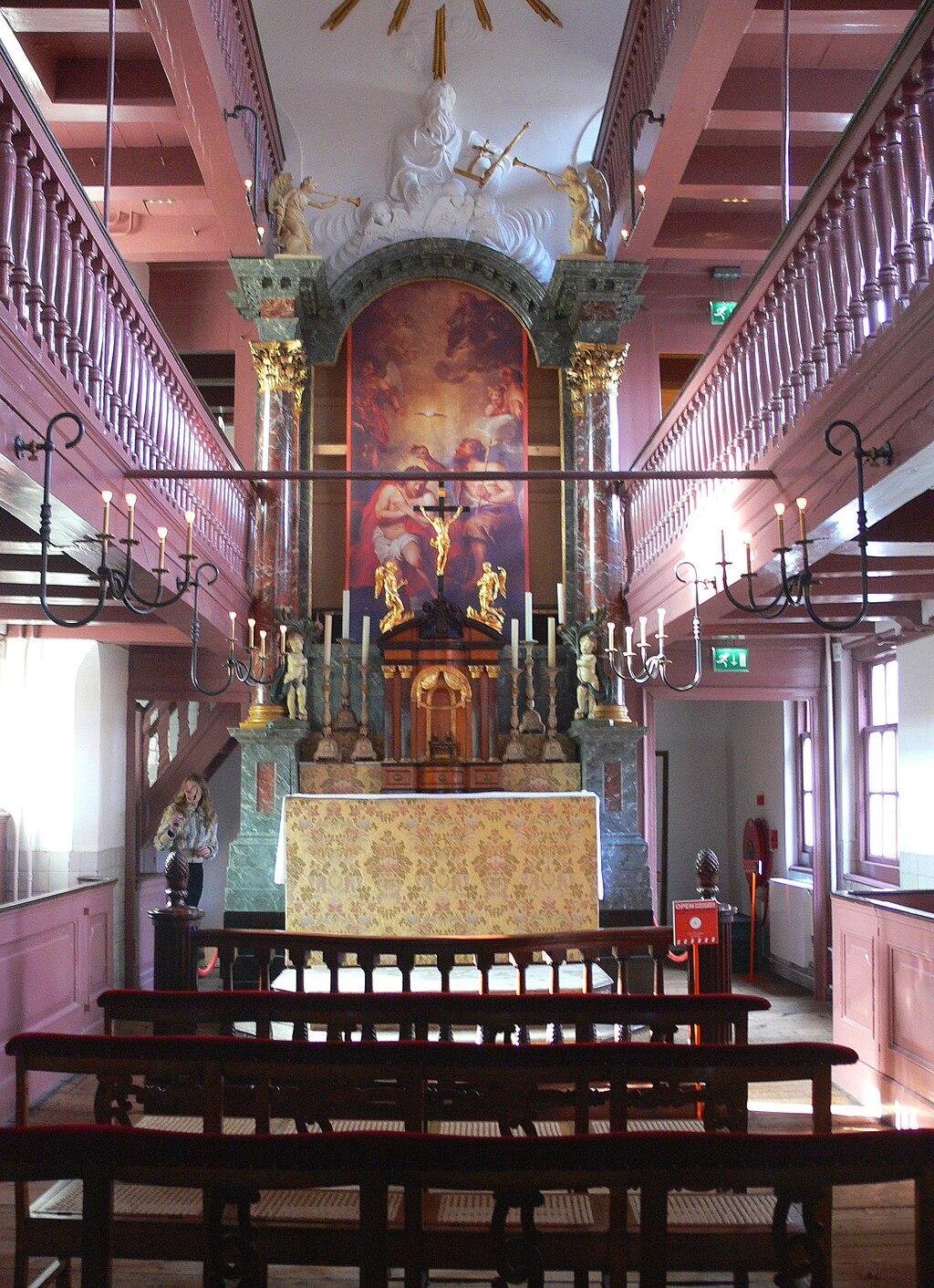
The interior is startlingly bare compared to a Catholic cathedral, because the Reformation stripped it in 1578, and that emptiness is the entire point. What survives is structure, glass, wood and the dead.
The floor is the collection. Around 2,500 grave slabs pave the entire church, under which roughly 10,000 Amsterdammers were buried. You walk on them. Every slab is numbered, and the effect of a whole building floored in worn, inscribed stone is one of those things that photographs poorly and lands hard in person.
Saskia van Uylenburgh, Rembrandt's wife, was buried here in 1642, and her grave is marked in the floor. Rembrandt's children were baptised in this church. Also buried here are Frans Banninck Cocq, the captain at the centre of The Night Watch, and Jan Pieterszoon Sweelinck, the composer who was organist of the Oude Kerk for four decades.
The wooden vault overhead is a medieval barrel vault of unpainted timber, ranking among the largest in Europe, built when a stone vault would have sunk the building into the marsh. Look up early and often. It is the single most impressive thing in the church and the easiest to walk beneath without noticing.
The Vater-Müller organ, begun by Christian Vater in 1724 and completed by Müller by 1742, dominates the west end in gilded casework. A second transept organ dates from 1965.
The stained glass includes the sixteenth-century Marian windows in the Lady Chapel, some of the oldest surviving glass in the city, and windows carrying the coats of arms of Amsterdam's mayors.
The bridal chamber carries an inscription warning that those who marry in haste will repent at leisure, which has been quietly judging Amsterdam couples for centuries.
The side chapels hold period rooms with objects from the church's own archive, and they are covered by your ticket. They are also the parts of the building that are not step-free.
What not to miss: the church once held nearly forty altars, each sponsored by a different guild, each with its own priest and its own congregation within the congregation. Once you know that, the empty side spaces stop reading as absence and start reading as erasure, and the whole building makes more sense.
Contemporary Art in a Medieval Church
This is the part that surprises people the most. The Oude Kerk is not a museum of church heritage that occasionally hosts art. It commissions two major solo exhibitions a year, made specifically for this building, and they are frequently large, strange and physically dominant. Artists are given the nave.
Currently on: Godsworth by Jesse Darling, until 27 September 2026. Darling, who won the Turner Prize in 2023, has covered large sections of the church floor with construction rubble collected around Amsterdam, out of which sculptures assembled from discarded furniture, scrap metal and broken appliances rise up on scaffolding. The work takes its cue from the nearly forty vanished altars, recreating them as provisional gathering points. A public programme of weekly walk-in tours, concerts and workshops runs alongside it, and Darling hosts an Evening Service on the exhibition's final weekend.
Manage your expectations in both directions. If you have come for a quiet Gothic interior and stained glass, an installation of rubble and scaffolding across the nave may not be what you wanted, and this is the most common source of disappointment here. If you have come for contemporary art, the setting does something no white cube can, and the collision of a Turner Prize installation with a fourteenth-century grave floor is the reason to come at all.
Check what is on before you book. The exhibition changes twice a year and the character of a visit changes completely with it. During changeover weeks the church shuts entirely.
Climbing the Oudekerkstoren Tower
The tower climb is the best thing the Oude Kerk offers, and a lot of visitors never realise it's something they can experience.
Season: end of April to end of October only. In 2026, from 25 April to 31 October, Wednesday to Sunday.
Times: Wednesday to Saturday at 13:00, 14:00, 15:00 and 16:00. Sunday at 13:30, 14:30, 15:30 and 16:30.
Format: a guided tour of roughly 30 minutes, in small groups, usually led by local students, often in English. The meeting point is inside the church, beneath the monumental organ. The old external door at the base of the tower is no longer used for tours, which trips up anyone following older guidance.
The climb: 155 steps across seven levels to the viewing platform, on narrow spiral staircases and steep step ladders. There is no lift. Passages are single-file, and you need both hands free for railings and ropes, so bags and backpacks go into lockers before you start.
What you see on the way up: the timber and iron bracing that holds the structure together, then the bell chamber on the fifth level with the 47-bell carillon, whose fourteen heaviest bells were cast by François Hemony in 1658. The largest weighs 3,700kg, and they are still rung by hand with ropes. On the sixth level is the mechanical drum that drives the hourly chimes.
The view: a 360-degree panorama from a narrow platform just over halfway up the 67-metre tower, taking in Centraal Station, the Beurs van Berlage, the Zuiderkerk tower and the Sint Nicolaaskerk, with the canal grid laid out below. You move around the platform in single file.
Who should not do this: anyone with mobility difficulties, significant knee problems, or a real fear of heights or confined spaces. Minimum age is 6.
I would say this is the best value add-on in central Amsterdam. The tower is smaller and less famous than the Westerkerk, which means the groups are tiny and the guide will often personalize the tour to the questions you ask.
The Oude Kerk and the Red Light District
The church stands in the middle of De Wallen, and the two have coexisted for centuries. Sex workers' windows face the churchyard directly. This is not a scandal or a curiosity to the city, it is simply what this neighbourhood is, and the Oude Kerk has never pretended otherwise.
Belle, a bronze statue of a woman standing confidently in a doorway, sits on Oudekerksplein just outside the church. Installed in 2007, its plaque reads "Respect sex workers all over the world". It is free, permanent, and easy to walk past.
During the day the streets around the church are quiet, residential and largely unremarkable, with far more locals than tourists. The area transforms after dark. If you are uneasy about the district, a morning visit to the Oude Kerk is completely unremarkable in atmosphere.
Around 9,000 people live in this postcode. Keep the noise down in the lanes, especially in the evening.
Guided Tours and the Audio Guide
The audio tour is free and included with every ticket, in Dutch, English, German, French, Spanish and Italian. It covers the history, architecture and highlights, and it is built around sound and atmosphere as much as information, which suits the building. You also receive a printed booklet at the entrance.
Bring your own headphones. There is nothing to borrow at the desk, and free Wi-Fi is available throughout the church if you need to stream it.
Walk-in guided tours run weekly as part of the public programme attached to the current exhibition, included with admission and listed on the events calendar rather than bookable in advance.
Tower tours are guided by default, as covered above.
For children: a free activity sheet in Dutch and English is available at the entrance for ages 4 to 12, built around finding a missing dog called Flip and learning about the people buried under the floor and the coats of arms in the windows.
I would take the audio guide here even if you normally skip them. The Oude Kerk deliberately keeps wall text to a minimum so the building can be experienced rather than read, which is a defensible choice that leaves you with very little context if you arrive without the guide running.
Is the Oude Kerk Worth Visiting?
At €14.50 this is not the biggest bargain in Amsterdam, and if you have spent time in Europe you will have seen larger, richer and more ornate churches. The Reformation stripped this one bare. What it has instead is age, atmosphere, that extraordinary floor of gravestones, and a wooden vault that most visitors do not look up at until someone tells them to. An hour here is well spent; two hours would be pushing it unless the art exhibition grabs you.
The most common frustration is arriving expecting a conventional historic church and finding a large contemporary art installation occupying the nave. That is not a mistake by the Oude Kerk, it is the institution's entire purpose, but it is not obvious from outside and people do feel misled by it. Look up the current exhibition before you buy.
For history lovers: you'll wan to visit. Amsterdam's oldest building, Rembrandt's wife under the floor, and the whole medieval city implied in one room.
For contemporary art followers: among the most interesting exhibition spaces in the Netherlands. The commissions are ambitious and the setting is unrepeatable.
For casual tourists on a short trip: this is a second-tier priority. If you have three days and have not yet done the Rijksmuseum, the Van Gogh Museum or Anne Frank House, do those first. If you have a Museumkaart or an I amsterdam City Card, it costs you nothing and takes an hour, and then it is an easy yes.
For families: better than it sounds. The activity sheet works, children like the idea of walking on graves, and the tower is a hit with anyone over about eight.
For anyone who dislikes contemporary art in religious buildings: probably skip it, and I would rather say so than have you discover it at the door. Consider the Nieuwe Kerk on Dam Square or the Westerkerk instead.
In summary: the tower plus the church together at €22 is the version of this attraction I would recommend, and it is considerably better value than the church alone. Skipping the tower and paying €14.50 for a stripped Gothic interior is where a lot of visitors become disappointed.
Where Should I Eat Near the Oude Kerk?
The immediate area is a mix of very good and very touristy, and the two sit metres apart. The rule is simple: walk east to Zeedijk, and avoid Damrak entirely.
Attached to the church:
De Koffieschenkerij occupies the church's former sacristy on Oudekerksplein, with a walled courtyard garden that is one of the quietest corners in the whole district. Coffee, cake and lemonade rather than a full meal, open daily 09:00 to 18:00, and you get 10% off drinks with a valid Oude Kerk ticket. You do not need a ticket to sit here. I would come here even without visiting the church.
A short walk away:
Thai Bird Snackbar, Zeedijk 77, is tiny, packed, cheap and excellent. Order the tom kha kai, eat elbow to elbow, spend under €20. This is the one I would send anyone to.
Kam Yin, Warmoesstraat 6, is a long-running Surinamese-Chinese place, generous and inexpensive, with roti and bami that locals have been eating for decades. The service is brisk rather than warm.
Kaap & Tein, Zeedijk 43A, does Dutch snacks and modern Dutch cooking with a hidden interior terrace tucked between the houses, which is a lovely surprise in a district this dense.
Lolo Amsterdam, Oudekerksplein 48, is the upscale pick and sits directly on the church square. Proper Italian cooking, a serious wine and cocktail list, and prices to match. Open evenings during the week and from lunchtime at weekends, so it does not work as a post-visit lunch on a Tuesday.
Sandwichshop Amsterdam, Warmoesstraat 48-50, is the quick, cheap breakfast and lunch option if you are heading in at opening time.
A word of warning: Damrak, two minutes west, is the most concentrated stretch of tourist-trap dining in the Netherlands, with laminated multi-language menus and €12 beers. The restaurants directly ringing Oudekerksplein are a mixed bag for the same reason. Zeedijk, five minutes east, is where the neighbourhood actually eats.
What Else is There to Do Near the Oude Kerk?
Our Lord in the Attic, Oudezijds Voorburgwal 38-40, is three minutes' walk and one of the most common pairings. A seventeenth-century canal house with a complete hidden Catholic church built into its attic, from the era when Catholic worship was banned and the Oude Kerk had gone Protestant. Adult admission is €18, free with the Museumkaart and the I amsterdam City Card, and it takes about 90 minutes. The two buildings tell two halves of the same story.
The He Hua Temple, Zeedijk 106-118, is five minutes east and is the largest Buddhist temple built in traditional Chinese style in Europe. Free to enter, quiet, and almost nobody visiting the district goes in.
Nieuwmarkt and De Waag are six minutes east. The Waag is a fifteenth-century city gate turned weigh house turned café, and the square around it is one of the better places in the centre to sit outside.
Beurs van Berlage, Damrak 243, is four minutes west. Berlage's 1903 commodity exchange is a landmark of modern Dutch architecture and hosts exhibitions and events in a hall worth seeing for its own sake.
Dam Square, the Royal Palace and the Nieuwe Kerk are five minutes west. The Nieuwe Kerk makes an instructive contrast, being the church Amsterdam built when the Oude Kerk got too small.
Red Light Secrets, Oudezijds Achterburgwal 60, is a small museum inside a former brothel covering the history and working reality of sex work in the district. It divides opinion, but it is more thoughtful than the location suggests.
Rules, Bags, and Security
Bags: there is no cloakroom anywhere in the Oude Kerk, and no luggage storage. Whatever you bring into the church, you carry for the whole visit. For the tower climb, bags must be left in lockers before you start, since you need both hands.
Food and drink cannot be brought into the church. The Koffieschenkerij in the former sacristy is the place for that.
Photography is permitted for personal use, without flash, and with consideration for other visitors. In the streets outside, photographing sex workers or their windows is prohibited and actively enforced.
Children are welcome throughout, with a free activity sheet for ages 4 to 12. The tower has a minimum age of 6.
Assistance dogs are welcome and should be kept on a lead. Other dogs are not permitted.
Toilets are available inside, including an accessible one.
Wi-Fi is free throughout the building.
Payment is cashless everywhere, including the museum shop.
The museum shop sits next to the entrance and keeps the same hours as the church. You do not need a ticket to visit it, which makes it a reasonable free stop if you are passing.
On Sunday mornings and Sunday evenings the building is in use by the resident congregation, which is why visitor hours do not begin until 13:00.
Accessibility at the Oude Kerk
The main church hall is largely wheelchair accessible, and it is the part of the building that holds the exhibitions, the organ, the vault and the grave floor. Most of what there is to see is reachable.
The historic side rooms are not accessible. These are the chapels holding the archival period displays, and they involve steps and narrow doorways.
The tower is not accessible under any circumstances. There is no lift, and the route is 155 steps of spiral staircase and step ladder.
An accessible toilet is available inside the church.
Companions go free. Visitors with disabilities are welcome to bring a companion or assistant at no charge.
For blind and partially sighted visitors: the free audio tour is built around sound, atmosphere and tactile description rather than visual commentary alone, which makes it usable as the primary way of experiencing the building. Doing it with a companion is recommended.
For deaf and hard of hearing visitors: printed information booklets covering the church and the current exhibition are available.
Assistance and guide dogs are welcome throughout, on a lead.
One thing to plan around: the floor is composed almost entirely of centuries-old grave slabs, which are uneven, worn and set at slightly varying heights. Wheels roll across it, but not smoothly, and anyone unsteady on their feet should expect an irregular surface throughout.
Final Tips for Visiting the Oude Kerk
Check the current exhibition before you book. The nave may be filled with a large contemporary installation, the church closes entirely during changeover weeks, and both facts catch people out. In 2026 the closures fall from 28 September to 2 October and 9 to 12 November.
Buy the combined tower ticket at €22 if you are visiting between late April and the end of October. The tower is the best part of the whole site and it cannot be bought separately. Only four slots run per day, Wednesday to Sunday.
Do not stress about your timeslot. It is used for counting visitors, not controlling entry, so arrive whenever suits you on the day printed on the ticket.
Go before noon, and in winter go before 16:00. The building is daylight-lit, and after mid-afternoon between November and April you simply cannot see it properly.
Bring headphones for the free audio tour. There is nothing to borrow, wall text is deliberately sparse, and without the guide you will walk past most of what matters.
Look up at the wooden vault, and look down at the floor. Almost everyone photographs the organ and misses the two things that actually make this building extraordinary.
Pair it with Our Lord in the Attic, three minutes away, then eat on Zeedijk rather than Damrak. Church, hidden attic church, and a bowl of tom kha kai is close to a perfect Amsterdam morning.
Back to Amsterdam Attractions
Explore other Amsterdam attractions

" width="24px"><path d="M 0 0 L 24 0 L 24 21.231 L 0 21.231 Z" fill="transparent" height="21.230768474975793px" id="nL2EwDcS9" width="24px"/><path d="M 0 0.541 C 0 0.242 0.245 0 0.547 0 L 2.735 0 C 3.037 0 3.282 0.242 3.282 0.541 L 3.282 4.598 C 3.282 4.897 3.037 5.139 2.735 5.139 L 0.547 5.139 C 0.245 5.139 0 4.897 0 4.598 Z" fill="rgb(196, 217, 201)" height="5.138657337892187px" id="hZ_rlBe_S" transform="translate(0 16.092)" width="3.2820512820512358px"/><path d="M 0 0.541 C 0 0.242 0.245 0 0.547 0 L 2.735 0 C 3.037 0 3.282 0.242 3.282 0.541 L 3.282 7.843 C 3.282 8.142 3.037 8.384 2.735 8.384 L 0.547 8.384 C 0.245 8.384 0 8.142 0 7.843 Z" fill="rgb(230, 211, 160)" height="8.38412513024521px" id="HgVBxIz3e" transform="translate(5.128 12.847)" width="3.282051282051235px"/><path d="M 0 0.541 C 0 0.242 0.245 0 0.547 0 L 2.735 0 C 3.037 0 3.282 0.242 3.282 0.541 L 3.282 12.982 C 3.282 13.281 3.037 13.523 2.735 13.523 L 0.547 13.523 C 0.245 13.523 0 13.281 0 12.982 Z" fill="rgb(232, 207, 164)" height="13.522782468137464px" id="utgrDnoM9" transform="translate(10.325 7.708)" width="3.282051282051377px"/><path d="M 0 0.541 C 0 0.242 0.245 0 0.547 0 L 2.735 0 C 3.037 0 3.282 0.242 3.282 0.541 L 3.282 16.498 C 3.282 16.797 3.037 17.039 2.735 17.039 L 0.547 17.039 C 0.245 17.039 0 16.797 0 16.498 Z" fill="rgb(233, 196, 166)" height="17.038705909853153px" id="OLOhW6STz" transform="translate(15.521 4.192)" width="3.2820512820512384px"/><path d="M 0 0.541 C 0 0.242 0.245 0 0.547 0 L 2.735 0 C 3.037 0 3.282 0.242 3.282 0.541 L 3.282 20.69 C 3.282 20.989 3.037 21.231 2.735 21.231 L 0.547 21.231 C 0.245 21.231 0 20.989 0 20.69 Z" fill="rgb(217, 170, 153)" height="21.230768474975793px" id="H5Z8wcwkd" transform="translate(20.718 0)" width="3.2820512820512278px"/></g></svg>)