Back to Amsterdam Attractions
Our Lord in the Attic Amsterdam: Everything You Need to Know Before You Visit
Updated August 2026
Our Lord in the Attic is a seventeenth-century canal house on the edge of the Red Light District with a complete Catholic church built into its top three floors, seating 150 people, constructed at a time when public Catholic worship was banned in Amsterdam. It is the second-oldest museum in the city after the Rijksmuseum, it carries the European Heritage Label, and the attic church is still used for Mass on the first Sunday of most months, which is the reason the museum's opening time changes on those days. Knowing about the stairs, and knowing that free-card holders still have to reserve a ticket, will save you the two most common frustrations at this particular door.
At a Glance
How Early to Book:
Book a timed-entry ticket a day or two ahead to guarantee entry. Same-day tickets are also almost always available at the on-site ticket office.
Best Times to Visit:
Early mornings and opening, and late afternoons after 4pm, will have the least crowds.
Ticket price:
€18.00 for adults.
Where to Book:
Landmark Address:
Do You Need to Book Our Lord in the Attic Tickets in Advance?
Advance booking is no longer obligatory, but it is worth doing anyways. Tickets are sold at the desk as well as online, and on a quiet weekday you will walk straight in. The building is small and takes limited numbers at once, though, so on summer weekends and in bad weather the timed slots do fill.
Where to book: The official ticket site is tickets.opsolder.nl.
The rule that catches people out: if you have a Museumkaart, an I amsterdam City Card or any other free-entry card, you still need to book a ticket. Select the "Reservation for free ticket" option in the ticket shop. Turning up with a valid card and no reservation is a common error visitors make.
Admission prices:
Adults: €18
Children 5 to 17: €7.50
Children up to 4: free
CJP, Dutch Student Card or ISIC International Student Card: €11.50
Amsterdam Uitpas: €10
Free entry with the Museumkaart, the I amsterdam City Card, Museumvriend, Stadspas, Vereniging Rembrandt or an ICOM card. Both main Amsterdam passes cover this museum in full.
An important limitation on student discounts: only CJP, the Dutch Student Card and ISIC are accepted. Other foreign student cards are not, regardless of how official they look. If you are an international student without an ISIC, budget for the full €18.
Museumkaart on site: you can buy one at the reception desk and use it immediately. The temporary card issued over the counter is valid for 31 days and five museum visits, and the permanent card arrives by post after you register online. At €75 for adults it pays for itself in about four Amsterdam museums, so if you are early in a longer trip this is a sensible place to buy one.
Refunds: payments are not refundable. You can swap your ticket for another date and time through the link in your confirmation email.
Payment: the museum is cashless and accepts all major credit and debit cards except American Express.
How far ahead to book: a day or two is plenty most of the year. Book a few days out for a weekend slot in July and August.
Our Lord in the Attic Opening Hours and Entry Information
Monday to Sunday: 10:00 to 18:00. Seven days a week, all year.
The exception: on the first Sunday of every month from September to June, the museum opens late, at 11:00, because Mass is being celebrated in the attic church. If you have planned an early first-Sunday visit in those months, you will be standing outside for an hour.
Closed days: 25 December for Christmas Day and 27 April for King's Day. The museum is open on all other public holidays.
Last entry: there is no separately published last-entry time, but a full visit runs to about 90 minutes and the route through the house is one-way. Arriving after 17:00 will leave you rushing the best part, which comes at the end.
Free areas without a ticket: the museum café and the museum shop are both in the modern entrance building and can be visited without paying admission. The café is on the first floor and looks out over the Red Light District, which is a peculiar and rather good view to have with a coffee.
Address: Oudezijds Voorburgwal 38-40, 1012 GD Amsterdam.
One naming note: the museum was formerly known as the Amstelkring Museum, and its Dutch name is Museum Ons' Lieve Heer op Solder. It is also frequently misremembered as "Our Lady in the Attic". All of these refer to the same place.

What is the Best Way to Get to Our Lord in the Attic?
The museum sits on the Oudezijds Voorburgwal canal in the medieval centre, about five minutes from several transport options and eight from Centraal Station.
On foot from Centraal Station: eight minutes. Walk down Damrak, turn left along Oudebrugsteeg or Warmoesstraat, and come out on Oudezijds Voorburgwal. Turn right and follow the canal south.
On foot from Dam Square: about five minutes east.
By metro: lines 51, 53 and 54 to Nieuwmarkt, then five minutes west through the lanes.
By tram: lines 4, 14 and 24 stop at Dam. Lines 2, 12, 13 and 17 stop at Nieuwezijds Kolk. Both leave a short walk.
By bike: practical, but bike parking in these lanes is scarce and heavily policed. The free multi-storey bike garage under Centraal Station is the better option.
By car: not viable. The surrounding streets are effectively pedestrian and parking rules here are punitive. The nearest sensible garage is the Q-Park under De Bijenkorf, entrance at Beursplein 15, roughly six minutes away on foot.
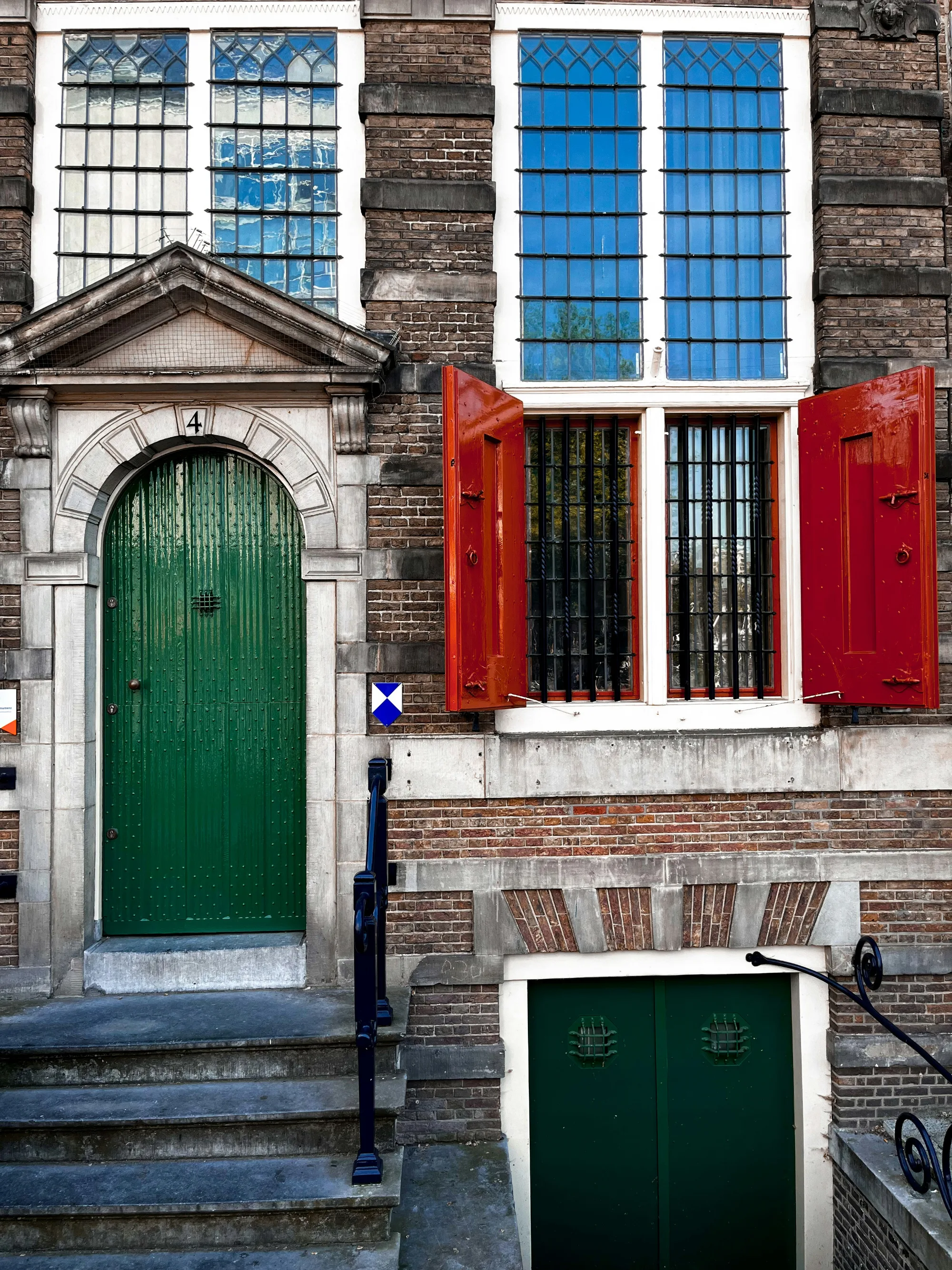
One practical tip: the entrance is not the historic canal house you have come to see. You enter through a modern building next door at number 38, which holds the ticket desk, lockers, café and shop, and you cross into the seventeenth-century house from there. People regularly stand outside the old façade wondering where the door is. Look for the modern frontage with the museum signage.
How Much Time Should I Spend at Our Lord in the Attic?
Between 50 minutes and 90 minutes covers a full self-guided visit with the audio tour, and 90 minutes is the more realistic figure if you are the sort of person who reads everything.
The route is a one-way circuit through the house, so you set your own pace and there is no doubling back. Most people find they slow down as they go, because the attic church arrives near the end and is where you will want to sit for a while.
Add 15 minutes for the café and shop in the entrance building, which are worth the stop and do not need a ticket.
Combining: the Oude Kerk is three minutes' walk away and the two together make a natural two-and-a-half to three-hour block. That pairing is the best use of a morning in this quarter, because the two buildings tell opposite halves of the same story about Amsterdam and religion.
Image Credit: Remi Mathis, CC BY-SA 3.0
Created by Joan Miró and his friend Joan Prats, the Fundació Joan Miró was designed to be an open, research-driven space rather than a traditional museum. It focuses on contemporary art, particularly the avant-garde.
What is the Best Time to Visit Our Lord in the Attic?
Best time of day: the 10:00 opening, or late afternoon from about 16:00. The middle of the day is when tour groups and cruise passengers filter through, and this is a small house where a group of twelve fills a room completely.
A specific recommendation for late afternoon: the house is lit largely as it would have been, and wandering the upper floors as dusk gathers is a noticeably more atmospheric experience than seeing it at midday. If you can only get an afternoon slot, treat that as a bonus rather than a compromise.
Best days: midweek. Tuesday to Thursday are consistently quieter than weekends.
Best season: autumn and winter suit this museum better than most. It is entirely indoors, it is warm, and the low light through the canal-front windows in November does something for the interiors that summer sun does not. It is also one of the best rainy-day options in central Amsterdam.
Avoid: the first Sunday of the month between September and June if you want an early start, since the museum does not open until 11:00 on those days.
Why Is There a Hidden Church in Amsterdam?
This is the question the whole museum exists to answer, and the answer is more interesting than "Catholics were persecuted", because they largely were not.
In 1578, in the upheaval known as the Alteration, Protestants took control of Amsterdam and every public church in the city, including the Oude Kerk, became Protestant. Public Catholic worship was banned. But the Dutch Republic was built on William of Orange's principle of freedom of conscience: behind your own front door, you could believe whatever you liked. So Catholics went on celebrating Mass in private houses, and the Protestant city authorities, who knew perfectly well these churches existed, tolerated them so long as they were not visible from the street.
The result was the schuilkerk, the clandestine or hidden church. At its height Amsterdam had dozens of them. They were not really secret. They were an open arrangement that everyone understood and nobody said out loud, which is a very Dutch solution to a religious conflict that was producing wars everywhere else in Europe.
Jan Hartman, a Catholic merchant from Coesfeld in Germany who had worked his way up from baker's apprentice, bought this house on Oudezijds Voorburgwal on 10 May 1661 along with the two houses in the alley behind, for 16,000 guilders. He then knocked the three attics together into one enormous space and built a church in it, seating 150. Worshippers came in discreetly through the alley, Heintje Hoekssteeg, and climbed the stairs, dipping their fingers in a holy water basin set into the wall on the way.
The church was run by Petrus Parmentier, an Augustinian priest from Ghent sent to Amsterdam in 1636 to win converts, supported by a group of unmarried women known as spiritual daughters who devoted their lives to the church. Under Parmentier the congregation flourished: in 1667 alone, seventy children were baptised here and fourteen weddings were held in the attic.
Hartman himself barely got to enjoy it. He died in April 1668 and was buried in the Oude Kerk, three minutes away, where his widow had the bells rung for three hours. He left substantial debts, and within a few years the family had to sell the house.
Almost every other hidden church in Amsterdam was demolished, converted or built over once Catholic worship became legal again in the nineteenth century. This one survived because a group of collectors bought it in 1888 and turned it into a museum, which is why it is now the only complete schuilkerk left standing anywhere.
What is Inside Our Lord in the Attic?
The museum is two things at once, and the house is at least half the reason to come. You move up through a preserved seventeenth-century merchant's home and then, without much warning, into a full church.
The Sael, the formal reception room, is the showpiece of the house: a chimney breast with twisted columns, a burlwood cupboard, and white marble tiles alternating with black Belgian flagstones. Look for the Hartman coat of arms over the mantelpiece, which combines a resting deer for his surname and a compass for his wife Elisabeth, whose father made them. Neither of them had any aristocratic claim to a crest at all, which tells you a good deal about what the room was for.
The day room on the first floor overlooks the canal, and served as living room by day and bedroom by night, with a bed built into the wall.
The kitchen and the bedsteads are the parts people remember, small tiled rooms with box beds set into the panelling, giving a sharper sense of how cramped even a wealthy Amsterdam household was than any amount of reading does.
The priest's quarters are preserved as well, a reminder that a resident chaplain lived on the premises.
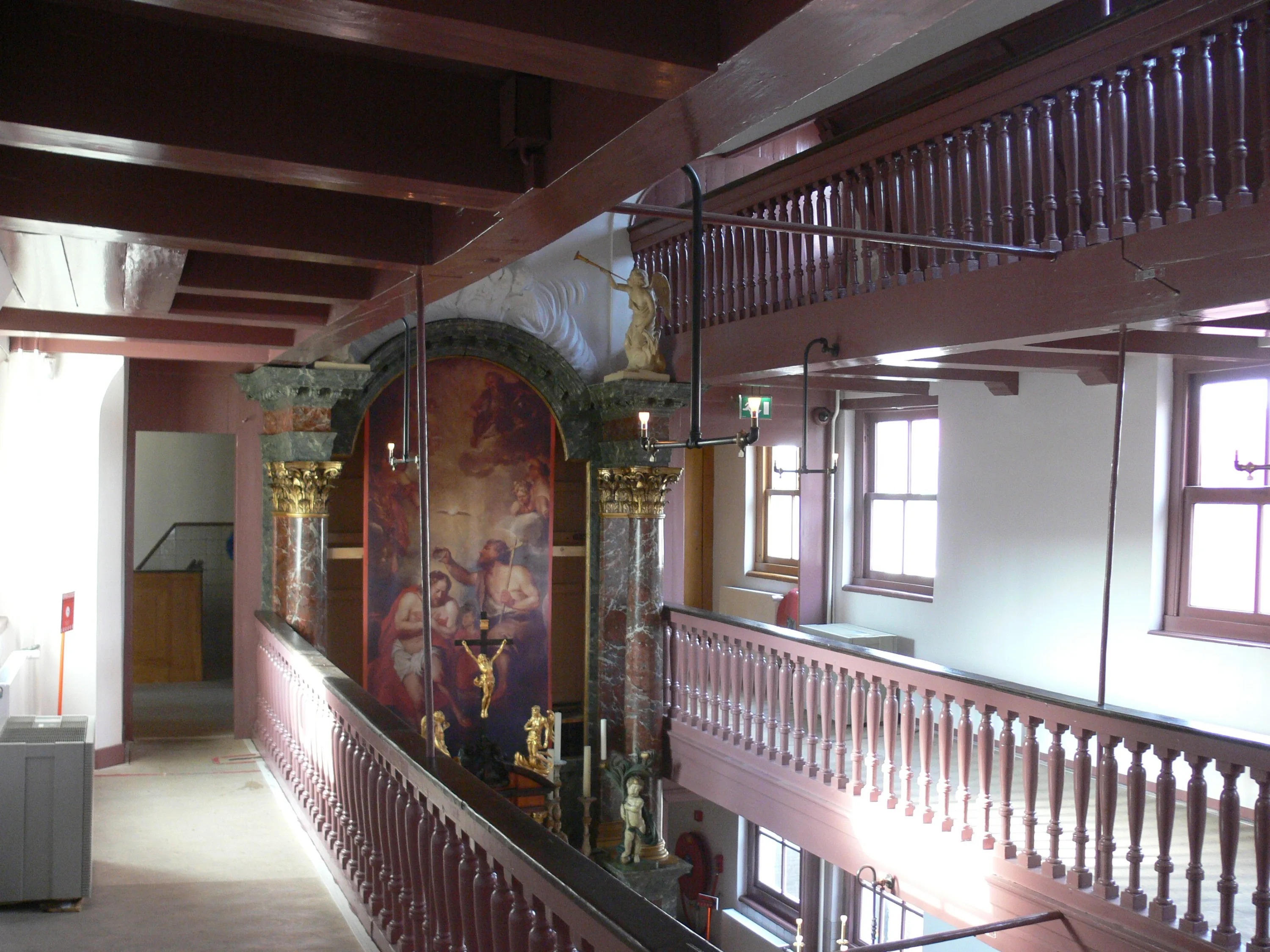
The attic church occupies the combined top floors of all three houses. It has two hanging galleries to increase capacity, a Baroque altar flanked by marbled columns with putti holding lilies, and a mahogany pulpit that folds out of the left column's pedestal to save space. Above the altar is The Baptism of Christ in the Jordan, painted by the Amsterdam artist Jacob de Wit in 1716, which was designed to be swapped for other scenes according to the church calendar.
What not to miss: almost everything that looks like marble and stone in the church is painted wood. The columns, the altar surround, the finishes, all of it is timber worked to imitate materials the congregation could not afford or could not get up the stairs. Get close and look. Once you have seen it, the whole room reads differently.
Also look for the IHS monogram repeated on objects throughout, a Christogram standing for the name of Jesus and used as the emblem of the Jesuits.

Mass in the Attic: The Church Is Still in Use
This is not a decommissioned space. Mass is celebrated in the attic church on almost every first Sunday of the month, a tradition revived in 1951 and organised by a congregation rather than by the museum. Services are open to attend, and the choir in that low wooden room is the sort of thing people remember for years.
Two practical points if you plan to go. Visitors are asked to wear the returnable overshoes provided before entering the church, to protect the historic floor. And lockers are available in the museum area for coats and bags, which you will want, because the church is reached by the same steep stairs as everything else.
The attic church is also licensed for weddings, and has been used for them, on and off, for several hundred years.
The direct consequence for ordinary visitors is the opening time. From September to June, the first Sunday of the month means an 11:00 opening rather than 10:00.
Guided Tours and the Audio Guide
The audio guide is free, included with admission, and is very good. It runs in eight languages: Dutch, English, German, French, Spanish, Italian, Russian and Chinese. It covers the house as well as the church, explaining the box beds, the kitchen, the painted woodwork and the arrangement that allowed the church to exist at all.
I would go further here than I normally would about audio guides: take it, and do not skip ahead. The museum deliberately keeps wall text light so the rooms read as rooms rather than displays, and without the guide running you will walk through a series of pretty interiors without understanding why any of it is remarkable. It is the difference between a nice old house and one of the more thought-provoking hours in Amsterdam.
Guided tours are for groups only. A museum guide leads either a one-hour tour at €90 or a 90-minute tour at €120, excluding admission tickets, with a maximum group size of 12. Larger groups are split. These must be booked in advance and there is no scheduled tour an individual visitor can join.
For children: there is an exploration trail through the seventeenth-century house for ages 5 to 10, built around hunting for ladybirds, with a prize at the end. Older children get their own audio guide about religious holidays. The ladybird hunt works considerably better than it sounds and keeps small children moving through rooms that would otherwise bore them.
Is Our Lord in the Attic Worth Visiting?
Yes, and this is one of the easier recommendations I make about Amsterdam. I'd describe it as a hidden gem as someone who didn't expect much, and the reveal of a full church at the top of an ordinary canal house lands even when you already know it is coming.
At €18 it is not cheap for 90 minutes, and that is the fairest criticism. What you get for it is a building that exists nowhere else, a preserved Golden Age interior thrown in, and an audio guide that does real work. Compared with the €14.50 the Oude Kerk charges for a stripped Gothic interior, this feels like the better value of the two, and if you can only do one, do this.
The caveat that matters more than the price is the stairs. This is a seventeenth-century house and the staircases are narrow, steep, and vary in tread depth, with the final flight up to the attic being the worst of them. Coming down is harder than going up. If you have knee trouble, balance issues or a fear of narrow enclosed stairs, take this seriously. It is the one thing that turns a delighted visitor into a miserable one.
For history lovers: an unqualified yes. The schuilkerk arrangement tells you more about how the Dutch Republic actually functioned than any number of Golden Age paintings.
For families: better than expected. The ladybird trail works, children like the secrecy of the premise, and the church at the top is a proper surprise if you have not spoiled it for them. Note that prams cannot go inside.
For anyone doing Amsterdam in a hurry: this is a strong second-tier choice, after the Rijksmuseum, Van Gogh Museum and Anne Frank House. It takes 90 minutes and sits between Centraal Station and everything else, so it slots into a gap easily.
For visitors with mobility difficulties: be honest with yourself about the staircases before booking, since the historic house has no lift and no alternative route.
For those with a Museumkaart or I amsterdam City Card: it costs you nothing and takes 90 minutes. Go.
Where Should I Eat Near Our Lord in the Attic?
The immediate streets swing between very good and outright tourist trap within a few metres. The rule is to walk east towards Zeedijk and to avoid Damrak entirely.
In the museum:
The museum café on the first floor of the entrance building does good coffee, tea, soft drinks and fresh pastries, with a window looking over the Red Light District. No ticket is needed, so it works as an ordinary café stop. Note that food and drink cannot be taken into the historic house at all, not even a water bottle, so eat before or after rather than during.
A short walk away:
Thai Bird Snackbar, Zeedijk 77, four minutes east, is small, busy and excellent. Tom kha kai, quick service, under €20 a head. This is where I would send most people.
Kam Yin, Warmoesstraat 6, is a long-standing Surinamese-Chinese place with generous roti and bami at prices that have not caught up with the neighbourhood. Brisk rather than charming.
Kaap & Tein, Zeedijk 43A, does modern Dutch cooking and bitterballen around a hidden interior terrace tucked between the houses, which is a lovely surprise in streets this tight.
Lolo Amsterdam, Oudekerksplein 48, is the upscale option, sitting on the Oude Kerk square five minutes away. Proper Italian food and a serious wine list. It opens evenings on weekdays and from lunchtime at weekends, so check before planning a Tuesday lunch there.
Sandwichshop Amsterdam, Warmoesstraat 48-50, is the fast, cheap breakfast option if you are heading in at opening.
A warning: Damrak, three minutes west, is the densest concentration of overpriced tourist dining in the Netherlands. Laminated photo menus and €12 beers. Zeedijk, four minutes east, is where the neighbourhood actually eats, and the difference in both price and quality is substantial.
What Else is There to Do Near Our Lord in the Attic?
The Oude Kerk, Oudekerksplein 23, is three minutes' walk and the essential pairing. Amsterdam's oldest building, the Protestant church that this hidden one existed in the shadow of, with a floor made almost entirely of gravestones and Jan Hartman himself buried somewhere beneath it.
The He Hua Temple, Zeedijk 106-118, six minutes east, is the largest Buddhist temple built in traditional Chinese style in Europe. Free to enter and almost always empty of tourists, which continues the theme of religious communities finding room for themselves in this quarter.
Nieuwmarkt and De Waag are seven minutes east. The Waag is a fifteenth-century city gate that became a weigh house and is now a café, and the square around it is a good place to sit outside.
Beurs van Berlage, Damrak 243, is four minutes west. Berlage's 1903 commodity exchange, a landmark of modern Dutch architecture, hosting exhibitions in a hall worth seeing on its own terms.
Dam Square, the Royal Palace and the Nieuwe Kerk are five minutes west. Petrus Parmentier, the priest who ran the attic church, is buried in the Nieuwe Kerk, which makes for a neat closing of the loop.
Amsterdam Museum's canal-house sites and the Rembrandt House are both within fifteen minutes on foot if you want to continue the preserved-interiors theme.
Rules, Bags, and Security
Bags and backpacks cannot be taken into the museum. The size limit for anything you carry with you is A4 format. There is an unguarded cloakroom and free lockers in the entrance building for coats and bags.
Luggage: small bags fit the lockers, but there is no space for suitcases or weekend bags. If you are visiting between hotels or before a train, use the large lockers at Centraal Station first.
Food and drink are not permitted anywhere in the historic house, and this includes water bottles. The rule exists because of the delicate historic interiors and it is enforced. Use the café in the entrance building.
Phone calls are not permitted inside the museum.
Photography is allowed without flash, and video without additional lighting. Some items in temporary exhibitions may be excluded, which will be signed. Photographing other visitors without asking is not on.
Tripods and lighting equipment need prior written permission. Photographs are for personal use only, and publishing or reproducing images of the museum and its objects is not permitted without permission.
Assistance dogs are welcome, though the narrow steep stairs are difficult for some dogs. Other pets are not permitted.
Prams and strollers cannot be brought into the historic house.
Groups, including school groups, must book in advance because of the limited space.
Accessibility at Our Lord in the Attic
This museum has significant access limitations that cannot be designed around, and it is better to know before booking.
The historic house is not wheelchair accessible. There is no lift in the seventeenth-century building and no alternative route. Wheelchairs, walkers and prams cannot be brought into the monument at all.
The stairs are the central issue. The route runs up through several floors on narrow, steep staircases with varying tread depths, and the final flight to the attic church is the steepest. The descent is harder than the ascent. Anyone with knee problems, balance difficulties, vertigo or claustrophobia should weigh this carefully.
What is accessible: the modern entrance building holds the museum café, the museum shop and the temporary exhibition space, all reachable by lift, with an adapted toilet on the ground floor. These can be visited without an admission ticket.
A virtual tour is available for visitors with limited mobility, offering a way to experience the house through an accompanying person.
For blind and partially sighted visitors: a special audio tour is available, currently in Dutch.
A guided tour designed for visitors with disabilities is offered, also in Dutch.
Companions go free. Anyone accompanying a visitor with a disability does not need to buy a ticket.
Assistance dogs are permitted throughout, with the caveat about the stairs.
Final Tips for Visiting Our Lord in the Attic
Reserve a free ticket even if you have a Museumkaart or I amsterdam City Card. Select "Reservation for free ticket" in the online shop. Arriving with a valid card and no booking is the most common problem here.
Take the stairs seriously before you book. Narrow, steep, uneven treads, worse coming down, and no alternative route through the historic house. This is the difference between a delighted visit and a wretched one.
Check whether you are visiting on the first Sunday of the month. From September to June the museum opens at 11:00 rather than 10:00 on those days, because Mass is being celebrated upstairs.
Use the audio guide and do not rush it. Wall text is deliberately sparse, and the guide is what turns a handsome old house into the story of how an entire city quietly agreed to look the other way.
Get close to the altar columns and the church fittings. Almost everything that reads as marble is painted wood, and spotting it changes how the whole room feels.
Empty your pockets into a locker first. Bags larger than A4 cannot come in, and no food or drink is allowed, water bottles included.
Go late if you have the choice. Arriving around 16:00 gets you the upper floors as the light drops, which suits the house far better than midday.
Pair it with the Oude Kerk three minutes away, then eat on Zeedijk. The hidden Catholic church and the Protestant church it was hiding from, in one morning, is the best history walk in central Amsterdam.
Back to Amsterdam Attractions
Explore other Amsterdam attractions


" width="24px"><path d="M 0 0 L 24 0 L 24 21.231 L 0 21.231 Z" fill="transparent" height="21.230768474975793px" id="nL2EwDcS9" width="24px"/><path d="M 0 0.541 C 0 0.242 0.245 0 0.547 0 L 2.735 0 C 3.037 0 3.282 0.242 3.282 0.541 L 3.282 4.598 C 3.282 4.897 3.037 5.139 2.735 5.139 L 0.547 5.139 C 0.245 5.139 0 4.897 0 4.598 Z" fill="rgb(196, 217, 201)" height="5.138657337892187px" id="hZ_rlBe_S" transform="translate(0 16.092)" width="3.2820512820512358px"/><path d="M 0 0.541 C 0 0.242 0.245 0 0.547 0 L 2.735 0 C 3.037 0 3.282 0.242 3.282 0.541 L 3.282 7.843 C 3.282 8.142 3.037 8.384 2.735 8.384 L 0.547 8.384 C 0.245 8.384 0 8.142 0 7.843 Z" fill="rgb(230, 211, 160)" height="8.38412513024521px" id="HgVBxIz3e" transform="translate(5.128 12.847)" width="3.282051282051235px"/><path d="M 0 0.541 C 0 0.242 0.245 0 0.547 0 L 2.735 0 C 3.037 0 3.282 0.242 3.282 0.541 L 3.282 12.982 C 3.282 13.281 3.037 13.523 2.735 13.523 L 0.547 13.523 C 0.245 13.523 0 13.281 0 12.982 Z" fill="rgb(232, 207, 164)" height="13.522782468137464px" id="utgrDnoM9" transform="translate(10.325 7.708)" width="3.282051282051377px"/><path d="M 0 0.541 C 0 0.242 0.245 0 0.547 0 L 2.735 0 C 3.037 0 3.282 0.242 3.282 0.541 L 3.282 16.498 C 3.282 16.797 3.037 17.039 2.735 17.039 L 0.547 17.039 C 0.245 17.039 0 16.797 0 16.498 Z" fill="rgb(233, 196, 166)" height="17.038705909853153px" id="OLOhW6STz" transform="translate(15.521 4.192)" width="3.2820512820512384px"/><path d="M 0 0.541 C 0 0.242 0.245 0 0.547 0 L 2.735 0 C 3.037 0 3.282 0.242 3.282 0.541 L 3.282 20.69 C 3.282 20.989 3.037 21.231 2.735 21.231 L 0.547 21.231 C 0.245 21.231 0 20.989 0 20.69 Z" fill="rgb(217, 170, 153)" height="21.230768474975793px" id="H5Z8wcwkd" transform="translate(20.718 0)" width="3.2820512820512278px"/></g></svg>)