Back to Barcelona Attractions
Do you Need to Book Tickets in Advance for Casa Vicens?
Updated July 2026
In 1878, a 26-year-old architecture graduate named Antoni Gaudí received his first substantial commission: a summer house for Manuel Vicens i Montaner, a tile manufacturer and currency broker, on an inherited plot of land in the then-independent town of Gràcia. The building Gaudí produced between 1883 and 1885, known as Casa Vicens, was unlike anything that had been built before in Catalonia or anywhere else. Its façade was covered in a checkerboard of green and white glazed ceramic tiles interspersed with hand-painted marigold panels, a nod to the carnation flowers that grew on the site before construction began. Its palm-leaf cast-iron gates, its Moorish-arched windows screened with elaborate ironwork grilles, its corner towers turning at different angles to create an impression of movement in an otherwise rectilinear structure, and its interior rooms combining Mudéjar stucco, Japanese-influenced painted ceilings, cedarwood furniture, and a smoking room of such ornate ambition that it has no equivalent in any other building Gaudí ever produced: all of it announced a mind that was going to do something no one had done before. This was the building that launched Gaudí's career. Declared a UNESCO World Heritage Site in 2005, it only opened to the public as a museum in 2017 after three years of meticulous restoration. Tucked into the streets of Gràcia rather than the Passeig de Gràcia, it is significantly less visited than Casa Batlló or Casa Milà, and for visitors who want to understand how Gaudí's genius began, it is one of the most rewarding hours in Barcelona. This guide covers everything you need to know before you go.
At a Glance
How Early to Book:
Pre-booking a timed entry ticket 1-2 days ahead is recommended to guarantee entry for general admission visits. Special types of visits and guided tours may require earlier bookings.
Best Times to Visit:
Early morning weekdays have the smallest crowds, and late afternoon weekdays are great for photographs as the sun will make the tiles most luminous.
Ticket price:
€21 for adults.
Where to Book:
Landmark Address:
Do You Need to Book Casa Vicens Tickets in Advance?
Yes, you should book tickets in advance. Daily visitor numbers are capped at Casa Vicens, weekend slots in peak season fill up, and booking online in advance guarantees your chosen time slot and avoids any wait at the ticket desk. Unlike Casa Batlló, which has a 15-minute grace period for late arrivals, Casa Vicens operates a strict no-late-arrival policy: if you miss your time slot, you will not be admitted. This makes advance booking and precise arrival timing more critical here than at most Barcelona attractions.
Book through the official Casa Vicens website. This is the only officially authorised booking platform. Third-party resellers add commission without adding any benefit. The official site is also the only platform that guarantees the cancellation and date-change policies that apply.
The 3 Houses of Gaudí bundle covers Casa Vicens, Casa Milà (La Pedrera), and Casa Batlló with skip-the-line access at all three buildings at a saving of approximately 5 to 10% over separate admissions. The bundle is the practical option for visitors planning all three Gaudí residences on the Passeig de Gràcia and in Gràcia within a single Barcelona trip.
Date changes: You can change the date and time of your ticket until 11:59pm on the day before your scheduled visit. This is a more flexible policy than Casa Batlló, which does not permit changes without purchasing the premium tier. There are no refunds once the cancellation window has passed.
The strict no-late-arrival policy deserves its own emphasis. Once your time slot has passed, entry will be refused without exception. Arrive at least 10 minutes before your booked slot to allow for any delays.
Casa Vicens Opening Hours and Entry Information
Casa Vicens is open daily throughout the year, including weekends and most public holidays, with two seasonal schedules:
April to October: 9:30am to 8:00pm (last admission at 7:00pm)
November to March: 9:30am to 6:00pm (last admission at 4:00pm, per some sources; check the official website for the precise last-entry time for your date)
Annual closures: 25 December and 6 January.
Special day hours: 24 and 31 December, the building closes at 5:00pm. On 22 May (the Feast of Santa Rita), the garden may operate on a special schedule as the traditional Santa Rita Mass takes place here.
The January 2026 closure (7 to 14 January 2026) has now passed. No further extended closures of this kind are currently announced; check the official website if visiting around any public holiday period.
Note on the last admission time: The gap between last admission and closing is shorter in summer than it might appear. Visitors who enter at 7:00pm in summer have only one hour before the building begins closing. Arriving 90 minutes before the end of the day gives a more comfortable visit.
What is the Best Way to Get to Casa Vicens?
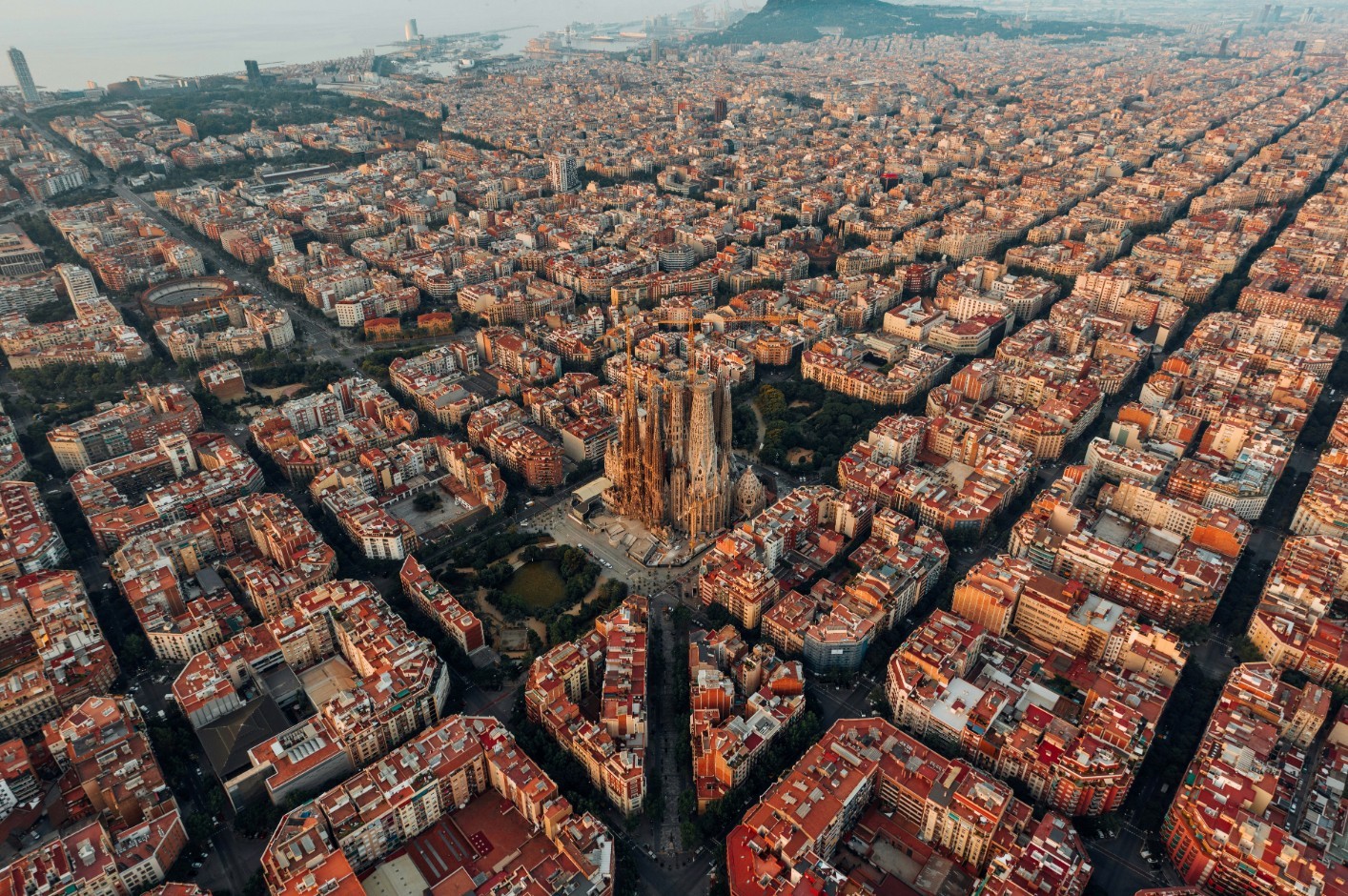
Casa Vicens is located at Carrer de les Carolines 20-26 in the Gràcia neighbourhood, which sits between the Eixample and the lower slopes of Tibidabo. Unlike the other major Gaudí buildings in Barcelona, it is not on the Passeig de Gràcia or a main tourist artery, which is part of what makes the visit feel different in character from Casa Batlló or La Pedrera.
By Metro (recommended): The closest station is Fontana (Line 3, green), which is around 250 metres from the building, a three-minute walk north along Carrer de l'Escorial and then left onto Carrer de les Carolines. This is by far the most direct and convenient approach from most of central Barcelona. Lesseps (Line 3, green) is 280 metres away and is equally convenient from the north. For visitors arriving from Paral·lel, Poble Sec, or the Eixample, Line 3 from Passeig de Gràcia station to Fontana takes around four to five minutes.
By Bus: Bus lines 22, 24, 27, 87, 114, H6, V17, D40, and N4 all have stops on or near Gran de Gràcia, around a three to five-minute walk from the building.
On foot from the Eixample: From the Passeig de Gràcia, the walk north into Gràcia and then to Casa Vicens takes around 20 to 25 minutes on foot. The route through the streets of Gràcia, passing the central squares of Plaça de la Vila de Gràcia and the neighbourhood's independent shops and café terraces, is a pleasurable walk in its own right and makes the approach to the building feel like an arrival in a place rather than a transit stop.
On foot from Park Güell: Casa Vicens is around a 25 to 30-minute walk from the lower entrance of Park Güell via the Carmel and Gràcia hills, or around 10 minutes by taxi. Combining the two in a single morning or afternoon is natural given their proximity and their shared place in Gaudí's career: both are early works in a part of Barcelona away from the tourist centre.
By taxi or rideshare: Taxis can drop off directly on Carrer de les Carolines. The drive from Plaça de Catalunya takes around 10 minutes off-peak.
By car: Street parking in Gràcia is very limited. Taking the Metro is significantly more practical from any part of the city.
What is the Best Time to Visit Casa Vicens?
Early morning (9:30am to 11:00am) is consistently the best time. The first slots of the day are the quietest, the light through the Moorish-screened windows and into the smoking room is at its most beautiful in the morning, and the garden and rooftop terrace are calm enough to explore slowly. Weekend morning slots still sell out in peak season, so booking the first slot on a weekday morning is the gold standard.
Late afternoon (after 5:00pm in summer) provides a second quiet window. The building thins noticeably in the final two hours before closing in summer, and the light on the façade from the west is warm and directional in the afternoon, making the ceramic tiles particularly vivid from the street.
Weekdays from Tuesday to Thursday are consistently less busy than weekends. The building attracts fewer visitors overall than Casa Batlló or La Pedrera, which means even the busiest days here are manageable compared to the peak crowds at the Passeig de Gràcia buildings.
November to February is the quietest seasonal window. The building is largely uncrowded and in winter conditions the interior rooms, with their warm decorative palette of gold, papier-mâché fruit, and stucco foliage, feel their most intimate.
The 2026 Gaudí centenary (marking 100 years since Gaudí's death on 10 June 1926) is generating elevated visitor interest across all Barcelona Gaudí sites throughout the year. Early morning and midweek visits are more important than usual during this exceptional year.
Gaudí designed Casa Vicens with rich natural motifs, including iron railings shaped like palm leaves and ceramic tiles with yellow flowers that match local flora. The house was expanded in 1925 by Joan Baptista Serra de Martínez, a friend of Gaudí, who matched the original style so closely that it’s hard to tell the difference.
Is Casa Vicens Worth Visiting?
Yes, because Casa Vicens is where Gaudí's story begins, and seeing it changes how you read everything else.
The mature Gaudí, the one who built Casa Batlló and the Sagrada Família, is a fully formed genius working in a visual language that he had developed over decades. Casa Vicens is that language being invented in real time. It is a building in which you can see a young architect pulling together every influence available to him, orientalism, Mudéjar craft traditions, Catalan naturalism, the structural innovations of the iron-and-glass age, and doing something entirely original with them. The result does not look like the Gaudí most visitors think they know, and that is the point.
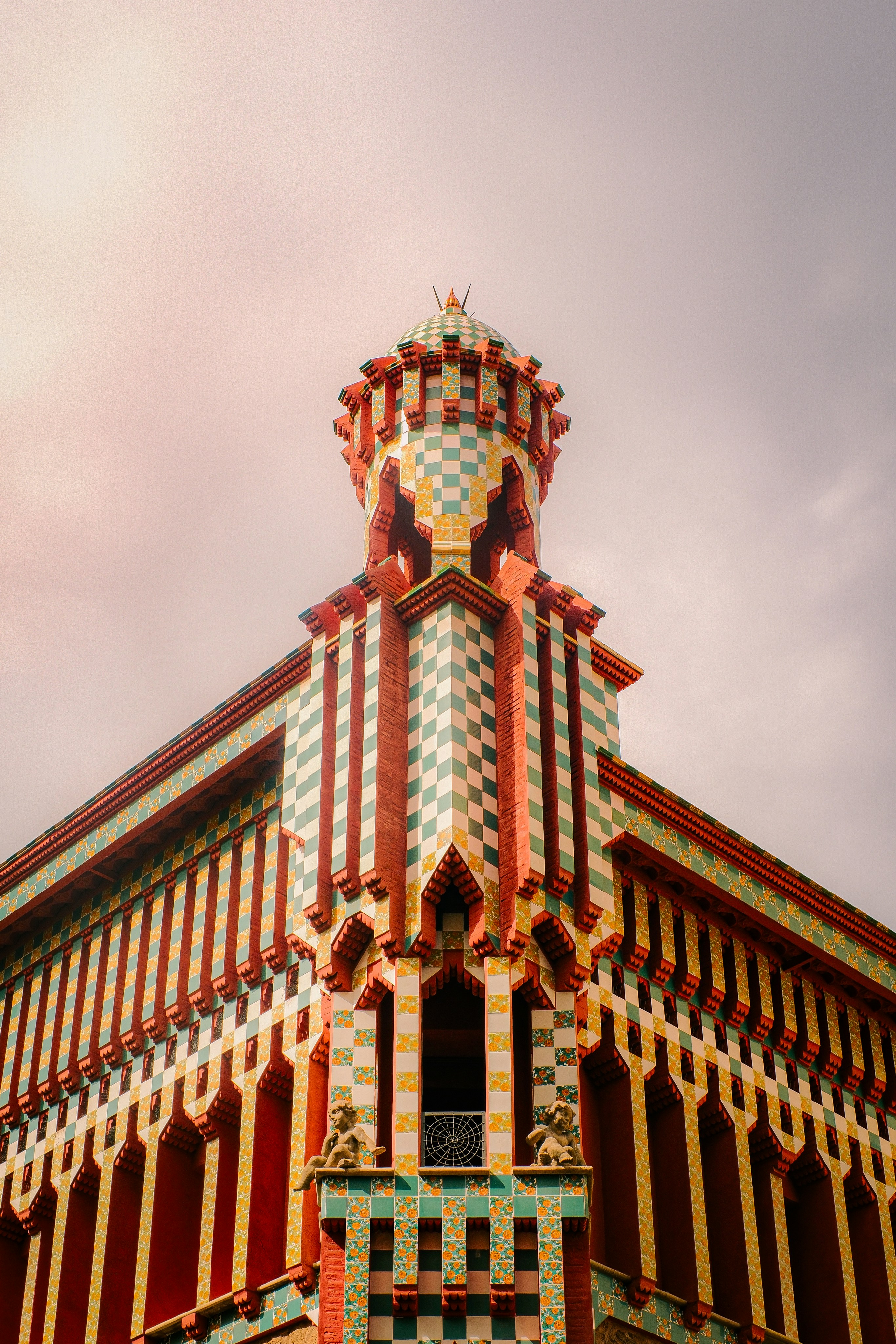
The exterior is the most immediately arresting thing about the building, and it is visible from the street without a ticket. The façade's checkerboard of white and green glazed tiles, combined with the hand-painted orange and green marigold panels, the Moorish-arched upper windows with their elaborate ironwork screens, and the corner towers rotating slightly on their axes to create movement in an otherwise orthogonal volume, form a surface of extraordinary visual energy. The cast-iron palm-leaf gates at the entrance, their fronds reaching upward with a botanical accuracy that no ironwork of the period had attempted, are the first indication that this architect was looking at the natural world differently from everyone around him.
The smoking room (fumoir) is the most extraordinary interior space in the building and one of the most ambitious rooms Gaudí ever created. Its walls and ceiling are covered in a forest of stalactites in gilded stucco, a Moorish muqarnas ceiling applied not as ornament but as the defining structural and atmospheric logic of the entire room. The effect is of being inside a cave of gold, or inside a pine cone seen from within. This is a room designed for a man who liked to smoke in the evening, and Gaudí turned it into a total art environment. The restoration of the smoking room's hard cardboard tile walls, which have been identified as a collaboration between Gaudí and the inventor Hermenegildo Miralles using a material patented in 1892 (seven years after the house was built, suggesting it was developed here first), is ongoing as a Gaudí Year 2026 conservation priority. Check the current state of the room on arrival, as it may be in a more complete state of restoration than at previous visits.
The dining room is the most domestic space in the building and the one where the collection of 32 oil paintings by the artist Josep Torrescassana, commissioned by Manuel Vicens and framed by furniture that Gaudí designed specifically around them, reveals Gaudí as a total interior designer as well as an architect. The walls are covered in climbing ivy in gold stucco on a gilt background, climbing papier-mâché fruit and flowers frame the doorways, and the furniture of Ceylon lemon wood was made to integrate with the paintings as a unified composition.
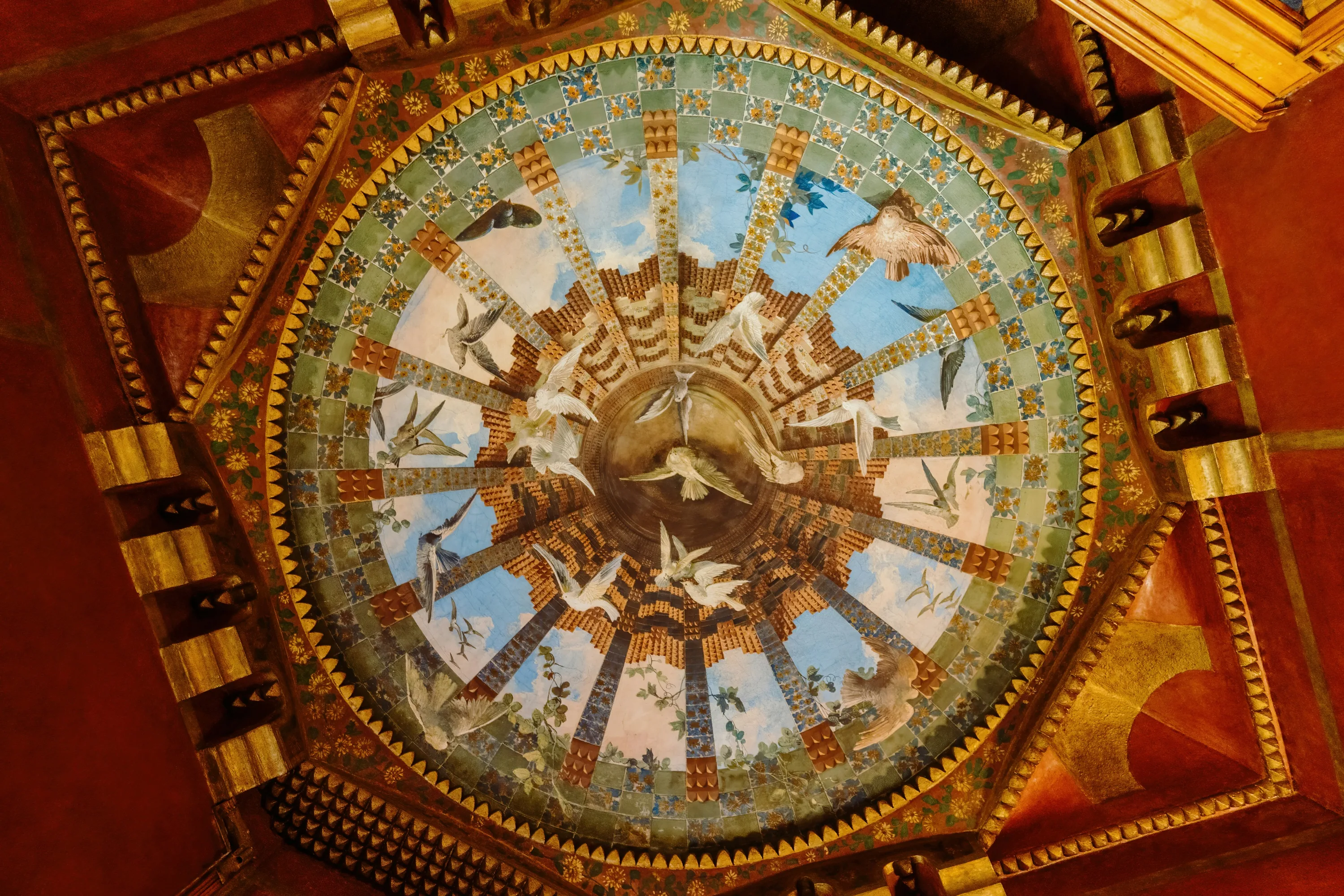
The living room above the smoking room has one of the most surprising ceilings in the building: a trompe-l'oeil vault painted with flying swallows, climbing plants, and open sky, designed to make the interior of the room feel like an extension of the garden outside. It is Gaudí's visual wit at its most playful and most assured.
The second floor exhibition space holds a permanent display covering the history and evolution of Casa Vicens, including Gaudí's original project plans, a 1:33 scale model of the full original estate, and audiovisual material explaining how Barcelona looked and developed during the years Gaudí was building the house. A cedar wood corner cabinet with gilt brass fittings, designed by Gaudí for Manuel Vicens's house in Alella and purchased by Casa Vicens at auction in 2023, is now on display after restoration. This is the only space in the building where the 1925 extension by Joan Baptista Serra de Martínez, which doubled the building's footprint, is visible in its post-restoration form.
The rooftop terrace carries the ceramic tile programme of the façade up to roof level, with turrets in chequered green and white cladding and elevated views across the Gràcia rooftops towards the Eixample and the Sagrada Família. It is not the vast sculpted landscape of La Pedrera's warrior terrace, but it is the direct ancestor of it, and standing on it with that lineage in mind makes the visit considerably richer.
The Mediterranean garden, while significantly reduced from its original extent by decades of urban development, preserves something of its original character through palms, magnolias, climbing plants, marigolds, and the shaded porch area that Gaudí designed to cool the house in summer. The garden is dedicated to Santa Rita, and a mass is celebrated here on 22 May each year in observance of a tradition that has continued uninterrupted since the house was built. The café is located in the garden area and is accessible during visiting hours.
How Much Time Should I Spend at Casa Vicens?
The standard visit runs approximately 60 to 90 minutes for most visitors at a comfortable pace, covering the main floor rooms, the smoking room, the living room, the second-floor exhibition, the rooftop terrace, and the garden. The guided tour format runs to approximately 75 minutes.
A rough guide:
Ground floor (foyer, dining room, covered porch, smoking room): 20 to 30 minutes
First floor (living room, bedroom areas, terrace): 10 to 15 minutes
Second floor (permanent exhibition, scale model, audiovisuals): 15 to 20 minutes
Rooftop terrace: 10 to 15 minutes
Mediterranean garden and café area: 10 to 15 minutes
Visitors on the guided tour will find the guide sets the pace and it typically runs slightly longer than the self-guided option, particularly in the smoking room and the dining room where the contextual commentary is most detailed.
Casa Vicens Visit Types, Audio Guides, and Guided Tours
General admission (self-guided with audio guide): The standard visit format. The audio guide app in 16 languages is included free and can be downloaded before arrival at the venue or in advance via your own device. The guide covers every room of the visitor route with commentary on Gaudí's decorative decisions, the life of the Vicens family, and the building's place in the history of architecture. A visitor review specifically notes that Bluetooth earbuds work with the app, but standard 3.5mm earphones can also be rented on site if needed. Download the app before arriving as the free Wi-Fi at the museum supports this and connectivity in the rooms may vary.
Guided tour: Includes a guide-led visit covering the full standard route with deeper architectural and historical commentary. Particularly recommended for visitors who want to understand the building's relationship with Gaudí's later work and the specific iconographic programme he was pursuing in the individual rooms. Tours run in Spanish, Catalan, and English on varying schedules; check the current availability when booking.
Early Access visit (before standard public opening): A small-group guided experience before the building opens to general visitors, in near-empty conditions. This is the recommended option for architectural photographers, for visitors who want the smoking room and the garden without other visitors present, and for anyone whose primary interest is the experience of the building as a spatial environment rather than as a crowded attraction. Tickets from approximately €40. Book well in advance as availability is extremely limited.
For groups of 10 or more, a dedicated group visit programme is available with specialist guides and flexible scheduling. Contact the museum through the official website for group bookings.
Temporary Exhibitions
The first and second floors of the Serra de Martínez 1925 extension provide the museum's exhibition spaces, hosting a temporary programme that explores the cultural context in which Casa Vicens was built and contemporary artistic dialogues with Gaudí's early work.
The temporary exhibition programme changes several times a year. Check the current programme on the website before your visit. Entry to the current temporary exhibition is included in the standard general admission ticket.
Where Should I Eat at and Near Casa Vicens?
The café at Casa Vicens is located in the garden area on the ground floor, accessible to ticket-holding visitors during museum hours. It serves coffee, a sweet breakfast (hot drink with a chocolate cookie or muffin), a vermouth hour option (vermouth, sangria, or a non-alcoholic drink with olives), and artisan Italian mango ice cream. The garden setting makes it one of the more pleasant spots for a break within any Barcelona museum. The café is a relaxed complement to the visit rather than a full meal option.
For eating beyond the museum, the Gràcia neighbourhood surrounding Casa Vicens is one of Barcelona's most rewarding and most local dining areas, with an excellent concentration of independent restaurants, wine bars, and café terraces at prices well below those of the tourist-facing Passeig de Gràcia.
Plaça de la Vila de Gràcia and Plaça de la Virreina, around five to eight minutes on foot south of the museum, are the social centres of the neighbourhood and are surrounded by café terraces and restaurants that serve a local clientele. Both squares are at their most animated in the late morning and evening.
Carrer de Verdi and the streets between it and the Travessera de Gràcia are the core of Gràcia's independent restaurant scene, with a very wide range of cuisines from traditional Catalan cooking to Japanese, Middle Eastern, and creative contemporary menus, most at accessible prices.
The area around Carrer del Torrent de les Flors and Carrer de Bruniquer, within a five to ten-minute walk of Casa Vicens through the neighbourhood grid, rewards walking as it is one of the least tourist-facing sections of Gràcia and has some of the best neighbourhood bars and small restaurants in the district.
For visitors combining Casa Vicens with Park Güell in the same morning or afternoon, the streets of the lower Carmel neighbourhood between the two sites have a handful of local bars and cafés that serve the neighbourhood rather than visitors.
Accessibility at Casa Vicens
Casa Vicens is fully accessible for wheelchair users on the main visitor route. The building has a lift to most floors, accessible restrooms, and lockers on the ground floor for small bags and umbrellas. Step-free access is available to the main floors; the rooftop is accessible by stairs only.
Wheelchairs are available on request at the entrance. For specific accessibility queries in advance, contact the museum through the official website.
Disabled visitors with a documented disability of 33% or more receive a reduced admission rate. One accompanying companion enters free with valid documentation.
Note on prams and pushchairs: Given Gaudí's characteristic uneven surfaces throughout the building, a baby carrier is recommended over a pushchair for visitors with very young children.
Rules and Practical Information
No late arrivals: This is the most important rule at Casa Vicens and the one that most commonly catches visitors off guard. Unlike most Barcelona attractions, there is absolutely no grace period for late arrival. If you miss your booked time slot, you will not be admitted and you will not receive a refund. Arrive at least 10 minutes before your slot time.
Re-entry: Once your ticket has been used to pass through an entrance point, you cannot leave and re-enter on the same ticket.
Photography for personal, non-commercial use is permitted throughout the building. Flash photography and tripods are prohibited.
Voices should be kept low throughout the visit to ensure a pleasant experience for all visitors.
Luggage and bags: Lockers are available on the ground floor for small backpacks and umbrellas. Large suitcases are not appropriate given the scale of the building.
Free Wi-Fi is available throughout the building and in the garden.
What Else is There to Do Near Casa Vicens?
Park Güell is around a 20 to 25-minute walk from Casa Vicens through the Gràcia neighbourhood and the lower slopes of the Carmel hill, or approximately 10 minutes by taxi. The combination of Casa Vicens and Park Güell in a single morning or afternoon makes natural sense as both are early Gaudí works in the same part of the city, away from the Passeig de Gràcia, and both reward visitors who approach them with an understanding of where they sit in Gaudí's development. Note that Park Güell's Monumental Zone requires its own separately booked timed ticket.
Casa Milà (La Pedrera) and Casa Batlló are the other Gaudí buildings covered by the 3 Houses bundle and are both around 20 to 25 minutes from Casa Vicens via the Metro (Line 3 from Fontana or Lesseps south to Passeig de Gràcia or Diagonal). Seeing all three in sequence across a single day is ambitious but achievable; most visitors will find spreading them across two days more satisfying. For booking guidance on both, see the dedicated What2Book pages.
The Gràcia neighbourhood itself is worth treating as a destination in its own right rather than simply the route to Casa Vicens. One of the few Barcelona districts that retains the character of an independent town (it was absorbed into the city only in 1897), Gràcia has its own squares, its own festival culture (the Festa Major de Gràcia in August, when its streets are decorated in themed installations competing for the best display, is one of the most joyful and most local of Barcelona's neighbourhood celebrations), and a density of independent shops, cafés, and restaurants that makes it one of the most rewarding areas to walk and spend time in the city.
The Gaudí House Museum (Casa Museu Gaudí) in Park Güell is the house where Gaudí lived for 20 years until his death, containing original furniture, personal effects, and objects from his life and work. It requires a separate ticket and is adjacent to the Park Güell Monumental Zone.
Final Tips for Visiting Casa Vicens
Visit Casa Vicens before Casa Batlló and La Pedrera. The standard tourist itinerary starts on the Passeig de Gràcia and never reaches Gràcia. Reversing the order, beginning Gaudí's story at its actual beginning and moving chronologically through his career, gives the later buildings a resonance and a context that seeing them first does not.
Book online and arrive 10 minutes early. The no-late-arrival policy is unusually strict. There are no exceptions and no refunds. Being five minutes late to a concert or a museum is generally manageable; at Casa Vicens it means being refused entry. Build a buffer into your travel time on the day.
Download the audio guide app before arriving. Free Wi-Fi is available at the building for this purpose, but downloading at home or at your accommodation saves time at the entrance and ensures you are ready to start immediately on entry.
Spend time in the smoking room. Most visitors move through it quickly on the way to the dining room or the staircase. The smoking room is one of the most ambitious interiors Gaudí ever created and it rewards slow looking. The restoration work ongoing for 2026 may reveal it in a more complete state than at any previous visit; ask staff about the current state of the restoration when you arrive.
Do not overlook the exterior from the street. The façade and the garden gates are visible from Carrer de les Carolines without a ticket, and the combination of the ceramic tile programme and the palm-leaf ironwork gates is one of the most distinctive exterior sequences of any building in Barcelona. Allow time to look at the building from across the narrow street before entering.
Combine with Park Güell. The two sites are 20 to 25 minutes on foot through the Gràcia grid. Combining both in a half-day gives a concentrated early-Gaudí experience in the part of Barcelona where he was first experimenting with the ideas that would eventually produce the Sagrada Família. Note that Park Güell requires its own separately booked timed ticket.
Eat in Gràcia rather than the Passeig de Gràcia. The neighbourhood around Casa Vicens has excellent food and drink at significantly lower prices than the tourist-facing streets of the Eixample to the south. Staying in the neighbourhood for lunch or dinner before or after the visit rewards the decision to come to this less-visited part of the city.
Back to Barcelona Attractions
Explore other Barcelona attractions
" width="24px"><path d="M 0 0 L 24 0 L 24 21.231 L 0 21.231 Z" fill="transparent" height="21.230768474975793px" id="nL2EwDcS9" width="24px"/><path d="M 0 0.541 C 0 0.242 0.245 0 0.547 0 L 2.735 0 C 3.037 0 3.282 0.242 3.282 0.541 L 3.282 4.598 C 3.282 4.897 3.037 5.139 2.735 5.139 L 0.547 5.139 C 0.245 5.139 0 4.897 0 4.598 Z" fill="rgb(196, 217, 201)" height="5.138657337892187px" id="hZ_rlBe_S" transform="translate(0 16.092)" width="3.2820512820512358px"/><path d="M 0 0.541 C 0 0.242 0.245 0 0.547 0 L 2.735 0 C 3.037 0 3.282 0.242 3.282 0.541 L 3.282 7.843 C 3.282 8.142 3.037 8.384 2.735 8.384 L 0.547 8.384 C 0.245 8.384 0 8.142 0 7.843 Z" fill="rgb(230, 211, 160)" height="8.38412513024521px" id="HgVBxIz3e" transform="translate(5.128 12.847)" width="3.282051282051235px"/><path d="M 0 0.541 C 0 0.242 0.245 0 0.547 0 L 2.735 0 C 3.037 0 3.282 0.242 3.282 0.541 L 3.282 12.982 C 3.282 13.281 3.037 13.523 2.735 13.523 L 0.547 13.523 C 0.245 13.523 0 13.281 0 12.982 Z" fill="rgb(232, 207, 164)" height="13.522782468137464px" id="utgrDnoM9" transform="translate(10.325 7.708)" width="3.282051282051377px"/><path d="M 0 0.541 C 0 0.242 0.245 0 0.547 0 L 2.735 0 C 3.037 0 3.282 0.242 3.282 0.541 L 3.282 16.498 C 3.282 16.797 3.037 17.039 2.735 17.039 L 0.547 17.039 C 0.245 17.039 0 16.797 0 16.498 Z" fill="rgb(233, 196, 166)" height="17.038705909853153px" id="OLOhW6STz" transform="translate(15.521 4.192)" width="3.2820512820512384px"/><path d="M 0 0.541 C 0 0.242 0.245 0 0.547 0 L 2.735 0 C 3.037 0 3.282 0.242 3.282 0.541 L 3.282 20.69 C 3.282 20.989 3.037 21.231 2.735 21.231 L 0.547 21.231 C 0.245 21.231 0 20.989 0 20.69 Z" fill="rgb(217, 170, 153)" height="21.230768474975793px" id="H5Z8wcwkd" transform="translate(20.718 0)" width="3.2820512820512278px"/></g></svg>)